

infiniFi Raises $3M+ Led by Electric Capital as On-Chain Dollar Yield Protocol Prepares Q4 2026 TGE
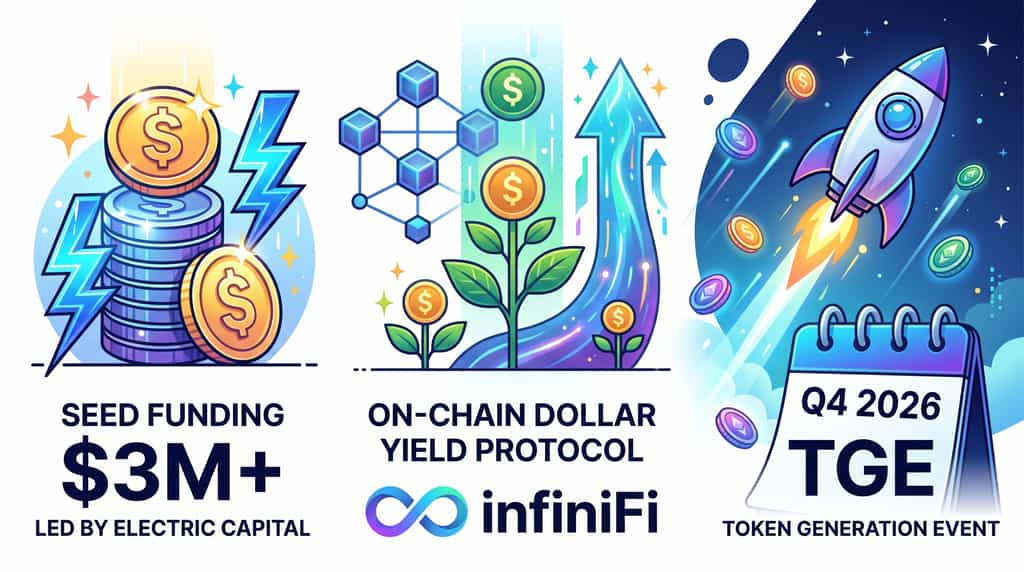
infiniFi Raises $3 Million to Expand Stablecoin Yield Infrastructure
infiniFi, an on-chain protocol that applies fractional reserve banking principles to stablecoin deposits, announced on September 23, 2026, the close of a seed funding round exceeding $3 million. The round was led by Electric Capital and included participation from New Form Capital, Generative Ventures, Fasanara Capital, 2Square, 4th Revolution Capital, DCFGod, The Rollup, and additional investors. Combined with its earlier oversubscribed $3 million pre-seed round completed in February 2025, also led by Electric Capital, total external capital raised now surpasses $6 million. The protocol launched publicly in June 2025 after emerging from stealth and has since generated more than $9 million in yield for depositors while recording an all-time high total value locked of $180 million.
Current TVL stands above $50 million according to the company and approximately $49.8 million on DefiLlama as of late September 2026. The new capital will support protocol development, additional integrations, multichain expansion, and product rollout as the project advances toward its confirmed token generation event in the fourth quarter of 2026. By generating more yield for users than the total outside capital it has raised and by preparing a broader distribution layer through infiniFi Prime, the protocol demonstrates early operating leverage in transparent on-chain dollar yield generation while positioning itself as infrastructure that can connect institutional private credit and consumer finance applications to decentralized markets.
Electric Capital Returns as Lead Investor for Expanding On-Chain Yield Infrastructure
Electric Capital’s decision to lead both infiniFi’s February 2025 pre-seed and September 2026 seed rounds reflects continued confidence in its model for bringing fractional reserve capital efficiency on-chain with transparency. The latest investment follows more than a year of live operations across multiple networks, with funding aimed at accelerating existing development rather than an untested concept. Founder and CEO Rob Montgomery said the capital will support efforts to improve how users earn interest on dollars while expanding distribution through the upcoming infiniFi Prime product. The product is designed to bring institutionally managed private credit yields into neobanks and consumer finance applications, extending infiniFi beyond crypto-native users and broadening access to on-chain dollar yield opportunities. Participation from New Form Capital, which also appeared in the pre-seed, alongside newer names such as Generative Ventures, Fasanara Capital, 2Square, 4th Revolution Capital, DCFGod, and The Rollup, broadens the investor base while reinforcing existing relationships.
Fasanara Capital’s involvement is particularly relevant given the protocol’s stated intention to incorporate institutionally managed private credit. The combined $6 million-plus raised remains modest relative to many DeFi protocols that have raised larger sums at earlier stages, yet the project has already returned more than $9 million in yield to depositors. This inversion of the typical capital-to-yield ratio provides a concrete performance benchmark that future investors and users can evaluate against the roadmap toward the Q4 2026 token generation event. The funding announcement therefore functions less as a pure capital raise and more as validation of a live system that has already produced measurable economic output for participants.
Yield Output Exceeds Cumulative External Capital Raised Since Launch
Since its June 2025 launch, infiniFi has generated over $9 million in yield for users, a figure that exceeds the more than $6 million raised across its two funding rounds. The company highlighted this milestone in its September 23 press release, framing it as evidence that the underlying allocation engine is functioning at scale. Cumulative fees tracked by DefiLlama stand near $8.84 million, with protocol revenue (performance fees) approaching $920,000. These numbers reflect activity across liquid and locked deposit tranches rather than speculative token emissions or temporary incentive programs. The yield figure therefore represents actual returns distributed to depositors who supplied stablecoins and received receipt tokens in return. Maintaining positive yield generation through multiple market regimes over roughly 15 months supplies a stronger signal of product-market fit than TVL peaks alone.
The economic model relies on automated maturity laddering rather than leverage. Users deposit stablecoins such as USDC and receive iUSD, a receipt token. They may then stake for liquid yield-bearing siUSD or lock into time-bound liUSD positions ranging from one to 13 weeks. The protocol deploys a portion of liquid capital alongside locked capital into higher-duration strategies, creating a blended return that exceeds what pure liquid or pure locked positions could achieve independently. Because the system operates with near-zero margin and passes returns directly to depositors, the cumulative yield figure of more than $9 million is a direct measure of capital efficiency achieved through transparency rather than through opacity or leverage amplification. This performance metric now forms a central part of the narrative as the project approaches its token generation event.
Fractional Reserve Mechanics Deliver Higher Returns Through Automated Maturity Matching
infiniFi replicates the traditional banking practice of maturity transformation inside transparent smart contracts. Depositors signal their liquidity preferences by choosing either immediate redeemability or defined lock periods. The protocol’s allocation engine then matches those liabilities with assets of corresponding duration. Liquid farms such as Aave-style lending receive a reserve buffer sufficient to support redemptions, while excess capital and locked deposits flow into maturity farms, including Pendle and Ethena positions. Documentation on the project’s site illustrates the efficiency gain with a simple numerical example: under a conventional approach, $1,000 liquid plus $500 locked would map one-for-one; under a 20 percent fractional deployment, the system can place $800 into liquid strategies and $700 into higher-yielding duration strategies, improving overall returns for both cohorts.
The design avoids reliance on leverage loops that have historically amplified both gains and losses in DeFi. Instead, the amplification comes from coordinated duration matching across a pooled set of preferences. Because every allocation and reserve level is visible on-chain, depositors can verify the fractional reserve ratio at any time rather than relying on opaque bank balance sheets. Audits and formal verification by Certora further support the claim that the system has operated without security incidents or depositor fund losses to date. The resulting yield surface sits above pure liquid money-market rates for stakers and above pure duration rates for lockers, creating a structural advantage that compounds as more capital participates and the ladder becomes more finely graded.
Liquid and Locked Tranches Establish Clear Risk Waterfall and Yield Differentiation
siUSD represents the senior, liquid tranche. Holders can redeem on demand under normal conditions and absorb losses only after junior capital has been exhausted. liUSD positions of varying durations form the junior tranche, accepting first-loss exposure in exchange for elevated yields that scale with lock length. Documentation describes a loss waterfall in which any shortfall first reduces the redemption value of locked positions proportionally before touching liquid stakes or unstaked iUSD. A worked example in the project’s materials shows a $9 million bad-debt event against a $20 million capital base fully absorbed by a $10 million junior tranche, leaving senior capital intact. This explicit hierarchy replaces the ambiguous risk sharing found in many pooled yield products.
Current pool data on DefiLlama illustrate the practical outcome. Staked siUSD carries an APY near 5.4 percent with roughly $32 million in TVL, while 13-week locked positions offer approximately 8.7 percent and shorter locks fall in between. The spread compensates lockers for both duration risk and first-loss priority. Users therefore face a transparent menu rather than a single blended rate whose risk composition remains opaque. The structure also supports secondary-market trading of locked positions and governance voting weighted by locked capital, further differentiating the economic rights of each tranche without requiring complex synthetic leverage.
Multichain Footprint and Expanding Integration Set Enable Capital Efficiency Across Networks
infiniFi currently operates on Ethereum, Arbitrum, Katana, and Base, with further chains planned. The multichain presence allows depositors to access the same fractional reserve logic while optimizing for gas costs and ecosystem-specific liquidity. Integrations span both liquid venues such as Aave, Morpho, Curve, and Euler and duration-oriented platforms including Pendle and Ethena. Institutional counterparties and asset managers listed in the funding announcement, Fasanara, FalconX, Accountable, Steakhouse Financial, and Silo, extend the yield sources beyond purely crypto-native strategies. Each new integration expands the opportunity set against which the allocation engine can ladder capital, improving the efficiency of the fractional reserve ratio.
The breadth of partners also reduces single-protocol concentration risk. Capital deployed into multiple independent farms means that an outage or underperformance in one venue does not halt yield generation across the system. The protocol’s documentation emphasizes that farms are categorized by liquidity profile and maturity bucket, allowing the engine to rebalance automatically or through governance votes when conditions change. As the set of supported networks and partners grows, the same core mechanism can absorb larger volumes without proportionally increasing operational complexity, a scalability characteristic that becomes more valuable as the project prepares for broader distribution via infiniFi Prime.
TVL Direction Shows Both Strong Peak Demand and Subsequent Normalization
The protocol reached an all-time high TVL of $180 million at some point after launch, according to the company statement. Current figures sit above $50 million on the project’s own reporting and near $49.8 million on DefiLlama, with the bulk still concentrated on Ethereum. The decline from peak does not appear driven by security events or yield collapse; rather, it tracks broader market conditions and the natural rotation of capital among competing yield venues. Importantly, cumulative yield generation continued through the period of TVL contraction, indicating that the remaining capital base remained productive.
DefiLlama data further show approximately $281,000 in fees collected over the most recent 30-day window and cumulative fees approaching $8.84 million. Protocol revenue of roughly $920,000 reflects the performance-fee share retained by the system. These metrics supply a clearer picture of economic activity than headline TVL alone. A protocol that can generate nine-figure cumulative yields and ongoing monthly fees at a $50 million TVL level demonstrates capital productivity that many larger pools have struggled to match on a per-dollar basis. The trajectory therefore supports the claim that the core engine functions independently of temporary liquidity surges.
Boosted Points Allocation Creates Non-Dilutive Path to Token Generation Event
In late August 2026, the team announced that Season 1 and the portion of Season 2 points already earned carry fixed token allocations that will not be diluted. From August 26 onward through the TGE, all depositors earn points from a new fixed allocation at the highest boost rates offered to date. The structure rewards continued participation without expanding the total token supply assigned to earlier cohorts. Founder Rob Montgomery emphasized that the decision followed more than a year of live operation and multiple yield and liquidity regimes successfully navigated by the allocation engine.
Because the points-to-token conversion parameters for prior activity are already locked, users evaluating participation today face a clearer economic calculus. Activity between the announcement and the Q4 2026 TGE draws from a separate, pre-defined pool rather than competing with historical points. This design reduces the common uncertainty surrounding long-running points programs in which later participants dilute earlier ones. The fixed-allocation approach also aligns incentives for the final pre-TGE growth phase, during which the protocol intends to expand both Core and Prime product features.
infiniFi Prime Targets Neobanks and Consumer Finance Distribution Channels
The forthcoming infiniFi Prime layer aims to embed the same diversified yield infrastructure into earn accounts offered by neobanks and consumer financial applications. Rather than requiring end users to interact directly with smart contracts, Prime is designed to surface institutionally managed private credit and on-chain strategies through familiar interfaces. CEO Rob Montgomery described the initiative as a way to expand distribution while simultaneously diversifying the sources of user returns. By acting as a conduit for off-chain capital seeking transparent on-chain yields, the product enlarges the addressable market beyond existing DeFi participants.
Success of this distribution strategy depends on reliable integration of private-credit yields and robust risk controls that satisfy both on-chain transparency standards and off-chain compliance expectations. The recent funding provides resources for those integrations and for the operational infrastructure needed to support larger, less crypto-native capital flows. If executed, Prime would convert the protocol from a pure DeFi destination into middleware that sits between traditional finance interfaces and decentralized yield sources, a positioning that few existing on-chain dollar products have achieved at scale.
Institutional Private Credit Partnerships Diversify Yield Beyond Pure DeFi Strategies
Inclusion of Fasanara Capital among both investors and listed partners signals a deliberate expansion into institutionally managed private credit. Other names such as FalconX, Accountable, and Steakhouse Financial further indicate that the protocol is sourcing duration assets outside the purely crypto-native set of Pendle, Ethena, and Aave-style farms. Private-credit yields historically exhibit lower correlation with crypto market cycles and can provide more stable duration profiles for the maturity ladder. By blending these sources with liquid DeFi venues, the allocation engine gains additional degrees of freedom when matching depositor preferences.
The diversification also addresses a common criticism of early on-chain yield products: over-reliance on a narrow set of strategies whose returns can compress simultaneously. Transparent on-chain reporting of allocations allows depositors to monitor the evolving mix rather than accepting a black-box composite rate. As the private-credit component grows, the overall risk-return profile of both liquid and locked tranches can shift in ways that pure DeFi ladders cannot easily replicate, strengthening the protocol’s claim to serve a broader set of dollar-yield preferences.
Audited Codebase and Explicit Loss Hierarchy Provide Structural Risk Mitigants
infiniFi has undergone two audits and formal verification by Certora. The project reports zero security incidents and no loss of depositor funds since launch. Beyond code quality, the protocol embeds an explicit loss waterfall that prioritizes junior locked capital as first-loss protection for senior liquid positions. Redemption queues operate on a first-in, first-out basis during temporary liquidity shortfalls, preventing bots from front-running ordinary users. These design choices convert abstract risk into observable, quantifiable parameters that depositors can evaluate before committing capital.
Transparency of reserves further differentiates the system from traditional fractional reserve banking. Every farm allocation and reserve level is visible on-chain, enabling real-time verification rather than periodic regulatory filings. While fractional reserve structures inherently carry duration and liquidity risk, the combination of audited contracts, a coded loss hierarchy, and continuous disclosure supplies concrete mitigants that participants can assess independently. The absence of leverage loops removes one common amplification channel that has produced cascading failures in other DeFi yield products.
Capital Allocation Engine Continuously Rebalances Across Liquid and Duration Buckets
The protocol categorizes farms into liquid (instant access), maturity (time-delayed), and internal protocol categories, then further buckets maturity farms by week-long intervals up to 13 weeks. Governance voting weighted by locked capital influences allocation targets, while automated hooks handle routine rebalancing. Manual intervention remains available for larger shifts into illiquid strategies. This hybrid approach allows the system to respond to changing yield surfaces without requiring constant depositor action. Because locked positions reveal duration preferences in advance, the engine can pre-position capital rather than reacting after the fact.
The practical result is a self-adjusting maturity ladder that improves capital efficiency as participation grows. Larger pools of locked capital enable deeper deployment into higher-yielding duration assets, while the liquid reserve buffer scales to support redemptions. Documentation emphasizes that the system has already navigated three distinct yield regimes and five liquidity shocks without gating depositors. That operational track record supplies empirical support for the claim that automated fractional reserve management can function reliably under live market conditions.
Late-2026 Market Environment Favors Transparent On-Chain Dollar Yield Products
Stablecoin yields remain a core demand driver within decentralized finance even as broader market conditions fluctuate. Duration markets that were relatively thin in early 2024 have expanded substantially, creating the raw material for maturity laddering strategies. Protocols that can offer differentiated liquid and locked rates with transparent risk hierarchies occupy a distinct niche relative to both pure money-market funds and leveraged yield aggregators. infiniFi’s combination of fractional reserve efficiency, multichain reach, and institutional credit partnerships positions it within that niche at a moment when capital is selective about both return and risk clarity.
The upcoming token generation event in Q4 2026 will introduce governance and incentive layers that can further align long-term participants with protocol growth. Because point allocations for prior seasons are already fixed, the TGE itself need not create unexpected dilution for existing depositors. The new capital raised in September 2026 therefore arrives at a logical transition point: the core yield engine has demonstrated live performance, distribution channels are expanding, and the token layer is scheduled to activate within a defined window. The combination of verified operating metrics and a clear near-term milestone supplies the factual basis for evaluating the protocol’s next phase.
🔥 Beyond the Headlines: What KuCoin 5.0 Means for You
Market news moves fast — but where you act on it matters just as much. This October, KuCoin launches KuCoin 5.0, transforming KuCoin into a rebuilt platform. Here's what actually changes for you:
-
One account for everything. Older platforms split your money across separate "spot," "margin," and "futures" accounts and expected you to understand why. KuCoin 5.0's unified account removes that entirely — deposit once, and everything is simply there (only available to VIPs for now).
-
Stocks, indices, and commodities. KuCoin 5.0 expands beyond crypto into global markets. When crypto chops sideways and equities rally (or the reverse), you rotate in minutes instead of opening a brokerage account and waiting days for fiat rails.
-
Real-world assets (RWA). Tokenized exposure to traditional assets like commodities, right inside your crypto account. One of the fastest-growing segments in global finance is no longer reserved for institutions — you access it from the same balance you trade with.
-
Earn while you learn. Not ready to trade? KCUSD lets your stablecoins earn daily, auto-compounding interest. The lowest-stress way to put your idle deposit to work for 4% yield.
-
An AI assistant in plain language. Ask questions, get market context, understand what you're looking at — built into the platform, no jargon required.
-
An app that doesn't overwhelm. Faster, cleaner, and consistent — intuitive from the first tap, not after a tutorial.
-
Safety you can check, not just trust. A MiCAR-licensed EU entity, Proof of Reserves you can verify yourself, and internationally certified security (SOC 2 Type II, ISO 27001:2022).
Create your account in minutes — and start on the platform built for where crypto is going, not where it's been.
FAQs
How does the fractional reserve model actually improve yields for both liquid and locked depositors?
The protocol pools capital according to the liquidity preferences depositors themselves select. Liquid capital supplies a redemption buffer, while a calculated fraction of that capital, together with all locked capital, is deployed into higher-duration strategies. Because the duration assets produce higher returns, the blended yield paid to liquid stakers exceeds what pure liquid farms would deliver, and the yield paid to lockers exceeds what pure duration strategies would deliver.
What happens to depositor funds if one of the underlying yield strategies experiences a loss?
Losses are absorbed according to a coded waterfall. Junior locked positions (liUSD of any duration) take first loss on a pro rata basis. Only after the junior tranche is exhausted do losses reach senior liquid siUSD holders, and unstaked iUSD sits behind both. The hierarchy is enforced atomically on-chain so that no preferential treatment occurs. Recovery proceeds, if any, are distributed pro-rata to the affected junior pool.
When is the exact date of the Q4 2026 token generation event?
The project has confirmed the quarter but has not published a specific calendar date, tokenomics details, or listing venues. Points earned in Season 1 and the completed portion of Season 2 already carry fixed allocations that will not be diluted. Activity from late August 2026 through the TGE draws from a separate fixed allocation at elevated boost rates. Further announcements are expected as the quarter approaches.
Is the current TVL of approximately $50 million a cause for concern given the earlier $180 million peak?
The decline tracks broader market rotation and does not coincide with security incidents or yield collapse. Cumulative yield generation has continued, and monthly fee collection remains positive. A protocol that can produce more than $9 million in total user yields and nearly $9 million in cumulative fees at a mid-eight-figure TVL demonstrates capital productivity independent of temporary peaks.
How do users choose between siUSD and liUSD positions?
After depositing stablecoins and receiving iUSD, a user may stake for liquid siUSD that remains redeemable on demand under normal conditions or lock into a chosen duration (one to 13 weeks) for higher yield and first-loss exposure. The decision reflects individual liquidity needs and risk tolerance. Locked positions can later be unwound after their chosen period, at which point the capital returns to liquid form.
Disclaimer: This content is for informational purposes only and does not constitute investment advice. Cryptocurrency investments carry risk. Please do your own research (DYOR).