

How to Find the Next PONS: Comparing Arc Chain Meme Coin Launchpads
Introduction
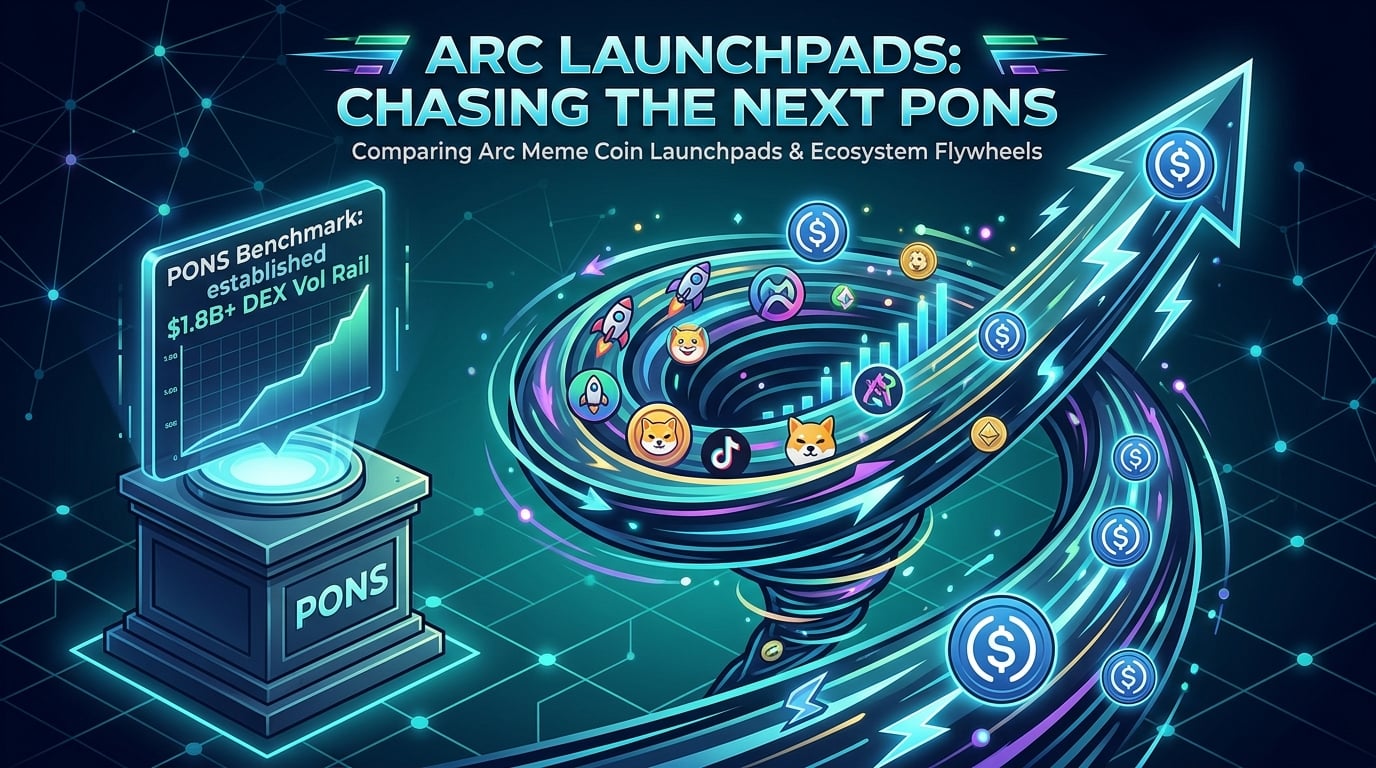
Can Arc produce the next PONS? The opportunity is real, but the answer will depend less on finding the loudest meme and more on identifying the launchpad that can generate sustainable trading activity. PONS has become a useful benchmark because its platform combines token launches, bonding-curve trading, graduation, and fee generation. DefiLlama currently tracks PONS at more than $1.8 billion in cumulative DEX volume, showing how quickly a launchpad can become an ecosystem-level liquidity venue.
Arc is entering a similar launchpad race, but with a different foundation: Circle's Arc uses USDC as native gas and targets sub-second finality. Circle has scheduled Arc's public mainnet launch for September 16, 2026.
This guide compares the leading Arc meme coin launchpads and explains what investors should actually look for when searching for the next PONS.
What Made PONS So Successful?
PONS succeeded because it became more than a meme token - it became infrastructure for token launches on Robinhood Chain. Its platform allows users to launch and trade fixed-supply tokens directly from their wallets, while the launch process creates a pipeline of new assets that can generate recurring trading activity.
Why Is PONS a Useful Benchmark?
PONS is a useful benchmark because its success can be measured through platform activity rather than token price alone. DefiLlama currently reports approximately $1.85 billion in cumulative DEX volume for PONS, with about $107 million in 24-hour token volume and a market capitalization of roughly $448 million at the time of its latest snapshot.
The more important lesson is the relationship between launchpad activity and token economics. A successful launchpad creates a feedback loop:
-
More creators launch tokens.
-
More tokens attract traders.
-
More trading generates platform fees.
-
Platform economics create incentives around the launchpad token or ecosystem.
-
Increased attention attracts more creators and traders.
This is the "flywheel" that new Arc launchpads are attempting to reproduce.
What Does PONS Actually Do?
PONS provides permissionless token creation and trading on Robinhood Chain. Its documentation describes a non-custodial model in which users approve transactions through their own wallets rather than depositing assets with the platform.
Its current documentation also describes fixed token supply, launch fees, liquidity pools, and a graduation process. These mechanics matter because they create a standardized path from token creation to secondary-market liquidity.
Therefore, finding the next PONS does not mean finding an identical copy. The better approach is to identify whether an Arc launchpad can reproduce the same economic conditions: low launch friction, continuous token discovery, reliable liquidity, attractive creator incentives, and enough trading volume to sustain the platform.
Why Could Arc Support a New Meme Launchpad Cycle?
Arc could support a new launchpad cycle because its infrastructure is particularly well suited to dollar-denominated trading. Circle describes Arc as an EVM-compatible Layer 1 built for stablecoin finance, with USDC as native gas and deterministic sub-second settlement.
Does USDC as Gas Matter for Meme Coins?
Yes. USDC-native gas removes one source of friction for users who want to trade dollar-denominated meme assets.
On many chains, a trader needs a separate native token to pay transaction fees. Arc instead uses USDC as its gas asset. This means the same asset can potentially fund both the trade and the transaction fee.
That design is particularly relevant for launchpads because meme coin trading involves frequent small transactions. When users repeatedly buy and sell low-cap tokens, predictable dollar-denominated transaction costs can make the user experience easier to understand.
It also creates a more intuitive pricing environment. A trader can think in dollars rather than constantly converting between a volatile gas token and USDC.
Does Arc's Institutional Position Guarantee a Successful Meme Ecosystem?
No. Arc's institutional backing is an infrastructure advantage, not proof that any particular meme launchpad will succeed.
Circle announced in August that Arc had more than 100 ecosystem and institutional builders and that its founding validator cohort included institutions such as BlackRock, DTCC, Mastercard, Visa, Standard Chartered, and others.
Those developments can help attract liquidity and developers to the network, but a meme launchpad still needs to solve a different problem: creating persistent retail trading activity.
The next PONS will therefore be determined by application-level traction, not by Arc's institutional reputation alone.
Which Arc Meme Coin Launchpads Are Worth Watching?
The leading Arc launchpads currently differentiate themselves primarily through their launch mechanism, liquidity model, fee distribution, and trading experience. Because Arc's public mainnet launch is scheduled for September 16, 2026, some projects are already operating in early or pre-launch conditions while others are preparing for the public launch.
| Launchpad | Core model | Key differentiator | What to watch |
| TOLLY | Direct USDC liquidity | No bonding curve or migration | Trading activity and fee distribution |
| ArcPad | Uniswap V3 launch | Fixed supply and permanently locked liquidity | Liquidity depth and token discovery |
| pmav | USDC-based launch | Uniswap V4, dollar-native trading and anti-snipe rules | User adoption and graduation volume |
| Parabola | Bonding curve | Fixed-supply tokens with curve-based trading | Graduation rate and sustained volume |
| Meme Arc | Bonding curve | Simple launch-to-DEX model | Real user activity versus platform incentives |
TOLLY: Could a No-Migration Model Win?
TOLLY is one of the more distinctive Arc launchpads because it removes the conventional bonding-curve graduation step. According to its current platform documentation, a token launches in one transaction, its entire supply becomes permanently locked USDC liquidity, and trading begins from the first block.
The platform charges a 1% pool fee. Its stated buy-side distribution sends 64% of the fee to creators, 12% to holder rewards, 10% to the protocol, 9% toward TOLLY removal from circulation, and 5% toward removal of the project token. Sell-side fees are denominated in the project token and are removed from circulation.
This model could be attractive because it eliminates migration risk and makes liquidity available immediately.
However, that advantage creates another challenge: the platform must generate enough liquidity without relying on a graduation milestone. Traders therefore need to watch actual volume, liquidity depth, number of active tokens, and repeat users rather than simply the number of tokens launched.
ArcPad: Is Permanent Liquidity More Important Than a Bonding Curve?
ArcPad takes an even more direct approach. Its documentation says tokens launch directly into Uniswap V3, with no separate bonding-curve contract and no later migration step. It also states that tokens have a fixed supply of 1 billion and no owner, mint, pause, or blacklist functions.
The liquidity position is locked at launch, rather than only after a token reaches a graduation threshold.
This architecture addresses one of the most important risks in meme launchpads: what happens to liquidity after the initial launch phase.
ArcPad's model is therefore attractive for traders who prioritize contract simplicity and permanent liquidity. The key question is whether technical cleanliness can translate into network effects. A launchpad can have excellent contracts and still fail if there are too few creators, traders, or liquid tokens.
pmav: Can Dollar-Native Trading Become the Killer Feature?
pmav is positioning itself around Arc's most distinctive property: USDC-native trading. Its platform states that tokens launch as Uniswap V4 pools denominated in native USDC, with fixed supply and on-chain trading controls.
Its stated launch model uses a $8,413.80 curve reserve threshold and a $42,069 market-cap graduation level, after which liquidity remains locked in the same pool. It also imposes a permanent 2% per-wallet cap and uses an anti-snipe mechanism during the first 30 seconds.
The platform additionally offers an MCP interface for AI agents, allowing agents to access read-only market information and prepare transactions while users retain control of signing.
That could become strategically interesting if AI-driven trading and discovery become meaningful sources of Arc activity. However, the important metric is not whether an AI integration exists. It is whether that integration generates measurable incremental trading activity.
Parabola: Can the Classic Bonding Curve Model Work on Arc?
Parabola uses the familiar bonding-curve model. Its official site describes the product as an Arc-native memecoin launchpad where users launch fixed-supply tokens, trade them on a single bonding curve, and graduate them into a permanent market after clearing the threshold. The platform announced a September 16, 2026 Arc mainnet launch.
The advantage of this model is familiarity.
Bonding curves provide traders with a clear progression mechanism. Early buyers enter the curve, the token price changes as demand increases, and successful launches can eventually transition to deeper liquidity.
The disadvantage is competition. Bonding curves are no longer novel, so a launchpad using this structure needs another reason for traders to choose it.
That reason could be better discovery, stronger creator incentives, lower fees, better anti-bot protection, or a more active community.
Meme Arc: Can Simplicity Win?
Meme Arc uses a straightforward bonding-curve model with a stated $6,000 to $60,000 curve, a 1% fee, a 2% maximum buy per wallet, and migration to Uniswap V3.
Its appeal is simplicity: creators can launch, traders can discover tokens, and successful assets can move toward DEX liquidity.
For a launchpad like this, the most important question is whether the platform can develop a critical mass of organic launches. A low-friction product is useful only if there is enough demand on both sides of the marketplace.
What Could Become the Next PONS on Arc?
The next PONS is more likely to be the launchpad with the strongest liquidity flywheel than the launchpad with the most aggressive marketing.
PONS provides a useful case study because its activity demonstrates how a launchpad can become an important application layer on a new chain. DefiLlama currently identifies PONS as a token launchpad for fixed-supply assets on Robinhood Chain and tracks substantial cumulative trading activity.
Arc launchpads are competing for the same strategic position. The strongest candidate should eventually demonstrate several characteristics at the same time:
-
A large and growing number of active launches.
-
Diversified trading volume.
-
Strong liquidity across successful tokens.
-
High creator retention.
-
Repeat trader activity.
-
Transparent smart contracts.
-
Sustainable fee economics.
-
A recognizable discovery mechanism.
-
Organic community growth.
-
A platform token or ecosystem incentive structure that does not depend entirely on speculative subsidies.
This is why "find the next PONS" should not be treated as a simple token-picking exercise. The real opportunity may sit at the infrastructure layer.
Beyond the Headlines: What KuCoin 5.0 Means for You
Market news moves fast — but where you act on it matters just as much. This October, KuCoin launches KuCoin 5.0, transforming KuCoin into a rebuilt platform. Here's what actually changes for you:
-
One account for everything. Older platforms split your money across separate "spot," "margin," and "futures" accounts and expected you to understand why. KuCoin 5.0's unified account removes that entirely — deposit once, and everything is simply there.
-
Stocks, indices, and commodities. KuCoin 5.0 expands beyond crypto into global markets. When crypto chops sideways and equities rally (or the reverse), you rotate in minutes instead of opening a brokerage account and waiting days for fiat rails.
-
Real-world assets (RWA). Tokenized exposure to traditional assets like commodities, right inside your crypto account. One of the fastest-growing segments in global finance is no longer reserved for institutions — you access it from the same balance you trade with.
-
Earn while you learn. Not ready to trade? KCUSD lets your stablecoins earn daily, auto-compounding interest. The lowest-stress way to put your idle deposit to work for 4% yield.
-
An AI assistant in plain language. Ask questions, get market context, understand what you're looking at — built into the platform, no jargon required.
-
An app that doesn't overwhelm. Faster, cleaner, and consistent — intuitive from the first tap, not after a tutorial.
-
Safety you can check, not just trust. A MiCAR-licensed EU entity, Proof of Reserves you can verify yourself, and internationally certified security (SOC 2 Type II, ISO 27001:2022).
Create your account in minutes — and start on the platform built for where crypto is going, not where it's been.
Conclusion
The search for the next PONS on Arc should focus on launchpad infrastructure rather than simply chasing the next meme token. PONS demonstrates how a launchpad can become an ecosystem-level application when token creation, trading liquidity, fee generation, and user incentives reinforce one another. DefiLlama's current data, which tracks more than $1.8 billion in cumulative PONS DEX volume, illustrates the scale that a successful launchpad can eventually reach.
Arc has several structural advantages for this competition. Circle designed the network around USDC-native gas, EVM compatibility, and sub-second finality, while its public mainnet launch is scheduled for September 16, 2026.
The leading candidates are pursuing different strategies. TOLLY emphasizes immediate permanent liquidity, ArcPad focuses on a simple Uniswap V3 architecture, pmav emphasizes dollar-native trading and contract-enforced controls, while Parabola and Meme Arc use familiar bonding-curve models.
Ultimately, the strongest candidate will be the platform that converts Arc's technical advantages into sustained creators, traders, liquidity, and fees.
FAQs
Is PONS built on Arc?
No. PONS is a launchpad on Robinhood Chain, not Arc. Its documentation identifies Robinhood Chain as its network and describes the platform as a place to launch and trade tokens there.
When does Arc mainnet launch?
Circle has announced September 16, 2026 as the public mainnet launch date for Arc.
Does Arc use ETH for gas?
No. Arc uses USDC as its native gas asset, according to Circle's description of the network.
Are Arc meme launchpads affiliated with Circle?
Not necessarily. Individual launchpads such as ArcPad explicitly state that they are independent projects and are not affiliated with or endorsed by Circle. Traders should verify each project's ownership and relationship claims independently.
What is the safest way to evaluate a new Arc launchpad?
Start with verifiable onchain information rather than promotional claims. Check the launch contract, liquidity-locking mechanism, admin permissions, fee structure, trading volume, unique users, liquidity depth, and whether activity is diversified across independent tokens. A launchpad's popularity alone does not establish that its contracts or individual tokens are safe.
Disclaimer: This article is for informational purposes only and does not constitute financial, legal, or investment advice. Always conduct your own research before interacting with digital assets.