

The End of Weekend Gaps? What CME’s 24/7 Crypto Futures Mean?
2026/05/27 16:51:01
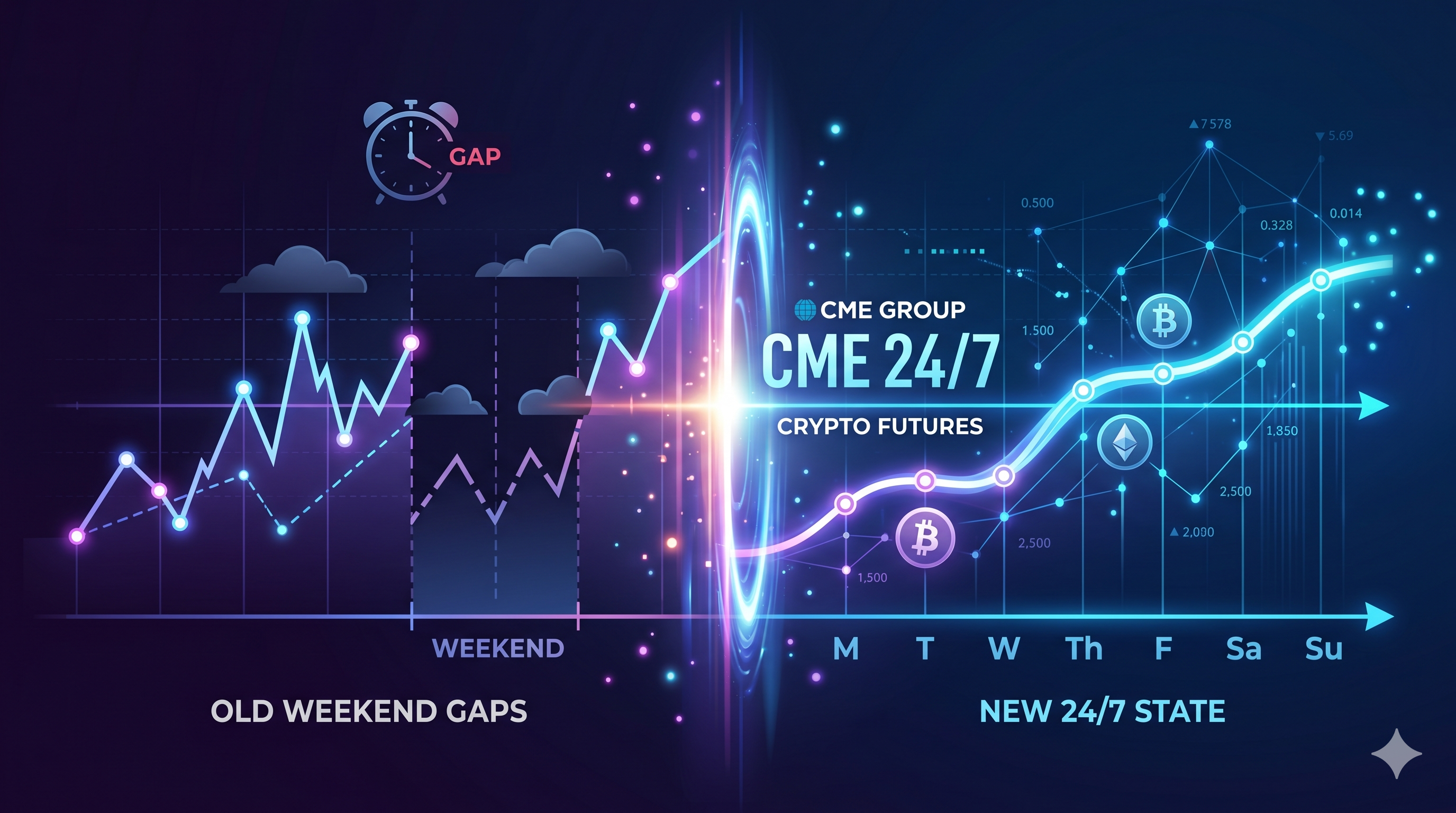
Cryptocurrency is a market that never sleeps, yet the world’s most powerful institutional capital has historically been tethered to the rigid operating hours of traditional finance. This profound temporal mismatch has long been the primary driver of fragmented liquidity and weekend volatility spikes. However, this dynamic is permanently shifting. On May 29, 2026, the Chicago Mercantile Exchange (CME Group) will officially launch 24/7 trading for its regulated cryptocurrency futures and options. This transition is far more than a mere extension of trading hours; it is a structural milestone that shatters the barrier between institutional liquidity and the native, always-on crypto market. By bridging the gap between Wall Street’s traditional infrastructure and the digital asset ecosystem, the upcoming CME crypto futures launch will fundamentally alter price discovery, reshape arbitrage strategies, and eliminate the notorious weekend effect.
💡 Tips: New to crypto? KuCoin's Knowledge Base has everything you need to get started.
Key Takeaways
-
Continuous Price Discovery: The May 29 update transitions CME from a legacy five-day schedule to a continuous 24/7 model, perfectly aligning with native crypto market hours.
-
Death of the Weekend Gap: The classic Monday morning "CME Gap" will be eliminated, rendering historical gap-fill trading strategies entirely obsolete.
-
Institutional Weekend Hedging: Hedge funds and large asset managers can now dynamically adjust risk and execute hedges during the weekend, injecting massive institutional liquidity into previously thin weekend markets.
-
Arbitrage Compression: Cross-market basis trades will become hyper-efficient, drastically narrowing the premium or discount between CME futures and spot prices on offshore exchanges.
-
Systemic Risk Alterations: While overall volatility will smooth out, the market must prepare for potential "flash crashes" during low-volume overnight hours when human market makers are less active.
The Significance of CME Going 24/7 on May 29
The May 29 launch of continuous trading resolves the most glaring structural inefficiency in the digital asset market: the 49-hour weekend blackout period that previously handcuffed institutional investors. For years, the traditional vs. crypto markets debate centered on this exact friction. While retail traders and offshore platforms drove price action from Friday evening to Sunday afternoon, institutional giants were frozen, unable to adjust their positions on the world's leading regulated derivatives platform.
Recent market data from April and May 2026 highlights the urgency of this update. CME’s Bitcoin and Ether futures open interest surged past $18 billion in early May, representing a 22% increase over the last two months alone. With such a massive concentration of capital, leaving institutions blind and paralyzed for two days a week poses an unacceptable systemic risk.
By operating 24/7, CME is not just updating its clock; it is validating the crypto-native financial standard. The exchange is acknowledging that digital assets are driven by global, round-the-clock news cycles that do not respect bank holidays or weekend closures. This structural modernization ensures that regulated, U.S.-based liquidity pools will now actively participate in weekend price discovery, rather than merely reacting to it on Monday mornings.
Legacy vs. 24/7 CME Crypto Futures Trading
| Feature | Legacy CME Schedule (Pre-May 2026) | New 24/7 Schedule (Post-May 29, 2026) |
| Operating Hours | Sunday 6:00 PM to Friday 5:00 PM EST | 24 Hours / 7 Days a week |
| Weekend Price Action | Frozen; vulnerable to offshore manipulation | Continuous; anchored by institutional volume |
| Monday Open Gaps | Frequent and often severe ($500+ differences) | Eliminated; prices track real-time spot |
| Institutional Risk | High; inability to hedge weekend news events | Low; immediate access to delta-hedging |
How Continuous Trading Will Reshape Crypto Liquidity
Continuous trading will fundamentally restructure the digital asset order books, driving liquidity deeper and making the market significantly more efficient. By allowing capital to flow without interruption, CME's update directly attacks the three most prominent inefficiencies of the current market structure.
Eliminating the Infamous "Weekend Effect"
The shift to 24/7 trading guarantees the eradication of the historical "weekend effect" and the subsequent Monday morning price gaps. Because CME futures will now update in real-time alongside spot markets on Saturday and Sunday, there will be no pent-up price discrepancies waiting to violently resolve when the traditional trading week begins.
Historically, the weekend effect was characterized by thin liquidity and elevated retail speculation. Because institutional market makers paused their CME operations, order books across the entire crypto ecosystem thinned out. This allowed relatively small amounts of capital to trigger outsized price swings. When CME reopened on Sunday evening, its futures contracts had to instantly "gap" up or down to catch up with the spot market's weekend movements.
Data from March 2026 showed that 88% of these weekend gaps eventually filled, creating a highly predictable, albeit unnatural, market dynamic. With the May 29 update, the continuous pricing engine of CME Globex will track spot prices seamlessly. The Monday gap will disappear from technical charts forever, smoothing out the transition between the weekend and the traditional workweek, and forcing technical analysts to discard one of their most reliable historical indicators.
Bridging Institutional and Retail Liquidity
The implementation of continuous trading allows institutional investors to seamlessly interact with and anchor the broader market during the weekend, effectively merging two historically segregated liquidity pools. Hedge funds and asset managers can now execute real-time risk mitigation without being forced to rely on offshore, crypto-native exchanges.
Previously, if a major geopolitical event or regulatory announcement occurred on a Saturday, a heavily exposed institutional fund was trapped. Their CME positions were locked. To hedge their delta risk, these entities were forced to open offsetting positions on platforms like Binance or Deribit, exposing themselves to counterparty risk and regulatory grey areas.
Now, with CME open all weekend, authorized participants and designated market makers can inject their capital directly into the regulated futures market exactly when it is needed. This influx of "smart money" over the weekend will thicken the order books, tighten bid-ask spreads, and provide a massive shock absorber against the erratic retail-driven volatility that usually plagues Saturday and Sunday trading sessions.
Impact on Arbitrage Opportunities
The transition to 24/7 trading will compress cross-market spreads to microscopic levels, making basis trading and arbitrage significantly more efficient while lowering the overall profit margins for these specific strategies. Arbitrageurs rely on exploiting the price differences between two distinct markets; when one market is closed, those differences naturally inflate.
During the legacy schedule, the basis—the difference between the CME futures price and the spot price of Bitcoin—often became highly distorted over the weekend. A sudden spike in retail buying on a Saturday would push spot prices up, while the locked CME futures price remained stagnant, creating a massive, artificial premium.
Starting May 29, high-frequency trading (HFT) algorithms will operate 24/7 across both CME and crypto-native spot platforms. The moment a price discrepancy emerges, algorithms will instantly execute cash-and-carry trades, buying the cheaper asset and shorting the more expensive one. This relentless, uninterrupted automated arbitrage will ensure that CME futures remain tightly pegged to the global spot index at all hours, resulting in the most accurate and unified digital asset pricing the market has ever seen.
What This Means for Crypto Traders and Researchers
The modernization of CME’s trading hours forces a complete paradigm shift for market participants, requiring the immediate recalibration of trading algorithms, backtesting models, and macro-analytical frameworks.
For Algorithmic Traders
Quantitative and algorithmic traders must urgently rewrite their execution logic to account for a continuous data stream, stripping out legacy code that dictates weekend de-risking or gap-exploitation. For years, trading bots were programmed with a "Friday close" protocol—reducing leverage and flattening positions to avoid the unpredictable risk of being trapped over the weekend.
With the May 29 rollout, these historical models are obsolete. The API feeds will no longer flatline on Friday evening. Algorithms must now be trained to navigate a continuous 24/7 time series. Furthermore, historical backtests that rely on data prior to May 2026 will carry a "weekend bias." Quants will need to apply statistical smoothing to historical data or weigh post-May 2026 data more heavily to accurately simulate future market conditions.
For Market Researchers
Market researchers and analysts will gain unprecedented, real-time visibility into institutional sentiment through uninterrupted Open Interest (OI) and funding rate data. The era of guessing what Wall Street is doing over the weekend is officially over.
Previously, analysts used offshore exchange OI as a proxy for total market sentiment during the weekend, which often skewed heavily toward retail exuberance. Now, researchers can monitor CME’s institutional positioning in real-time on a Saturday night. If CME Open Interest dramatically increases during a weekend dip, analysts can confidently conclude that institutional players are buying the dip, rather than just retail traders attempting to catch a falling knife. This new, continuous data pipeline will radically improve the accuracy of on-chain and derivative market research reports.
Strategic Adaptations for Market Participants
| Participant Type | Old Paradigm (Pre-May 29) | New Paradigm (Post-May 29) |
| Retail Swing Traders | Traded the "Monday Gap Fill" setup. | Must rely on continuous price action and volume analysis. |
| Quant Funds | Flattened risk on Friday afternoons. | Maintain 24/7 delta-neutral positioning. |
| Macro Analysts | Ignored weekend CME data (static). | Monitor real-time weekend CME Open Interest. |
Potential Risks and Volatility Concerns
While the shift to continuous trading is a massive net positive for market maturity, it introduces acute structural risks regarding order book depth during traditional off-hours, potentially setting the stage for localized extreme volatility events. The core issue lies in the human element of market making.
Even though the CME Globex matching engine will hum along 24/7, the Wall Street trading desks and designated market makers that provide the bulk of the liquidity still operate with human oversight. During the "graveyard shifts"—such as 3:00 AM EST on a Sunday—human staffing at these institutional desks is minimal. Consequently, algorithms may be programmed to run with wider spreads and lower maximum size limits to protect against unattended risk.
If a massive, sudden market order hits the CME order book during these thin weekend hours, it could easily chew through the available liquidity. This scenario risks triggering a "flash crash" or an aggressive wick on the charts, liquidating over-leveraged traders before the market makers' algorithms can re-populate the book. Regulators and risk managers are currently monitoring this dynamic closely, utilizing data from late April and early May 2026 simulations to stress-test how well automated clearing mechanisms handle sudden weekend volume spikes without human intervention.
A Seamless Transition to Continuous Crypto Markets
As the traditional financial world adapts to the 24/7 nature of digital assets, having the right platform to execute your strategies continuously is more critical than ever. Whether you are adjusting to the disappearance of weekend gaps or looking to capitalize on tighter cross-market arbitrage spreads, trading on a platform built natively for round-the-clock action gives you the edge. KuCoin offers deep liquidity, advanced API connectivity for algorithmic traders, and a seamless interface that aligns perfectly with the new continuous market paradigm.
Conclusion
The transition of CME cryptocurrency futures to a 24/7 trading model marks the final, definitive step in merging traditional financial infrastructure with the native digital asset economy. By keeping the doors open all weekend, CME is providing institutional capital with the continuous risk management tools they have desperately needed. This historic shift directly addresses long-standing market inefficiencies, ensuring the permanent elimination of the Monday weekend gap and fostering a hyper-efficient cross-market arbitrage environment. Furthermore, it supplies market researchers with an uninterrupted stream of institutional sentiment data, forever altering how quantitative models are built and deployed. While traders must remain vigilant regarding thin order books during overnight hours, the overall result is a deeper, more resilient, and uniformly priced global cryptocurrency market. The era of paused liquidity is over; the future of regulated derivatives is truly continuous.
FAQs
Will CME's 24/7 schedule apply to all of their financial products?
No. The May 29 continuous trading update applies strictly to CME’s cryptocurrency suite, including Bitcoin and Ether futures and options. Traditional assets like agricultural commodities, equities, and forex will remain on their standard legacy schedules.
How will weekend margin calls be processed if traditional banking systems like Fedwire are closed?
To manage weekend margin requirements while banks are offline, clearinghouses are increasingly utilizing internal liquidity buffers and authorized stablecoin integrations. Traders must ensure sufficient margin is pre-funded on Fridays to withstand potential weekend volatility.
Can retail traders access these new 24/7 CME futures directly?
Direct access to CME requires a brokerage account that supports futures trading and meets specific margin requirements. While not as simple as opening a standard crypto exchange account, retail traders can access these markets through compliant retail brokerages that route orders to CME Globex.
Will the new schedule change the contract expiration dates for CME crypto futures?
No. The expiration dates and settlement procedures remain unchanged. Contracts will still expire on the last Friday of the contract month at 4:00 PM London time. Only the active trading hours leading up to that expiration are being extended.
What happens if there is a severe technical glitch on the exchange during a weekend?
CME has implemented robust, automated "circuit breakers" and dynamic price limits that operate continuously. In the event of a severe anomaly during weekend hours, trading can be automatically halted to protect market integrity until operations are normalized.
Disclaimer: This article is for informational purposes only and does not constitute financial or investment advice. Cryptocurrency investments carry significant risk. Always conduct your own research before trading.