

CLARITY Act Senate Vote Fails: Why the Crypto Bill Collapsed and What Comes Next
Introduction
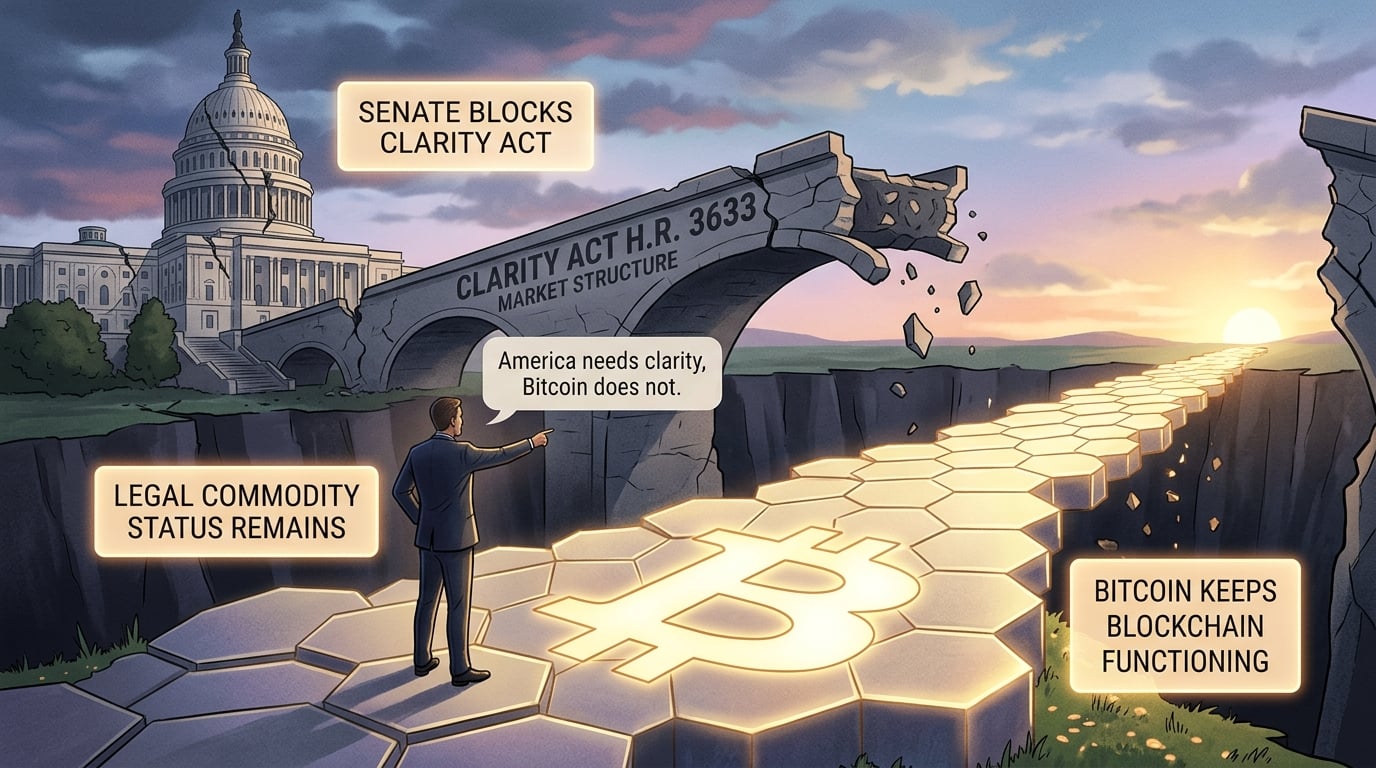
Bitcoin does not need the CLARITY Act to keep functioning. Michael Saylor, executive chairman of Strategy, put that case in one line when the Senate first delayed the bill: “Bitcoin doesn’t need CLARITY. America needs clarity.” After the September 15, 2026 cloture vote failed 49–50, Strategy repeated the same thesis: Bitcoin already had legal and regulatory clarity in the United States.
The Senate still blocked H.R. 3633, the Digital Asset Market Clarity Act. The bill needed 60 votes to start debate. It did not get them. That is a setback for U.S. market-structure legislation. It is not the end of the crypto market, and it is not a legal reset for Bitcoin.
The House had already passed the bill 294–134 in July 2025, according to Congress.gov. The network, the spot market, and existing commodity treatment did not depend on that statute passing this week.
What Is the CLARITY Act and Who Actually Needed It?
The CLARITY Act is a U.S. market-structure bill for digital assets, not a survival law for Bitcoin. According to House Report 119-168 on Congress.gov, H.R. 3633 would give the Commodity Futures Trading Commission jurisdiction over digital commodities and keep the Securities and Exchange Commission focused on investment contracts.
That split matters most for token issuers, exchanges, brokers, and DeFi firms that still sit in a gray zone. It matters far less for Bitcoin, which U.S. regulators and courts have long treated as a commodity rather than a newly issued security.
House Report 119-168 states that digital commodities, as defined in the bill, account for roughly 70 percent of total digital-asset market capitalization traded today. Bitcoin is the largest of those assets. The report also says the digital-commodity marketplace still lacks a single federal statute for customer disclosures, fund segregation, and intermediary registration.
Saylor supported the bill for America, not because Bitcoin’s protocol required it. On July 31, 2026, he said he backed bipartisan work “to establish clear, durable rules, protect property rights, promote innovation, and strengthen American capital markets,” then added that Bitcoin will succeed with or without legislation.
In other words, CLARITY was a competitiveness bill for U.S. capital markets. It was not a switch that turns Bitcoin on or off.
Why Did the CLARITY Act Fail the Senate Vote?
The bill failed because it could not reach 60 votes, and it did not even hold a simple majority. Republicans hold 53 Senate seats. All 49 yes votes came from Republicans. No Democrat voted to proceed.
Four Republicans voted no: Susan Collins, Josh Hawley, Jerry Moran, and Thom Tillis. Tillis used a procedural no so he could move to reconsider later. Senator Chris Coons did not vote.
The 60-vote rule was the binding constraint. A House supermajority in 2025 and a Senate Banking Committee markup earlier in 2026 did not carry onto the floor.
How Did Ethics Rules Break the Coalition?
Ethics language broke the last coalition. Democrats wanted enforceable limits on senior officials and family crypto holdings while those officials set crypto rules. Republicans added late ethics text, including a role for state attorneys general. Several Democratic negotiators still said the package left existing holdings too intact.
Once talks collapsed on vote day, even Democrats who had spent months on the draft voted no. That ended the math.
Why Did Banks Fight Stablecoin Rewards?
Banks opposed platform-level rewards on stablecoin balances. The GENIUS Act already limits yield paid directly by issuers. Banking groups argued that exchange rewards could still pull deposits from community lenders.
That fight moved Republican votes as well as Democratic ones. Hawley and Moran were associated with those community-bank concerns. A market-structure bill that pits banks against crypto platforms is hard to pass in the Senate.
Why Does Bitcoin Not Need the CLARITY Act, According to Michael Saylor?
Bitcoin does not need the CLARITY Act because its legal status, monetary design, and market infrastructure already exist without that statute. Saylor’s August 7, 2026 line — “Bitcoin doesn’t need CLARITY. America needs clarity” — separated the asset from the jurisdiction.
After the September 15 vote, Strategy stated that Bitcoin has had legal and regulatory clarity in the United States for years. Saylor also posted that the only clarity investors need is Bitcoin. Those comments match his longer thesis: Bitcoin is a commodity with a fixed 21 million supply, and the network keeps producing blocks whether Congress writes a new title or not.
Strategy’s own position makes the point concrete. According to company disclosures cited after the vote, Strategy held 845,050 BTC with an average cost near $75,412 per coin. That treasury strategy was built under current U.S. law, commodity treatment, accounting rules, and public-market disclosure — not under H.R. 3633.
Saylor has also said Americans do not need a license to discuss, advocate, or recommend Bitcoin, because Bitcoin is a commodity, not a security. Fraud and manipulation remain illegal. Advocacy does not. That is existing law, not pending law.
Why Is the Failed Vote Not the End of the Crypto Market?
The failed vote is not the end of the crypto market because trading, settlement, stablecoins, and agency rulemaking continue without a new statute. Markets sold off on the headline, then had to price a delay rather than a ban.
Bitcoin slipped after the result, and crypto-linked equities moved harder than the base asset. That is the usual pattern when Washington risk hits listed intermediaries first. Coinbase, Strategy, and related stocks price listing expansion and compliance timelines more directly than Bitcoin’s protocol does.
The GENIUS Act remains law for payment stablecoin issuance. Exchanges can still list assets. The SEC and CFTC still have authority. Coinbase CEO Brian Armstrong said before the vote that agency rulemaking could deliver regulatory clarity even if the bill failed.
Ripple made a parallel point for XRP after the vote, citing a 2023 federal court ruling and a later joint agency interpretation. Different assets have different legal files. The common message from large firms was the same: one Senate procedural loss did not rewrite existing case law.
Global venues also keep running. When Washington pauses a statute, activity does not freeze. It stays on exchanges, in ETFs, in corporate treasuries, and in overseas licensing regimes.
What Happens to U.S. Crypto Regulation Now?
Regulation now moves back to agencies. The SEC and CFTC can still write rules, supervise intermediaries, and define token categories under existing securities and commodities law.
According to a September 2026 Congressional Research Service product on Congress.gov, the SEC has already proposed a “Regulation Crypto Assets” framework and has said legislation remains the more durable path. Agency rules can arrive faster than a 60-vote Senate bill. They can also be revised by a future commission or tested in court.
Firms that needed CLARITY the most — token issuers, DeFi teams, and platforms seeking a single federal registration path — still face dual-agency uncertainty. Bitcoin holders face a narrower change: headline volatility and a slower U.S. push to become the lead venue for every digital-asset product.
State law, bank supervision, and existing anti-money-laundering rules also remain in force. The statute that failed was an overlay, not the entire legal stack.
Can Congress Still Revive Market Structure Legislation?
Congress can revive a market-structure bill, but the September text is politically spent. Tillis reserved a motion to reconsider, so leadership can try again without starting from a blank calendar. That is procedure, not a new coalition.
A later draft would still need an ethics title Democrats will vote for, a stablecoin-rewards deal banks will accept, and at least seven Democratic votes if Republicans stay near 53 seats. Midterms can change committee control and rewrite that map.
The House CFTC-SEC split is likely to survive in future drafts. Ethics, DeFi liability, and bank-competition clauses are the parts that failed. Bitcoin commodity treatment is the part least in doubt.
Beyond the Headlines: What KuCoin 5.0 Means for You
Market news moves fast — but where you act on it matters just as much. This October, KuCoin launches KuCoin 5.0, transforming KuCoin into a rebuilt platform. Here's what actually changes for you:
-
One account for everything. Older platforms split your money across separate "spot," "margin," and "futures" accounts and expected you to understand why. KuCoin 5.0's unified account removes that entirely — deposit once, and everything is simply there.
-
Stocks, indices, and commodities. KuCoin 5.0 expands beyond crypto into global markets. When crypto chops sideways and equities rally (or the reverse), you rotate in minutes instead of opening a brokerage account and waiting days for fiat rails.
-
Real-world assets (RWA). Tokenized exposure to traditional assets like commodities, right inside your crypto account. One of the fastest-growing segments in global finance is no longer reserved for institutions — you access it from the same balance you trade with.
-
Earn while you learn. Not ready to trade? KCUSD lets your stablecoins earn daily, auto-compounding interest. The lowest-stress way to put your idle deposit to work for 4% yield.
-
An AI assistant in plain language. Ask questions, get market context, understand what you're looking at — built into the platform, no jargon required.
-
An app that doesn't overwhelm. Faster, cleaner, and consistent — intuitive from the first tap, not after a tutorial.
-
Safety you can check, not just trust. A MiCAR-licensed EU entity, Proof of Reserves you can verify yourself, and internationally certified security (SOC 2 Type II, ISO 27001:2022).
Create your account in minutes — and start on the platform built for where crypto is going, not where it's been.
Conclusion
The CLARITY Act failed Senate cloture on September 15, 2026, by a 49–50 vote, well short of 60. Ethics fights, bank pressure over stablecoin rewards, and the filibuster stopped H.R. 3633 after the House passed it 294–134 in July 2025, according to Congress.gov.
That loss is real for U.S. market-structure legislation. It is not a verdict on Bitcoin. Michael Saylor said Bitcoin does not need CLARITY and that America does. Strategy later said Bitcoin has had legal and regulatory clarity in the United States for years. The network, commodity treatment, ETFs, and corporate treasuries were already in place.
The crypto market does not end when one bill stalls. Agency rulemaking, existing statutes such as the GENIUS Act, court rulings, and global trading venues remain. Prices can react to headlines. The market itself keeps operating.
Watch the SEC, the CFTC, and product flow. A future Congress may try again. Until then, Bitcoin’s own rules — fixed supply, open settlement, and commodity status — remain the clearest framework on the board.
FAQs
Did Michael Saylor say Bitcoin needs the CLARITY Act?
No. Saylor said Bitcoin does not need CLARITY and that America needs clarity for digital assets. He also said Bitcoin will succeed with or without legislation.
Does the failed Senate vote make Bitcoin a security?
No. Strategy and Saylor have described Bitcoin as a commodity with existing U.S. legal and regulatory clarity. The cloture vote did not rewrite that classification.
Is the crypto market finished because CLARITY failed?
No. Spot markets, ETFs, stablecoins under existing law, and agency rulemaking continue. The vote delayed a statute. It did not close the market.
Why did some Republicans vote no?
Community-bank concerns about stablecoin rewards and other policy objections drove Republican no votes. Tillis also voted no to preserve a motion to reconsider.
Can Congress pass a new crypto bill later?
Yes. Leadership can try again after revisions or after the midterms. Any new text will still need 60 Senate votes unless the chamber changes its rules.
Disclaimer: This article is for informational purposes only and does not constitute financial, legal, or investment advice. Always conduct your own research before interacting with digital assets.