

Citrini Research's Breaking the Wall: Could UNI, AAVE, and HYPE Benefit From the Rise of Onchain Finance?
Introduction
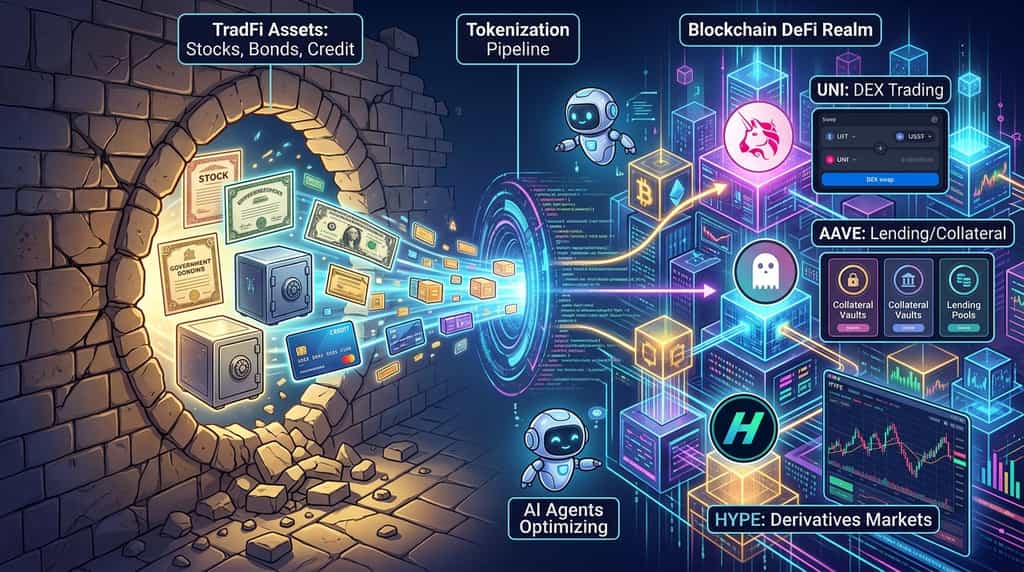
What if the next major crypto investment opportunity comes not from another digital currency, but from bringing stocks, bonds, credit, and other traditional financial assets onto blockchains? In its October 8, 2026, report, Breaking the Wall, Citrini Research argues that the convergence of traditional finance (TradFi), decentralized finance (DeFi), and AI agents could finally give blockchain infrastructure a compelling real-world purpose. The investment question is no longer simply whether asset tokenization will grow, but which protocols can capture the resulting economic value.
Three crypto tokens deserve particular attention under this thesis: Uniswap's UNI, Aave's AAVE, and Hyperliquid's HYPE. UNI could benefit from increased onchain trading activity and protocol-fee mechanisms; AAVE could gain from demand for lending and collateral infrastructure; and HYPE could benefit if tokenized assets drive more trading activity through Hyperliquid's markets. These are potential beneficiaries, not guaranteed winners. Tokenization adoption does not automatically translate into token appreciation, and the strength of each investment case depends on how effectively its protocol captures fees, users, and sustainable demand.
What Does Citrini Research's "Breaking the Wall" Report Mean for Crypto?
Citrini Research's central argument is that tokenization could turn blockchains from a relatively isolated crypto trading infrastructure into a foundation for broader financial activity. Its October 8 report, "Breaking the Wall," connects three developments: traditional financial assets moving onchain, decentralized applications becoming more capable, and AI agents increasingly able to interact with programmable financial systems.
Why Could Asset Tokenization Change the Role of Blockchain?
Asset tokenization represents ownership rights or economic exposure to assets through blockchain-based tokens. Depending on the legal structure, the underlying asset could be a stock, a government bond, a money-market fund, real estate, or a credit instrument.
The potential benefit goes beyond creating a digital representation of an existing asset. Tokenized assets can become programmable, transferable between compatible applications, and potentially usable as collateral in onchain financial markets. This creates opportunities to combine trading, lending, payments, and asset management within a shared infrastructure.
For example, a tokenized stock could be traded through an eligible onchain venue and, if the product and protocol permit it, deposited as collateral to borrow a stablecoin. That stablecoin could then be used for another transaction without requiring the investor to liquidate the original position. Actual functionality depends on the token's legal rights, transfer restrictions, protocol support, and applicable regulations.
The institutional direction is becoming more concrete. On September 17, 2026, the US Securities and Exchange Commission announced a temporary, conditional innovation exemption to facilitate trading of certain tokenized national market system stocks through qualifying venues. The exemption is limited and subject to conditions; it does not represent blanket approval of every tokenized security or decentralized trading platform.
This development supports the broader tokenization thesis: blockchain infrastructure is increasingly being considered for regulated financial market functions, not merely native cryptocurrency transfers.
Why Does the Rise of AI Agents Matter?
AI agents could expand the potential user base for onchain financial infrastructure because they can execute software-driven tasks continuously, subject to permissions, available integrations, and security controls.
A human investor might compare interest rates, move stablecoins, exchange assets, or rebalance a portfolio manually. An authorized financial agent could perform similar tasks programmatically, potentially interacting with multiple protocols without requiring the user to operate each interface individually.
This creates a possible feedback loop. More tokenized assets create more opportunities for automated trading and portfolio management. More automated activity can increase demand for liquidity, market data, lending, and settlement. Those requirements, in turn, could create additional demand for blockchain-based financial applications.
However, AI adoption does not guarantee that public blockchains or crypto tokens will capture the resulting value. Traditional financial institutions can build their own programmable infrastructure, and regulated intermediaries may remain necessary for custody, identity verification, asset issuance, and compliance.
The investment question is therefore which crypto protocols can offer competitive infrastructure and capture measurable economic value from the additional activity.
Which Crypto Tokens Could Benefit Most From Asset Tokenization?
UNI, AAVE, and HYPE are the top three candidates worth examining because they provide exposure to different layers of onchain finance: decentralized exchange liquidity, lending and collateral infrastructure, and trading markets. Their potential upside depends on whether tokenization generates incremental activity that translates into stronger protocol economics or token demand.
| Token | Protocol exposure | Potential tokenization catalyst | Main value-capture question |
| UNI | Uniswap decentralized trading | More tokenized assets and onchain swaps | Does additional trading generate meaningful UNI burns or other token demand? |
| AAVE | Lending and collateral markets | Tokenized securities used in eligible lending markets | Does additional lending activity strengthen AAVE's economic value capture? |
| HYPE | Hyperliquid trading infrastructure | More tokenized-asset markets and derivatives activity | Does increased activity support fee-driven HYPE demand and supply reduction? |
These tokens are not interchangeable bets. UNI is linked to decentralized exchange activity and governance, AAVE to lending infrastructure, and HYPE to a trading-focused ecosystem. Each has a distinct mechanism through which tokenization might influence its economics.
Could UNI Benefit From the Growth of Tokenized Asset Trading?
UNI could benefit if tokenized assets increase trading activity on Uniswap and the protocol's fee mechanisms capture part of that growth. As a decentralized exchange protocol, Uniswap provides liquidity infrastructure for swapping compatible onchain assets. A broader range of tokenized assets could create more opportunities for trading pairs, liquidity provision, and transactions between tokenized securities and stablecoins.
The important distinction is between growth in onchain trading and growth in Uniswap's own activity. Tokenized stocks could trade on specialized venues, permissioned systems, or competing decentralized exchanges without generating meaningful volume for Uniswap. Asset issuers may also restrict transfers or trading to approved participants, limiting the extent to which a token can be used in permissionless liquidity pools.
UNI's value-capture mechanism is also relevant. According to the official Uniswap developer documentation, UNI is the protocol's governance token, and protocol fees collected under the active fee mechanism are used in a process that burns UNI. The documentation explains that protocol fees are active on Uniswap v2 pools and selected v3 pools, while the broader fee architecture can be expanded through governance.
This provides a potential link between increased protocol activity and reduced UNI supply. If tokenized assets materially increase volume on fee-enabled pools, the resulting protocol fees could increase the amount of UNI burned, all else being equal.
However, higher trading volume does not automatically translate into proportionally higher burns. Fee-enabled pool coverage, fee parameters, trading-pair composition, liquidity incentives, and governance decisions all affect the outcome. UNI holders also do not automatically receive a pro-rata share of protocol revenue.
Investment implication: UNI offers a potential way to gain exposure to tokenization through decentralized spot trading. The strongest evidence for its thesis would be sustained growth in tokenized-asset trading on Uniswap, increased fee generation on eligible pools, and a measurable increase in UNI burns relative to supply.
Could AAVE Benefit From Tokenized Securities Becoming Collateral?
AAVE could benefit if tokenized securities and other real-world assets become usable collateral in regulated or permissioned lending markets. Tokenization makes financial assets representable onchain, but lending protocols provide the additional infrastructure needed to turn eligible assets into borrowing capacity.
Aave's institutional-oriented Horizon market is particularly relevant because it is designed to allow qualified participants to supply permissioned tokenized real-world assets as collateral and borrow stablecoins through a separate liquidity layer. The market's architecture aims to connect regulated asset access with decentralized liquidity while preserving asset-level restrictions.
A concrete example emerged on September 25, 2026. According to Aave's official announcement, seven Coinbase Tokenized Stocks representing US technology companies became available as collateral for borrowing USDC on Aave v4 on Base. The announcement identified Chainlink as the official oracle provider for these tokenized assets and stated that the products were available in eligible jurisdictions outside the United States.
This integration demonstrates a real connection between tokenized equities and DeFi lending. Rather than simply trading a token that tracks or represents a stock, eligible users can potentially use the token to access liquidity without selling their exposure.
The potential benefit for Aave is increased demand for lending markets, collateral management, liquidity, and risk infrastructure. If tokenized assets become more widely accepted as collateral, protocols capable of handling asset-specific restrictions and risk parameters could become more important.
But the growth of Aave's lending business is not identical to growth in the AAVE token's price. The token's value capture depends on governance decisions, protocol economics, market demand, and the relationship between revenue and token-holder benefits. Asset eligibility also remains constrained by jurisdiction, issuer requirements, collateral parameters, liquidity, and oracle reliability.
Investment implication: AAVE offers exposure to the financial infrastructure layer of tokenization. Relevant indicators include growth in tokenized collateral supplied to Aave, borrowing activity against that collateral, risk-adjusted protocol revenue, and governance decisions that influence AAVE's economic value capture.
Could HYPE Benefit From the Expansion of Tokenized Asset Markets?
HYPE could benefit if tokenization brings more trading activity to Hyperliquid, especially as the platform expands beyond conventional cryptocurrency markets. The core thesis is that tokenized financial assets and onchain derivatives could attract traders who want access to a wider range of markets through crypto-native trading infrastructure.
Citrini Research highlights Hyperliquid's role in demonstrating how crypto venues can provide price discovery for assets beyond native cryptocurrencies. Its report describes how Hyperliquid became a significant venue for crude-oil price discovery during the escalation of the Iran conflict over a weekend in March 2026, when many traditional markets were closed. The broader point is that around-the-clock trading can become valuable when market participants need to respond to events outside conventional exchange hours.
Hyperliquid's infrastructure also provides a potential path for new markets to emerge. Under HIP-3, its builder-deployed perpetuals framework, eligible builders can deploy perpetual futures markets with their own market definitions, oracle configurations, and operating parameters. This could support a broader range of derivatives markets, provided the underlying asset has a reliable reference price and the market satisfies relevant requirements.
Tokenization could strengthen this opportunity by expanding the assets that traders can access through onchain venues. However, tokenized spot assets and perpetual futures are different products. A perpetual contract may provide price exposure without conferring ownership of the underlying stock or other asset. Market availability also does not establish that a product is legally available to every user or jurisdiction.
HYPE's economic linkage is another important consideration. According to Hyperliquid's official fee documentation, trading fees are directed to designated ecosystem destinations, including the assistance fund, which converts fees to HYPE and burns the acquired tokens. The precise distribution depends on the product and fee mechanism.
If tokenized-asset markets generate additional trading activity, and that activity produces net incremental fees that support HYPE purchases and burns, the token could benefit from both stronger ecosystem demand and a reduced supply. Yet competition, fee discounts, market quality, builder economics, and the proportion of volume that generates protocol-level value all matter.
Investment implication: HYPE provides exposure to the trading and derivatives layer of the tokenization thesis. Evidence to monitor includes sustained volume in non-crypto markets, growth in deployed markets, fee generation, and the amount of HYPE purchased and burned through protocol mechanisms.
Beyond the Headlines: What KuCoin 5.0 Means for You
Market news moves fast — but where you act on it matters just as much. This October, KuCoin launches KuCoin 5.0, transforming KuCoin into a rebuilt platform. Here's what actually changes for you:
-
One account for everything. Older platforms split your money across separate "spot," "margin," and "futures" accounts and expected you to understand why. KuCoin 5.0's unified account removes that entirely — deposit once, and everything is simply there (only available to VIPs for now).
-
Stocks, indices, and commodities. KuCoin 5.0 expands beyond crypto into global markets. When crypto chops sideways and equities rally (or the reverse), you rotate in minutes instead of opening a brokerage account and waiting days for fiat rails.
-
Real-world assets (RWA). Tokenized exposure to traditional assets like commodities, right inside your crypto account. One of the fastest-growing segments in global finance is no longer reserved for institutions — you access it from the same balance you trade with.
-
Earn while you learn. Not ready to trade? KCUSD lets your stablecoins earn daily, auto-compounding interest. The lowest-stress way to put your idle deposit to work for 4% yield.
-
An AI assistant in plain language. Ask questions, get market context, understand what you're looking at — built into the platform, no jargon required.
-
An app that doesn't overwhelm. Faster, cleaner, and consistent — intuitive from the first tap, not after a tutorial.
-
Safety you can check, not just trust. A MiCAR-licensed EU entity, Proof of Reserves you can verify yourself, and internationally certified security (SOC 2 Type II, ISO 27001:2022).
Create your account in minutes — and start on the platform built for where crypto is going, not where it's been.
Conclusion
Citrini Research's "Breaking the Wall" report presents a compelling thesis: the convergence of traditional finance, blockchain infrastructure, and AI agents could expand crypto's role beyond native digital assets. As stocks, bonds, and other financial products move onchain, the resulting demand for trading, lending, collateral management, and settlement could create opportunities for established DeFi protocols.
UNI, AAVE, and HYPE stand out because they offer exposure to different layers of this emerging financial infrastructure. UNI could benefit from increased decentralized trading and fee-driven token burns. AAVE could gain from the use of tokenized assets as collateral in eligible lending markets. HYPE could benefit if tokenized financial markets drive additional trading activity and support its fee-driven token economics.
However, none of these outcomes is guaranteed. Tokenization may grow without generating meaningful value for a particular token, and regulatory constraints, competition, liquidity, and valuation can all influence investment performance.
The most useful way to evaluate this opportunity is to follow the economic evidence. Monitor protocol usage, fee generation, token-specific value capture, and the durability of adoption rather than relying solely on a broad industry narrative. Tokenization may reshape financial infrastructure, but identifying which crypto assets capture its value requires protocol-level analysis and disciplined risk management.
FAQs
1. What is the difference between tokenized stocks and stock perpetual futures?
Tokenized stocks may represent ownership rights or economic exposure to underlying shares, depending on their legal structure. Stock perpetual futures are derivatives that provide price exposure without necessarily granting ownership of the underlying stock. Investors should examine the specific product's legal rights, settlement method, and collateral requirements.
2. Can tokenized assets be traded 24/7?
Some tokenized assets and derivatives can trade around the clock on eligible platforms, but availability depends on the product, venue, liquidity, and applicable restrictions. Continuous blockchain operation does not guarantee uninterrupted trading or continuous access to every underlying financial market.
3. Can tokenized stocks be used as collateral in DeFi?
Yes, some tokenized stocks can be used as collateral in supported lending markets. For example, Aave announced in September 2026 that seven Coinbase Tokenized Stocks were available as collateral for borrowing USDC on Aave v4 on Base. Eligibility depends on the asset, protocol, jurisdiction, and user requirements.
4. Does buying UNI, AAVE, or HYPE give investors ownership of the underlying protocols' assets?
No. Holding these tokens does not automatically confer ownership of tokenized stocks, protocol assets, or a proportional claim on all protocol revenue. Token rights and economic benefits differ by project and should be verified through official documentation and governance decisions.
5. How can investors tell whether tokenization adoption is sustainable?
Investors can monitor recurring onchain activity, growth in assets actually used by financial applications, protocol revenue, liquidity, and evidence of continued participation after incentives decline. Sustainable adoption is more credible when real usage and economic demand improve together, rather than when activity rises temporarily due to speculation.
Disclaimer: This article is for informational purposes only and does not constitute financial, legal, or investment advice. Cryptocurrency markets are volatile, and tokenization does not guarantee price appreciation for any digital asset. Always conduct your own research before interacting with digital assets.