

BOJ Rate Decision Preview: Why a Hike to 1.25% Is Priced In — and Why the Yen May Still Fall
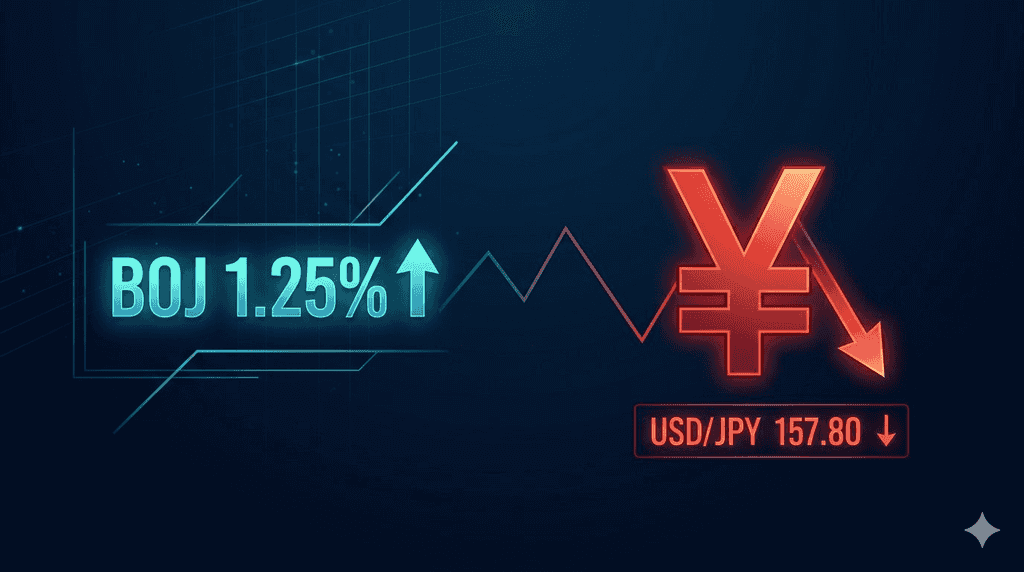
On September 18, 2026, the Bank of Japan (BOJ) delivered a historic monetary policy decision, raising its benchmark interest rate to 1.25%. This 25-basis-point increase marked a 31-year high for Japanese borrowing costs. However, instead of strengthening, the Japanese currency experienced a sharp sell-off, with the USD to JPY exchange rate rallying rapidly past 156.00.
Why is the Yen falling despite a rate hike? The Yen fell because the 1.25% hike was fully priced in, and the 2.75% interest rate gap with the US Federal Reserve continues to incentivize the Yen carry trade. Market participants engaging in crypto macro trading strategies and traditional forex were quick to digest the central bank's forward guidance, realizing that the end of ultra-loose monetary policy does not automatically equate to a strong currency. This analysis breaks down the mechanics behind the BOJ rate decision, the interest rate differential, and the broader liquidity implications for global markets.
Key Takeaways
-
The Bank of Japan (BOJ) raised its policy interest rate to 1.25% on September 18, 2026, reaching a 31-year high following a 7-2 board vote.
-
Despite the rate hike, the Japanese Yen depreciated rapidly against the US Dollar, pushing the USD/JPY exchange rate toward the 156.00–158.00 zone.
-
The US Federal Reserve raised its target range to 3.75%–4.00% just 48 hours prior, maintaining a substantial interest rate differential of roughly 2.75%.
-
The BOJ's cautious guidance prevented a sudden unwinding of the Yen carry trade, sustaining global macro liquidity that supports high-risk assets, including cryptocurrencies.
Breaking Down the September 2026 BOJ Rate Decision
The BOJ interest rate 2026 trajectory reached a critical milestone during the September policy meeting. The central bank raised the uncollateralized overnight call rate target from 1.00% to 1.25%. This move solidifies Japan's departure from decades of zero and negative interest rate policies, reflecting a domestic economy that is generating sustained inflation.
The decision was not unanimous. The policy board voted 7-2 in favor of the hike. The two dissenting votes came from members who argued that current economic conditions and underlying price momentum did not justify immediate tightening. These dissenting voices highlighted concerns that raising borrowing costs too quickly could stifle wage growth and hamper the recovery of small and medium-sized enterprises.
During the subsequent press conference, BOJ Governor Kazuo Ueda emphasized a shift in the central bank's mandate. For years, the BOJ's primary goal was to push inflation up to the 2% target. Now, with the underlying rate of price increases approaching and occasionally exceeding 2%, the objective has transitioned toward stabilizing inflation at that level. Governor Ueda noted that the central bank must now weigh upside inflation risks, driven by elevated energy prices, global AI-related demand, and previous yen depreciation, against downside economic risks.
This Bank of Japan 1.25% baseline establishes a new reality for domestic borrowers and savers. However, the accompanying commentary remained highly conditional. The BOJ stated that future rate adjustments will depend strictly on incoming data regarding economic activity and financial conditions. By refusing to commit to a preset terminal rate or a specific timeline for the next hike, the BOJ injected a degree of dovish sentiment into what was ostensibly a hawkish policy action.
Why the Market Wasn't Surprised
To understand the foreign exchange market's reaction, it is necessary to examine market positioning prior to September 18. What does a priced-in rate hike mean? A priced-in event occurs when financial markets fully anticipate a specific outcome and execute trades based on that expectation long before the official announcement.
In the weeks leading up to the BOJ rate decision, a Reuters poll of 68 economists revealed that 66 predicted an exact 25-basis-point increase to 1.25%. Foreign exchange traders and institutional speculators adjusted their portfolios accordingly, buying the Yen and pushing the USD JPY forecast lower in anticipation of the tightening. When an outcome is heavily anticipated, the first market move is driven by how the actual decision differs from expectations, rather than the decision itself.
Because the 1.25% hike materialized exactly as forecast, it offered no hawkish surprise. Traders operating on the "buy the rumor, sell the fact" principle immediately closed their long Yen positions to take profits. This sudden unwinding of pre-positioned trades generated immediate technical selling pressure on the Japanese currency.
Economic Indicators and Inflation Targets
The consensus expectation for the hike was built on hard economic data. Japan's core consumer price index (CPI), which excludes fresh food, hovered around 1.7% to 1.8% heading into the meeting. More importantly, corporate goods prices (PPI) had surged, indicating that businesses were facing higher input costs due to a weak yen and rising commodity prices.
Simultaneously, Japan recorded a 2.4% year-on-year increase in real wages, a critical metric for the BOJ. The central bank has long maintained that sustainable inflation must be accompanied by wage growth, ensuring that consumers can absorb higher prices. With the recent wage negotiations yielding positive results, the fundamental economic requirements for a rate hike had been met. The market recognized these indicators, calculating the BOJ's next move and eliminating the element of surprise from the September announcement.
Why is the Yen Falling Despite a Rate Hike?
The textbook economic theory suggests that higher interest rates attract foreign capital seeking yield, thereby strengthening the domestic currency. The reality of the September 2026 BOJ decision sharply contradicted this theory. The reasons for the Yen's decline are rooted in relative yields, speculative mechanics, and government intervention dynamics.
The US-Japan Interest Rate Differential (Fed at 3.75%-4.00%)
Currency valuations are relative. A currency's strength is determined not by its domestic interest rate in isolation, but by its rate compared to other major economies. Two days before the BOJ decision, on September 16, 2026, the US Federal Reserve raised its federal funds rate target range to 3.75%–4.00% in a unanimous 12-0 vote.
This simultaneous central bank action meant that the BOJ vs Fed interest rate gap 2026 remained vast. Even with Japan raising rates to 1.25%, the interest rate differential between the two nations sits at approximately 2.75 percentage points.
| Central Bank | Policy Meeting Date | New Policy Interest Rate | Rate Action |
| US Federal Reserve (Fed) | September 16, 2026 | 3.75% – 4.00% | +25 bps |
| Bank of Japan (BOJ) | September 18, 2026 | 1.25% | +25 bps |
| Current Interest Rate Differential | ~ 2.75% | Gap Maintained |
As long as this substantial yield gap exists, holding US Dollars generates significantly more passive income than holding Japanese Yen. Capital naturally flows toward higher nominal yields.
Yen Carry Trade Dynamics Remain Intact
The persistent interest rate differential is the primary fuel for the Yen carry trade. In a carry trade, investors borrow money in a currency with a low interest rate (the Yen) and invest that capital in assets denominated in a currency with a higher interest rate (the US Dollar).
Prior to the BOJ meeting, some market participants feared that an aggressive Japanese rate hike cycle would force a massive unwinding of carry trades, prompting investors to buy back Yen to cover their loans. However, because the BOJ's guidance was cautious and the absolute rate remains a low 1.25%, the math of the Yen carry trade remains profitable. Institutional investors and hedge funds realized that the cost of borrowing in Japan is still cheap relative to global yields. Consequently, the carry trade persists, resulting in continuous selling pressure on the Yen.
Dovish Signals and Intervention Fears at 158
The 7-2 vote split and Governor Ueda's cautious rhetoric acted as dovish signals. The market interpreted the internal board division as evidence that the BOJ will be slow and hesitant to push rates toward 1.50% or 1.75% in the near term.
As this realization set in, the USD to JPY exchange rate spiked, approaching the 158.00 threshold. At this level, market mechanics collide with political reality. The Japanese government and the Ministry of Finance view rapid Yen depreciation as a threat to domestic stability due to the rising cost of imported energy and food. Reports indicated that the BOJ conducted a "Rate Check"—calling commercial banks to ask for quotes on the USD/JPY pair. This action is historically recognized as the final warning before direct foreign exchange intervention. The threat of the government utilizing its dollar reserves to forcefully buy Yen capped the currency's decline, trapping the exchange rate in a volatile holding pattern near 156.00.
What the BOJ Decision Means for the Crypto Market
The implications of the BOJ rate decision extend far beyond traditional foreign exchange desks; they directly influence global macro liquidity, which is a primary driver of cryptocurrency valuations. For participants executing crypto macro trading strategies, the BOJ's cautious approach is a highly relevant data point.
How does the BOJ interest rate affect the crypto market? Bitcoin and broader digital asset markets rely on global liquidity. When central banks maintain low interest rates, capital is cheap, and investors are willing to move out on the risk curve into assets like cryptocurrencies. The Yen carry trade acts as a massive pipeline of cheap liquidity for global financial markets. Institutional investors borrow Yen and funnel that capital into US Treasuries, tech equities, and, indirectly, the crypto ecosystem.
Had the BOJ delivered a hawkish surprise, raising rates aggressively and signaling rapid future hikes, it could have triggered a violent unwind of the carry trade. Such an event forces investors to liquidate their high-risk assets (including crypto) to repatriate funds to Japan, causing severe liquidity contractions and market downturns.
By opting for a highly anticipated, cautious 1.25% hike, the BOJ signaled that the era of cheap Yen liquidity is ending, but it will end gradually. For the crypto market, this means the immediate threat of a liquidity vacuum has been averted. The carry trade pipeline remains functional for now. Crypto investors monitoring the BOJ vs Fed interest rate gap 2026 can factor this stability into their risk models, knowing that Japanese monetary policy is not currently positioned to trigger a systemic deleveraging event in digital assets.
🔥 Beyond the Headlines: What KuCoin 5.0 Means for You
Market news moves fast — but where you act on it matters just as much. This October, KuCoin launches KuCoin 5.0, transforming KuCoin into a rebuilt platform. Here's what actually changes for you:
-
One account for everything. Older platforms split your money across separate "spot," "margin," and "futures" accounts and expected you to understand why. KuCoin 5.0's unified account removes that entirely — deposit once, and everything is simply there.
-
Stocks, indices, and commodities. KuCoin 5.0 expands beyond crypto into global markets. When crypto chops sideways and equities rally (or the reverse), you rotate in minutes instead of opening a brokerage account and waiting days for fiat rails.
-
Real-world assets (RWA). Tokenized exposure to traditional assets like commodities, right inside your crypto account. One of the fastest-growing segments in global finance is no longer reserved for institutions — you access it from the same balance you trade with.
-
Earn while you learn. Not ready to trade? KCUSD lets your stablecoins earn daily, auto-compounding interest. The lowest-stress way to put your idle deposit to work for 4% yield.
-
An AI assistant in plain language. Ask questions, get market context, understand what you're looking at — built into the platform, no jargon required.
-
An app that doesn't overwhelm. Faster, cleaner, and consistent — intuitive from the first tap, not after a tutorial.
-
Safety you can check, not just trust. A MiCAR-licensed EU entity, Proof of Reserves you can verify yourself, and internationally certified security (SOC 2 Type II, ISO 27001:2022).
Create your account in minutes — and start on the platform built for where crypto is going, not where it's been.
Conclusion
Despite the BOJ’s historic rate hike to 1.25%, the Japanese Yen continued to fall because the move was entirely priced in and accompanied by cautious forward guidance. The persistent 2.75% yield gap with the US Federal Reserve keeps the Yen carry trade highly profitable. For global markets and crypto, this gradual policy approach averts a sudden liquidity shock, sustaining the risk-on environment for now despite shifting Japanese monetary conditions.
FAQs
Why did the Yen fall after the BOJ raised rates?
The 1.25% hike was fully priced in, prompting traders to "sell the fact." Additionally, the BOJ's cautious guidance indicated future hikes will be slow, keeping the Yen unattractive for global yield-seekers.
How does the Yen carry trade impact the currency?
Investors borrow low-yielding Yen to buy higher-yielding US Dollar assets. Because the 2.75% interest rate differential remains wide, borrowing Yen remains highly profitable, creating continuous selling pressure on the Japanese currency.
Will the Japanese government intervene to support the Yen?
As the USD/JPY rate approached 158.00, the BOJ conducted a "rate check." This acts as a final warning that the government may utilize its dollar reserves to directly buy Yen and halt rapid depreciation.
What does a priced-in rate hike mean?
A priced-in rate hike means that market participants have already adjusted their trades and asset valuations based on the expectation that the central bank will raise rates. When the actual hike occurs, it causes little positive reaction because the economic impact has already been accounted for in the currency's current price.
How does the BOJ interest rate affect the crypto market?
The BOJ interest rate influences the cost of borrowing Japanese Yen. When rates are low, investors borrow Yen to fund investments in higher-risk global assets, including cryptocurrencies. If the BOJ raises rates aggressively, it makes borrowing more expensive, which can force investors to sell their crypto holdings to repay their Yen loans, draining liquidity from the digital asset market.
Disclaimer
The information provided on this page may originate from third-party sources and does not necessarily represent the views or opinions of KuCoin. This content is intended solely for general informational purposes and should not be considered financial, investment, or professional advice. KuCoin does not guarantee the accuracy, completeness, or reliability of the information, and is not responsible for any errors, omissions, or outcomes resulting from its use. Investing in digital assets carries inherent risks. Please carefully evaluate your risk tolerance and financial situation before making any investment decisions. For further details, please consult KuCoin’s Terms of Use and Risk Disclosure.