

Bitcoin-to-Gold Ratio Nears 20: Is BTC Undervalued Against Gold in 2026?
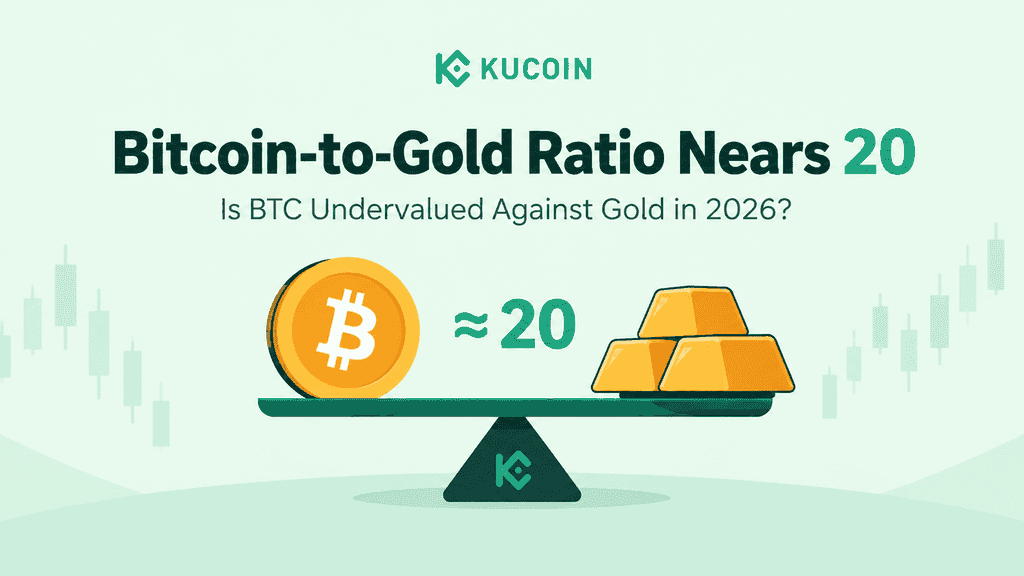
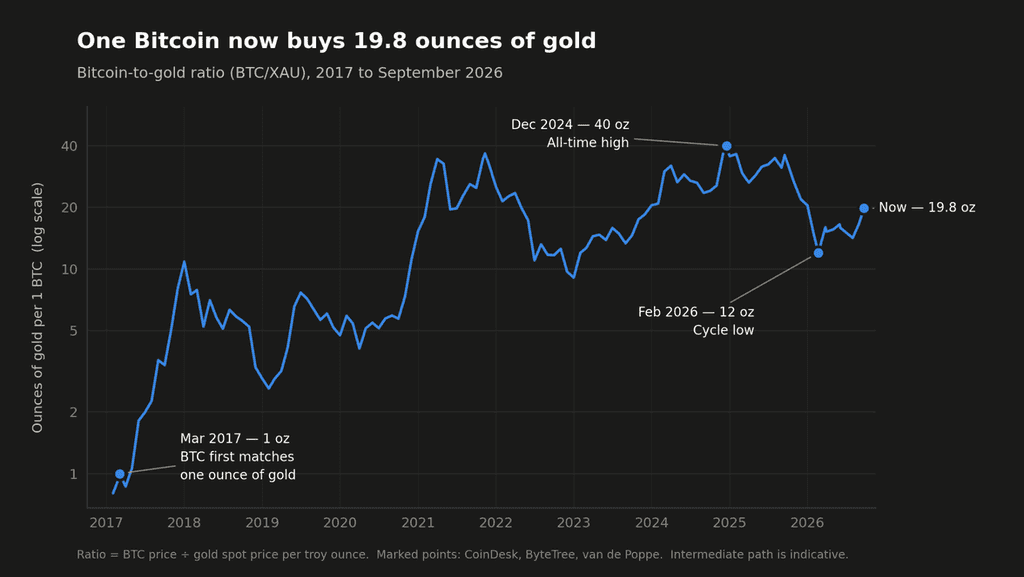
One Bitcoin buys 19.8 ounces of gold today. In February, it bought just 12. At its record high, it bought more than 40.
This simple comparison tells an interesting story about Bitcoin and gold in 2026. Gold surged to a record $5,589 an ounce early in the year but later lost more than a fifth of its value as rate-hike fears grew. Bitcoin also fell sharply, dropping below $60,000 in February. But it has since rebounded, gaining 44% in the third quarter and climbing above $85,000 this week.
Bitcoin's recovery looks strong in dollar terms. But compared with gold, it has barely gained ground this year. The BTC/XAU ratio is still down about 1% and remains below half its record high.
So, is Bitcoin finally catching up with gold, or is its latest rally running out of steam?
This article explores what drives the Bitcoin-to-gold ratio, why it fell from above 40 to 12, and whether Bitcoin can regain ground against gold in Q4 2026.
What Is the Bitcoin-to-Gold Ratio, and Why Does 19.8 Matter?
The Bitcoin-to-gold ratio shows how many ounces of gold one Bitcoin can buy. It is one of the clearest ways to judge whether "digital gold" is gaining or losing ground against the metal it was named after. At 19.8, it sits at a level that deserves a closer look.
How to Calculate the Bitcoin-to-Gold Ratio (BTC/XAU Formula)
The formula is simple: divide Bitcoin's price by the spot price of one troy ounce of gold. Trading platforms often display it as BTC/XAU.
Bitcoin-to-gold ratio = BTC price ÷ gold price per ounce
With Bitcoin near $85,200 and spot gold near $4,308, the math gives roughly 19.8 ounces per coin.
The direction matters more than the number. When the ratio rises, Bitcoin is outperforming gold. When it falls, gold is winning.
Traders like this measure because it takes the US dollar out of the comparison. Many analysts argue that gold is a better yardstick for Bitcoin than fiat money, because both are scarce. Bitcoin is capped at 21 million coins, with fewer than 1 million, under 5%, still left to mine. Gold has no hard cap, but mining adds only about 1.5% to 2% to its supply each year, which is actually faster than Bitcoin's issuance today. The ratio therefore shows which scarce asset the market prefers, without the dollar's own value getting in the way of the comparison.
How Many Ounces of Gold Is One Bitcoin Worth Today?
Right now, one Bitcoin is worth about 19.8 ounces of gold, up from a February low of 12. For perspective, Bitcoin only matched one ounce of gold for the first time in March 2017, at around $1,241. The record came in December 2024, when Bitcoin first broke $106,000 while gold traded near $2,650, pushing the ratio to 40.
That makes today's reading a 65% recovery from the low, yet still under half the peak. There is one more catch: the ratio is down just 1% year to date. Bitcoin's third-quarter rally has repaired the damage against gold rather than built a lead. For Bitcoin to claim it is beating gold in 2026, the ratio needs to push, and hold, above where it started the year.
How Did the Bitcoin-to-Gold Ratio Crash From 40 to 12 Ounces?
Two things happened at once, and the ratio counted both. Gold posted its best year in nearly half a century and kept climbing into January. Bitcoin, at the same time, lost more than half its value. A ratio divides one by the other, so it fell harder than either move on its own.
Why Did Gold Hit a Record $5,589 in January 2026?
Gold arrived in 2026 with serious momentum behind it. The metal rallied about 65% across 2025, its strongest annual gain since 1979, driven by central bank buying, Fed rate cuts, de-dollarization, and safe-haven demand.
The demand data explains the staying power. Total gold demand, including over-the-counter trade, passed 5,000 tonnes for the first time in 2025, reaching 5,002.3 tonnes. Central banks took 863.3 tonnes, ETFs absorbed 801.2 tonnes, and investment demand jumped 84% to 2,175.3 tonnes. The average price for the year was $3,431.50.
Then January compressed months of buying into days. Spot gold cleared $5,000 for the first time on January 26 and set its record of $5,589.38 on January 28. Goldman Sachs had just raised its December 2026 forecast to $5,400, estimating central banks were buying around 60 tonnes a month against a pre-2022 average of 17 tonnes. Gold passed that year-end target within two days of it being published.
Why Did Bitcoin Crash to $60,000 in February 2026?
Bitcoin was moving the opposite way. After peaking near $126,200 on October 6, 2025, it fell to roughly $60,000 by February 6, a 52% decline in four months that erased over $1 trillion in crypto market value.
No single trigger explains it. Institutional money was already leaving: US spot Bitcoin ETFs shed nearly $4.5 billion over the first eight weeks of 2026, including $434 million on February 5 alone, and every redemption forced real selling into the spot market. Derivatives did the rest, with options on BlackRock's IBIT trading at roughly ten times their average volume and leveraged positions closing automatically on the way down. Bitcoin's fundamentals did not deteriorate. Its ownership base had simply become financialized enough to transmit a stock market shock directly.
What followed removed the path back. On February 21, Trump raised global tariffs from 10% to 15%, effective immediately, and equities closed sharply lower. That killed expectations of further Fed rate cuts, the main fuel behind Bitcoin's 2025 run.
The result was a numerator collapsing into a record-high denominator. Analyst Michaël van de Poppe called it "the heaviest in the history of Bitcoin," noting the ratio fell 66% in five months
Bitcoin-to-Gold Ratio History: Key Milestones
|
Date
|
Ratio (oz of gold per BTC)
|
What was happening
|
|
December 2024
|
~40
|
Record high as BTC first cleared $106,000
|
|
September 2025
|
~36
|
Final peak, a month before Bitcoin's own price top
|
|
February 2026
|
~12
|
Cycle low: gold just off its January record, BTC under $60,000
|
|
March 2026
|
~16
|
Gold's longest losing streak in a century
|
|
September 2026
|
19.8
|
BTC up 44% for the quarter
|
Why Is Bitcoin Outperforming Gold Again in Q3 2026?
Because money moved. Bitcoin gained 44% in the third quarter against gold's 8.7%, and the gap opened as institutional flows returned to Bitcoin at the same moment rising rates took the shine off gold.
Both assets rose. Only one of them moved the ratio.
Why Is Gold Falling While Bitcoin Rises?
Gold is falling because the market spent 2026 repricing for a Federal Reserve that would raise rates rather than cut them. Gold pays no yield, so every step toward higher rates raises the cost of holding it.
That repricing has been running all year. Gold posted its worst quarter in 13 years in Q2 on a hawkish Fed stance, and by the time the FOMC voted 12-0 on September 16 to lift rates 25 basis points to a target range of 3.75% to 4.00%, its first increase since 2023, the move was already in the price. Spot gold traded near $4,308 on September 22, down roughly 7% over the month and about 23% below its January record, though prices have held in a narrow range since the Fed's decision.
The demand itself has not gone anywhere. Chinese gold imports passed 1,000 tonnes through August, already more than the whole of 2025, with strong investment demand holding onshore prices at a premium to world benchmarks and drawing more metal in, according to Zijie Wu, an analyst at Jinrui Futures. Gold remains up more than 14% year over year. What changed is not the bid for gold. It is that Bitcoin found a stronger one.
Why Did Bitcoin ETF Inflows Hit $999 Million in One Day?
Bitcoin's rally to an eight-month high pulled institutional money back in, days after news that should have driven it out.
US spot Bitcoin ETFs absorbed $998.95 million on Monday, September 21, their largest daily inflow since the day Bitcoin set its record in October 2025, with BlackRock's IBIT taking the biggest share.
More telling than the size was the level it cleared. Bitcoin reclaimed the average US spot ETF cost basis of $82,225 for the first time since January, putting the typical ETF buyer back above water.
Corporate treasuries followed. Strategy ended a three-week pause with $75.7 million of BTC, and Strive added another $107.7 million.
The timing is what makes it notable. All of it landed within a week of the Senate killing the CLARITY Act and the Fed raising rates.
Is the Bitcoin Rally a Short Squeeze or Real Demand?
Both. The squeeze supplied the spark and the ETF money supplied the fuel, and the difference matters because only one of them leaves someone holding the coins afterwards.
A squeeze forces traders who bet against Bitcoin to buy it back at any price. An ETF inflow is a deliberate allocation someone intends to hold. The first is mechanical and ends when the leverage clears. The second is a decision.
September 21 delivered plenty of the mechanical kind. Roughly $750 million in positions were liquidated over 24 hours across nearly 135,000 traders, with shorts making up 86% of the total and 96% of the most recent hour, a sign the squeeze was accelerating rather than burning out.
What came next is the warning. Traders added more than $2 billion in futures bets after the break above $82,000, pushing open interest past $31 billion in notional value, according to Coinalyze. Nansen's Nicolai Sondergaard and Wintermute's Jasper De Maere both see $90,000 as the next test, but Sondergaard cautions that if spot demand cannot keep pace with rising derivatives leverage, the move can reverse sharply.
Is Bitcoin Undervalued Against Gold? The Bull and Bear Cases
The honest answer depends entirely on which buyer you think sets the price. Valuation models built on gold's market size make Bitcoin look historically cheap, and the ratio is sitting at a level that has preceded big rallies before.
Why Do Analysts Think Bitcoin Is Undervalued Against Gold?
The bull case rests on how extreme today's reading looks against history.
JPMorgan's model, built by Nikolaos Panigirtzoglou's team, values Bitcoin at $266,000 relative to gold. It puts private-sector gold holdings near $8 trillion and asks what Bitcoin's market cap would need to be to carry equivalent store-of-value exposure once adjusted for Bitcoin's higher volatility. In September the bank noted that Bitcoin's volatility against gold had hit record lows, improving its risk-adjusted case. The model carries no timeline.
ByteTree's Charlie Morris makes the chart argument. One BTC first surpassed an ounce of gold in March 2017, then set higher lows at 2.7 ounces in 2019, 3.4 in the 2020 crash, 9.1 after FTX, and 12.4 in February 2026. Every floor has been higher than the one before it.
Michaël van de Poppe adds a statistical one. The ratio hit a two-standard-deviation low in April 2026, a reading seen only three times before: the 2015 Mt. Gox bottom, the March 2020 crash, and FTX. Van de Poppe puts Bitcoin's median return in the twelve months after those at 370%.
Why Do Central Banks Still Choose Gold Over Bitcoin?
The bear case is that the largest and least emotional buyers on earth are still choosing the metal.
Central banks made net purchases of 288.9 tonnes of gold in Q2 2026, up 62% year over year and the strongest second quarter in the World Gold Council's records. They did it in the same quarter gold posted its steepest price decline since 2013. That is conviction buying into weakness, and it is demand Bitcoin is not capturing.
Bitcoin's own flows are thinner than one headline suggests. Even after September's near-billion-dollar day, US spot ETFs remain roughly $450 million in net outflows for the year, and Bitcoin has spent almost all of 2026 underwater.
The deeper problem is behavioural. Bitcoin fell with equities in February and rallied with them in September. An asset that tracks the risk trade is not yet doing the job that would justify taking gold's place.
Bitcoin vs Gold Forecast: What Could Push the Ratio Above 20?
Three things decide it: what the Fed does next, whether the risk-on mood holds, and whether Bitcoin's institutional bid outlasts its leverage.
What Could Move the Bitcoin-to-Gold Ratio in Q4 2026?
The Fed comes first, twice. The FOMC meets on October 27 and 28, then again on December 8 and 9 with a fresh set of projections. With 16 of 18 officials already pencilling in another hike this year, those two decisions will do more to gold than to Bitcoin.
Energy is the second lever. Brent fell for four straight sessions into September 21, its longest losing run in three months, as Washington and Tehran explored talks. Cheaper energy eases the inflation picture keeping the Fed hawkish, which supports risk assets and Bitcoin with them.
Two calendar items complete the list. Trump and Xi meet at the White House on September 24, with trade, AI and export controls on the agenda. And the SEC's Regulation Crypto Assets, proposed on August 18, closes its comment window on October 20. It is the live regulatory path now that the CLARITY Act has stalled, though closing comments begins the review rather than the rules.
How Do You Trade the Bitcoin-to-Gold Ratio?
Most traders express it as a pair rather than a forecast, holding one asset against the other so the dollar drops out of the equation.
Tokenized gold makes that practical on-chain. PAX Gold (PAXG) and Tether Gold (XAUT) are each backed one to one by vaulted bullion and together account for roughly 90% of a category worth about $5 billion to $6 billion. Pairing either against BTC tracks the ratio directly, and both trade around the clock, which physical gold and gold ETFs do not.
The usual caution applies. The ratio is a relative measure, so both assets can fall while it rises. Nothing here is investment advice.
Conclusion
The Bitcoin-to-gold ratio's recovery from 12 to 19.8 ounces shows that Bitcoin has regained ground against gold, but it has yet to reclaim its 2026 starting point or challenge previous highs. Its next move will depend on Federal Reserve policy, institutional demand, and whether the current rally can sustain itself beyond short squeezes and leveraged trading.
For investors comparing Bitcoin with gold, the ratio offers a useful way to evaluate relative performance without relying solely on dollar prices. Whether Bitcoin is undervalued depends on how its future adoption, volatility, and role as a store of value compare with gold's established institutional demand. As Q4 approaches, both assets face shifting macroeconomic conditions that could reshape their relative performance.
🔥 Beyond the Headlines: What KuCoin 5.0 Means for You
Market news moves fast — but where you act on it matters just as much. This October, KuCoin launches KuCoin 5.0, transforming KuCoin into a rebuilt platform. Here's what actually changes for you:
-
One account for everything. Older platforms split your money across separate "spot," "margin," and "futures" accounts and expected you to understand why. KuCoin 5.0's unified account removes that entirely — deposit once, and everything is simply there (only available to VIPs for now).
-
Stocks, indices, and commodities. KuCoin 5.0 expands beyond crypto into global markets. When crypto chops sideways and equities rally (or the reverse), you rotate in minutes instead of opening a brokerage account and waiting days for fiat rails.
-
Real-world assets (RWA). Tokenized exposure to traditional assets like commodities, right inside your crypto account. One of the fastest-growing segments in global finance is no longer reserved for institutions — you access it from the same balance you trade with.
-
Earn while you learn. Not ready to trade? KCUSD lets your stablecoins earn daily, auto-compounding interest. The lowest-stress way to put your idle deposit to work for 4% yield.
-
An AI assistant in plain language. Ask questions, get market context, understand what you're looking at — built into the platform, no jargon required.
-
An app that doesn't overwhelm. Faster, cleaner, and consistent — intuitive from the first tap, not after a tutorial.
-
Safety you can check, not just trust. A MiCAR-licensed EU entity, Proof of Reserves you can verify yourself, and internationally certified security (SOC 2 Type II, ISO 27001:2022).
Create your account in minutes — and start on the platform built for where crypto is going, not where it's been.
FAQs
What is the Bitcoin-to-gold ratio?
The Bitcoin-to-gold ratio measures how many troy ounces of gold one Bitcoin can buy. It is calculated by dividing Bitcoin's price by gold's spot price per ounce.
How many ounces of gold is one Bitcoin worth in 2026?
As of September 22, 2026, one Bitcoin is worth approximately 19.8 ounces of gold, up from its February low of 12 ounces.
Why did the Bitcoin-to-gold ratio fall in 2026?
The ratio fell because Bitcoin declined sharply while gold reached record highs. Bitcoin's drop below $60,000 and gold's January rally pushed the ratio down to approximately 12.
Is Bitcoin undervalued compared with gold?
Some analysts consider Bitcoin undervalued relative to gold based on historical ratios and valuation models. However, gold's institutional demand and Bitcoin's volatility create competing considerations.
Can Bitcoin surpass gold in Q4 2026?
Bitcoin's performance against gold will depend on Federal Reserve policy, institutional ETF demand, market sentiment, and leverage. The article does not establish whether Bitcoin will surpass gold in Q4.
Disclaimer
The information provided on this page may originate from third-party sources and does not necessarily represent the views or opinions of KuCoin. This content is intended solely for general informational purposes and should not be considered financial, investment, or professional advice. KuCoin does not guarantee the accuracy, completeness, or reliability of the information, and is not responsible for any errors, omissions, or outcomes resulting from its use. Investing in digital assets carries inherent risks. Please carefully evaluate your risk tolerance and financial situation before making any investment decisions. For further details, please consult KuCoin’s Terms of Use and Risk Disclosure.