

Babylon Proposes Ending Bitcoin Staking by Year-End: What Happens to 41,600 BTC?
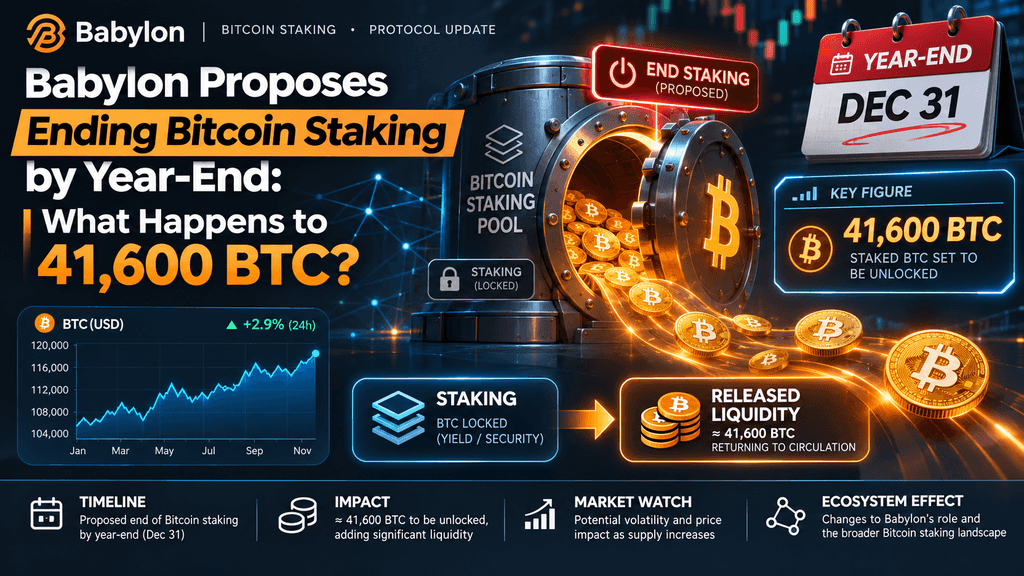
Babylon is considering a major strategic shift in its Bitcoin DeFi business, with co-founder Fisher Yu proposing to end the protocol's Bitcoin Staking service by the end of 2026. The proposal comes as Babylon prepares to expand its Trustless Bitcoin Vaults (TBV), which allow native BTC to serve as collateral in decentralized lending applications. With approximately 41,600 BTC, worth around $2.65 billion, still staked on the platform, the potential transition raises questions about withdrawal activity, market liquidity, and the future of Bitcoin DeFi.
Key Takeaways
-
Babylon co-founder Fisher Yu proposed ending Bitcoin Staking by year-end, but the proposal has not received final approval.
-
Approximately 41,600 BTC remains actively staked, representing around $2.65 billion in value at the November 20 dashboard snapshot.
-
Babylon plans to prioritize Trustless Bitcoin Vaults, enabling native BTC-backed borrowing without conventional wrapping or bridging.
-
Aave has approved the preliminary governance proposal for native BTC collateral, while final deployment approval remains outstanding.
-
The proposed reduction in BABY inflation from 5.5% to 2% could reduce token emissions, although its long-term economic impact depends on adoption and demand.
What Happened? Why Is Babylon Proposing to End Bitcoin Staking?
On November 17, 2026, Babylon co-founder Fisher Yu published a discussion proposal titled "On Sunsetting Bitcoin Staking" on the Babylon Foundation governance forum. He suggested that the community consider ending the protocol's Bitcoin Staking service before the end of the year, allowing the development team to concentrate its resources on Trustless Bitcoin Vaults. The proposal followed Aave's November 9 approval of an initial governance proposal to introduce native Bitcoin as collateral on Aave V4 through Babylon's TBV infrastructure. According to Yu, the new product offers broader financial applications but requires substantially more engineering and security work than the existing staking system.
The proposed sunset would involve three main changes: setting Bitcoin staking and co-staking rewards to zero, disabling the BTC-backed staking finality mechanism, and preventing new staking registrations. Importantly, Yu stated that existing participants should retain the ability to unstake under the protocol's existing rules, including after the sunset. Therefore, the proposal does not call for confiscating deposited Bitcoin or automatically transferring existing positions into the new vault system. Instead, it would gradually end the existing incentive and security arrangements while allowing holders to determine how they use their BTC afterward.
| Proposed Change | Potential Consequence |
| BTC staking rewards reduced to zero | Existing participants stop receiving new staking incentives |
| Co-staking rewards reduced to zero | Additional rewards linked to combined staking positions end |
| Staking finality disabled | BTC-backed finality services for connected networks are discontinued |
| New staking registrations disabled | No additional BTC enters the existing staking program |
| Existing withdrawal rules retained | Current participants can initiate exits under applicable protocol conditions |
The distinction between a proposal and an approved protocol change is important. As of November 20, the discussion remained at the community consideration stage, without a completed Babylon governance vote or confirmed execution block. The proposed December 31 deadline is therefore a target rather than an established shutdown date. The outcome will depend on subsequent governance decisions and the technical arrangements required to transition existing participants.
What Happens to the 41,600 BTC Currently Staked on Babylon?
The amount of Bitcoin involved is the main reason this proposal has attracted market attention. Babylon's official staking dashboard showed approximately 41,590 BTC in total value locked on November 20, equivalent to roughly $2.65 billion at the displayed market valuation. The platform also reported 18 active Finality Providers out of 133 registered providers, while its displayed BTC staking APR ranged from approximately 0.03% to 0.51%. These figures represent a substantial amount of Bitcoin participating in an alternative financial use case rather than remaining in conventional long-term holdings.
| Babylon Staking Indicator | November 20, 2026 Snapshot |
| Active BTC staking | 41,590.21 BTC |
| Estimated dollar value | $2.65 billion |
| Active Finality Providers | 18 |
| Total registered Finality Providers | 133 |
| Displayed BTC staking APR range | 0.03%–0.51% |
These current figures should be distinguished from Babylon's historical adoption metrics. In its October 14 Aave proposal, the project reported that more than 100,000 BTC had been activated cumulatively since the protocol launched in August 2024, with peak total value locked reaching approximately 72,000 BTC. Cumulative activated Bitcoin represents historical participation rather than the amount currently locked. The 41,600 BTC figure is therefore the more relevant measure when assessing potential withdrawal activity.
Will All 41,600 BTC Be Released at Once?
No. Ending the staking service would not automatically make every deposited Bitcoin immediately available for withdrawal. Each position remains subject to its existing staking transaction, time-lock, and unbonding procedures. Babylon's current CLI documentation specifies a minimum unbonding timelock of 301 Bitcoin blocks after the unbonding transaction is processed. Separately, its staking FAQ describes a 64,000-block staking period, equivalent to approximately 15 months. These parameters relate to different stages of the staking lifecycle, and individual users must follow the applicable withdrawal procedure for their positions.
The process also involves more than simply clicking an unstake button. The protocol's unbonding procedure requires communication between the Babylon chain, covenant emulators, and the Bitcoin blockchain. Depending on the position and service provider, users may face additional operational requirements. For customers accessing Babylon through exchanges or custodial platforms, withdrawal instructions and processing times may also differ from those of direct protocol participants. Consequently, any eventual exit would likely occur over time rather than through one simultaneous release of the entire BTC balance.
This distinction matters for Bitcoin market analysis. The release of staked BTC increases the amount of capital that could potentially become available for other uses, but it does not mean holders will sell their assets. Some may transfer Bitcoin to personal cold wallets, while others could redeploy it into alternative staking products, lending markets, or the proposed TBV ecosystem. Actual exchange inflows and changes in active staking balances will provide more meaningful evidence of selling pressure than the headline figure alone.
Why Is Babylon Shifting From Bitcoin Staking to Trustless Bitcoin Vaults?
Babylon's strategic change reflects a broader evolution in Bitcoin DeFi, commonly known as BTCFi. Bitcoin Staking and Trustless Bitcoin Vaults serve different financial purposes, even though both are designed to make native BTC more productive without requiring conventional custodial transfers. The original staking protocol allows Bitcoin holders to lock BTC on the Bitcoin network and delegate economic security to Finality Providers supporting Babylon Genesis and connected Bitcoin Supercharged Networks. Participants receive BABY-denominated rewards for contributing to this security model. Bitcoin itself remains a proof-of-work network; Babylon uses BTC as an economic security asset for external systems rather than changing Bitcoin's underlying consensus mechanism.
Trustless Bitcoin Vaults pursue a different objective: enabling Bitcoin holders to use native BTC as collateral in decentralized financial applications. Under the proposed system, users lock their Bitcoin in a Taproot output with predefined spending conditions. Cryptographic proofs connect events on an external blockchain, such as Ethereum, with the rules governing the release of the underlying BTC. A valid redemption can proceed only under the conditions encoded in the vault, while challenge mechanisms allow invalid claims to be disputed. The system is designed to reduce dependence on centralized custodians, conventional wrapped assets, and trusted bridge operators.
| Feature | Bitcoin Staking | Trustless Bitcoin Vaults |
| Primary purpose | Provide economic security to external networks | Enable BTC-backed financial applications |
| Asset arrangement | BTC locked through Bitcoin staking scripts | BTC locked in self-custodial Taproot vaults |
| Main application | Staking and finality services | Lending, borrowing, and other DeFi products |
| Economic mechanism | BABY-denominated staking rewards | Borrowing and application-specific financial activity |
| Main risks | Protocol, slashing, and staking risks | Cryptographic, application, liquidity, and liquidation risks |
The broader opportunity is improving Bitcoin's capital utilization. A substantial portion of BTC remains outside decentralized lending and financial markets because holders may be reluctant to use wrapped tokens or rely on third-party custodians. TBV aims to address this limitation by allowing Bitcoin to remain on its native blockchain while its collateral value is recognized by compatible financial applications. However, this is not a risk-free arrangement: users still depend on cryptographic implementation, participating operators, external blockchain applications, and the security of the protocols handling their positions.
How Could the Aave Integration Change Bitcoin DeFi?
The proposed integration with Aave V4 is central to Babylon's decision to prioritize TBV. On November 9, 2026, Aave DAO approved the relevant ARFC governance stage with 100% of votes in favor, according to Babylon. The proposal would allow users to lock native BTC in Babylon vaults and borrow supported assets, including USDC and USDT, through Aave's lending infrastructure. However, the ARFC approval is not the final onchain deployment approval. The integration still requires the subsequent Aave Improvement Proposal (AIP) stage and completion of deployment preparations before becoming available on Ethereum mainnet.
The intended borrowing process connects Bitcoin's native collateral system with Aave's Ethereum-based lending markets. First, a user deposits BTC into a self-custodial Taproot vault through Babylon. The vault's collateral information is then registered through the Aave adapter, allowing the lending market to recognize the locked Bitcoin. The user can borrow supported assets from Aave's liquidity infrastructure against that collateral and later repay the debt to withdraw the underlying BTC. The system is designed to preserve the user's title to native Bitcoin without requiring the asset to become freely transferable WBTC or another conventional wrapped token.
An important technical distinction is that Aave V4 uses ERC-20 collateral accounting, while the underlying BTC remains locked on Bitcoin. Babylon therefore introduces a transfer-restricted internal collateral record that represents the BTC amount for Aave's accounting system. This record is not a user-facing wrapped Bitcoin token and cannot be freely traded or transferred to arbitrary addresses. The distinction matters because the integration aims to connect native Bitcoin with Ethereum lending without introducing a conventional liquid wrapped asset as the user's collateral.
What Are the Proposed Collateral and Lending Parameters?
The LlamaRisk assessment published through Aave governance lists a proposed 78% collateral factor for native BTC in the Babylon Core Lending Spoke. This means the market's initial risk configuration would allow borrowing against a portion of collateral value rather than treating the entire BTC balance as available credit. Actual borrowing capacity would also depend on supported assets, liquidity, credit lines, and the user's position health factor.
The initial configuration is deliberately limited. The November 19 risk assessment lists a 20 BTC collateral add cap and restricted borrowing credit lines, including $500,000 allocations for USDC and USDT from the Core Hub, alongside smaller allocations for other supported assets. These are launch-stage risk controls, not evidence that the entire 41,600 BTC currently staked on Babylon can immediately migrate into Aave. The available borrowing capacity would need to expand through subsequent risk reviews and governance decisions as the integration develops.
Liquidation also requires special infrastructure because native Bitcoin cannot settle as quickly as an ordinary Ethereum-based ERC-20 collateral position. Aave's design uses the BTC Vault Swap Spoke to provide liquidators with wrapped BTC liquidity while arbitrageurs handle the subsequent redemption of the underlying Bitcoin. This separates the immediate settlement required by Aave from the multi-day process involved in claiming BTC through the vault's cryptographic challenge mechanism. It also introduces dependencies on WBTC liquidity, arbitrage participation, and the operational reliability of the liquidation system.
What Does the Proposed BABY Inflation Reduction Mean?
The proposed shutdown also has important implications for Babylon's token economics. Fisher Yu stated that ending Bitcoin Staking would allow the protocol to reduce BABY's annual inflation rate from 5.5% to 2%. This represents a reduction of 3.5 percentage points, or approximately 63.6% relative to the existing annual rate. The current 5.5% inflation rate is documented in Babylon's tokenomics materials, while the 2% figure remains a proposed adjustment linked to the staking sunset.
The reasoning is connected to the existing reward structure. Babylon uses BABY emissions to incentivize participation across its staking and network security ecosystem. If Bitcoin staking and co-staking rewards are discontinued, the protocol could reduce the amount of newly issued tokens allocated to those activities. This would lower the pace of additional BABY supply, although the final distribution of the remaining emissions and any revised incentive arrangements would need to be clarified through the appropriate governance process. A reduction in inflation is not equivalent to a token burn, and it does not automatically create additional market demand.
The Aave integration also introduces a potential source of protocol-level revenue. Under the proposed revenue-sharing framework, qualifying fees would be distributed between Aave DAO and Babylon Foundation, with a portion allocated to open-market purchases of AAVE and BABY. Importantly, this allocation applies to specified protocol fees rather than all interest paid by borrowers. The proposal also directs 85% of the token-purchase allocation toward AAVE and 15% toward BABY. These purchases depend on the integration generating qualifying revenue and do not guarantee a particular level of demand or token-price appreciation.
What Could the Strategic Shift Mean for BTC, BABY, and the BTCFi Market?
For Bitcoin, the immediate concern is the possibility that a significant amount of previously staked BTC could become available for withdrawal. If a meaningful share of holders decides to sell, the resulting exchange inflows could increase short-term supply, particularly during periods of weak market liquidity. However, the opposite outcome is also possible: holders may retain their BTC, move it into self-custody, or redeploy it into other financial applications. The net market effect will therefore depend on actual withdrawal behavior rather than the nominal value of the staking balance.
For BABY, lower token emissions could reduce ongoing supply pressure, but the loss of BTC staking incentives also changes the reasons users participate in the ecosystem. If TBV generates substantial borrowing activity and recurring protocol revenue, Babylon may develop a different economic model based on financial utility rather than staking rewards. If adoption remains limited, however, reduced emissions alone may not compensate for weaker incentive demand. Investors should therefore evaluate token supply changes alongside active vaults, borrowing volume, fee generation, and the pace of new application integrations.
For the wider BTCFi market, Babylon's transition could signal a shift toward using Bitcoin as collateral rather than primarily as a source of shared network security. Native BTC lending could expand access to stablecoin liquidity without requiring holders to sell their Bitcoin or depend on conventional wrapped assets. Nevertheless, the opportunity depends on whether the new infrastructure can demonstrate reliable redemption, sufficient liquidity, and secure liquidation processes. A successful launch could encourage additional financial applications to integrate native BTC, while technical or liquidity problems could slow adoption across the sector.
What Risks Could Undermine Babylon's Transition?
The first challenge is technical security. TBV involves Taproot vaults, pre-signed transaction paths, zero-knowledge proofs, challenge mechanisms, and several operator roles. Although these components are designed to reduce reliance on centralized custody, they introduce a more sophisticated system than a conventional staking product. LlamaRisk's public assessment reported that initial audit findings included high- and critical-severity issues that were subsequently reported as resolved, with further review rounds conducted. It also recommended independent proof-of-reserves verification for BTC held in the vaults. This demonstrates why security validation and transparent reporting remain important before large-scale deployment.
The second challenge is liquidation and liquidity management. Borrowers using BTC as collateral remain exposed to market volatility. If Bitcoin prices decline substantially, the value of collateral may fall below the required level, triggering liquidation under Aave's risk rules. Because BTC vaults settle through Bitcoin transactions and challenge periods rather than instant ERC-20 transfers, the liquidation process relies on additional infrastructure and available WBTC liquidity. Arbitrageurs must also remain willing and able to acquire liquidated vaults and complete the redemption process. A shortage of liquidity or a disruption involving these participants could affect settlement efficiency.
Governance and adoption introduce further uncertainty. The Bitcoin Staking sunset has not yet received final approval, while the Aave integration still requires its final deployment stage. Existing stakers may also respond differently depending on their original lock conditions, staking providers, and alternative financial options. Some may choose not to use TBV at all. Consequently, Babylon must demonstrate that its new lending infrastructure offers sufficient utility and a credible security model before it can replace the participation and network-security role previously supported by Bitcoin Staking.
What Should Investors Watch Next?
Several developments will help determine whether Babylon's transition moves from a governance discussion into an operational change. The first is the publication of a formal sunset proposal, including its voting schedule, reward-distribution changes, and implementation details. Changes in the official staking dashboard will also reveal whether participants begin withdrawing their BTC before the end of the year. Investors should monitor active BTC balances, unbonding transactions, provider-level activity, and exchange inflows rather than assume that all 41,600 BTC will enter the open market.
The second major milestone is TBV's progression toward mainnet deployment and the final Aave governance approval. Babylon has indicated that a restricted mainnet launch is targeted for late November 2026, followed by a gradual expansion toward permissionless participation in early 2027. Actual vault deposits, borrowing demand, supported assets, collateral limits, and completed security reviews will provide stronger evidence of adoption than announcements alone. For BABY, the final inflation parameters and realized protocol revenue will help determine whether the proposed economic transition creates a sustainable replacement for the existing staking incentive model.
Conclusion
Babylon's proposed Bitcoin Staking sunset represents a significant change in its approach to BTCFi. Rather than relying primarily on BTC-backed network security and staking incentives, the project aims to develop native Bitcoin collateral infrastructure through Trustless Bitcoin Vaults and Aave V4. Although approximately 41,600 BTC is currently involved, its withdrawal will not automatically translate into market selling pressure. The longer-term outcome will depend on governance approval, TBV security, lending demand, and BABY's revised token economics. Ultimately, Babylon's transition will test whether native Bitcoin lending can become a sustainable alternative to traditional BTC staking.
FAQs
Has Babylon Officially Ended Bitcoin Staking?
No. As of November 20, 2026, co-founder Fisher Yu's proposal remains a community discussion. A formal governance decision and implementation details are still required.
Will All 41,600 BTC Be Unlocked at Once?
No. Existing positions remain subject to their applicable unbonding procedures and Bitcoin time-lock conditions. The proposal also states that existing participants should retain withdrawal rights after the sunset.
What Is Babylon Trustless Bitcoin Vaults?
TBV is a protocol that allows users to lock native Bitcoin in Taproot-based vaults and use it as collateral in supported DeFi applications without conventional wrapping or bridging.
How Does the Aave Integration Work?
The planned integration allows users to deposit native BTC into Babylon vaults and borrow supported assets through Aave V4. The BTC remains locked on Bitcoin, while Aave uses an internal collateral record to recognize its value.
Will BABY Inflation Definitely Fall to 2%?
Not yet. The reduction from 5.5% to 2% is part of the proposed strategic adjustment. Its implementation depends on the relevant governance and tokenomics decisions.
Disclaimer: This general market information, possibly from third-party, commercial, or sponsored sources, is provided for reference and educational purposes only and does not constitute financial or investment advice, an offer, solicitation, or guarantee. We disclaim liability for its accuracy, completeness, reliability, and any resulting losses. Investments/trading are risky; past performance doesn’t guarantee future results. Users should research, judge prudently, and take full responsibility. For further details, please consult KuCoin’s Terms of Use and Risk Disclosure.