

Apollo Economist: Magnificent Seven Profit Margins Rise as the Rest of the S&P 500 Stagnates in 2026
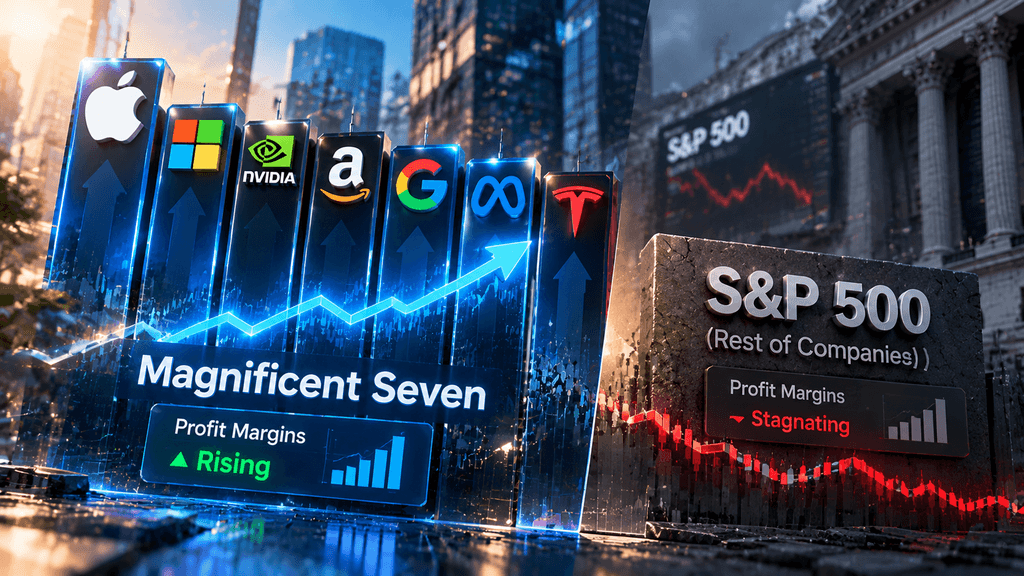
Artificial intelligence has become one of the biggest investment themes of 2026, attracting hundreds of billions of dollars in spending on chips, data centers, cloud computing, and AI models. Yet a growing question is emerging across financial markets: Are these investments generating measurable economic returns beyond the companies supplying the technology? Apollo Global Management chief economist Torsten Slok raised this issue in an October 24 research note, arguing that revenue per worker and profit margins have improved among the Magnificent Seven while remaining largely flat across the other 493 companies in the S&P 500. He also found no clear evidence of an AI-driven acceleration in productivity growth.
The implications extend beyond traditional equities. If AI infrastructure spending continues to rise faster than the financial benefits received by enterprise customers, investors may reassess technology valuations, corporate earnings expectations, and demand for AI services. The same question matters to cryptocurrency markets, where AI-related tokens, decentralized computing networks, and blockchain-based AI projects increasingly compete for investor attention. The central issue is not whether AI technology is advancing, but whether its commercial value can spread beyond a relatively small group of dominant technology companies.
Key Takeaways
-
AI profits remain concentrated: Apollo's October 2026 analysis shows rising revenue per worker and profit margins among the Magnificent Seven, while comparable measures remain broadly flat across the S&P 493.
-
Enterprise AI adoption faces a financial test: Model subscriptions, token consumption, integration expenses, and human oversight can offset efficiency gains when businesses cannot translate AI capabilities into measurable financial results.
-
Infrastructure spending creates both opportunity and risk: Major technology companies continue investing heavily in computing capacity, but the sustainability of those investments depends on customer demand and future cash generation.
-
Stock-market performance may conceal economic differences: The market capitalization of large technology companies can support headline index performance even when earnings growth remains uneven across sectors.
-
Crypto-related AI projects face a similar challenge: Investor interest in AI infrastructure and digital assets does not guarantee sustainable demand for blockchain-based services or the tokens associated with them.
What Apollo's S&P 493 Analysis Reveals About AI's Financial Returns
Apollo's October 24 research note, published by Torsten Slok, argues that the financial benefits of AI remain concentrated in large technology companies rather than spreading broadly across corporate America. The analysis separates Alphabet, Amazon, Apple, Meta, Microsoft, Nvidia, and Tesla from the S&P 500, referring to the remaining companies as the S&P 493. According to Slok, revenue per worker and profit margins have increased for the Magnificent Seven but have remained largely flat for the rest of the index. His analysis also identifies no clear acceleration in productivity growth attributable to AI.
The distinction matters because the Magnificent Seven occupy several different positions in the AI value chain. Nvidia supplies computing hardware, Microsoft and Alphabet operate cloud and software ecosystems, Amazon combines cloud infrastructure with commerce, and Meta and Apple benefit from large consumer platforms. Tesla has a different business mix, but remains part of the same market grouping. These companies can monetize AI through chips, cloud services, advertising, subscriptions, software, and other established revenue channels. By comparison, many companies outside this group purchase AI capabilities and must demonstrate that the resulting efficiencies exceed their costs.
Revenue per Worker and Profit Margins Show a Growing Divide
Apollo's analysis highlights the difference between financial performance and technological adoption. A company can introduce AI tools, automate selected tasks, or increase employee access to advanced models without producing an immediate improvement in overall profitability. The benefits may appear as faster service, fewer errors, improved customer retention, or lower unit costs, but these gains can be offset by implementation expenses, wage growth, energy costs, and additional software spending. Revenue per worker and profit margins provide useful aggregate measures, although neither captures every potential benefit of AI adoption.
| Indicator | Magnificent Seven | S&P 493 |
| Revenue per worker | Rising in Apollo's analysis | Broadly flat |
| Profit margins | Rising toward approximately 30% in reported comparisons | Broadly flat near approximately 10% |
| AI-related productivity gains | Stronger financial performance, although causation is not established by the comparison alone | No clear aggregate acceleration identified by Apollo |
| Position in the AI economy | Includes major AI infrastructure and platform suppliers | Includes a broad range of AI customers and other businesses |
The figures are approximate values reported in coverage of Apollo's analysis, not identical measurements for every company. They describe group-level differences and do not establish that AI alone caused the gap.
The findings should not be interpreted as proof that every company outside technology has failed to benefit from AI. Aggregate margins can conceal individual successes, and productivity improvements may take time to appear in financial statements. Nevertheless, Apollo's analysis raises a material question for investors: if AI is expected to transform the wider economy, when should that transformation become visible in the financial performance of the companies adopting it?
Why AI Spending Has Not Yet Translated Into Broader Corporate Profits
The gap between AI investment and measurable financial returns reflects the complexity of integrating new technology into existing businesses. Purchasing access to an advanced model is relatively straightforward; redesigning a company's workflows, data infrastructure, responsibilities, and decision-making processes is much harder. AI may reduce the time needed to complete a task without eliminating the surrounding work required to validate its output, maintain compliance, or communicate the result to customers. As a result, improvements at the individual-task level do not necessarily translate into higher company-wide margins.
Token Costs Are Becoming an Important Enterprise Expense
Many AI services charge according to model usage, including the number of input and output tokens processed. As employees and automated agents perform more tasks through AI systems, consumption can increase substantially. For companies running large-scale operations, the total cost may include model access, cloud infrastructure, data preparation, security controls, software integration, and human review. A more capable model may improve accuracy on complex tasks, but its additional expense is difficult to justify when a cheaper model can produce sufficiently good results.
Slok argues that mainstream businesses are becoming more cautious about paying for the newest models because the financial benefits have not consistently appeared in their bottom lines. Meanwhile, venture-backed companies continue spending heavily on AI capabilities, creating a difference between firms pursuing rapid technological expansion and established businesses demanding clear economic returns. This distinction is especially relevant as AI providers seek to convert growing usage into recurring revenue while maintaining attractive unit economics.
Business Judgment Limits What Automation Can Achieve
AI can summarize information, generate code, analyze documents, and assist with calculations. However, many business decisions depend on context, accountability, customer trust, organizational culture, and ethical considerations. A financial institution may use AI to review applications, for example, but still require controls for compliance, fairness, and decisions affecting customers. A healthcare provider may automate documentation while retaining human responsibility for clinical judgments. In both cases, the technology can improve selected tasks without removing the wider operational costs associated with delivering the service.
This helps explain why adoption rates alone are insufficient measures of commercial success. Businesses must determine whether AI improves measurable outcomes such as conversion rates, processing time, customer retention, or cost per transaction. If those improvements fail to exceed implementation and operating expenses, additional AI usage may increase spending without improving profitability. Apollo's argument is therefore less about the absence of technological progress than about the difficulty of translating that progress into broad, measurable financial gains.
Productivity Gains May Take Time to Appear
There is also a timing problem. Companies often incur expenses before realizing the full benefits of a new technology. Employees require training, internal systems need modification, and managers must determine which tasks should be automated and which require human review. During this transition, productivity gains may remain limited or may be offset by the cost of reorganizing work.
Goldman Sachs chief economist Jan Hatzius offers a more optimistic interpretation of AI's long-term economic potential, arguing that investment could eventually support higher productivity and broader corporate profits. However, Goldman also sees the growth contribution from the current AI investment cycle potentially peaking in late 2026 or early 2027. The difference between the two economists is not simply whether AI is useful, but how quickly and broadly its benefits will appear.
For investors, the appropriate test is whether future financial results validate the spending already taking place. Delayed returns remain possible, but companies still need to demonstrate that their AI programs create durable value rather than relying on the expectation that value will eventually emerge.
3. The $650 Billion AI Infrastructure Boom Creates a Financial Test
The scale of AI infrastructure spending makes the question of investment returns increasingly important. Reporting published by The Indian Express on October 28 cited estimates that major technology companies plan to spend approximately $650 billion on AI infrastructure in 2026. The same report cited Gartner's warning that more than $3.5 trillion in AI infrastructure investment could face impairment risk by 2030 if AI-generated revenue fails to justify the spending. These are forward-looking estimates and conditional risk assessments, not confirmed losses.
The infrastructure boom supports several layers of the technology economy, including semiconductor manufacturers, cloud providers, data-center operators, networking suppliers, and electricity infrastructure. These companies can generate revenue as equipment is delivered, computing capacity is leased, or cloud services are consumed. Enterprise customers, however, must recover their AI-related expenses through future productivity improvements, increased sales, or other economic benefits. This creates a timing difference: infrastructure suppliers can record revenue before the companies purchasing their services have demonstrated a positive return on investment.
Capital Expenditure, Depreciation, and Cash Flow Matter
A Reuters Breakingviews analysis published on October 23 examined how AI infrastructure investment affects corporate earnings and financial risk. It noted that equipment suppliers can recognize revenue when products are sold, while buyers generally recognize capital expenditure over time through depreciation. For data centers that are still being constructed, depreciation may not begin until the facilities become operational. This accounting timing can make the near-term financial benefits of the investment cycle appear stronger than the ultimate economic returns.
The same analysis highlighted rising debt issuance and equipment-related commitments among major technology companies. These obligations do not automatically indicate financial distress, particularly for firms with established revenue streams and strong balance sheets. However, they increase the importance of future utilization rates, pricing power, and customer demand. If computing capacity expands faster than customers' willingness to pay, providers may face pressure on margins and cash flow even while the underlying technology continues to improve.
What Happens if AI Demand Does Not Match Infrastructure Supply?
The principal risk is not simply that AI adoption slows, but that the financial assumptions supporting infrastructure expansion prove too optimistic. Data centers require large upfront investments, long-term power arrangements, hardware purchases, and ongoing maintenance. If utilization falls short of expectations or model prices decline faster than operating costs, some investments may generate lower returns than originally forecast. Smaller infrastructure operators with limited cash reserves may be more exposed to financing conditions than established technology platforms.
For the market, the key indicators are therefore not spending totals alone. Investors should monitor capital expenditure relative to revenue, free cash flow, debt commitments, depreciation expenses, and evidence of recurring customer demand. Continued spending can support near-term supplier revenues, but sustainable long-term growth requires customers to derive enough economic value from AI services to justify recurring expenditure.
What the AI Profitability Divide Means for the S&P 500 and Technology Stocks
The Magnificent Seven's strong performance can influence the broader stock market because the S&P 500 is weighted by market capitalization. When the largest constituents rise, they can support the headline index even if many smaller companies experience weaker earnings growth or limited margin expansion. This makes index-level performance an incomplete measure of how widely economic benefits are spreading across the corporate sector.
Apollo's findings suggest that investors should distinguish between the performance of AI suppliers and the financial outcomes of companies adopting AI. A semiconductor company can benefit from increased infrastructure spending, while a retailer using AI for inventory forecasting may need several reporting periods to demonstrate measurable savings. Both companies may be connected to the same technological trend, but their revenue models, cost structures, and exposure to AI demand are fundamentally different.
AI Valuations Depend on Future Earnings
The investment case for AI-related equities depends partly on expectations that current spending will support future earnings growth. If demand for computing services continues to expand and providers maintain pricing power, infrastructure investment may generate attractive returns. If customers reduce usage, shift to cheaper models, or delay projects, earnings expectations could weaken even if AI adoption continues to grow.
Reuters' October analysis also emphasized that AI-linked investment has contributed disproportionately to corporate earnings growth, while raising questions about financing costs and future cash generation. This does not establish that AI stocks are necessarily overvalued. Instead, it highlights why investors need to compare valuations with sustainable earnings and cash flow rather than relying exclusively on projected growth.
Market Breadth Could Become a More Important Signal
Investors can also examine whether earnings growth is spreading beyond the largest technology companies. The performance of equal-weighted versus capitalization-weighted indexes, the number of companies reporting margin expansion, and earnings revisions across sectors can help reveal whether market strength is broadening. If AI-driven productivity gains begin to appear in industries such as healthcare, finance, manufacturing, and consumer services, the evidence would support a wider economic payoff.
Conversely, if AI-related revenue and profits remain concentrated among infrastructure suppliers while enterprise customers continue to absorb rising costs, the market may become more sensitive to capital expenditure guidance and spending efficiency. In that environment, even companies with strong AI exposure could experience greater differences in performance as investors distinguish between businesses selling AI capacity and those generating sustainable returns from using it.
What Apollo's AI Warning Means for Cryptocurrency and Blockchain Projects
For cryptocurrency markets, the same debate raises questions about AI tokens, decentralized computing, and blockchain-based AI services. Projects that connect computing providers with AI developers, coordinate decentralized infrastructure, or use tokens to reward network participants may benefit from demand for AI resources. Yet the broader lesson from Apollo's analysis is that technological adoption and financial value creation are separate questions. Rising interest in AI does not automatically create sustainable demand for every project associated with the theme.
AI Tokens Need Real Utility and Measurable Demand
A token associated with an AI project may be used to pay for computing, reward service providers, coordinate network participation, or access particular platform features. The important question is whether users need the token to obtain a valuable service and whether that demand persists beyond speculative trading. A project can report increasing wallet activity or community engagement without generating enough paid usage to support its operating costs.
Investors should therefore distinguish between a project's technological capabilities, actual customer adoption, and the economic role of its token. Useful indicators may include paid compute demand, recurring customers, network utilization, service revenue, token emissions, and the relationship between token supply and real network activity. These measures can help establish whether an AI-related crypto project is developing a viable service or mainly benefiting from broader market enthusiasm.
Decentralized Computing Faces Its Own Cost and Utilization Challenges
Decentralized GPU networks and other distributed computing projects seek to connect users who need computing resources with providers that have available hardware. Their potential advantages may include flexible access, alternative supply channels, and new ways to coordinate infrastructure. However, these networks still face practical questions involving hardware quality, uptime, latency, data privacy, verification, and pricing.
A decentralized network must offer a compelling reason for customers to use it rather than a conventional cloud provider. If it cannot deliver predictable performance at a competitive total cost, demand may remain limited even when AI computing requirements increase. In addition, token incentives can attract providers before sufficient customer demand exists, creating a mismatch between available capacity and paid workloads. Apollo's broader warning about the gap between AI investment and commercial returns is relevant here, although its S&P 493 analysis does not directly measure decentralized AI networks.
Stablecoins and Blockchain Payments Could Support AI Commerce
Stablecoins and blockchain-based payment systems may play a role in automated digital services, including payments between software agents, international settlement, and machine-to-machine transactions. However, expanding AI activity does not automatically increase stablecoin usage, transaction fees, or demand for native blockchain tokens. The economic outcome depends on whether businesses adopt these systems, whether payments are settled on-chain, and whether the resulting activity creates sustainable revenue for the network.
For cryptocurrency investors, the practical lesson is to evaluate AI-related projects using evidence of customer demand, transaction economics, and token utility rather than thematic exposure alone. The AI sector may continue expanding while individual projects struggle to establish sustainable business models. In the same way that the Magnificent Seven's financial performance does not prove every AI investment is profitable, growth in the broader AI economy does not guarantee that every AI-linked crypto asset will benefit.
What Investors Should Watch Next
The next phase of the AI investment debate will depend on whether companies begin to demonstrate measurable financial returns. Quarterly earnings reports, management guidance, and capital expenditure announcements will provide important evidence. Investors should look for companies that explain how AI affects operating expenses, customer acquisition, output per employee, service quality, and revenue growth. General claims about AI adoption are less informative than measurable results linked to specific business processes.
| Indicator | What to monitor | Why it matters |
| Profit margins and revenue per worker | Whether improvements spread beyond the Magnificent Seven | Tests whether AI benefits are broadening |
| AI capital expenditure | Spending growth relative to revenue and cash flow | Helps assess the sustainability of infrastructure expansion |
| Enterprise model spending | Customer retention, usage, and willingness to pay | Indicates whether AI services deliver sufficient value |
| Depreciation and financing costs | Rising expenses as infrastructure becomes operational | Reveals delayed costs of the investment boom |
| AI-related crypto activity | Paid usage, network utilization, token emissions, and recurring demand | Helps distinguish practical utility from speculative interest |
A particularly important signal would be a sustained improvement in profitability across companies outside the largest technology platforms. Such a development would strengthen the argument that AI is generating economy-wide economic benefits rather than primarily supporting infrastructure suppliers and established platforms. On the other hand, continued spending growth without corresponding improvements in enterprise financial performance could lead investors to scrutinize investment budgets more closely.
Investors should also compare different economic interpretations rather than treating Apollo's assessment as a definitive forecast. Slok emphasizes the lack of visible financial returns outside technology, while Goldman Sachs' Jan Hatzius remains more optimistic about the longer-term productivity potential of AI. The eventual outcome will depend on adoption, implementation quality, pricing, financing conditions, and the ability of businesses to convert technical capabilities into profitable products and services.
Conclusion
Apollo economist Torsten Slok's October 2026 analysis highlights a growing divide between the companies supplying AI technology and the wider corporate sector expected to benefit from it. The Magnificent Seven continue to show stronger revenue per worker and profit margins, while the S&P 493 has yet to demonstrate comparable aggregate improvement. Meanwhile, substantial infrastructure spending is increasing the importance of customer demand, cash flow, and sustainable returns.
For equity and cryptocurrency investors alike, the central question is whether AI's growing technical capabilities can translate into recurring economic value. The next stage of the investment cycle will be judged less by spending announcements and adoption claims than by measurable improvements in productivity, profitability, and customer willingness to pay. AI may ultimately deliver broad economic benefits, but investors will need evidence that those benefits extend beyond a relatively small group of leading technology companies.
FAQs
What does the term S&P 493 mean?
The S&P 493 refers to the 493 companies remaining in the S&P 500 after excluding the Magnificent Seven: Alphabet, Amazon, Apple, Meta, Microsoft, Nvidia, and Tesla. Analysts use the grouping to compare the performance of the largest technology-related companies with that of the broader index.
Does revenue per employee measure productivity directly?
No. Revenue per employee measures the amount of revenue generated for each employee, but it can be influenced by pricing, acquisitions, outsourcing, business mix, and changes in staffing. Productivity measures generally examine output relative to inputs and require additional context to determine whether operational efficiency has improved.
Why might AI adoption increase while corporate margins remain unchanged?
AI-related costs may rise alongside adoption, including model fees, infrastructure, training, integration, and human review. Efficiency improvements may also be passed to customers through lower prices or offset by costs elsewhere in the business. As a result, greater AI usage does not necessarily produce immediate margin expansion.
Could smaller AI models benefit businesses more than the most advanced models?
Yes, depending on the task. Smaller or less expensive models may provide sufficient accuracy for routine classification, document extraction, customer support, or other narrowly defined workflows. The appropriate model depends on the task's complexity, reliability requirements, latency, and total cost rather than model capability alone.
How can investors distinguish an AI-related business from an AI-driven business?
An AI-related business may sell products or services connected to AI, while an AI-driven business can demonstrate that AI materially improves its operating model or revenue generation. Evidence may include lower costs per transaction, higher output per employee, improved customer retention, recurring AI revenue, or measurable productivity gains.
Does AI infrastructure spending guarantee continued demand for GPUs?
No. Demand depends on the economics of AI services, model efficiency, utilization rates, customer budgets, and the availability of alternative computing capacity. More efficient models may reduce the computing required for certain tasks even as total AI usage expands, making long-term hardware demand dependent on several competing factors.
Disclaimer: This general market information, possibly from third-party, commercial, or sponsored sources, is provided for reference and educational purposes only and does not constitute financial or investment advice, an offer, solicitation, or guarantee. We disclaim liability for its accuracy, completeness, reliability, and any resulting losses. Investments/trading are risky; past performance doesn’t guarantee future results. Users should research, judge prudently, and take full responsibility. For further details, please consult KuCoin’s Terms of Use and Risk Disclosure.