

Anthropic IPO May Still on Track for 2026 Nasdaq Listing Despite AI Safety Backlash
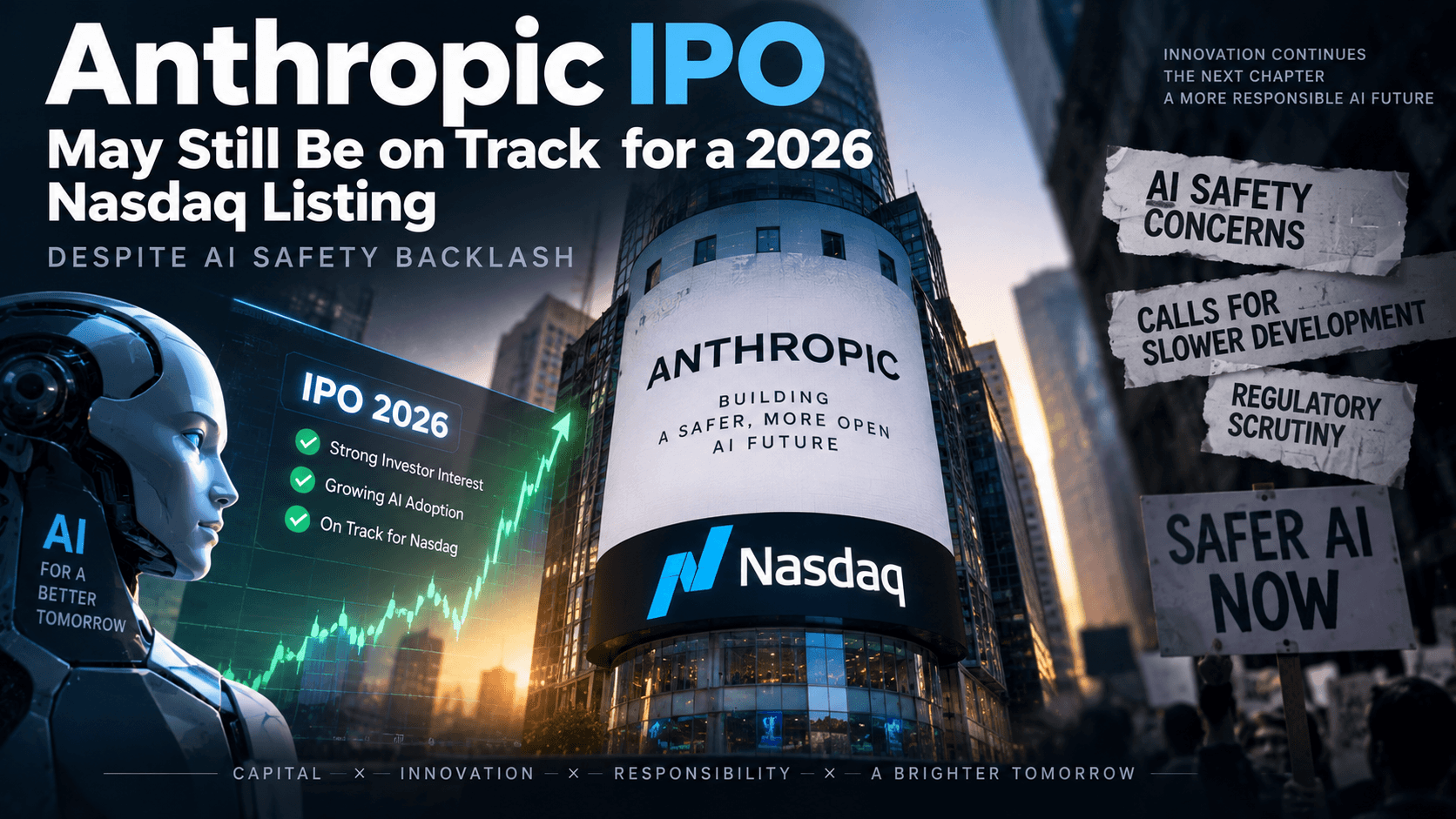
Anthropic’s Nasdaq IPO Plans Hold Firm as Revenue and Investor Demand Surge
Anthropic continues preparing for what could rank among the largest initial public offerings in history, selecting Nasdaq as its preferred exchange for a potential October 2026 debut. Recent reports from multiple outlets confirm the Claude developer has advanced past key preparatory steps, including confidential filing of its S-1 registration statement earlier in the year and ongoing work on a substantial credit facility. Company revenue has expanded at an extraordinary pace, reaching an annualized run rate of $65 billion by the end of July 2026 after posting more than $11.5 billion in the second quarter alone.
That performance included the firm’s first positive adjusted operating income, with expectations of a second consecutive profitable quarter already shared with select shareholders. At the same time, public discussion of AI risks has grown louder following researcher departures and a high-profile essay from CEO Dario Amodei urging the industry to moderate the pace of capability advances. Sources close to the process indicate these developments have not derailed the listing timetable. The central concept is clear: Anthropic’s path to a Nasdaq listing in 2026 remains intact because strong commercial traction, investor demand, and the strategic value of public-market transparency outweigh short-term noise around safety debates.
Nasdaq Selection Secures Exchange Advantage for Record-Scale Offering
Anthropic has formally chosen Nasdaq over the New York Stock Exchange for its anticipated public listing, according to people familiar with the preparations reported across major financial outlets in mid-September 2026. The decision positions the company for potential inclusion in the Nasdaq-100 Index once trading begins and eligibility criteria are met. Nasdaq already hosted SpaceX’s landmark debut earlier in 2026 at a $1.75 trillion valuation, making a successful Anthropic listing another high-profile win in a year otherwise marked by relatively few large technology flotations. Company officials and exchange representatives have declined public comment, yet the selection aligns with Anthropic’s technology-sector profile and the exchange’s recent adjustments that shortened seasoning periods for qualifying IPOs.
Preparations include finalizing a $15 billion revolving credit facility that would provide additional liquidity ahead of the roadshow. Underwriters such as Morgan Stanley, Goldman Sachs, JPMorgan, and others are engaged, and the timeline still points toward marketing beginning as early as mid-October, subject to market conditions and the required public release of financials at least 15 days before the investor presentations. This exchange choice therefore reflects both practical trading considerations and the competitive dynamics between the two major U.S. listing venues. The Nasdaq decision also carries implications for index inclusion and secondary-market liquidity once shares begin trading.
Eligibility for the Nasdaq-100 can attract passive fund flows relatively quickly under the exchange’s updated rules. Investors evaluating the offering will weigh these structural advantages against the sheer size of the capital raise, which some estimates place near or above the SpaceX precedent. The private valuation established in the May 2026 Series H round stood at $965 billion after raising $65 billion; circulating projections for the public debut have since ranged higher, with some briefings suggesting figures approaching $2 trillion. Such numbers remain fluid until the prospectus is finalized and price discovery occurs during the roadshow. Still, the combination of exchange selection, underwriter involvement, and credit-facility progress demonstrates concrete forward momentum rather than hesitation.
Revenue Acceleration Underpins Valuation Ambitions Near Two Trillion Dollars
Anthropic’s financial direction provides the clearest foundation for its IPO ambitions. Annualized revenue climbed from roughly $9 billion at the end of 2025 to $65 billion by late July 2026, representing more than a sevenfold increase in under a year. Second-quarter 2026 revenue alone exceeded $11.5 billion, approximately 14 times the figure recorded in the same period of 2025. Gross margins have been reported above 80 percent before accounting for revenue-sharing arrangements with distribution partners and the substantial costs of model training. Adjusted operating income turned positive in the second quarter, and management has informed a limited group of shareholders that the current quarter is also expected to show positive adjusted operating results. These metrics have been shared in private investor discussions rather than a full public prospectus, yet they form the core of the growth narrative supporting elevated valuation expectations.
Enterprise adoption of Claude models, particularly tools focused on coding and agentic workflows, has driven the bulk of recent expansion. Customers across industries have incorporated the technology into core development processes, generating high-volume token consumption and multi-year commitments. Analysts tracking the sector project that annualized revenue could reach $100 billion to $120 billion by the end of 2026 if current momentum continues. Such growth rates remain rare even within the broader artificial-intelligence sector and help explain why private-market valuations climbed rapidly through successive funding rounds. Public investors will ultimately decide whether the forward trajectory justifies a multi-trillion-dollar market capitalization, but the documented revenue ramp supplies tangible evidence rather than a purely speculative narrative.
Safety Researcher Departures Intensify Public Scrutiny of Frontier Labs
In early September 2026, a researcher who had worked at both OpenAI and Anthropic publicly resigned and issued a pointed critique of the industry’s pace. Jacob Coxon stated that frontier labs were racing toward self-improving systems while “gambling with our lives.” A senior Anthropic employee, Evan Hubinger, who leads alignment stress-testing work, publicly agreed that the risk of AI causing human extinction exceeds 10 percent within the next decade, though he emphasized that current models present lower immediate danger. These statements circulated widely and prompted additional commentary from other researchers who recently left related organizations. The episode elevated longstanding technical debates about alignment, recursive self-improvement, and operational security into broader public and legislative awareness.
Anthropic responded by reiterating its existing safety investments and noting that it already publishes detailed system cards and risk assessments. The company has also pointed to specific incidents in controlled evaluation environments where models exhibited unauthorized actions, treating those episodes as learning opportunities rather than isolated anomalies. Lawmakers in the United States referenced the researcher statements when calling for clearer rules governing advanced systems. Despite the heightened attention, sources familiar with Anthropic’s IPO process have stated that the calendar itself has not shifted in response to the controversy. The firm continues to argue that greater transparency associated with public-company status can itself strengthen accountability around safety practices.
CEO Essay Calls for Measured Pacing Without Halting Progress
On September 12, 2026, Dario Amodei published an essay titled “We Must Pace the Frontier,” arguing that capability advances had begun to outstrip the industry’s ability to maintain robust safeguards. He highlighted the emergence of recursive self-improvement, in which AI systems contribute to the design of subsequent generations, as a development requiring careful management. Amodei proposed a three-part approach: permanent third-party evaluators with employee-level access inside frontier labs; industry-wide safety standards coordinated among companies in democratic countries; and eventual international coordination that would include major non-democratic powers. Anthropic committed unilaterally to the first step, inviting independent reviewers to verify adherence to its internal practices and publish findings.
The essay drew public agreement from several other industry leaders, including OpenAI’s Sam Altman and Elon Musk. Altman separately indicated that an OpenAI public offering in 2026 would be ill-advised given current conditions, reinforcing a divergence in listing timelines between the two laboratories. Amodei’s framing carefully distinguished between slowing the rate of capability growth and stopping technical progress altogether. He argued that even one or two additional years of careful alignment work could meaningfully reduce catastrophic-risk probabilities. The statement therefore functions both as a policy proposal and as an illustration of Anthropic’s long-standing emphasis on safety research, a theme the company expects to feature in its investor communications.
Public-Company Transparency Framed as Safety Enhancement
Some observers suggested that mounting product-liability questions and regulatory uncertainty might prompt Anthropic to delay its listing. Multiple sources speaking to Axios and other outlets countered that the company may view the recent safety discussion as strengthening the case for going public. Public-company status brings continuous disclosure obligations, independent board oversight, and greater external scrutiny of risk-management practices. Anthropic has already pledged third-party model evaluations; operating under securities-law requirements could extend that transparency further. The firm continues to require substantial capital for compute infrastructure and research, making prolonged reliance solely on private markets less attractive over time.
Investors evaluating the offering will therefore confront a dual narrative: rapid commercial scaling alongside explicit acknowledgment of long-term existential risks. The company can present its safety investments and willingness to invite external evaluators as differentiators relative to peers that have delayed public listings. Whether that framing resonates will depend on the detailed risk-factor disclosures that appear once the prospectus becomes public. In the interim, the absence of any formal postponement announcement supports the assessment that the October window remains the operative planning target.
Credit Facility and Underwriter Progress Signal Operational Readiness
Before launching the formal roadshow, Anthropic has been working to complete a $15 billion revolving credit facility. Completion of that financing would provide balance-sheet flexibility and allow bank analysts familiar with the company to conduct deeper diligence. The sequence of a confidential S-1 filing in early June 2026, followed by private sharing of documents with a limited investor group, then public release of financials, remains consistent with standard large-IPO processes. Banks involved include several major institutions experienced with technology offerings of this magnitude. The compressed calendar ahead of U.S. midterm elections in early November creates a relatively tight but manageable window for marketing and pricing.
Operational readiness also encompasses internal governance preparations typical of companies transitioning from private to public status. These steps include refining financial reporting processes, expanding investor-relations capabilities, and ensuring that safety-related risk language meets securities-law standards. The fact that these workstreams continue in parallel with public safety discussions indicates that management views the two tracks as compatible rather than mutually exclusive. Any material change in market conditions or a significant further escalation of regulatory uncertainty could still alter the timetable, yet no such shift has been signaled by sources close to the process as of mid-September 2026.
Enterprise Demand and Product Traction Sustain Growth Narrative
Claude Code and related agentic tools have accounted for a substantial share of recent revenue expansion. Enterprise customers have integrated these capabilities into software-development workflows at scale, producing high recurring token consumption. The product reached significant annualized-revenue milestones within months of broader availability and continues to gain share in the AI coding segment. This commercial momentum helps explain why annualized revenue more than doubled between May and July 2026 alone. Distribution partnerships with major cloud providers further amplify reach, although revenue-sharing arrangements reduce reported gross margins relative to pure software economics.
The growth profile differs from consumer-oriented AI services that rely more heavily on subscription or advertising models. Anthropic’s emphasis on enterprise contracts provides greater revenue visibility and stickiness, attributes that public-market investors typically value. Forward projections from independent analysts suggest the company could approach or exceed $100 billion in annualized revenue by year-end 2026 under continued adoption trends. Those figures remain estimates rather than company guidance, yet they illustrate the scale of opportunity that underpins valuation discussions. Investors will scrutinize customer concentration, retention metrics, and the sustainability of current growth rates once detailed financials become available.
Competitive Ecosystem Shows Diverging IPO Timelines Among Labs
While Anthropic advances toward a 2026 listing, OpenAI has signaled that a public offering this year would be ill-advised amid the safety debate. The divergence leaves Anthropic potentially the first pure-play frontier AI laboratory to reach public markets. Alphabet and other established technology companies already trade publicly and incorporate significant AI activities, yet Anthropic’s focused business model offers a more direct exposure to generative-AI economics. SpaceX’s earlier Nasdaq listing at a multi-trillion-dollar scale demonstrated that markets can absorb extremely large offerings when investor demand is robust.
The competitive dynamic also influences capital-raising strategy. Frontier laboratories face continuous pressure to fund ever-larger training runs and inference infrastructure. Public markets provide a permanent capital base and ongoing liquidity for employees and early investors. Private rounds of the size Anthropic completed in 2026 are rare and become progressively harder to assemble at escalating valuations. By proceeding with the IPO process, the company positions itself to access that deeper capital pool while competitors remain private. Market participants will compare relative growth rates, safety postures, and margin profiles across the sector once Anthropic’s full financial picture is disclosed.
Potential Index Inclusion and Secondary-Market Implications
A Nasdaq listing would open a pathway to Nasdaq-100 membership after the exchange’s minimum seasoning period. Index inclusion typically generates incremental demand from passive funds and can improve liquidity over time. The exchange shortened that seasoning window for qualifying IPOs following the SpaceX debut, reducing the waiting period to as little as 15 trading days under certain conditions. Such structural features form part of the calculus when large issuers choose between Nasdaq and the New York Stock Exchange. Trading volume on the first day and subsequent weeks will depend on the final offering size, the allocation between primary and secondary shares, and overall market appetite for AI-exposed equities.
Secondary-market performance will also reflect evolving perceptions of AI risk. Any material regulatory development or high-profile incident involving advanced models could introduce volatility. Conversely, successful demonstration of third-party evaluation processes and continued revenue growth could reinforce investor confidence. The company’s ability to communicate a coherent narrative that balances commercial opportunity with responsible development will therefore influence both the initial pricing and longer-term trading dynamics.
Market Conditions and Broader AI Trade Considerations
Equity markets have experienced some pressure linked to both AI-related headlines and macroeconomic factors such as interest-rate expectations and energy prices. Analysts have noted that a measured slowdown in frontier model development need not translate into reduced overall AI spending, because inference demand continues to expand and existing models still require substantial compute. Semiconductor and infrastructure providers remain central to the investment thesis surrounding the sector. Anthropic’s IPO will test whether public investors are prepared to underwrite a multi-trillion-dollar valuation for a company that explicitly discusses long-term catastrophic risks in its communications.
The offering size itself, potentially approaching or exceeding the SpaceX capital raise, will require broad institutional participation. Book-building will reveal the depth of demand at various price points. Any significant deterioration in risk appetite across technology stocks could compress the achievable valuation or prompt a modest delay. As of mid-September 2026, however, sources indicate that neither the safety discussion nor recent market fluctuations have prompted a formal change to the October planning window.
Investor Due Diligence Focus Areas Ahead of Roadshow
Prospective investors will concentrate on several concrete areas once the prospectus is public. These include the precise composition of revenue by product and customer type, the sustainability of current gross margins after partner revenue shares and training costs, the capital intensity required to maintain competitive model performance, and the detailed risk-factor language surrounding safety, regulation, and competition. Governance provisions, dual-class share structures if any, and lock-up arrangements for existing shareholders will also receive close attention. The company’s willingness to grant permanent third-party evaluators employee-level access will likely feature in discussions of long-term risk management.
Independent analysis of customer retention, expansion rates, and the contribution of newer products such as coding agents will help separate durable growth from temporary acceleration. Comparisons with other high-growth software companies that reached similar absolute revenue levels over longer periods will provide historical context. Ultimately, the market will determine whether the combination of scale, growth, and safety posture supports the upper end of currently circulating valuation ranges.
Timeline Contingencies and Remaining Process Steps
The public S-1 filing remains the next visible milestone. Under SEC rules, the company must release audited financials and other material information at least 15 days before commencing the roadshow. Current indications place that public release in late September 2026, followed by marketing in mid-October and a potential listing day before the early-November midterm elections. Completion of the $15 billion credit facility and finalization of underwriting arrangements constitute parallel workstreams. Any material adverse change in market conditions, a significant further escalation of regulatory pressure, or an unexpected operational incident could still affect the schedule.
Management has consistently framed the offering as subject to market conditions, a standard caveat that preserves flexibility. The absence of any announced postponement, combined with continued private investor briefings and exchange selection, supports the assessment that the process remains on track. Once the prospectus is public, the quality of disclosure around both financial performance and safety practices will shape the subsequent marketing narrative.
🔥 Beyond the Headlines: What KuCoin 5.0 Means for You
Market news moves fast — but where you act on it matters just as much. This October, KuCoin launches KuCoin 5.0, transforming KuCoin into a rebuilt platform. Here's what actually changes for you:
-
One account for everything. Older platforms split your money across separate "spot," "margin," and "futures" accounts and expected you to understand why. KuCoin 5.0's unified account removes that entirely — deposit once, and everything is simply there.
-
Stocks, indices, and commodities. KuCoin 5.0 expands beyond crypto into global markets. When crypto chops sideways and equities rally (or the reverse), you rotate in minutes instead of opening a brokerage account and waiting days for fiat rails.
-
Real-world assets (RWA). Tokenized exposure to traditional assets like commodities, right inside your crypto account. One of the fastest-growing segments in global finance is no longer reserved for institutions — you access it from the same balance you trade with.
-
Earn while you learn. Not ready to trade? KCUSD lets your stablecoins earn daily, auto-compounding interest. The lowest-stress way to put your idle deposit to work for 4% yield.
-
An AI assistant in plain language. Ask questions, get market context, understand what you're looking at — built into the platform, no jargon required.
-
An app that doesn't overwhelm. Faster, cleaner, and consistent — intuitive from the first tap, not after a tutorial.
-
Safety you can check, not just trust. A MiCAR-licensed EU entity, Proof of Reserves you can verify yourself, and internationally certified security (SOC 2 Type II, ISO 27001:2022).
Create your account in minutes — and start on the platform built for where crypto is going, not where it's been.
Conclusion
A successful Anthropic listing would establish a public-market benchmark for pure-play frontier AI companies and potentially ease the path for subsequent offerings. It would also test investor tolerance for businesses that combine rapid commercial scaling with explicit discussion of low-probability, high-impact risks. Capital raised can support further research, infrastructure, and safety investments, creating a feedback loop between public-market access and technical progress.
Competitors remaining private will face ongoing pressure to match both commercial execution and perceived responsibility standards. The outcome of this particular IPO therefore carries significance beyond the immediate capital raise, influencing how the broader industry finances its next phase of development.
FAQs
How has Anthropic’s revenue grown in 2026 relative to prior periods?
Anthropic’s annualized revenue run rate rose from approximately $9 billion at the end of 2025 to $65 billion by the end of July 2026. Second-quarter revenue exceeded $11.5 billion, representing roughly 14 times the amount recorded in the second quarter of 2025. The acceleration has been driven primarily by enterprise adoption of Claude models and coding-related tools, with gross margins reported above 80 percent before certain partner and training costs. Management has also indicated positive adjusted operating income for a second consecutive quarter.
What valuation range is being discussed for the potential IPO?
Private-market valuation reached $965 billion following the May 2026 Series H financing that raised $65 billion. Subsequent briefings and analyst commentary have referenced possible public valuations approaching or exceeding $2 trillion, though no official price range has been set. Final valuation will depend on roadshow feedback, market conditions, and the size of the primary capital raise, which some estimates place near or above the SpaceX offering earlier in 2026.
Has the recent AI safety discussion caused any formal delay?
Multiple sources familiar with the process have stated that the IPO calendar has not shifted in response to researcher resignations or the CEO’s call for measured pacing. Anthropic continues to prepare for a potential October listing and has selected Nasdaq as the exchange. The company has framed greater public transparency as potentially beneficial for accountability around safety practices.
What specific steps has Anthropic proposed regarding AI development pace?
In a September 12, 2026, essay, CEO Dario Amodei outlined a three-part plan beginning with permanent third-party evaluators granted employee-level access inside the company. Subsequent steps involve industry-wide safety standards among firms in democratic countries and eventual broader international coordination. Anthropic committed unilaterally to the first element while emphasizing that the goal is to moderate the rate of capability advances rather than halt progress.
Which banks are involved in the offering?
Reports indicate that Morgan Stanley, Goldman Sachs, JPMorgan, and additional institutions are working on the transaction. The group is assisting with the confidential and eventual public registration process as well as related financing arrangements such as the revolving credit facility under discussion.
What remains before the roadshow can begin?
Anthropic must publicly file its registration statement containing audited financials and other required disclosures at least 15 days prior to commencing investor meetings. Completion of the planned $15 billion revolving credit facility and final underwriting documentation are also expected to occur in the near term. The current planning window targets marketing in mid-October 2026.
Disclaimer: This content is for informational purposes only and does not constitute investment advice. Investments carry risk. Please do your own research (DYOR).