

AI Infrastructure Shortage May Last Until 2028 as Hyperscaler Capex Keeps Rising
Introduction
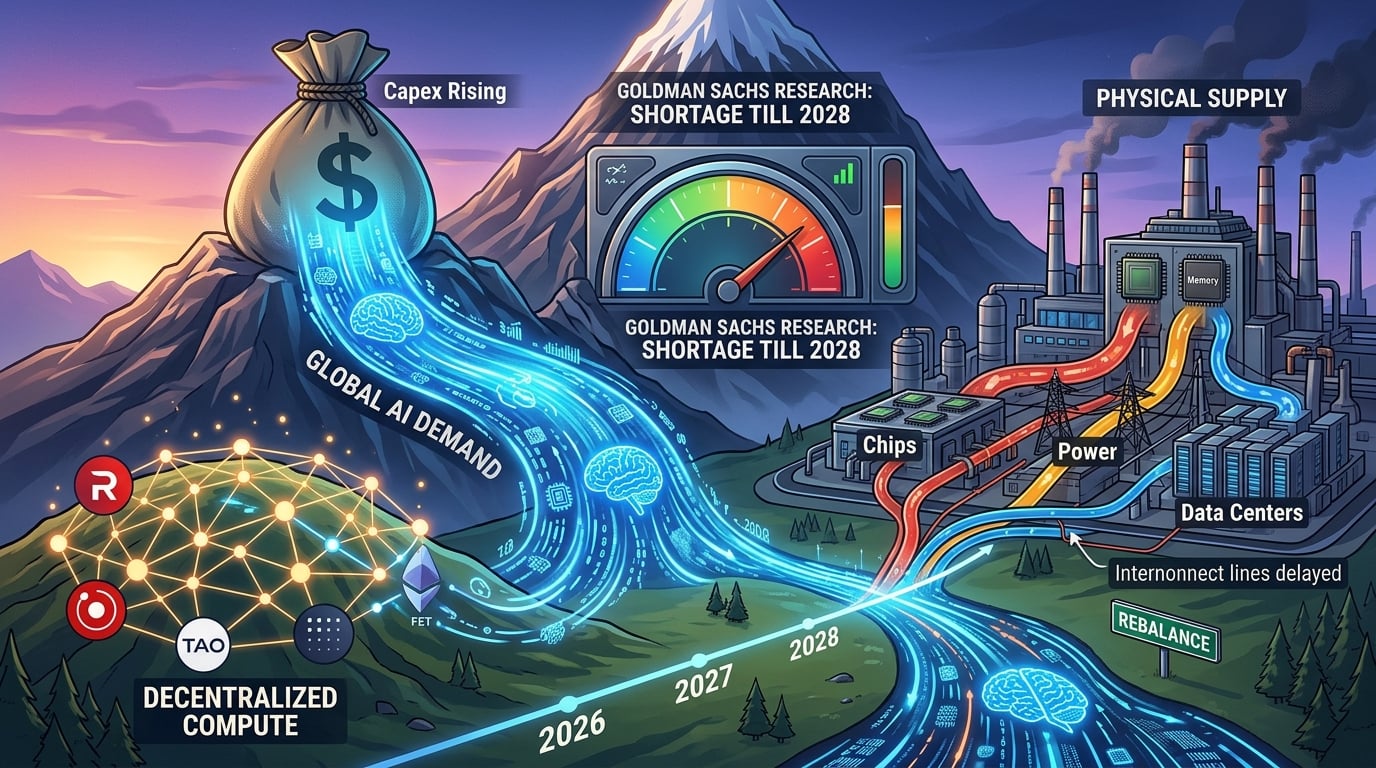
Can the global AI boom keep scaling if the physical layer — chips, power, land, and data centers — cannot keep up? Goldman Sachs Research and related Goldman TMT analysis argue that it cannot, at least not yet. The bank’s view is that AI infrastructure supply and demand may not rebalance until 2028, while hyperscaler capital expenditure continues to rise rather than peak.
That imbalance is the core story for markets. According to Goldman Sachs Research, global AI-related capex is estimated at about $1.019 trillion in 2026. The Goldman Sachs Global Institute baseline model implies roughly $765 billion of annual AI capex in 2026 and about $7.6 trillion of cumulative spend across compute, data centers, and power from 2026 to 2031. For crypto and digital-asset investors, the same shortage is why decentralized compute tokens and AI-linked networks remain part of the infrastructure debate.
Why Does Goldman Sachs Say the AI Infrastructure Shortage Lasts Until 2028?
Goldman Sachs says the shortage lasts because demand for AI compute is still growing faster than the industry can deliver chips, memory, power, and finished data-center capacity.
Eric Sheridan, Goldman’s TMT research lead, has described a persistent gap between AI compute demand and available supply. The pressure points have already moved beyond GPUs. Storage pricing, chip pricing, land, electricity, facility shells, and delivery cycles are all tightening at once.
Goldman analysis has also flagged that supply and demand may not balance until at least the second half of 2027 in some scenarios, with later commentary pointing to first-half 2028 as a more realistic window. That later date matters because it implies several more years of raised capex guidance, not a one-year spending spike.
Physical bottlenecks explain the delay. Grid interconnection queues, permitting, specialized labor shortages, and long lead times for transformers, switchgear, turbines, and cooling systems stretch the gap between money committed and capacity online. The Goldman Sachs Global Institute calls this “elongation”: capital is deployed, but usable compute arrives later than planned.
How High Could Hyperscaler Capex Climb Through 2027 and 2028?
Hyperscaler capex is still heading higher. Consensus 2027 estimates are too low if AI investment keeps rising as a share of GDP, according to Goldman Sachs.
Goldman has said Wall Street’s roughly $920 billion consensus for 2027 hyperscaler capex implies growth slowing from about 84% in 2026 to 22% in 2027. The bank’s own work puts a more realistic figure near $1.1 trillion, or about 45% growth, if incremental AI investment reaches 2% to 3% of GDP. An upside case tied to cash-flow generation and investment-grade credit capacity could reach about $1.4 trillion.
Those GDP comparisons are deliberate. Goldman notes prior general-purpose technology buildouts peaked near 2% to 5% of GDP. U.S. railroad investment in the 1880s reached about 3.4% of GDP. Electric-motor infrastructure in the 1920s reached about 2.2%. Auto infrastructure in the 1910s reached about 2.1%. AI spend is large, but it is not yet outside historical ranges.
Goldman Sachs Research estimates U.S. AI capex at 1.8% of GDP in 2026, 2.5% in 2027, and 2.8% in 2028. Global AI investment is estimated at 0.9% of GDP in 2026, 1.3% in 2027, and 1.4% in 2028.
Separately, Goldman has raised its combined capex forecast for Meta, Microsoft, Amazon, and Alphabet to $5.3 trillion between fiscal 2025 and 2030, up from $4.5 trillion before first-quarter earnings. That revision is one of the clearest signs that the spending cycle is still expanding.
What Physical Constraints Are Blocking AI Data Center Supply?
Power, equipment, and site delivery — not financing alone — are the binding constraints.
According to the U.S. Department of Energy’s Lawrence Berkeley National Laboratory 2024 Report on U.S. Data Center Energy Use, U.S. data centers used about 4.4% of national electricity in 2023, or 176 TWh, up from 58 TWh in 2014. The same official report estimates 325 to 580 TWh by 2028, or 6.7% to 12.0% of U.S. electricity use.
That power ramp collides with interconnection delays. Goldman has noted that islanded data centers — facilities that generate much of their own power off-grid — have moved from an edge case to a credible path. Estimates cited in Goldman-linked analysis suggest as much as one-third of future capacity could be islanded because grid queues are too slow.
Equipment backlogs compound the problem. Electrical distribution gear from major manufacturers faces multiyear waits. Cooling systems must handle higher rack densities. Next-generation AI halls are no longer simple warehouses with servers. Compute, memory, networking, cooling, and power are now codesigned.
Memory is another pinch point. Once the shortage was framed as a GPU problem. Goldman’s TMT commentary now treats HBM and related memory as a co-equal constraint with land and power. When memory and chips rise together, data-center build costs rise with them.
Labor and permitting add friction. Specialized electricians, commissioning engineers, and high-voltage technicians cannot be hired as fast as capex budgets can be approved. Local opposition and longer environmental reviews stretch timelines further.
How Are Hyperscalers Paying for the AI Build-Out?
Hyperscalers are funding more of the boom with bonds, private infrastructure capital, and off-balance-sheet structures, not only operating cash flow.
Goldman expects the five large hyperscalers — Alphabet, Amazon, Meta, Microsoft, and Oracle — to move from about $405 billion of capex in 2025 toward roughly $750 billion in 2026 and about $1.14 trillion in 2027. Investment-grade bond issuance from the group was $108 billion in 2025, or about 26% of capex. Goldman expects that mix to approach $250 billion in 2026 and $400 billion in 2027, or about 35% of capex.
Private infrastructure and real estate capital are filling the rest. Goldman has said those pools will play a larger role as projects split into land, power, buildings, and equipment. From 2021 to 2024, the private infrastructure market grew at about 11.5% annualized, and Goldman sees room for that rate to rise toward the 16% to 17% pace seen in earlier years.
The financing shift does not remove risk. Alphabet has already shown how heavy capex can push free cash flow negative in a single quarter. Credit markets can fund a large share of the build-out, but issuer concentration and liquid-market capacity become tighter as issuance grows.
What Does the Shortage Mean for AI Compute Markets and Crypto Tokens?
A multi-year compute shortage keeps centralized cloud prices elevated and leaves room for alternative compute networks, including crypto-native GPU and AI marketplaces.
According to CoinGecko, the Artificial Intelligence crypto category recently clustered around a market cap in the mid-$20 billion to high-$20 billion range, with 24-hour volumes in the billions of dollars. Bittensor (TAO), Render (RENDER), and the Artificial Superintelligence Alliance (FET) remain among the most watched names because they sit closest to compute, model coordination, or decentralized rendering demand.
The link is economic, not promotional. If hyperscalers cannot deliver enough capacity until 2028, unused or underused GPUs outside the largest clouds become more valuable. Networks that route inference, training, or rendering jobs to distributed hardware can compete on price and availability even if they cannot match hyperscaler reliability at scale.
Token demand is still speculative. CoinGecko data also shows sharp drawdowns and rotations inside the AI category. A physical shortage in data centers does not automatically reprice every AI ticker. Traders should separate infrastructure scarcity from narrative tokens that have no real compute throughput.
Enterprise adoption remains early. Goldman has noted that while a majority of companies discuss AI productivity on earnings calls, only a small share quantify the earnings impact. That gap is why capex can stay high while monetization stays uneven.
Beyond the Headlines: What KuCoin 5.0 Means for You
Market news moves fast — but where you act on it matters just as much. This October, KuCoin launches KuCoin 5.0, transforming KuCoin into a rebuilt platform. Here's what actually changes for you:
-
One account for everything. Older platforms split your money across separate "spot," "margin," and "futures" accounts and expected you to understand why. KuCoin 5.0's unified account removes that entirely — deposit once, and everything is simply there.
-
Stocks, indices, and commodities. KuCoin 5.0 expands beyond crypto into global markets. When crypto chops sideways and equities rally (or the reverse), you rotate in minutes instead of opening a brokerage account and waiting days for fiat rails.
-
Real-world assets (RWA). Tokenized exposure to traditional assets like commodities, right inside your crypto account. One of the fastest-growing segments in global finance is no longer reserved for institutions — you access it from the same balance you trade with.
-
Earn while you learn. Not ready to trade? KCUSD lets your stablecoins earn daily, auto-compounding interest. The lowest-stress way to put your idle deposit to work for 4% yield.
-
An AI assistant in plain language. Ask questions, get market context, understand what you're looking at — built into the platform, no jargon required.
-
An app that doesn't overwhelm. Faster, cleaner, and consistent — intuitive from the first tap, not after a tutorial.
-
Safety you can check, not just trust. A MiCAR-licensed EU entity, Proof of Reserves you can verify yourself, and internationally certified security (SOC 2 Type II, ISO 27001:2022).
Create your account in minutes — and start on the platform built for where crypto is going, not where it's been.
Conclusion
Goldman Sachs’ warning is simple: AI demand is still outrunning the physical stack, and that gap may last into 2028. Hyperscaler capex is not rolling over. Goldman’s work points to trillion-dollar annual run-rates, U.S. AI investment rising toward nearly 3% of GDP by 2028, and a $5.3 trillion 2025–2030 spend path for the four largest U.S. hyperscalers.
The constraints are concrete. According to the U.S. Department of Energy’s Lawrence Berkeley National Laboratory, data-center electricity use could reach 6.7% to 12.0% of U.S. demand by 2028. Memory, land, transformers, cooling, and interconnection queues sit beside GPUs as binding limits. Financing has shifted toward bonds and private infrastructure capital, which can fund the boom but also raise leverage and volatility.
For digital-asset markets, a longer shortage keeps the case for alternative compute networks alive, while CoinGecko’s AI category shows both liquidity and high token-level risk. Investors should watch capex revisions, grid delivery, silicon replacement cycles, and actual AI revenue — not slogans about an endless boom.
The build-out is large enough to reshape power markets, credit markets, and crypto compute tokens at the same time. It is not large enough to erase the chance that spending slows once capacity finally catches demand.
FAQs
Does a 2028 shortage date mean AI stocks and tokens only go up until then?
No. Goldman has separately warned that rich valuations and positioning can produce volatility even while capex guidance rises.
Is the bottleneck still just NVIDIA GPUs?
No. Goldman’s TMT commentary now treats memory, land, power, facility shells, and delivery cycles as co-equal pressure points.
How much electricity could U.S. data centers use by 2028?
According to the U.S. Department of Energy’s Lawrence Berkeley National Laboratory, the range is 325 to 580 TWh, or 6.7% to 12.0% of U.S. electricity use.
Why would hyperscalers issue more bonds if they are highly profitable?
Because capex is growing faster than free cash flow at several firms, Goldman expects investment-grade issuance to fund a larger share of spend by 2027.
Disclaimer: This article is for informational purposes only and does not constitute financial, legal, or investment advice. Always conduct your own research before interacting with digital assets.