

Is the AI Bubble Entering Its Final Stage? AI Stocks Face a Late-Cycle Test
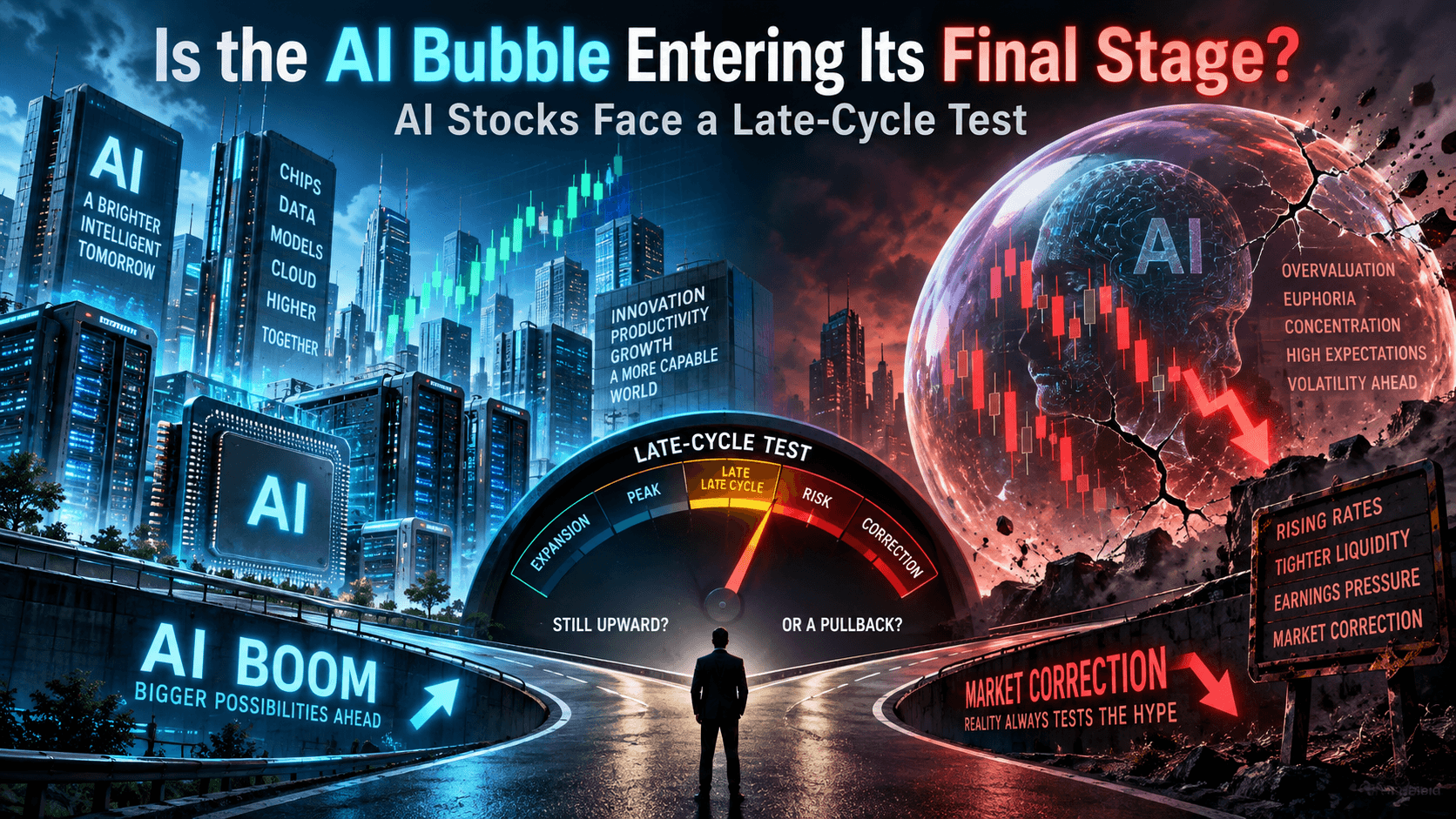
AI Rally Enters Late-Cycle Territory as Bubble Risks Mount
Wall Street’s multiyear AI-driven equity advance has delivered extraordinary gains, with semiconductor indexes still posting roughly 57% year-to-date advances even after recent pressure and the broader S&P 500 more than doubling since the October 2022 bull market began. Yet a cluster of fresh warnings from Capital Economics, the Bank for International Settlements, and market participants has intensified debate over whether the rally has entered its final phase. On September 14–15, 2026, chipmakers including Nvidia, Micron, Broadcom, and AMD fell sharply after OpenAI, Anthropic, and xAI executives publicly called for a measured pace of frontier-model development on safety grounds.
At the same time, the 10-year Treasury yield climbed above 5%, free-cash-flow projections for major hyperscalers turned negative for 2027 in some forecasts, and Capital Economics’ James Reilly concluded that most of the firm’s eight categories of bubble indicators sit at or near levels that historically preceded major peaks. The central thesis is that while artificial intelligence remains a durable technological shift grounded in real demand for compute, the equity market’s pricing of that shift now exhibits classic late-cycle characteristics, stretched valuations relative to sustainable earnings growth, circular financing, and capital spending that risks outrunning near-term returns, raising the probability of a meaningful correction beginning in 2027 rather than an immediate collapse.
Capital Economics Screens Point to Late-Stage Bubble Conditions Across Key Metrics
Capital Economics has spent recent months constructing one of the more detailed public cases that the AI equity rally has moved into its final innings. In a September 10 report and subsequent commentary, senior markets economist James Reilly examined eight categories of indicators and found the majority already at or close to readings that preceded past stock-market peaks. Valuation metrics such as the cyclically adjusted price-to-earnings ratio sit near dot-com extremes, while the S&P 500’s valuation relative to Treasury bonds also approaches those earlier highs. Forward 12-month earnings-per-share growth expectations for the index align with the peak of the late-1990s bubble, even as the underlying economy expands at a far more moderate pace. The firm’s “best guess” is that the AI-driven advance begins to crack in 2027, with the S&P 500 ultimately falling at least 30% from its high, one of the more severe declines of the past century.
Market behavior in recent weeks has reinforced the late-stage diagnosis. On July 30 Microsoft’s market value rose roughly $450 billion in a single session; the following day Apple lost $360 billion, while Amazon gained nearly $388 billion and Meta declined more than $100 billion. Acadian Asset Management data show that the degree of dispersion in individual stock returns has reached its third-highest level in nearly 2,850 trading days, trailing only the 2020 vaccine rally and the 2025 DeepSeek shock. Such extreme daily swings among mega-cap names are characteristic of markets that have already discounted aggressive growth scenarios and are now highly sensitive to incremental news. Capital Economics notes that if the Federal Reserve continues tightening and the 10-year yield remains above 5%, the current environment will more closely resemble the monetary backdrop that ended the internet boom than the ultra-low-rate period that fueled earlier stages of the AI advance.
Hyperscaler Capital Expenditure Approaches the Trillion-Dollar Mark for 2027
The five largest American hyperscalers, Microsoft, Alphabet, Amazon, Meta Platforms, and Oracle, are projected by Bank of America Global Research to spend approximately $795 billion on capital expenditures in 2026 and nearly $1.08 trillion in 2027. Nvidia has estimated that the big five alone will direct close to $800 billion into data center infrastructure this year, with the figure potentially rising further next year. These outlays fund the construction of AI-optimized data centers, procurement of advanced GPUs and high-bandwidth memory, and the associated power and cooling systems required to train and serve large language models. The scale dwarfs previous technology investment cycles and has become the primary engine of semiconductor revenue growth.
Yet the same forecasts that underpin optimistic equity valuations also highlight the financing strain. Combined free cash flow for the leading hyperscalers is expected to turn negative in 2027 as capital spending continues to accelerate. Meta’s free cash flow, for example, collapsed to under $800 million in a recent period from more than $8 billion a year earlier, even as the company narrowed its 2026 capex guidance to a still-elevated $130–145 billion range. Microsoft’s full-year fiscal 2026 capital spending guidance has been revised higher, with calendar-year 2026 investment now expected to be around $175 billion after a shift toward operating leases. The quick expansion of off-balance-sheet lease obligations and rising debt issuance, along with global AI-related debt projected to exceed $570 billion this year, introduces a new layer of leverage into a sector that previously funded growth largely from internal cash generation.
Current AI Valuations Remain Below Dot-Com Extremes but Reflect Aggressive Growth Assumptions
Defenders of the AI trade correctly note that today’s multiples are substantially lower than those recorded at the peak of the internet bubble. The average two-year forward price-to-earnings ratio for the largest AI data center spenders, Microsoft, Alphabet, Amazon, and Meta, stands near 18 times, compared with nearly 70 times for the top four technology leaders of the early 2000s. Nvidia itself trades in a range of roughly 22–28 times forward earnings, far below Cisco’s 130–200 times multiple at the height of the earlier mania. The PHLX Semiconductor Index forward P/E remains around 20 times, roughly the same level it occupied in early 2023 shortly after ChatGPT’s public release.
These lower absolute multiples, however, are applied to earnings growth trajectories that many analysts now view as optimistic. Expected earnings expansion for the S&P 500 already matches the unsustainable rates seen at the end of the 1990s, while the concentration of market capitalization in a handful of AI-exposed names has risen to levels that exceed the late-1990s technology share of the index. Nearly one-fifth of U.S. equity market capitalization is now tied directly to AI themes, and the ten largest S&P 500 constituents account for close to 40% of the benchmark. When growth assumptions are revised lower, as they may be if safety-related slowdowns or weaker-than-expected monetization materialize, the valuation compression can be rapid even from seemingly reasonable starting multiples.
On the weekend of September 13–14, 2026, the chief executives of OpenAI, Anthropic and xAI issued coordinated public statements urging a more deliberate pace of frontier-model development, citing unresolved safety risks. The remarks marked the starkest industry acknowledgment yet that the breakneck timeline of AI progress carries material downside. Markets reacted immediately: Nvidia shares declined more than 3%, Micron fell over 5%, and Broadcom and AMD each dropped more than 4%. The PHLX Semiconductor Index tumbled nearly 6% in a single session, trimming its still-substantial 2026 advance. SoftBank, a major OpenAI stakeholder, lost more than 10% in Tokyo trading.
The episode illustrates how tightly equity valuations have become linked to uninterrupted acceleration in model capability and the associated capital spending. Any credible signal that the competitive race may moderate, even for legitimate safety reasons, promptly reduces the expected growth rate of GPU demand. OpenAI’s simultaneous indication that it would not proceed with an IPO in 2026 further underscored the shift in tone. While some market participants argue that greater safety discipline could ultimately strengthen the long-term commercial case for AI, the immediate effect has been to inject doubt into the near-term spending trajectory that underpins semiconductor order books and hyperscaler guidance.
Free Cash Flow Deterioration Signals Growing Tension Between Investment and Returns
A defining feature of the current cycle is the widening gap between capital deployed and identifiable near-term revenue. One detailed analysis places AI infrastructure capital expenditure above $200 billion against roughly $12 billion in clearly attributable revenue, with the disparity continuing to expand rather than narrow. Token costs have fallen more than 70% annually; sustaining flat revenue under those price declines would require demand growth exceeding 225% per year, an outcome that current inference workloads, still dominated by conversational and coding applications, have not yet demonstrated.
Hyperscalers have responded by leaning more heavily on debt and lease financing. Net cash positions have declined, and large off-balance-sheet commitments have accumulated. The Bank for International Settlements has repeatedly flagged the rapid rise in leverage and the opacity of many financing arrangements, noting that a significant share of deals involve circular flows within the same ecosystem of suppliers, customers, and investors. When free cash flow turns negative while depreciation schedules remain long and secondary markets for specialized AI hardware are thin, the risk shifts from temporary liquidity pressure to longer-term solvency questions for the most aggressive spenders.
Circular Financing Structures Create Interdependent Demand That May Prove Fragile
A small cluster of firms, Microsoft, Nvidia, Amazon, Meta, Google, OpenAI, and Anthropic, function simultaneously as suppliers, customers, equity investors, and validators in what one researcher has termed a closed recursive financing loop. Hyperscalers purchase GPUs and cloud capacity from the same companies in which they hold equity stakes; those companies in turn spend a meaningful portion of the capital on the hyperscalers’ own cloud services. The arrangement has accelerated the buildout, but it also means that reported demand is partly an artifact of internal capital recycling rather than purely external end-user adoption.
Should any major participant revise its spending plans downward, the feedback loop can reverse quickly. Historical technology cycles that featured similar vendor financing, most notably the late-1990s telecom buildout, ultimately experienced sharp contractions once external capital became less freely available. The current structure has so far been supported by strong internal cash generation at the largest participants, yet the projected turn to negative free cash flow in 2027 removes that buffer and increases reliance on continued capital-market access at favorable terms.
Historical Precedent Suggests AI Capex Has Not Yet Reached Peak Bubble Intensity
Barron’s analysis of 250 years of U.S. economic history finds that transformative technology spending typically reaches roughly 25% of economic output before serious stress appears. With U.S. GDP near $30 trillion, that threshold implies an additional $5–6 trillion of domestic AI-related outlays before the classic danger zone is entered. Hyperscalers alone are projected to spend $3.7 trillion globally through 2029, and the broader ecosystem, including Oracle, SpaceX, Anthropic, and OpenAI, will add further sums. On the current direction, the 25% rule may not be breached until the early 2030s.
This longer timeline does not eliminate the possibility of interim corrections. Prior cycles, including railroads and the internet, experienced multiple sharp drawdowns well before the ultimate peak in capital spending. The equity market can reprice growth expectations long before physical capacity is fully built. Investors who treat the historical spending threshold as a guarantee of uninterrupted advances risk underestimating the volatility that typically accompanies the later stages of infrastructure booms.
Semiconductor Leadership Faces Its First Sustained Reality Check of the Cycle
The Philadelphia Semiconductor Index remains up nearly 60% in 2026 even after the September selloff, reflecting the extraordinary demand for AI accelerators and high-bandwidth memory. Nvidia’s data center revenue continues to grow at triple-digit rates, and management has guided for further robust expansion under supply-constrained conditions. Yet the index’s forward valuation and the concentration of gains in a narrow set of names leave little margin for error if hyperscaler order growth moderates.
Recent order-book commentary from memory and logic suppliers already shows some customers stretching delivery schedules or seeking greater flexibility. If safety-driven slowdowns or weaker-than-expected enterprise monetization reduce the urgency of capacity additions, the semiconductor complex could experience the first multi-quarter period of sequential order declines since the AI surge began. Such an outcome would not end the technology’s long-term trajectory, but it would force a meaningful re-rating of the equities that have led the market for three years.
Treasury Yields Above 5% Introduce a New Constraint on Mega-Project Funding
The 10-year Treasury yield’s move above 5% has revived comparisons with the monetary environment that preceded the end of the dot-com boom. Ruchir Sharma and others have argued that a decisive breach of this level would signal the start of a tighter-money era in which multi-year AI infrastructure projects become materially harder to finance. Higher discount rates also compress the present value of distant cash flows that currently support elevated equity multiples.
Capital Economics notes that the combination of stretched valuations and rising yields more closely resembles the late-1990s setup than the zero-rate regime that underpinned the early AI advance. If the Federal Reserve proceeds with additional policy tightening, market pricing currently assigns meaningful odds to a 25-basis-point move; the cost of both equity and debt capital for capital-intensive AI projects will rise further, accelerating the pressure on free-cash-flow negative firms.
Measured Productivity Gains Have Yet to Match the Scale of Infrastructure Investment
Corporate executives surveyed in recent periods expect only about 1.4% productivity growth over three years from AI adoption, an outcome that falls well short of the returns implied by current capital outlays. While token volumes continue to expand rapidly (Google reported processing 3.2 quadrillion tokens per month in May 2026), the translation of that usage into durable, high-margin revenue streams remains uneven. Many early applications remain concentrated in relatively low-willingness-to-pay categories such as consumer chat and basic coding assistance.
The gap between infrastructure spending and realized economic surplus is a classic late-cycle signal. Previous technology waves eventually closed the gap through broader diffusion and secondary innovations, but the interim period often featured sharp equity corrections as investors recalibrated expectations. The current cycle’s heavy reliance on a small number of hyperscalers and model providers concentrates that recalibration risk in the most heavily owned names.
Market Concentration in a Handful of AI-Exposed Names Heightens Systemic Sensitivity
Technology stocks’ share of U.S. market capitalization has surpassed the levels recorded during the late-1990s internet bubble, reaching approximately 37.5% in mid-2026. The Magnificent Seven and a small group of semiconductor leaders now account for a disproportionate fraction of both index returns and active-manager positioning. This concentration means that any sustained disappointment in AI-related earnings or capital-spending plans transmits rapidly across the broader market.
Passive ownership structures further amplify the effect. Large index funds and ETFs that track market-capitalization-weighted benchmarks automatically increase exposure to the very names that have already appreciated the most, creating a self-reinforcing flow that can reverse with equal force once relative performance turns. The September 2026 chip selloff provided a small-scale illustration of how quickly such reversals can unfold when incremental news challenges the prevailing growth narrative.
Selective Positioning Across the AI Stack Offers a Path Through Elevated Volatility
Even if the equity market experiences a late-cycle correction, the underlying technology continues to demonstrate durable demand for compute and expanding real-world applications. Investors who differentiate among layers of the stack, separating pure infrastructure providers from application and software companies with clearer paths to monetization, can reduce exposure to the most stretched valuations while retaining participation in the longer-term theme. Companies with strong free-cash-flow generation, diversified end markets, and pricing power are better positioned to weather a period of slower capital spending.
Historical technology cycles show that the most enduring winners often emerge after the first wave of over-investment has been written down. The same pattern is likely to repeat: capacity that is currently being built at elevated cost will eventually be available at lower effective prices, accelerating adoption in sectors that have so far remained on the sidelines. Maintaining a selective rather than wholesale exposure to AI equities therefore remains a rational response to the late-cycle risks now visible in the data.
🔥 Beyond the Headlines: What KuCoin 5.0 Means for You
Market news moves fast — but where you act on it matters just as much. This October, KuCoin launches KuCoin 5.0, transforming KuCoin into a rebuilt platform. Here's what actually changes for you:
-
One account for everything. Older platforms split your money across separate "spot," "margin," and "futures" accounts and expected you to understand why. KuCoin 5.0's unified account removes that entirely — deposit once, and everything is simply there.
-
Stocks, indices, and commodities. KuCoin 5.0 expands beyond crypto into global markets. When crypto chops sideways and equities rally (or the reverse), you rotate in minutes instead of opening a brokerage account and waiting days for fiat rails.
-
Real-world assets (RWA). Tokenized exposure to traditional assets like commodities, right inside your crypto account. One of the fastest-growing segments in global finance is no longer reserved for institutions — you access it from the same balance you trade with.
-
Earn while you learn. Not ready to trade? KCUSD lets your stablecoins earn daily, auto-compounding interest. The lowest-stress way to put your idle deposit to work for 4% yield.
-
An AI assistant in plain language. Ask questions, get market context, understand what you're looking at — built into the platform, no jargon required.
-
An app that doesn't overwhelm. Faster, cleaner, and consistent — intuitive from the first tap, not after a tutorial.
-
Safety you can check, not just trust. A MiCAR-licensed EU entity, Proof of Reserves you can verify yourself, and internationally certified security (SOC 2 Type II, ISO 27001:2022).
Create your account in minutes — and start on the platform built for where crypto is going, not where it's been.
FAQs
How do current AI stock valuations compare with those of the late-1990s internet bubble?
The largest hyperscalers currently trade at roughly 18 times two-year forward earnings, far below the nearly 70 times multiples recorded by the top technology names in the early 2000s. Nvidia’s forward multiple in the low-to-mid 20s is also well below the extreme levels reached by Cisco and peers at the prior peak. Absolute valuation levels therefore remain more moderate, yet they are applied to earnings-growth assumptions that many independent analysts now regard as aggressive relative to macroeconomic reality.
What is the scale of planned hyperscaler capital expenditure through 2027?
Bank of America Global Research projects that Microsoft, Alphabet, Amazon, Meta, and Oracle will spend approximately $795 billion in 2026 and nearly $1.08 trillion in 2027. Nvidia has separately estimated that the five largest spenders will direct close to $800 billion into data center infrastructure this year alone. These figures represent a material acceleration from prior years and form the primary demand driver for advanced semiconductors.
Why did semiconductor shares fall sharply in mid-September 2026?
The chief executives of OpenAI, Anthropic, and xAI issued public statements calling for a more measured pace of frontier-model development on safety grounds. Markets interpreted the comments as a potential signal that the competitive urgency fueling rapid capacity additions could moderate. Nvidia, Micron, Broadcom, and AMD all declined several percentage points, and the PHLX Semiconductor Index fell nearly 6% in a single session.
Are free-cash-flow projections for major AI spenders deteriorating?
Yes. Combined free cash flow for the leading hyperscalers is widely expected to turn negative in 2027 as capital spending continues to rise faster than operating cash generation. Individual companies such as Meta have already reported sharp sequential declines in free cash flow even while maintaining elevated capital-expenditure guidance.
Does historical analysis suggest the AI spending boom still has room to run?
Barron’s examination of 250 years of U.S. economic history indicates that transformative technology investment typically reaches about 25% of GDP before serious stress appears. On current trajectories, domestic AI-related spending is unlikely to hit that threshold until the early 2030s. Interim corrections remain possible, however, as equity markets reprice growth expectations well before physical capacity peaks.
Disclaimer: This content is for informational purposes only and does not constitute investment advice. Investments carry risk. Please do your own research (DYOR).