

21Shares Lists First European Zcash ETP on Euronext After Grayscale’s US ETF
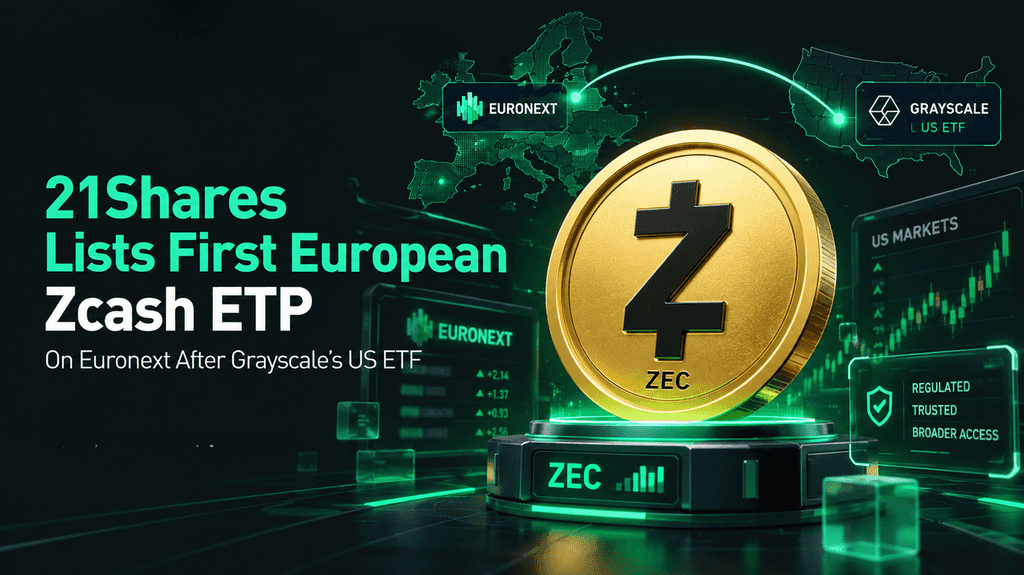
Zcash is gaining a bigger presence in traditional financial markets after 21Shares launched Europe’s first dedicated Zcash ETP on Euronext Paris and Euronext Amsterdam. The product arrived only weeks after Grayscale brought its Zcash investment vehicle to NYSE Arca in the United States under the ticker ZCSH. Together the launches expand regulated access to ZEC beyond crypto exchanges and self custody at a time when privacy focused digital assets are drawing renewed investor attention. The 21Shares product trades under the ticker ZCASH and is physically backed by ZEC while Grayscale’s U.S. product had already reached roughly $533 million in assets under management by September 8 2026. The developments raise a larger question for the Zcash market about whether easier investment access can translate into sustained demand, deeper liquidity and broader adoption rather than only short term interest around new listings.
The 21Shares Zcash ETP gives European investors a regulated way to gain exposure to Zcash through traditional financial markets without directly buying or storing ZEC. Launched in September 2026 under the ticker ZCASH the product is physically backed by the underlying cryptocurrency and trades on Euronext Paris and Euronext Amsterdam. Investors can access the product through supported brokerage accounts while the underlying ZEC remains within an institutional custody framework. This setup brings Zcash into a familiar exchange traded format and provides another route for investors who want exposure to ZEC without taking responsibility for crypto wallets and private keys themselves.
How the 21Shares ZCASH ETP Trades on Euronext
The ZCASH ETP is listed across two major European trading venues with the Paris listing available in euros and the Amsterdam listing providing another route into the product. The product uses the ISIN CH1608218801 and carries an annual product fee of 2.50 percent. Because it is an exchange listed security investors can buy and sell it through brokers that provide access to the relevant Euronext markets. Its value is designed to provide exposure to the underlying ZEC holdings after applicable fees and product expenses are taken into account.
This structure may be particularly relevant for investors who prefer holding digital asset exposure alongside other securities in an established investment account. Buying ZCASH does not give the holder direct control over the underlying coins because the investor owns the listed security rather than ZEC in a personal wallet. Investors comparing this structure with direct ownership can also follow the ZEC USDT spot market where ZEC itself trades against USDT. The physically backed ETP model nevertheless offers a different route because actual cryptocurrency supports the exposure while investors interact with the product through traditional financial infrastructure.
How the Physically Backed Zcash ETP Works
The physically backed Zcash ETP keeps the underlying cryptocurrency within a professional custody structure while investors trade securities linked to those holdings. 21Shares lists BitGo as a custodian and Flow Traders and Virtu Financial Ireland among the product’s authorized participants and market makers. These service providers support the operational infrastructure needed to connect the underlying crypto asset with an exchange traded security.
Several product details are useful for investors comparing ZCASH with other crypto investment vehicles
-
Ticker ZCASH
-
ISIN CH1608218801
-
Underlying asset ZEC
-
Annual product fee 2.50 percent
-
Issuer 21Shares AG
-
Initial securities outstanding 5000
-
Inception date September 21 2026
-
Custodian BitGo
The European product is classified as an ETP rather than a conventional fund structure. For investors the practical benefit is that Zcash exposure can sit within traditional market infrastructure even though the underlying asset remains a cryptocurrency. The distinction is important because an exchange traded crypto product can carry different legal structures, protections and risks from conventional mutual funds or ETFs.
The arrival of 21Shares ZCASH in Europe follows the earlier launch of Grayscale’s ZCSH in the United States and gives Zcash regulated investment products on both sides of the Atlantic. Rather than changing how the Zcash blockchain operates these products change how investors can gain exposure to the asset through established financial markets. Their emergence also shows how exchange traded crypto products are expanding beyond Bitcoin and Ethereum as issuers test investor interest in individual digital assets with more specialized use cases.
21Shares ZCASH vs Grayscale ZCSH Across Europe and the United States
The most obvious difference between the two products is the market they serve. Grayscale ZCSH began trading on NYSE Arca on August 25 2026 while the 21Shares product provides access through European exchanges. Grayscale describes ZCSH as an exchange traded product dedicated solely to ZEC and notes that it is not registered under the Investment Company Act of 1940. That means investors should not assume it has the same regulatory framework and protections as a conventional 1940 Act ETF or mutual fund despite its official name being The Zcash ETF.
Timing also matters when comparing the size of the two products. By September 8 Grayscale reported approximately $532.95 million in assets under management with about 464514.86 ZEC held by the fund and 5.799 million shares outstanding. Its management fee was 2.50 percent. The 21Shares ZCASH product only launched later in September so comparing their assets immediately after the European debut would give a distorted picture of demand. Longer term fund flows trading activity and changes in underlying ZEC holdings should provide a more useful comparison between investor demand in the United States and Europe.
Grayscale ZCSH Shows Growing Institutional Interest in Zcash Exposure
One of the most notable developments surrounding ZCSH came from Digital Currency Group. On September 8 DCG acquired approximately $100 million of ZCSH shares through an authorized participant in exchange for 85705.32563297 ZEC. The transaction shows that large ZEC positions can move into an exchange traded structure through the fund creation process rather than relying solely on purchases through public crypto markets. It also helped increase the scale of the U.S. product soon after its NYSE Arca listing.
The transaction should not be interpreted as proof that institutional demand will continue at the same pace or that ZEC prices must rise. DCG is Grayscale’s parent company so the relationship is also relevant when assessing the significance of the investment. The more useful long term signals will come from diversified investor participation, sustained secondary market activity and changes in assets under management after the initial launch period.
Why More Regulated Zcash Products Matter for the ZEC Market
Another notable development is Grayscale’s planned three for one forward share split for ZCSH. Shareholders of record at the close of September 28 are scheduled to receive three post split shares for every pre split share with split adjusted trading expected to begin on September 30. The change will lower the price of an individual share proportionally while increasing the number of shares outstanding without changing the total economic value of an investor’s position.
The wider market is worth watching for several additional developments
-
New fund flows can indicate whether demand survives beyond the initial product launch period.
-
Additional issuers could increase competition around fees, custody and market making.
-
Regional regulation will influence where privacy focused products can be offered and who can access them.
-
Share liquidity and spreads will help determine how efficiently investors can enter and exit listed Zcash positions.
For Zcash the bigger development is therefore not simply the arrival of another financial product. ZCASH and ZCSH create additional links between ZEC and traditional capital markets and provide more measurable indicators of investor demand. Whether these products develop into a large and durable segment will depend on sustained participation rather than launch announcements alone.
The launch of Europe’s first dedicated Zcash ETP adds another potential demand channel for ZEC at a time when the asset has already experienced strong market interest. ZEC recently traded above $1600 alongside increased trading activity around the European launch. Investors tracking whether that momentum continues can follow ZEC live price and market data alongside fund flows, trading volume and other market indicators. Several forces were operating at the same time so it is more accurate to treat the ETP as one new market catalyst rather than claim that the listing alone caused the price move.
ZEC Demand Could Broaden Beyond Crypto Native Investors
One potential effect of the European product is a broader investor base for ZEC. Direct cryptocurrency ownership typically requires an investor to choose an exchange or wallet and understand custody private keys transfers and other crypto specific processes. A listed security can remove some of these operational steps for investors who already work through conventional brokerage accounts. That does not automatically produce new buying pressure but it reduces one practical barrier that may previously have kept some market participants from considering Zcash exposure.
The longer term effect will depend on whether the product attracts sustained assets rather than short lived interest around its launch. Investment managers experienced retail investors and other market participants may find listed exposure easier to integrate into existing portfolios and reporting systems. If participation becomes broader over time it could increase Zcash visibility within traditional investment markets. If demand fades after the initial launch however the existence of an ETP by itself would have a limited effect on the wider ZEC market.
Higher Investment Activity Could Improve ZEC Liquidity
A larger ecosystem of exchange traded Zcash products could contribute to deeper market activity if the products generate consistent creation redemption and hedging flows. Additional participation by market makers and professional trading firms may improve price discovery and potentially make larger transactions easier to absorb. Better liquidity does not remove ZEC volatility and the relationship between an ETP and underlying spot market liquidity can change as market conditions shift.
Several indicators can help show whether regulated Zcash demand is becoming more meaningful
-
Assets under management can reveal whether capital is accumulating inside listed products over time.
-
Changes in ZEC holdings can show whether the amount of cryptocurrency associated with investment vehicles is expanding or contracting.
-
ETP trading volume can provide insight into secondary market participation.
-
Bid ask spreads can help investors assess the efficiency and liquidity of the listed securities.
These measurements provide more useful evidence than relying on a single day of ZEC price action. They can show whether regulated access is creating a deeper investment market or whether activity is mainly driven by short term speculation.
Zcash Adoption Still Depends on Privacy Demand and Regulation
Zcash’s longer term investment case remains closely connected to its privacy technology. The network allows transparent transactions as well as shielded transactions that use zero knowledge cryptography to conceal selected transaction information.
That same privacy focus can introduce regulatory complexity. The future of Zcash investment products will therefore depend on more than market performance. Regulatory treatment exchange availability, network development investor demand and real world use of privacy technology may all influence adoption. A growing ETP market can improve financial access to ZEC but it cannot by itself determine the success of the underlying network.
The launch of the 21Shares Zcash ETP on Euronext marks an important expansion of regulated access to ZEC in Europe and follows Grayscale’s move to bring ZCSH to NYSE Arca in the United States. The two products give Zcash a stronger connection with traditional investment infrastructure while creating new ways to measure demand through assets under management trading volume fund holdings and market liquidity. Grayscale’s early asset growth and DCG’s approximately $100 million ZCSH transaction show that substantial capital can enter regulated Zcash vehicles although these early developments should not be treated as guarantees of continued inflows or higher ZEC prices. For the market the next stage will depend on whether European and U.S. investment products can attract sustained participation while Zcash continues navigating the opportunities and regulatory questions surrounding financial privacy.
What risks should investors consider with a Zcash ETP?
Important risks include ZEC price volatility liquidity conditions product fees custody and operational risks and regulatory developments affecting crypto assets or privacy focused technologies. The market price of an ETP can also differ from its underlying net asset value particularly when trading conditions become volatile.
Can Zcash ETP inflows affect the available supply of ZEC?
They potentially can if growing investment products require additional underlying ZEC to support new securities. The size of any market effect would depend on the amount of new capital the products attract, the creation and redemption process existing fund holdings and liquidity across the broader ZEC market. A small product may have little influence while much larger holdings could become more relevant.
Why is Zcash receiving attention as a privacy focused cryptocurrency?
Zcash combines a public blockchain with optional privacy preserving transactions based on zero knowledge cryptography. The technology allows users to choose between transparent activity and shielded transactions that can conceal information such as addresses and amounts. Growing debate around digital financial privacy has helped keep that capability relevant even as regulatory questions around privacy coins remain.
How can investors measure demand for Zcash investment products?
Useful indicators include assets under management changes in underlying ZEC holdings shares outstanding trading volume bid ask spreads and fund creations or redemptions when those figures are available. Looking at several indicators together can provide a better picture of demand than using ZEC price movements alone.
The information provided on this page may originate from third-party sources and does not necessarily represent the views or opinions of KuCoin. This content is intended solely for general informational purposes and should not be considered financial, investment, or professional advice. KuCoin does not guarantee the accuracy, completeness, or reliability of the information, and is not responsible for any errors, omissions, or outcomes resulting from its use. Investing in digital assets carries inherent risks. Please carefully evaluate your risk tolerance and financial situation before making any investment decisions. For further details, please consult KuCoin’s Terms of Use and Risk Disclosure.