

Hashi Launches on Sui Mainnet: Bringing Bitcoin Into DeFi With hBTC
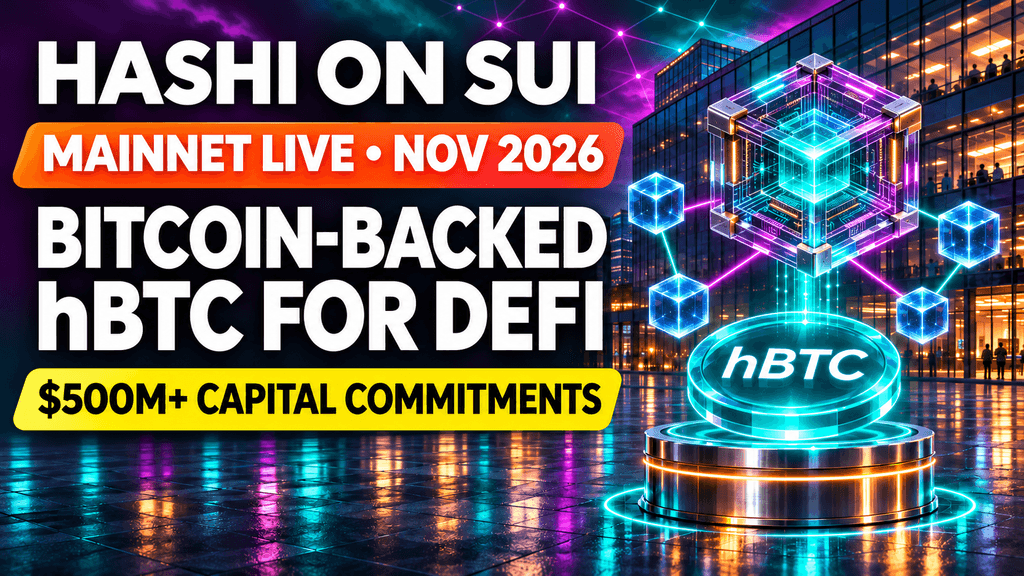
Hashi's Sui mainnet launch brings Bitcoin-backed lending and other decentralized finance applications to the network through hBTC, a token backed one-to-one by native BTC. The Sui Foundation confirmed the mainnet rollout on November 19, 2026, following an October announcement of more than $500 million in capital commitments from launch participants. Developed by Mysten Labs, Hashi keeps deposited Bitcoin on its original blockchain while making a corresponding asset usable in Sui applications. Fluid, Suilend, Cetus, Upshift, and institutional custody providers are part of the rollout, although individual services are becoming available on different schedules.
Key Takeaways
-
November 19, 2026: Sui officially announced Hashi mainnet was live with more than 20 custody, trading, and DeFi participants.
-
The announced $500 million-plus figure represents capital commitments, not verified deposits or total value locked.
-
Hashi issues hBTC at a 1:1 ratio against BTC retained in Bitcoin-network addresses managed through its protocol.
-
Fluid, Suilend, and Cetus introduced hBTC-related lending or liquidity markets during the launch period.
-
Upshift's USDC vault opened first; its HoneyB-linked hBTC vault was listed as forthcoming at launch.
-
Validator-based threshold signing, an independent Guardian, and lending-market risks will shape adoption as more integrations roll out.
Hashi Sui Mainnet Launch and $500 Million in Capital Commitments
Hashi's arrival on Sui mainnet introduces an infrastructure layer for using Bitcoin (BTC) as collateral in blockchain-based financial applications without converting the underlying asset into a custodial balance on another network. The November 19 launch announcement follows a phased deployment and an earlier funding-related statement that attracted attention because of its scale. What matters for the market is the distinction between backing announced by participating firms and Bitcoin or stablecoins actually supplied to individual protocols, which will become measurable as onchain activity develops.
Hashi Mainnet Goes Live With More Than 20 Ecosystem Partners
The Sui Foundation confirmed on November 19, 2026, that Hashi was operational on mainnet with a coalition of more than 20 organizations spanning custody, liquidity, lending, vault infrastructure, and user access. Mysten Labs developed the underlying technology, while third-party providers build their own products on top of it. The partners named around the launch include Anchorage Digital, Fluid, Upshift, HoneyB, Ember, Suilend, Cetus, Bluefin, Current, and other Sui ecosystem participants. Their involvement covers different functions; membership in the coalition does not mean that every announced product was immediately open to users.
The rollout also reflects a sequence of milestones rather than a single simultaneous product release. Sui had described a phased mainnet launch on October 8, while its November 19 statement confirmed live access and identified services already operating. Fluid opened Bitcoin-backed borrowing markets, and other applications announced support for the new asset during the same launch period. This sequencing matters because the availability of hBTC itself, the availability of lending capacity, and access to a specific managed strategy are separate conditions. A live protocol does not automatically imply that every connected vault or institutional workflow is ready.
How $500 Million in Commitments Shapes the Rollout
On October 8, 2026, the Sui Foundation said launch participants had committed more than $500 million in capital to the Hashi ecosystem. The figure described intended support across the coalition, including liquidity and capital for related products. It was not reported as $500 million already deposited into Hashi's Bitcoin reserve, nor as verified total value locked across Sui lending applications. Treating commitments as deployed assets would overstate the scale of activity at launch, particularly while individual vaults and financial services continue to open in stages.
The commitments are nevertheless relevant to Hashi's market prospects because a collateral token needs borrowing demand, stablecoin liquidity, trading depth, and redemption access to become useful beyond its initial issuance. Firms including Anchorage Digital, Cumberland, and Wave Digital Assets were identified as prospective contributors to institutional access or liquidity. The strength of that ecosystem will be easier to assess through subsequent figures such as hBTC in circulation, borrowing against hBTC, active lending liquidity, and actual vault deposits. None of those measures can be inferred directly from the headline commitment amount.
How Hashi's 1:1 Bitcoin-Backed hBTC Works on Sui
Hashi connects native Bitcoin with the Sui blockchain through a deposit-and-redemption process. When BTC is deposited into a protocol-managed Bitcoin address and the required checks are completed, Hashi issues an equivalent amount of hBTC on Sui. This makes hBTC a representation of a claim on the underlying BTC rather than a new independent cryptocurrency with its own backing model. Sui's Move-based asset framework allows compatible applications to handle hBTC as a standard onchain coin, while the actual Bitcoin remains in addresses on the Bitcoin network.
BTC Deposits, hBTC Minting and Bitcoin Redemptions
Each Sui address is associated with a distinct Hashi Bitcoin deposit address, allowing the protocol to identify which account should receive hBTC. After a Bitcoin transfer, the user must also register the deposit through a Sui transaction. Hashi's published defaults require six Bitcoin confirmations, committee approval, and a further 10-minute delay following approval before minting can be finalized. These are configuration defaults, so they should not be interpreted as a fixed delivery time under all conditions. Once completed, the amount of hBTC minted corresponds to the accepted BTC amount, maintaining the stated one-to-one backing design.
Redemption runs in the opposite direction: an hBTC holder submits a withdrawal request and a supported Bitcoin destination address, after which approved requests are processed for settlement on Bitcoin. The corresponding hBTC is burned when the request is committed to a Bitcoin transaction, helping keep the issued supply aligned with underlying reserves. Hashi lists a default minimum of 30,000 satoshis, or 0.0003 BTC, for both deposits and withdrawals. Its documentation specifies no separate protocol fee, although SUI is needed for relevant Sui transaction charges and Bitcoin miner fees apply to withdrawals. Completion time can vary with committee processing, available withdrawal capacity, and Bitcoin network conditions.
Which Sui DeFi Platforms Support hBTC Lending and Vaults
The first Hashi-linked services focus on two practical uses: obtaining stablecoin liquidity against Bitcoin collateral and placing assets into managed vault strategies. These activities fall within decentralized finance (DeFi), but they involve different contracts, counterparties, liquidity conditions, and user requirements. Announcements from November 19–20, 2026, confirm initial hBTC markets on several Sui applications. However, a project's inclusion in the wider Hashi coalition should not be mistaken for proof that every planned market, strategy, or user interface is already available.
Fluid Opens hBTC-Backed USDC Lending
Fluid confirmed its hBTC lending markets on Sui in a November 20 announcement, following the network's mainnet launch. The initial model lets borrowers use hBTC as collateral to access USDC liquidity without first selling their underlying Bitcoin exposure, while stablecoin suppliers provide the other side of the lending market. For readers, the key distinction is between owning hBTC and opening a collateralized loan: borrowing creates a debt position governed by loan-to-value thresholds, interest costs, and liquidation conditions set by the lending protocol. Fluid's wider operating history may provide context for its design, but it does not guarantee liquidity or the performance of this newly introduced Sui market.
Suilend Lending and Cetus hBTC Liquidity
Suilend said hBTC became available in its Main Market on November 19, allowing users to supply the asset and use it as collateral for loans. The project reported approximately $5.8 million in hBTC supplied within eight hours and later said the amount had passed $10 million within a day. These are project-reported launch-period snapshots, not a live balance or an independently audited measure of Hashi's total reserve. Cetus separately announced an hBTC market and liquidity-pool support, providing a venue for onchain exchanges and market making. Together, the two integrations address distinct needs: collateral-based credit on Suilend and trading liquidity on Cetus. Neither launch figure establishes long-term demand or the depth of liquidity available in changing market conditions.
Upshift and HoneyB Roll Out USDC Vaults Ahead of hBTC
Upshift's November 19 update identified HoneyB as the strategy partner for two planned vault products, but its launch-status table made an important distinction: the USDC vault was open for deposits, while the hBTC vault was still to follow. HoneyB's strategies may involve exposure to traditional financial assets and other investment categories, with Upshift providing the vault contracts and net asset value reporting. That arrangement differs from simple hBTC collateral lending because a managed vault's results depend on its underlying positions, valuation process, and withdrawal arrangements. Upshift also described permissioned access for some institutional vaults, meaning eligibility may differ between products. Future hBTC vault availability should be confirmed through a subsequent operator update rather than assumed from the initial announcement.
Anchorage Digital Expands Institutional Access
Anchorage Digital is a key connection between Hashi and institutional holders that require specialized custody and operational procedures. Sui's November 19 statement said eligible institutions could access hBTC and selected Fluid strategies through Porto, Anchorage Digital's self-custody wallet. Additional tri-party settlement arrangements through Anchorage's institutional infrastructure were described as planned for early 2027, rather than fully available on launch day. BitGo was also identified as a prospective provider of access to hBTC and stablecoin strategies during 2027. These arrangements could broaden participation among organizations with stricter operational requirements, but the scale of institutional use will depend on actual product availability, client eligibility, and the capital deployed after integrations are completed.
How Hashi Secures Bitcoin Collateral, Key Risks and Future Plans
Hashi's security model is central to its claim that Bitcoin can support onchain lending without relying on one conventional custodian. Its architecture uses a committee drawn from Sui validators to manage Bitcoin signing authority, together with an independent Guardian that must authorize ordinary withdrawals. That design introduces protections at the infrastructure level, but it cannot remove every source of risk once hBTC moves into third-party lending markets or managed vaults. The distinction matters as the ecosystem expands from basic deposits and withdrawals to financial products with their own pricing, liquidity, and operational dependencies.
Threshold MPC Signatures, Guardian and Recovery Design
Hashi uses threshold multi-party computation, or MPC, so committee members jointly generate signatures for Bitcoin transactions instead of one operator holding the complete private key. The Guardian acts as a separate signer for normal spending from the protocol's Taproot deposit addresses. Its design includes a withdrawal-rate limiter intended to restrict how quickly BTC can leave the managed pool, even if another part of the system encounters a failure. The Guardian operates through a protected signing environment, and the validator committee changes as the network's validator configuration evolves. These features reduce reliance on a single signing party, but they do not eliminate the need to assess software security, committee coordination, and governance decisions.
Hashi also documents a 60-day recovery path for Bitcoin outputs if the Guardian's signing key is lost. After the relevant time delay, the committee can use a recovery script to spend eligible outputs without the Guardian, providing a mechanism for recovering funds in a severe operational failure. This is a safety feature with its own trust assumptions, not a guarantee of immediate redemption: ordinary withdrawals still depend on approvals, rate-limiter capacity, and Bitcoin settlement. Published security reviews include work by Certora and Common Prefix, according to Sui's Hashi materials, although a completed review does not establish that all future integrations are free of vulnerabilities.
DeFi Risk Management and Hashi's 2027 Roadmap
The most direct financial risk arises when hBTC is pledged in a lending market. A decline in Bitcoin's market value, changes in borrowing costs, or an inadequate collateral ratio can make a position eligible for liquidation under that application's rules. Price oracles must also deliver sufficiently reliable data for collateral calculations, while smart-contract faults, thin trading liquidity, and delays in obtaining native BTC can affect users in different ways. Managed vaults add strategy-specific exposure and withdrawal queues, which are not equivalent to holding unencumbered Bitcoin. The one-to-one issuance design describes the backing relationship; it does not mean hBTC will always trade at an identical market price or remain immediately redeemable under every circumstance.
Looking ahead, the announced roadmap includes Ember's planned vault rollout later in 2026, further Upshift vault products, additional support from Sui lending and trading protocols, and institutional custody integrations extending into 2027. Sui has also pointed to broader access through BitGo and early-2027 tri-party settlement services. These are stated plans, not completed launches, and dates can change as technical, compliance, and operational work proceeds. The clearest evidence of progress will come from operating markets, successful redemptions, usable liquidity, and transparent onchain activity rather than partner counts alone. Without those measures, it would be premature to conclude that Hashi has already transformed Bitcoin-backed borrowing on Sui.
Conclusion
Hashi's November 2026 mainnet rollout gives Sui a new way to represent Bitcoin as hBTC for lending, trading liquidity, and potentially managed financial strategies while the underlying BTC remains on its native network. The launch has credible initial integrations and more than $500 million in announced capital commitments, but those commitments should not be confused with assets already held by the protocol. The emerging market will depend on sustained liquidity, reliable redemption, effective security measures, and the completion of products still on partner roadmaps. For now, Hashi is an operational piece of Bitcoin-backed DeFi infrastructure whose longer-term significance remains to be demonstrated through measurable use.
FAQs
Is there an official HASHI token or a Hashi airdrop?
No. Hashi's protocol documentation states that hBTC is the only coin it issues and that there is no separate HASHI governance, utility, or airdrop token. Unofficial claims about a newly issued HASHI asset should not be treated as part of the protocol's announced token design.
Do users need SUI tokens to mint or withdraw hBTC?
Yes, SUI is required to pay transaction charges when interacting with Hashi on the Sui network. The amount varies with the transaction and network settings, while a withdrawal also incurs a Bitcoin miner fee. Hashi itself specifies no separate protocol fee in its documentation.
Why might hBTC not appear after a Bitcoin deposit?
A Bitcoin transfer alone does not complete the minting process; the deposit must also be registered through a Sui transaction. Hashi then waits for the required Bitcoin confirmations, committee approval, and the configured delay. An expired registration request may need to be resubmitted for the same eligible Bitcoin output.
Are all Hashi-linked vaults available to retail users?
No. Some vaults may limit participation to approved institutional wallets, and product access depends on the provider's rules. Availability also changes by launch stage, so an announced vault should not automatically be treated as open for deposits.
Which Bitcoin address formats does Hashi support for withdrawals?
Hashi's documentation lists native SegWit P2WPKH (bech32) and Taproot P2TR (bech32m) Bitcoin destination addresses. Legacy addresses and P2WSH destinations are not supported in the documented withdrawal flow. The destination must belong to the Bitcoin network paired with the relevant Sui deployment.
Disclaimer: This general market information, possibly from third-party, commercial, or sponsored sources, is provided for reference and educational purposes only and does not constitute financial or investment advice, an offer, solicitation, or guarantee. We disclaim liability for its accuracy, completeness, reliability, and any resulting losses. Investments/trading are risky; past performance doesn’t guarantee future results. Users should research, judge prudently, and take full responsibility. For further details, please consult KuCoin’s Terms of Use and Risk Disclosure.