

GRAM Token Price and the App Store Incident: What Investors Need to Know
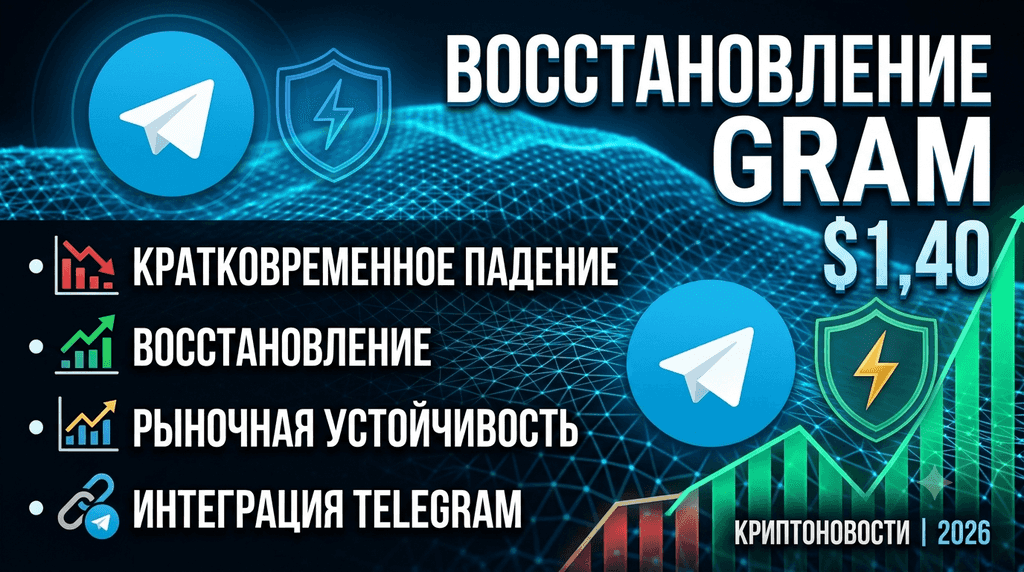
The GRAM token price demonstrated high resilience, recovering to $1.40 just hours after a brief 6% dip caused by the temporary removal of Telegram from the App Store. This incident served as a classic example of "emotional volatility," where a technical disruption in the messenger's distribution triggered short-term panic among asset holders in the TON ecosystem. According to market aggregators, the native GRAM token (formerly known as Toncoin) dropped to a local low of $1.32 but quickly regained its position following official clarifications from Apple and the Telegram team.
In this article, we will analyze why the removal of Telegram does not pose fundamental threats to the TON blockchain, how investors should react to such "black swans," and what prospects are opening up for GRAM amid its integration with the largest messenger in 2026.
Why Did Telegram Vanish from the App Store? A Breakdown of Causes
The temporary removal of Telegram from the App Store on August 4, 2026, was due to a prohibited content moderation procedure rather than a global ban or sanctions against the platform. This incident caused a widespread resonance in the crypto community, as many users mistakenly interpreted it as the beginning of a full-scale war by Apple against decentralized technologies. However, the reality proved much more mundane and was related to internal App Store security check algorithms that were triggered by a specific case of platform rule violation.
To deeply understand the situation, it is important to consider the mechanisms by which moderation works in the iOS ecosystem. Apple imposes extremely strict requirements on User Generated Content (UGC), especially in apps with multi-million audiences. Any signal of the distribution of materials related to the exploitation of minors leads to an immediate suspension of the app's distribution until the circumstances are clarified. In Telegram's case, the messenger's moderation system—based on artificial intelligence and manual review of reports—recorded the violation almost simultaneously with Apple, but the technical removal cycle from the store worked faster.
According to Forbes Russia, citing internal sources within the company, Telegram has significantly increased its moderation staff over the past year, working with both Russian-speaking and global segments. Nevertheless, with daily traffic volumes in the hundreds of petabytes, isolated cases of filter breaches are inevitable. Importantly, the August 4 incident was localized within 45 minutes. This is a record time for such situations, confirming the high readiness of Pavel Durov's technical service for crisis management. For GRAM investors, this is a positive signal: the company knows how to quickly negotiate with tech giants while maintaining access to its massive user base.
How Did the GRAM Token Price and TON Ecosystem React?
The GRAM token price reacted to the news of Telegram's "delisting" from the App Store with an immediate 6% drop, which was followed by a 4% recovery within the same trading day. KuCoin exchange charts recorded a sharp increase in trading volume for the GRAM/USDT pair, indicating the triggering of algorithmic stop-losses and subsequent dip-buying by major players. According to CoinMarketCap statistics as of August 5, 2026, the token is trading in the range of $1.38–$1.41, which almost corresponds to pre-incident levels.
Below is a comparative table of the GRAM token's reaction to key events in recent months, based on market analytics data from June–August 2026:
|
Event
|
Date
|
Price Reaction (Immediate)
|
Outcome after 48 Hours
|
|
TON to GRAM rebranding on KuCoin
|
June 15, 2026
|
+12%
|
Stabilization
|
|
Announcement of Wallet Pay launch
|
July 10, 2026
|
+7%
|
Growth maintained
|
|
Telegram removal from App Store
|
August 4, 2026
|
-6%
|
Full recovery
|
The GRAM drop was driven purely by psychological factors. Investors, fearing the loss of access to Telegram Wallet and Mini Apps, began to exit positions en masse. However, as soon as it became clear that the TON blockchain's technical infrastructure was unaffected, buyers returned the price to fair values. It is crucial to understand that GRAM is not just a "messenger token" but the native currency of a scalable blockchain that continues to operate independently of the client app's availability in a specific store.
Asset Security: Are Wallet and Mini Apps Under Threat?
Your assets in Telegram Wallet and Mini Apps (GRAM, TON, USDT) were and remain completely safe, as the temporary absence of the app in the App Store does not affect blockchain operations or the security of keys on servers. The removal of the app from the store only means the inability for new users to download it or for old users to update it. All installed copies of Telegram continued to function normally, providing access to crypto wallets and decentralized applications (dApps).
According to the TON Foundation's technical documentation, the ecosystem's architecture is built on the principle of separating the interface from the protocol. Even in a hypothetical scenario of a total Telegram ban in the App Store, users could access their funds through:
-
Wallet Web Interfaces: Direct interaction with the blockchain via a browser.
-
Telegram Desktop Versions: Apps for Windows and macOS that do not depend on Apple or Google stores.
-
Third-party Wallets: Tonkeeper, MyTonWallet, and other apps supporting the GRAM standard.
Thus, the panic surrounding "loss of access" was unfounded. Blockchain explorer data confirms that during the August 4 incident, the TON network processed transactions without delays, with an average block generation time of a stable 5 seconds. Investors should remember that the security of the GRAM cryptocurrency is provided by a distributed network of validators, not by Apple's moderation policy.
Is This a "Black Swan" or a Buying Opportunity?
For experienced traders, the GRAM price dip following the App Store news became a classic "buy the dip" opportunity, as the project's fundamental indicators remained unchanged. In technical analysis, such events are called "false breakouts" or "shaking out weak hands." When the crowd panics and starts selling the asset at any price, large institutional investors (so-called "whales") use this liquidity to accumulate positions at favorable prices.
The psychology of the cryptocurrency market in 2026 is largely built on the speed of news distribution. In an era where news in Telegram channels spreads in seconds, price reactions often outpace common sense. Let's consider why the drop to $1.32 was irrational:
-
No impact on emission: Removal from the App Store does not change the number of GRAM tokens in circulation and does not affect the consensus algorithm.
-
Preservation of ecosystem revenue: Telegram's advertising model, tied to GRAM, continued to generate income as ads are shown in desktop versions and already installed apps.
-
Historical precedents: Recall temporary blocks of other major services (e.g., Binance in some jurisdictions or temporary Solana outages). In 90% of cases, assets recovered in price as soon as the media noise subsided.
From a long-term investment perspective, the GRAM price around $1.40 looks attractive compared to forecasts from leading analysts for the end of 2026. Many experts predict a return to the $3–$5 levels as more services within Telegram (from purchasing virtual numbers to subscriptions for closed channels) switch to payment exclusively in GRAM. Thus, what at first glance seemed like a catastrophe actually turned out to be a gift for those who know how to analyze the situation deeper than news headlines.
Success Story: From Toncoin to GRAM and the Role of KuCoin
The GRAM token's journey to its current status as a market leader has been challenging: from legal battles with the SEC in 2020 to a massive rebranding and recognition by global exchanges like KuCoin in 2026. A major milestone was June 2026, when the project finally consolidated its resources under the GRAM brand to emphasize ecosystem unity and simplify asset perception for mass users.
KuCoin exchange played a key role in this process, ensuring a smooth transition for millions of Toncoin holders. Support for the rebranding by KuCoin provided users with a seamless transition without stopping trading. This trust from a major exchange is a powerful factor in supporting the GRAM price, signaling the market about the asset's long-term prospects.
Today, GRAM is not just a cryptocurrency but a symbol of how a decentralized community can complete an ambitious project started by a genius. KuCoin's support provides the asset with a necessary "safe haven" during storms like the App Store incident, allowing traders to be confident in the security of their funds and the ability to make a trade at any time. Market analysts note that such short-term crashes caused by external news are often the best entry points. Given that GRAM in 2026 is actively integrated into the Telegram advertising platform and used for payouts to content creators, the demand for the token has a real economic basis.
Based on analytical agency reports from July 2026, three reasons can be highlighted why GRAM remains an attractive asset:
-
Mass Adoption: Over 900 million Telegram users have potential access to GRAM through the built-in wallet.
-
Deflationary Mechanisms: A portion of commissions in the TON network is burned, limiting the token supply.
-
Mini Apps Ecosystem: The growing popularity of games and services within Telegram increases GRAM's utility value.
Regulatory Pressure on Telegram in 2026: Context
Although the App Store incident was related to content moderation, it occurred against a backdrop of overall increased regulatory pressure on Telegram from authorities in the UK (Ofcom), Australia (eSafety), and Russia. In 2026, the world entered an era of "digital sovereignty," where every state seeks to control information flows. Telegram, as a platform with the highest level of privacy, naturally finds itself in the crosshairs.
The British regulator Ofcom initiated a massive investigation into the messenger's activities in April 2026, demanding the implementation of client-side message scanning technologies. Similar demands are made by the Australian eSafety agency, which has already imposed several fines on the company for "insufficient cooperation." In Russia, the situation reached a peak in late July when Pavel Durov was declared wanted. These events create a so-called "regulatory discount" around GRAM—the token price is lower than it could be due to investor concerns about the platform's future.
However, it's worth looking at the situation from another side. Telegram is not just an app; it is a critical infrastructure for business, media, and government communications in many countries. A total ban on the messenger would cause colossal economic damage that most governments are not ready for. Therefore, we see a process of "painful adaptation": regulators push, Telegram implements necessary compromise moderation tools (as in the App Store case), but the platform's essence remains unchanged. For GRAM, this means that volatility will persist, but fundamental demand backed by real usage will not disappear. Moreover, it is precisely under pressure that the value of decentralized financial instruments within Telegram increases.
In late July 2026, the Russian FSB declared Pavel Durov wanted internationally on charges of assisting terrorism, creating a tense information background. GRAM investors should consider that geopolitical risks remain a significant factor of volatility for all projects closely tied to the messenger. Nevertheless, it is important to separate legal claims against the founder's personality from the technical viability of the blockchain. The TON (The Open Network) blockchain was handed over to the developer community back in 2020 and has since functioned as an independent decentralized structure. According to legal analysis in crypto law, even in the event of personal sanctions against Telegram's leadership, the TON protocol will continue to work, as its nodes are distributed worldwide and not controlled by a single organization.
How to Buy and Trade GRAM Token on KuCoin?
To purchase GRAM (formerly TON), the most reliable method is using the KuCoin exchange, which was one of the first to complete the asset's rebranding and provide deep liquidity in pairs with USDT and BTC. In conditions of market turbulence like the App Store incident, the choice of trading platform becomes critically important. KuCoin provides not only access to the asset but also a multi-level protection system that includes cold storage of funds and advanced encryption protocols.
Trading GRAM on KuCoin offers several advantages:
-
High Liquidity: Even with sharp price swings, you can close a position at the market price without significant losses.
-
Variety of Instruments: In addition to spot trading, KuCoin offers GRAM futures, allowing you to earn on both price increases and decreases (risk hedging).
-
Localized Support: An interface in multiple languages and an efficient support service help quickly resolve any arising issues.
-
KuCoin Earn: You can make your GRAM "work" by placing them in products with fixed or flexible yields, which is especially relevant for long-term holders.
To get started, simply create an account on KuCoin, top up your balance in USDT, and place an order in the trading terminal. This is the fastest and safest way to become part of the GRAM ecosystem in 2026.
Join KuCoin 9th Anniversary Trading Campaign
KuCoin is celebrating its 9th anniversary with a special platform campaign filled with exclusive rewards, trading activities, and limited-time offers. Don’t miss the chance to participate and enjoy the benefits as the exchange marks nine years of growth and innovation. Visit the official campaign page now:
Conclusion
For active KuCoin users and long-term GRAM holders, this case served as an important lesson in market psychology: in the world of cryptocurrency, Fear, Uncertainty, and Doubt (FUD) factors often create artificial and short-term price fluctuations without real economic basis. Given the ongoing expansion of GRAM into Telegram's advertising infrastructure, the launch of new payment solutions, and the rapid growth of Mini Apps users, current price levels can be seen as a period of healthy consolidation before the potential start of a new major growth cycle.
It is crucial for investors to remain calm during such "black swans." Analyzing primary sources and using reliable platforms like KuCoin allow for capital preservation and taking advantage of the crowd's panic. The future of GRAM is inextricably linked with the mass adoption of decentralized technologies, and temporary moderation difficulties are only small obstacles on this path. Stay informed and make balanced decisions.
Frequently Asked Questions (FAQ)
1. Why did the GRAM price drop specifically because of the App Store?
The GRAM price dropped due to the close associative link between the token and the Telegram messenger. Investors feared that the app's removal from the App Store would limit access to the TON ecosystem and slow down the influx of new users, leading to short-term sell-offs.
2. Is it safe to store GRAM in a wallet inside Telegram?
Yes, it is safe. The wallet in Telegram uses an independent blockchain infrastructure. Even if the app is unavailable in the store, your assets remain under your full control.
3. How does GRAM differ from TON?
GRAM is the new name for the Toncoin token after the official rebranding completed in June 2026. On KuCoin and other major exchanges, the asset now trades under the GRAM ticker, but its technical characteristics and transaction history remain the same.
4. Can Telegram be removed forever?
The total and final removal of Telegram from the App Store is unlikely, as the company actively cooperates with regulators on content security issues. As the August 4 case showed, any violations are resolved within an hour to restore access.
5. Where is the best place to buy GRAM in 2026?
The optimal choice is the KuCoin exchange. It provides high security, low fees, and supports all relevant trading pairs with GRAM, including staking and other financial instruments for investors.
Disclaimer : This material is provided for informational purposes only and does not constitute financial, investment, legal, or tax advice. Transactions involving cryptocurrencies and tokenized assets carry substantial risks — including price volatility, limited liquidity, counterparty exposure, and the potential for total loss of invested capital. Readers should conduct their own research and, where appropriate, consult a qualified professional before making any financial decisions.