

Glassnode Altcoin Cycle Signal Flips to Altcoin Season After September Rally
Introduction
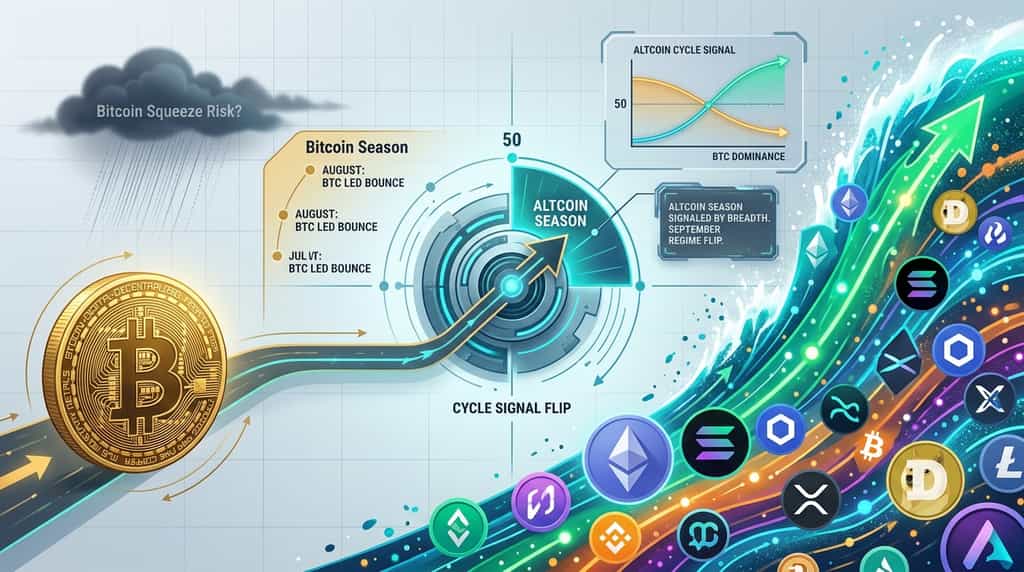
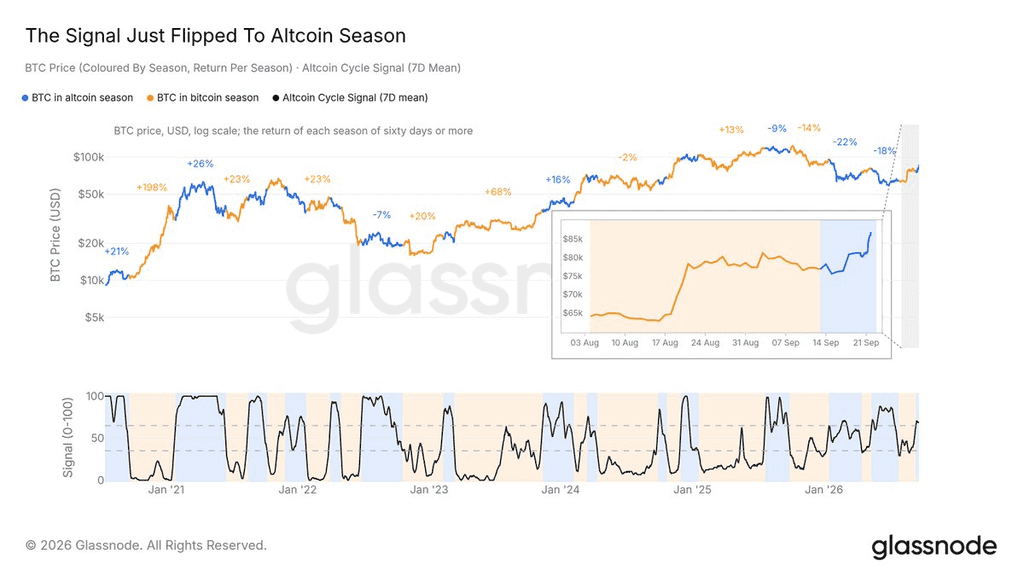
Did the September rally finally pull the rest of crypto off Bitcoin's coattails? According to Glassnode, yes. On 21 September 2026 the on-chain analytics firm said its Altcoin Cycle Signal had just flipped from Bitcoin season to altcoin season, with that day's advance igniting the full breadth of the altcoin market after August's Bitcoin-led bounce left most tokens flat.
The flip does not mean every altcoin is in a confirmed multi-month bull run. It means Glassnode's model now favors a basket of the top 250 altcoins over Bitcoin on a relative-performance basis. Traders still need to separate breadth from leverage, dollar gains from share-of-market gains, and one firm's signal from stricter 90-day indices that have not yet printed a classic altseason reading.
What Does Glassnode's Altcoin Cycle Signal Measure?
Glassnode's Altcoin Cycle Signal measures whether the market favors Bitcoin or a broad altcoin basket. According to Glassnode Docs, the metric uses price data for the top 250 altcoins by market capitalization, excludes stablecoins, and is designed to stay largely agnostic to which individual tokens an investor holds.
The firm updates the series daily at 10:15 UTC with the previous day's print. During Bitcoin season, Bitcoin is more likely to outperform that 250-coin basket. During altcoin season, the dynamic inverts.
A reading above 50 is the conventional line between those two regimes. The June 2026 print that first put the model back in altcoin-season territory reached 86, well above that line. The September 21 announcement is a regime flip, not a restatement of that June peak. Glassnode Studio still showed a recent daily value near 43.75 in the hours before the public note, which underscores how quickly the latest session changed the model's stance.
The signal is relative, not absolute. Altcoins can "win" the print because they rise faster than Bitcoin, because they fall less than Bitcoin, or because a single session lifts a wide set of names at once. That last case is what Glassnode highlighted for the September rally.
Why Did the September Rally Show Full Market Breadth?
Glassnode's answer is direct: August's first rally lifted Bitcoin while altcoins stayed relatively flat, but the September 21 advance spread across the broader altcoin market. Breadth, in this usage, means participation across many tokens rather than a handful of large-cap leaders.
That distinction matters because a Bitcoin-only bounce can look like risk-on without rotating capital down the risk curve. A breadth-led session does the opposite. It shows buyers willing to bid Ethereum, large Layer 1s, and a wider set of mid-caps in the same window.
The backdrop was already a rising altcoin complex in dollar terms. In The Week On-chain (Week 36, 2026), Glassnode reported that Altcoin Market Cap had risen 21% over the month, with data as of 7 September 2026. The same report stressed that this dollar gain had not yet become an outsized grab of Bitcoin's market-share. The 90-day change in altcoin share of combined Bitcoin and altcoin market cap was still negative at -0.9 points.
So the September 21 print is best read as a breadth event on top of a month-long dollar recovery, not as proof that altcoins have already taken the cycle's liquidity away from Bitcoin.
Is the Broader Crypto Market Confirming an Altcoin Season?
Not on every widely used gauge. Blockchain Center's Altcoin Season Index stood at 49 on 22 September 2026, below the 75 threshold that service uses to declare altcoin season. Its rule is simple: if 75% of the top 50 coins beat Bitcoin over the last 90 days, it is altcoin season. A 49 reading remains in Bitcoin-season or neutral territory on that scale.
CoinMarketCap uses a related 90-day test on the top 100 eligible coins, excluding stablecoins and wrapped assets. Altcoin season on that index also requires 75% outperformance versus Bitcoin. CMC's public methodology has not changed, and mid-year Academy material from the firm still described readings in the mid-40s to 50s as Bitcoin-favoring rather than a completed altseason.
These indices and Glassnode's cycle signal answer different questions. Glassnode compares Bitcoin with a cap-weighted-style basket of 250 names and can flip on shorter momentum. The 90-day top-50 and top-100 tests demand sustained, majority outperformance. Traders who treat "altcoin season" as a single binary label will misread the tape.
Market size context helps. According to CoinGecko data around 22 September 2026, total cryptocurrency market capitalization was about $3.01 trillion, with 24-hour volume near $158 billion and Fear and Greed at 59 (Greed). Bitcoin market capitalization printed about $1.74 trillion on 22 September 2026 after an $86,597 close on 21 September. Ethereum market capitalization was about $334 billion, with ETH near $2,736. Solana market capitalization was about $70 billion.
Those figures show a market large enough for altcoins to move in dollars without yet dominating Bitcoin's share.
What Risks Could Invalidate a Fresh Altcoin Season Call?
A Bitcoin squeeze through nearby overhead supply can invalidate the call by pulling liquidity back up the risk curve. Glassnode's early-September on-chain work placed a well-watched Bitcoin ceiling between $83,000 and $86,000 using long-term holder cost basis, the futures liquidation map, and the US spot ETF break-even. Spot had already tested near that band. A violent Bitcoin squeeze that leaves alts behind would recreate the August pattern.
A second invalidation is leverage catching up without spot. If altcoin open interest closes the gap with Bitcoin while funding turns persistently positive, breadth can look healthy right before liquidations.
A third invalidation is index divergence that never closes. If Glassnode stays in altcoin season while 90-day top-50 and top-100 tests remain stuck near 45 to 55, the "season" is a model regime, not a market-wide fact.
Macro still sits over all three. The same Glassnode weekly note recorded US core inflation at a two-year low of 2.5% while the US 10-year yield was near 4.8%. Tight financial conditions can cut risk appetite across Bitcoin and alts together, which would mute any rotation.
Beyond the Headlines: What KuCoin 5.0 Means for You
Market news moves fast — but where you act on it matters just as much. This October, KuCoin launches KuCoin 5.0, transforming KuCoin into a rebuilt platform. Here's what actually changes for you:
-
One account for everything. Older platforms split your money across separate "spot," "margin," and "futures" accounts and expected you to understand why. KuCoin 5.0's unified account removes that entirely — deposit once, and everything is simply there.
-
Stocks, indices, and commodities. KuCoin 5.0 expands beyond crypto into global markets. When crypto chops sideways and equities rally (or the reverse), you rotate in minutes instead of opening a brokerage account and waiting days for fiat rails.
-
Real-world assets (RWA). Tokenized exposure to traditional assets like commodities, right inside your crypto account. One of the fastest-growing segments in global finance is no longer reserved for institutions — you access it from the same balance you trade with.
-
Earn while you learn. Not ready to trade? KCUSD lets your stablecoins earn daily, auto-compounding interest. The lowest-stress way to put your idle deposit to work for 4% yield.
-
An AI assistant in plain language. Ask questions, get market context, understand what you're looking at — built into the platform, no jargon required.
-
An app that doesn't overwhelm. Faster, cleaner, and consistent — intuitive from the first tap, not after a tutorial.
-
Safety you can check, not just trust. A MiCAR-licensed EU entity, Proof of Reserves you can verify yourself, and internationally certified security (SOC 2 Type II, ISO 27001:2022).
Create your account in minutes — and start on the platform built for where crypto is going, not where it's been.
Conclusion
Glassnode's Altcoin Cycle Signal flipped from Bitcoin season to altcoin season on 21 September 2026 because that day's rally spread across the altcoin complex after August's Bitcoin-led bounce left most tokens relatively flat. The model compares Bitcoin with a top-250 altcoin basket excluding stablecoins and treats readings above 50 as altcoin-favoring.
The flip sits on top of a month in which Glassnode already recorded a 21% rise in altcoin market cap, while the 90-day change in altcoin share of combined Bitcoin and altcoin cap was still negative at -0.9 points as of early September. Dollar gains arrived before share gains. Stricter 90-day tests, including Blockchain Center's reading of 49 on 22 September 2026, have not yet printed a classic 75-plus altseason.
Leverage in alts remained below Bitcoin's in mid-September research, which lowers squeeze risk and raises the bar for spot confirmation. CoinGecko data around 22 September 2026 put total crypto market cap near $3.01 trillion, Bitcoin near $1.74 trillion, and Ethereum near $334 billion. Treat the Glassnode flip as an early breadth regime change, then wait for dominance, 90-day majority outperformance, and open-interest behavior to agree before calling a full seasonal rotation.
FAQs
Does a Glassnode flip guarantee that small-cap memecoins will rally next?
No. The signal covers a top-250 basket excluding stablecoins and does not rank individual narratives. Small-cap follow-through still depends on liquidity and risk appetite.
Why can Glassnode say altcoin season while other indices disagree?
Glassnode uses a broad 250-coin relative-performance model that can flip on shorter momentum. Blockchain Center and CoinMarketCap use 90-day majority-outperformance tests with a 75 threshold.
Did altcoins already take market share from Bitcoin in September 2026?
Not on Glassnode's early-September share measure. Altcoin market cap rose about 21% over the month, but the 90-day change in altcoin share was still -0.9 points.
What confirmation would make this look like a durable altcoin season?
A sustained Glassnode reading above 50, 90-day indices moving toward 75, a positive 90-day change in altcoin share, and altcoin open interest that rises with spot volume rather than funding alone.
Disclaimer: This article is for informational purposes only and does not constitute financial, legal, or investment advice. Always conduct your own research before interacting with digital assets.