

Why Anthropic Is Worth $1.4 Trillion Pre-IPO: What Its Explosive Revenue Growth Means for AI, Crypto, and 2026
2026/05/14 16:33:02
Introduction
Anthropic just became the most valuable private company in history. According to The Kobeissi Letter, the AI startup's valuation has soared to approximately $1.4 trillion on a pre-IPO basis in mid-2026 — surpassing SpaceX and rivaling publicly traded tech giants. This meteoric rise is fueled by annualized revenue reportedly exceeding $9 billion, a figure that has roughly tripled year-over-year. For crypto investors, the implications are significant: Anthropic's trajectory signals a broader capital rotation into AI that could reshape liquidity flows across digital asset markets.
To understand the full context, the below are the recommended readings:
-
Anthropic Mythos Security explores how the company's AI models are already reshaping cybersecurity landscapes,
-
Anthropic IPO Crypto Impact examines how upcoming tech IPOs could redirect capital flows affecting BTC and crypto market liquidity,
-
and Anthropic Crypto Threats analyzes the emerging risks AI poses to blockchain security infrastructure.
What Is Anthropic and Why Has Its Valuation Reached $1.4 Trillion?
Anthropic is an AI safety company that has become the world's most valuable private startup, reaching an estimated $1.4 trillion pre-IPO valuation by mid-2026. Founded in 2021 by former OpenAI executives Dario and Daniela Amodei, the company develops the Claude family of large language models — including Claude Opus 4 and Claude Sonnet 4 — with a stated focus on AI safety and reliability.
From Startup to Trillion-Dollar Valuation
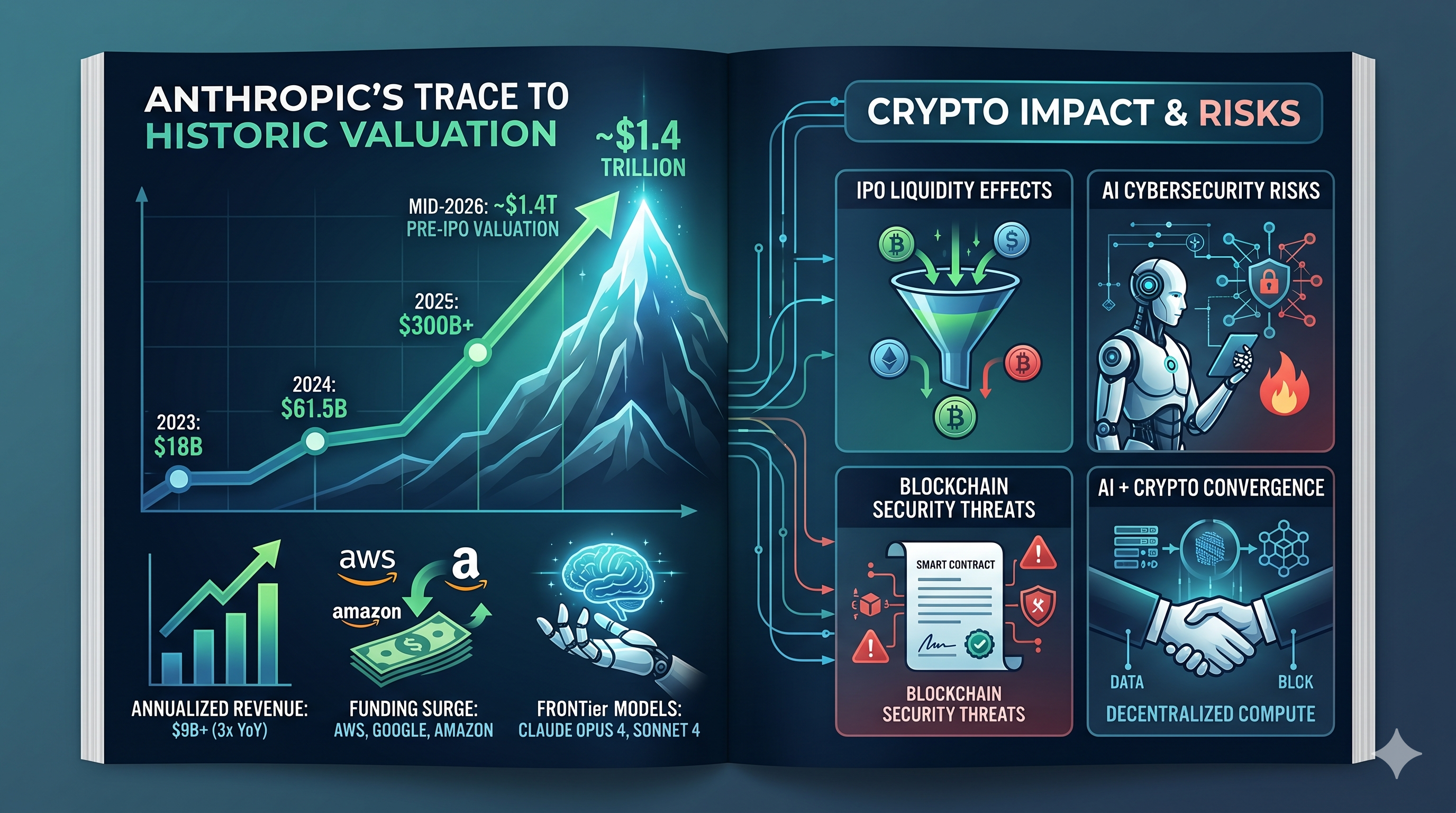
The company's valuation trajectory has been nothing short of extraordinary. Anthropic was valued at roughly $18 billion in late 2023, jumped to $61.5 billion by early 2025, and then rocketed past the $1 trillion mark in 2026. According to reporting by The Kobeissi Letter in May 2026, the company's pre-IPO valuation now sits at approximately $1.4 trillion, making it the most valuable private company ever — surpassing SpaceX's prior record.
This valuation surge has been driven by several factors. Massive funding rounds from investors including Google, Amazon, and Salesforce Ventures have injected tens of billions of dollars into the company. Amazon alone committed up to $8 billion in investment by early 2025, with additional capital deployed since. The competitive race to build frontier AI models has created a funding environment where top-tier AI labs command valuations previously reserved for mature public companies.
How Anthropic Compares to Other AI Giants
Anthropic's $1.4 trillion valuation places it in rarefied air. For context, OpenAI was reportedly valued at around $300 billion in its most recent private round in early 2026, meaning Anthropic's valuation is now roughly 4-5 times that of its closest private competitor. Among publicly traded companies, only Apple, Microsoft, NVIDIA, Alphabet, and Amazon consistently maintain market capitalizations above $1.4 trillion.
|
Company
|
Valuation (Mid-2026)
|
Status
|
Primary AI Product
|
|
Anthropic
|
~$1.4 Trillion
|
Private (Pre-IPO)
|
Claude (Opus 4, Sonnet 4)
|
|
OpenAI
|
~$300 Billion
|
Private
|
GPT Series, ChatGPT
|
|
Google DeepMind
|
Part of Alphabet (~$2.2T)
|
Public
|
Gemini
|
|
Meta AI
|
Part of Meta (~$1.6T)
|
Public
|
Llama
|
The gap between Anthropic and OpenAI is particularly striking given that OpenAI had a significant head start in consumer adoption. Anthropic's premium valuation reflects investor confidence in its enterprise-focused strategy, its AI safety positioning, and — most critically — its explosive revenue growth trajectory.
How Fast Is Anthropic's Revenue Actually Growing?
Anthropic's revenue growth is among the fastest ever recorded for a technology company at this scale. Based on data cited by The Kobeissi Letter in May 2026, the company's annualized revenue has surpassed $9 billion, representing approximately a 3x increase year-over-year from an estimated $3 billion annualized run rate in mid-2025.
Breaking Down the Revenue Numbers
The revenue acceleration has been dramatic across multiple timeframes. In early 2024, Anthropic's annualized revenue was estimated at roughly $900 million. By the end of 2024, that figure had climbed to approximately $2 billion. The company then reportedly hit a $3 billion annualized run rate by mid-2025 and has now tripled that figure to over $9 billion by mid-2026.
This growth rate — roughly 10x over a two-year period — outpaces even the most aggressive revenue ramps seen in prior technology cycles. For comparison, OpenAI's revenue was estimated at around $5-6 billion annualized in early 2026, meaning Anthropic has not only closed the gap but potentially surpassed its rival in top-line revenue generation.
What Is Driving This Revenue Surge?
Enterprise adoption of Claude models is the primary revenue engine. Anthropic has aggressively pursued enterprise contracts, positioning Claude as a reliable, safety-focused AI assistant for regulated industries including finance, healthcare, and legal services. The launch of Claude Opus 4 and Claude Sonnet 4 in 2026 significantly expanded the company's capabilities, particularly in complex reasoning, coding, and agentic workflows.
The API business has scaled rapidly as developers integrate Claude into production applications. Anthropic's pricing model — based on token usage — creates a revenue structure that scales directly with adoption. As enterprises move from pilot programs to full-scale deployments, per-customer revenue has expanded substantially.
Additionally, strategic partnerships with Amazon Web Services (AWS) and Google Cloud have provided built-in distribution channels. Claude is available as a first-party offering on both major cloud platforms, reducing friction for enterprise customers who already operate within those ecosystems.
What Does Anthropic's Growth Mean for a Potential IPO?
An Anthropic IPO would likely be the largest technology public offering in history, and its timing could significantly impact capital markets — including crypto. At a $1.4 trillion pre-IPO valuation, a public listing would need to price at or above this level to satisfy existing investors, creating an IPO of unprecedented scale.
IPO Timeline and Market Expectations
While Anthropic has not officially announced IPO plans, multiple reports suggest the company is actively preparing for a public listing, potentially in late 2026 or early 2027. The company has been hiring for public-company readiness roles, including financial reporting and investor relations positions, according to industry reporting from early 2026.
An IPO at this valuation would dwarf previous records. Saudi Aramco's 2019 IPO raised $25.6 billion at a $1.7 trillion valuation, while no technology company has ever gone public at anything close to $1.4 trillion. The sheer scale of capital required to absorb such an offering could create significant liquidity effects across global markets.
How an Anthropic IPO Could Affect Crypto Markets
Large technology IPOs historically create capital rotation effects that ripple across asset classes, including cryptocurrencies. When massive amounts of institutional capital are redirected toward a high-profile IPO, other risk assets — including BTC and altcoins — can experience temporary liquidity compression.
The mechanism is straightforward. Institutional investors managing diversified portfolios may liquidate positions in crypto, growth stocks, or other speculative assets to fund IPO allocations. This effect was observed during previous large tech IPOs, though the magnitude depends on broader market conditions and investor sentiment.
However, the relationship is not purely negative. A successful Anthropic IPO could also validate the broader technology and innovation narrative, creating a positive sentiment spillover that benefits risk assets including crypto. The net effect depends on timing, market conditions, and the specific structure of the offering.
Why Does Anthropic's AI Development Matter for Blockchain and Crypto Security?
Anthropic's advancing AI capabilities represent both an opportunity and a threat to the cryptocurrency ecosystem. The company's frontier models — particularly the Mythos research line — have demonstrated capabilities that directly intersect with blockchain security, smart contract auditing, and cryptographic analysis.
AI-Powered Security Auditing
Anthropic's AI models have already proven their value in identifying software vulnerabilities at scale. The company's Mythos model helped Mozilla identify and fix 271 security bugs in Firefox, demonstrating an ability to detect complex vulnerabilities that human auditors might miss. This same capability, when applied to blockchain codebases and smart contracts, could dramatically improve the security posture of the entire crypto ecosystem.
For crypto projects, AI-powered auditing offers the potential to catch exploitable vulnerabilities before they result in hacks. DeFi protocols lost over $1.5 billion to exploits in 2025 alone, according to blockchain security firms. Advanced AI models capable of reasoning about code at a deep level could significantly reduce these losses.
The Double-Edged Sword of Advanced AI
The same capabilities that make Anthropic's models useful for defense also create potential offensive risks. Advanced AI systems could theoretically be used to identify vulnerabilities in smart contracts for exploitation, generate sophisticated phishing attacks targeting crypto wallet holders, or even accelerate research into breaking cryptographic primitives.
While current AI models — including Claude — are not capable of breaking modern encryption standards, the trajectory of capability improvement raises legitimate long-term questions. If AI continues to advance at its current pace, the timeline for quantum-resistant cryptography adoption in blockchain networks becomes more urgent.
This dual-use nature of AI technology means that the crypto industry must proactively engage with AI safety research — precisely the kind of work Anthropic prioritizes — rather than treating AI development as an external concern.
How Does Anthropic's Rise Fit Into the Broader AI Investment Landscape?
Anthropic's $1.4 trillion valuation is the most visible indicator of a massive capital reallocation toward artificial intelligence that is reshaping the entire technology investment landscape. Total AI investment across venture capital, corporate R&D, and public markets is estimated to exceed $500 billion annually by mid-2026, according to industry analyses.
The AI Capital Supercycle
The current AI investment cycle dwarfs previous technology booms in both speed and scale. NVIDIA's market capitalization has grown to over $3.5 trillion, driven almost entirely by AI chip demand. Microsoft, Google, Amazon, and Meta have each committed over $50 billion annually to AI-related capital expenditure. Venture capital funding for AI startups reached record levels in the first half of 2026.
This capital concentration has created a gravitational pull that affects all other technology sectors, including crypto. When institutional investors allocate increasing portfolio weight to AI, the capital available for other sectors — including digital assets — can be constrained. This dynamic has been visible in 2025-2026, as some crypto venture funds have pivoted to include AI investments in their mandates.
AI and Crypto Convergence
Despite the competitive dynamic for capital, AI and crypto are increasingly converging. Several trends illustrate this intersection:
-
AI agent infrastructure built on blockchain networks has emerged as a significant narrative, with protocols enabling autonomous AI agents to transact using crypto wallets.
-
Decentralized AI compute networks aim to provide alternatives to centralized cloud providers for AI training and inference.
-
AI-powered trading systems using models like Claude are being deployed by crypto trading firms for market analysis, risk management, and automated execution.
This convergence suggests that Anthropic's growth — and the broader AI boom — is not purely competitive with crypto but is creating new use cases and demand drivers for blockchain technology.
What Are the Risks and Criticisms of Anthropic's Valuation?
The $1.4 trillion valuation carries significant risks that investors and market observers should consider carefully. The most fundamental concern is whether any private company — regardless of growth rate — can justify a valuation that exceeds most publicly traded corporations on Earth.
Valuation Sustainability Concerns
At $9 billion in annualized revenue, Anthropic's $1.4 trillion valuation implies a price-to-revenue multiple of approximately 155x. Even for a hypergrowth technology company, this multiple is extreme. For comparison, NVIDIA — the poster child of the AI boom — trades at roughly 25-30x forward revenue. SaaS companies at peak valuations during the 2021 bubble rarely exceeded 50-60x revenue.
Bulls argue that Anthropic's growth rate justifies the premium. If revenue continues to triple annually, the company could reach $27 billion in revenue by mid-2027, bringing the multiple down to approximately 52x — still high but more comparable to historical growth-stage valuations. However, sustaining triple-digit revenue growth at this scale is historically unprecedented.
Competitive and Regulatory Risks
The AI landscape remains intensely competitive. OpenAI, Google DeepMind, Meta AI, and a growing number of well-funded startups are all pursuing frontier AI capabilities. Anthropic's current technological edge — particularly in reasoning and safety — could narrow as competitors invest heavily in similar approaches.
Regulatory risk is also mounting. Governments worldwide are implementing AI governance frameworks that could impose significant compliance costs, restrict certain model capabilities, or mandate transparency requirements that affect competitive positioning. The EU AI Act, U.S. executive orders on AI, and China's AI regulations all create a complex and evolving regulatory landscape.
Additionally, the concentration of AI investment in a small number of companies raises systemic risk concerns. If the AI investment thesis falters — due to slower-than-expected enterprise adoption, a major AI safety incident, or macroeconomic headwinds — the valuation correction could be severe and could cascade across related asset classes.
Conclusion
Anthropic's rise to a $1.4 trillion pre-IPO valuation represents a watershed moment in technology history. The company's annualized revenue has surged past $9 billion — roughly tripling year-over-year — making it one of the fastest-growing companies ever at this scale. This growth has been driven by aggressive enterprise adoption of Claude models, strategic cloud partnerships with AWS and Google, and the launch of increasingly capable AI systems including Claude Opus 4 and Sonnet 4.
For crypto market participants, Anthropic's trajectory carries multiple implications. A potential IPO of this magnitude could create short-term liquidity effects across risk assets, including BTC and altcoins. Simultaneously, the company's advancing AI capabilities present both opportunities and threats to blockchain security. The convergence of AI and crypto — through decentralized compute, AI agents, and AI-powered trading — suggests these sectors will become increasingly intertwined rather than purely competitive.
The key risk remains valuation sustainability. A 155x revenue multiple demands continued hypergrowth, and any deceleration could trigger corrections that ripple beyond AI into broader technology and crypto markets. Investors should monitor Anthropic's revenue trajectory, IPO timing, and the competitive AI landscape as critical signals for 2026 and beyond.
FAQs
Who are Anthropic's biggest investors?
Amazon and Google are Anthropic's largest corporate investors. Amazon has committed over $8 billion in total investment, while Google has invested approximately $2 billion directly, with additional capital deployed through Google Cloud partnership arrangements. Other notable investors include Salesforce Ventures, Spark Capital, and various sovereign wealth funds that participated in later funding rounds.
How does Anthropic make money?
Anthropic generates revenue primarily through API access to its Claude models and enterprise subscription contracts. Businesses pay based on token usage — the volume of text processed through Claude's API — creating a consumption-based revenue model that scales with adoption. Enterprise customers on annual contracts provide recurring revenue, while the API business captures usage from developers building applications on top of Claude.
What is the difference between Anthropic and OpenAI?
Anthropic differentiates itself through a stronger emphasis on AI safety research and enterprise reliability. While OpenAI has pursued a consumer-first strategy with ChatGPT, Anthropic has focused more heavily on enterprise adoption and regulated industries. Structurally, Anthropic operates as a public benefit corporation, whereas OpenAI has transitioned from a nonprofit to a capped-profit and now a more traditional for-profit structure. Both companies develop frontier large language models but take different approaches to safety, deployment, and commercialization.
Could Anthropic's AI models break Bitcoin's encryption?
No — current AI models, including Anthropic's most advanced systems, cannot break the cryptographic algorithms securing Bitcoin or other major blockchains. Bitcoin uses SHA-256 hashing and ECDSA digital signatures, which remain computationally infeasible to break with classical or AI-powered computing. The theoretical threat to cryptography comes from quantum computing rather than AI, though AI could accelerate certain aspects of cryptographic research over longer time horizons.
How might an Anthropic IPO affect cryptocurrency prices?
The primary mechanism would be temporary liquidity reallocation. Institutional investors may redirect capital from crypto holdings to fund IPO allocations, creating short-term selling pressure on digital assets. However, the magnitude of this effect depends on broader market conditions, the IPO's size, and investor sentiment. Historically, major tech IPOs have had mixed effects on crypto — sometimes creating brief dips, other times coinciding with broader risk-on rallies that lift all speculative assets simultaneously.