

What is TVL? Exploring the TVL Top 5 Categories Shaping DeFi in 2026
2026/04/02 14:30:02
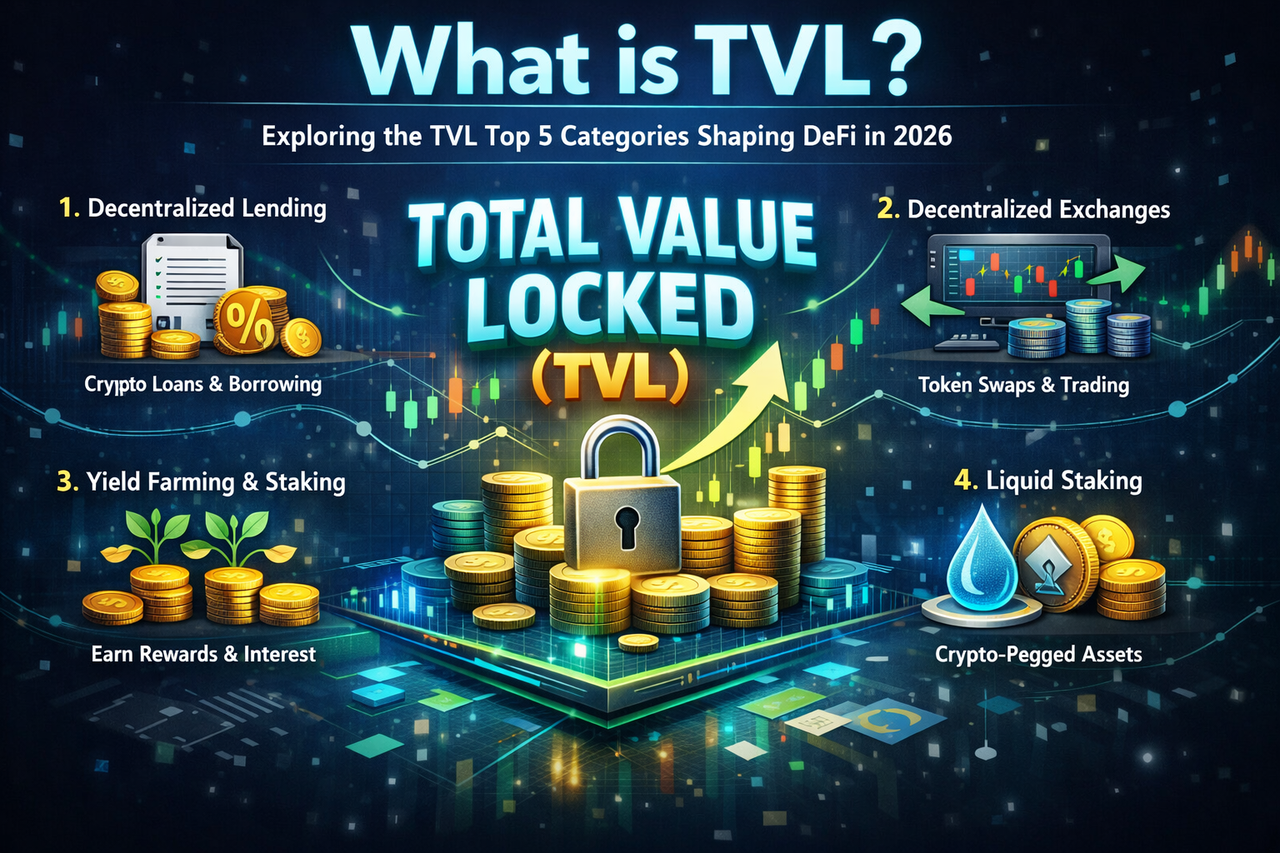
As the decentralized finance (DeFi) ecosystem matures in 2026, understanding where the "smart money" is moving is more critical than ever for both retail and institutional investors. Total Value Locked (TVL) serves as the primary pulse of this landscape, reflecting the deep liquidity and trust users place in specific protocols.
In this comprehensive guide, we will explore the TVL Top 5 Categories Shaping DeFi to help you navigate the complex world of on-chain finance.
Key Takeaways
-
TVL (Total Value Locked) remains the definitive metric for assessing the liquidity and adoption of DeFi protocols.
-
The Liquid Staking sector is currently the largest by TVL, driven by the demand for capital efficiency on Ethereum and Solana.
-
Restaking has emerged as the fastest-growing category, significantly expanding the utility of staked assets.
-
Core infrastructure sectors like Lending and DEXes continue to provide the foundational liquidity for the entire ecosystem.
-
Monitoring TVL trends allows investors to identify shifts in market sentiment and emerging risk factors.
What is TVL (Total Value Locked)?
Total Value Locked, commonly referred to as TVL, represents the cumulative value of all crypto assets currently deposited in a DeFi protocol's smart contracts. This figure includes assets used for providing liquidity, acting as collateral for loans, or participating in governance through staking. For any crypto exchange platform or DeFi user, TVL serves as a "liquidity moat"—the higher the TVL, the more robust and reliable the protocol is generally perceived to be.
Defining TVL: The "Gold Standard" Metric for DeFi Growth
In the crypto industry, TVL is often likened to "Assets Under Management" (AUM) in traditional banking. It provides a snapshot of a protocol’s market share and the level of confidence users have in its security. When a protocol's TVL increases, it typically indicates a virtuous cycle: more liquidity leads to lower slippage for traders and better rates for borrowers, which in turn attracts even more capital.
Beyond the Numbers: Why TVL Composition Matters More Than Size
While a high TVL is impressive, the quality of that value is equally important. A protocol's TVL might be inflated by governance tokens with low circulating supply or "wash" liquidity. Sophisticated investors look at the ratio of stablecoins versus volatile altcoins within the TVL to determine how the protocol might perform during a market downturn. Understanding the TVL composition helps in distinguishing between sustainable growth and temporary hype.
Deep Dive: The TVL Top 5 Categories Shaping DeFi
As of 2026, the DeFi landscape has consolidated into five dominant sectors. These categories don't just hold the most value; they define the functional utility of the entire blockchain economy. By analyzing the TVL Top 5 Categories Shaping DeFi, we can see a clear trend toward "layered" finance, where one asset can generate multiple streams of value.
1. Liquid Staking — The Crown Jewel of Capital Efficiency
Liquid Staking remains the undisputed leader in DeFi TVL. Traditionally, staking required users to lock their tokens (like ETH or SOL) to secure the network, rendering those assets illiquid. Liquid Staking Derivatives (LSDs) solved this by issuing a "receipt token" that represents the staked asset while remaining tradable.
How It Works: Unlocking Liquidity from Staked Assets (LSTs)
When you stake through a liquid staking protocol, you receive a Liquid Staking Token (LST), such as stETH. This token earns staking rewards automatically but can also be used as collateral in lending protocols or traded on DEXes. This "double-dipping" of yield is what propelled this category to the top of the TVL charts.
Market Leaders: Exploring the Dominance of Lido and Rocket Pool
-
Lido: The giant of the sector, Lido accounts for a massive portion of all staked ETH, providing deep liquidity that makes stETH the "de facto" version of Ethereum in many DeFi strategies.
-
Rocket Pool: A decentralized alternative that emphasizes node operator diversity, appealing to users who prioritize the long-term health and decentralization of the network.
2. Lending & Borrowing — The Foundation of Decentralized Finance
Lending protocols are the "banks" of the blockchain. They allow users to deposit assets to earn interest or borrow against their holdings. This category is a permanent fixture in the TVL Top 5 Categories Shaping DeFi because it enables leverage and complex financial strategies.
Over-collateralization: Risk Management in Aave and Morpho
Unlike traditional banks, DeFi lending is largely over-collateralized. To borrow $100 in USDC, a user might need to deposit $150 in ETH. This ensures that even if the market crashes, the protocol has enough funds to remain solvent. Protocols like Aave and the modular Morpho have pioneered these safety mechanisms, making them multi-billion dollar TVL hubs.
Interest Rate Models: How Supply and Demand Drive TVL
DeFi interest rates are algorithmic. If many people want to borrow a specific stablecoin, the interest rate rises, which then incentivizes more lenders to deposit that stablecoin to earn the higher yield. This dynamic balancing act keeps TVL fluid and responsive to market needs.
3. DEXes (Decentralized Exchanges) — The Engine of Liquidity
Decentralized Exchanges (DEXes) allow for the peer-to-peer swapping of tokens without a central intermediary. They rely on "Liquidity Providers" (LPs) who deposit their tokens into pools in exchange for a share of the trading fees.
AMM Evolution: Comparing Uniswap’s V3/V4 with Curve’s Stable Pools
The Automated Market Maker (AMM) model has evolved significantly. Uniswap v4 introduced "hooks," allowing for highly customizable liquidity pools, while Curve Finance remains the leader for low-slippage stablecoin swaps. These innovations ensure that DEXes maintain high TVL by offering the most efficient trading paths for users.
Liquidity Provision: Why Yield Seekers Fuel DEX TVL
Investors are drawn to DEXes because they can earn "passive income" from trading fees. In 2026, sophisticated LP strategies—such as concentrated liquidity—allow users to earn significantly higher returns on their capital, which continues to drive the TVL of major exchanges.
4. Restaking — The Rapidly Growing Security Frontier
Restaking is the newest entrant to the TVL Top 5 Categories Shaping DeFi. It allows users to take their already-staked ETH (or LSTs) and "restake" them to provide security for other decentralized services like oracles, bridges, or new Layer 2 networks.
The EigenLayer Revolution: Sharing Security Across Networks
EigenLayer pioneered this concept, creating a marketplace for decentralized trust. By opting into restaking, users can earn additional rewards on top of their original staking yield. This has led to a massive influx of capital, as it maximizes the utility of Ethereum's massive economic security.
Liquid Restaking Tokens (LRTs): The Next Layer of Yield Generation
To maintain liquidity, protocols have introduced Liquid Restaking Tokens (LRTs). These tokens represent your position in a restaking protocol, allowing you to earn three layers of yield (Staking + Restaking + DeFi usage) while keeping your capital mobile.
5. CDP (Collateralized Debt Positions) — The Stablecoin Mint
CDP protocols allow users to "mint" stablecoins by locking up collateral. This is essentially how decentralized, over-collateralized stablecoins are born, providing the ecosystem with non-volatile assets that aren't tied to a centralized bank.
Minting Mechanics: How Sky (Maker) and Lybra Generate Decentralized Dollars
Sky (formerly MakerDAO) is the pioneer of this space. Users lock up assets like ETH or RWA (Real World Assets) to mint USDS (formerly DAI). This allows users to access liquidity without selling their underlying assets, a strategy that has kept CDP protocols at the forefront of TVL rankings for years.
The Role of Liquidation Buffers in Maintaining Protocol Solvency
To prevent a "death spiral," CDP protocols use liquidation buffers. If the value of your collateral falls below a certain threshold, the protocol automatically sells a portion of it to pay back the minted stablecoins. This automated risk management is vital for the stability of the entire DeFi sector.
How to Analyze the TVL Top 5 for Investment Insights
For an investor, the TVL data provided by platforms like DefiLlama is a goldmine of information. However, raw numbers are only the starting point; the real value lies in identifying trends and anomalies.
The TVL/Market Cap Ratio: Identifying Undervalued Protocols
A common SEO-friendly metric used by analysts is the TVL/Market Cap ratio. If a protocol has a high TVL but a relatively low market capitalization for its native token, it may be undervalued. This suggests that the protocol is being heavily used, but the market hasn't yet priced in the value of the governance token.
Tracking Capital Flows: Using DefiLlama to Spot Emerging Trends
By monitoring 7-day or 30-day TVL changes, you can see where the market's attention is shifting. If you notice a sudden spike in the "Restaking" category, it’s a signal that new yield opportunities or a major protocol launch (like a new AVS) is attracting liquidity.
Risk Management: Why High TVL Doesn’t Mean "Risk-Free"
While high TVL indicates trust and liquidity, it also makes a protocol a more attractive target for hackers. In the crypto industry, "size" is not a substitute for "security."
Smart Contract Vulnerabilities and Governance Risks
Even the most established protocols in the TVL Top 5 Categories Shaping DeFi are subject to smart contract bugs. Additionally, as protocols decentralize, "governance attacks"—where a large holder votes in their own interest at the expense of the protocol—become a genuine threat.
The Multiplier Effect: Risks of Recursive Leverage Across Top Sectors
The interconnectedness of DeFi means that a failure in one sector can trigger a domino effect. For example, if a major Liquid Staking token de-pegs, it could lead to liquidations in the Lending sector, which then causes a spike in trading volume (and potential slippage) on DEXes. Understanding this "money lego" risk is crucial when managing a DeFi portfolio.
Conclusion
The TVL Top 5 Categories Shaping DeFi—Liquid Staking, Lending, DEXes, Restaking, and CDPs—form the backbone of the modern decentralized economy. By tracking the TVL of these sectors, investors can gain a high-level view of capital efficiency, security trends, and emerging yield opportunities. As we move further into 2026, the boundaries between these categories continue to blur, creating a more integrated and powerful financial system. Always remember that while TVL is a powerful metric for measuring adoption, it must be paired with diligent risk management and a deep understanding of protocol mechanics.
FAQ
Q1: Why is TVL important for the crypto industry?
TVL (Total Value Locked) is a key indicator of a protocol's liquidity and user trust. High TVL generally means better prices for traders and more stability for the platform, making it a "gold standard" for measuring DeFi growth and protocol health.
Q2: Which category currently has the highest TVL?
As of early 2026, Liquid Staking holds the highest TVL. This is due to its ability to provide users with staking rewards while maintaining the liquidity of their assets, which can then be used across other DeFi protocols.
Q3: How does Restaking impact the TVL Top 5 Categories Shaping DeFi?
Restaking has significantly boosted DeFi TVL by allowing the same capital to be used twice. By securing additional networks with already-staked ETH, users generate more yield, which attracts more capital into the ecosystem, often at the expense of traditional staking.
Q4: Is a high TVL protocol always safe to use?
No. While high TVL suggests a protocol is battle-tested, it also creates a massive bounty for hackers. Investors should always consider smart contract audits, the decentralization of governance, and the historical performance of the protocol before committing funds.
Q5: Where can I track the TVL of different DeFi categories?
DefiLlama is the most popular tool for tracking TVL across various chains and categories. It provides real-time data on the TVL Top 5 Categories Shaping DeFi, allowing you to monitor capital flows and protocol rankings.