

What Is the Coinbase Bitcoin Premium Index? A Complete Guide for Crypto Traders
2026/05/26 18:15:02
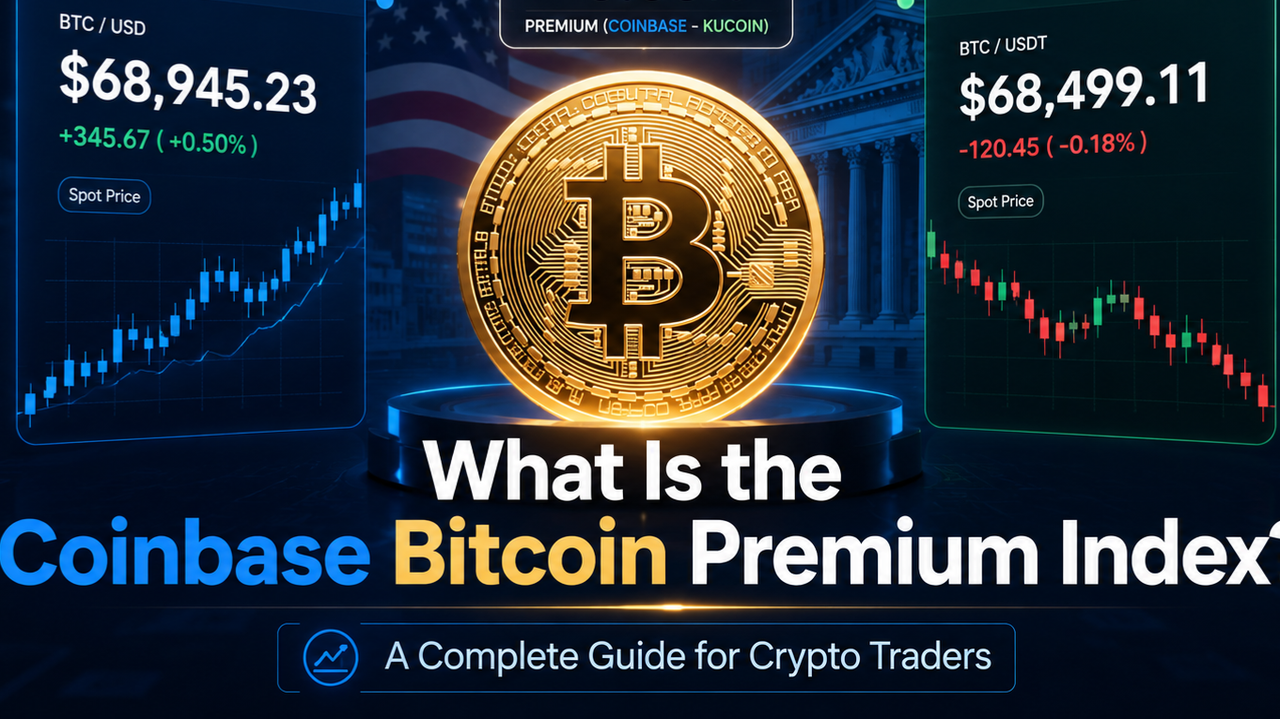
The Coinbase Bitcoin Premium Index is a crypto market indicator used to measure whether Bitcoin is trading at a higher or lower price on Coinbase compared with another major global exchange such as KuCoin. For traders, this price difference can reveal important clues about U.S.-linked Bitcoin demand, institutional buying pressure, ETF-related flows, and broader market sentiment.
Because Coinbase is strongly connected with the U.S. crypto market, many analysts watch the Coinbase BTC Premium to estimate whether American investors are buying Bitcoin aggressively or reducing exposure. A positive premium may suggest stronger U.S. spot demand, while a negative premium may point to weaker demand or increased selling pressure.
However, the Coinbase Bitcoin Premium Index should not be used as a standalone trading signal. It works best when combined with Bitcoin price action, spot volume, ETF inflows and outflows, funding rates, open interest, and liquidity data.
The Coinbase Bitcoin Premium Index is a market indicator that measures the price difference between Bitcoin trading on Coinbase and Bitcoin trading on KuCoin. In this article, KuCoin is used as the global BTC/USDT reference market to compare against Coinbase BTC/USD pricing.
It helps traders see whether Bitcoin is trading at a premium or discount on Coinbase compared with a major global crypto exchange.
In simple terms, the index can help traders estimate whether Coinbase-side Bitcoin demand is stronger or weaker than demand on a global BTC/USDT market such as KuCoin. Because Coinbase is one of the most important regulated crypto exchanges in the United States, many analysts use Coinbase premium data as a proxy for U.S. investor interest, including institutional demand and spot Bitcoin ETF-related buying or selling.
Coinbase Bitcoin Premium Index Formula
The Coinbase Bitcoin Premium Index is calculated by comparing the Bitcoin price on Coinbase with the Bitcoin price on KuCoin. In this version, Coinbase represents U.S.-linked market demand, while KuCoin represents broader global exchange pricing.
The formula is:
Coinbase Bitcoin Premium Index = [(Coinbase BTC Price - KuCoin BTC Price) / KuCoin BTC Price] × 100
This formula shows the percentage difference between the Bitcoin price on Coinbase and the Bitcoin price on KuCoin.
Example of a Positive Coinbase Premium
Suppose Bitcoin is trading at $80,500 on Coinbase and $80,000 on KuCoin.
Using the formula:
Coinbase Bitcoin Premium Index = [($80,500 - $80,000) / $80,000] × 100
Coinbase Bitcoin Premium Index = [$500 / $80,000] × 100
Coinbase Bitcoin Premium Index = 0.625%
This means Bitcoin is trading at a 0.625% premium on Coinbase compared with KuCoin. In trading terms, this may suggest stronger buying demand on Coinbase, which is often interpreted as a sign of stronger U.S.-linked spot demand.
Example of a Negative Coinbase Premium
Now suppose Bitcoin is trading at $79,500 on Coinbase and $80,000 on KuCoin.
Using the formula:
Coinbase Bitcoin Premium Index = [($79,500 - $80,000) / $80,000] × 100
Coinbase Bitcoin Premium Index = [-$500 / $80,000] × 100
Coinbase Bitcoin Premium Index = -0.625%
This means Bitcoin is trading at a 0.625% discount on Coinbase compared with KuCoin. A negative reading may suggest weaker U.S. buying interest, selling pressure on Coinbase, or stronger demand on global exchanges.
Simple Interpretation
A positive Coinbase Bitcoin Premium Index means BTC is more expensive on Coinbase than on KuCoin. This may point to stronger U.S.-linked demand.
A negative Coinbase Bitcoin Premium Index means BTC is cheaper on Coinbase than on KuCoin. This may point to weaker U.S.-linked demand or stronger selling pressure on Coinbase.
A reading near 0% means Bitcoin prices on Coinbase and KuCoin are closely aligned, suggesting balanced demand between the two exchanges.
How the Coinbase Bitcoin Premium Index Works
The index works by tracking whether Bitcoin is more expensive or cheaper on Coinbase compared with KuCoin. If Bitcoin is priced higher on Coinbase than on KuCoin, the premium turns positive. If Bitcoin is priced lower on Coinbase, the premium turns negative.
-
A positive reading suggests that buyers on Coinbase are willing to pay more for Bitcoin than traders on KuCoin. This can point to stronger U.S.-linked demand, possible institutional accumulation, or increased buying linked to spot Bitcoin ETFs.
-
A negative reading suggests that Bitcoin is cheaper on Coinbase than on KuCoin. This may signal weaker U.S.-linked demand, institutional selling pressure, ETF outflows, or stronger buying activity on global exchanges outside the United States.
Reading the Coinbase Premium Index helps traders understand whether Bitcoin demand is stronger on Coinbase compared with KuCoin. Since Coinbase is closely linked with U.S. investors and institutional activity, the index can provide useful clues about market sentiment, spot buying pressure, and possible trend strength.
However, traders should not read the index as a simple “buy” or “sell” signal. It works best when combined with price action, spot volume, ETF flows, funding rates, and broader market conditions.
-
Read Positive Coinbase Premium as a Sign of Stronger U.S. Demand
A positive Coinbase Premium Index means Bitcoin is trading at a higher price on Coinbase than on KuCoin. This suggests that buyers on Coinbase are willing to pay more for Bitcoin, which may indicate stronger U.S.-linked spot demand.
For crypto traders, a positive premium can be a bullish confirmation signal when it appears alongside rising Bitcoin prices, strong spot volume, and positive ETF inflows. It may show that U.S. investors or institutions are actively accumulating BTC, but it should still be confirmed with other market data.
-
Read Negative Coinbase Premium as a Warning of Weak U.S. Demand
A negative Coinbase Premium Index means Bitcoin is trading cheaper on Coinbase than on KuCoin. This may suggest weaker U.S. buying interest, selling pressure from Coinbase users, or stronger demand on global exchanges.
For traders, a negative premium can be a caution signal, especially if Bitcoin is struggling near resistance or if ETF outflows are increasing. It may show that the current market rally is not strongly supported by U.S.-linked spot demand.
-
Watch the Direction, Not Just the Number
The trend of the Coinbase Premium Index is often more important than one single reading. A premium moving from negative to positive may suggest improving U.S.-linked demand, while a premium moving from positive to negative may suggest weakening demand.
For example, if Bitcoin is rising and the premium is also increasing, the rally may have stronger spot-market support. But if Bitcoin is rising while the premium is falling, traders may question whether the move is being driven by leverage, offshore buying, or short-term speculation.
-
Compare the Index With Bitcoin Price Action
The Coinbase Premium Index becomes more useful when compared with Bitcoin’s price chart. If BTC breaks above a major resistance level while the Coinbase premium is positive, the breakout may look more reliable because it is supported by spot demand.
On the other hand, if BTC breaks higher while the Coinbase premium remains negative, traders may be more cautious. This kind of divergence can suggest that the price move is not being strongly confirmed by Coinbase-based buying pressure.
-
Use ETF Flows as Confirmation
Spot Bitcoin ETF flows can help confirm what the Coinbase Premium Index is showing. A positive premium combined with strong ETF inflows may suggest healthy institutional demand. A negative premium combined with ETF outflows may suggest that U.S. investors are reducing exposure.
This is why many traders now watch Coinbase Premium data together with ETF flow reports. When both indicators point in the same direction, the signal becomes more meaningful.
-
Check Funding Rates and Open Interest
The Coinbase Premium Index should also be compared with derivatives data such as funding rates and open interest. If the Coinbase premium is positive while funding rates remain stable, it may suggest that spot buying is driving the move.
But if Bitcoin is rising with high funding rates, rising open interest, and a weak or negative Coinbase premium, the rally may be more leverage-driven. That can increase the risk of a sharp pullback if long positions become overcrowded.
-
Avoid Trading on Short-Term Spikes Alone
Short-term spikes in the Coinbase Premium Index can happen because of liquidity gaps, sudden market orders, exchange-specific order book imbalances, or temporary arbitrage delays. These moves may disappear quickly.
Traders should focus more on sustained changes in the index rather than one-off spikes. A premium that remains positive for several sessions may be more important than a brief move above zero.
-
Use the Index as a Confirmation Tool
The best way to use the Coinbase Premium Index is as a confirmation indicator. It can help traders understand whether U.S.-linked demand is supporting Bitcoin’s move, but it should not replace a full trading plan.
A stronger trading setup usually appears when the Coinbase Premium Index aligns with other signals: positive price structure, rising spot volume, ETF inflows, healthy liquidity, and controlled leverage. When these signals conflict, traders should be more cautious.
The Coinbase BTC Premium matters because it can act as a real-time signal of how strongly U.S.-based investors may be buying or selling Bitcoin compared with traders on global exchanges. Since Coinbase is one of the most important regulated crypto platforms in the United States, price behavior on Coinbase is often watched as a proxy for U.S. institutional demand, especially from funds, asset managers, corporate buyers, and spot Bitcoin ETF-related activity.
However, the premium should be treated as an approximation, not direct proof of institutional buying or selling.
-
Coinbase Is Closely Linked to U.S. Market Activity
Coinbase has a strong connection to the U.S. crypto market because it operates under U.S. regulatory standards and is widely used by American investors. For this reason, when Bitcoin trades at a premium on Coinbase, traders often interpret it as a sign that U.S.-linked buyers are more aggressive than global buyers.
If BTC is more expensive on Coinbase than on KuCoin, it means buyers on Coinbase may be willing to pay a higher price to access Bitcoin. This can suggest stronger demand from U.S. spot market participants.
-
A Positive Premium Can Signal Institutional Accumulation
A positive Coinbase BTC Premium may indicate that large U.S. investors are accumulating Bitcoin. Institutional buyers often prefer regulated and liquid platforms, and Coinbase is commonly associated with this type of activity.
When the premium rises during a Bitcoin uptrend, it may suggest that the rally is being supported by real spot demand rather than only leveraged trading. This can make the move appear healthier and more sustainable.
Still, a positive premium does not prove institutional accumulation by itself. It is more reliable when confirmed by ETF inflows, spot volume, order-book liquidity, and broader market strength.
-
A Negative Premium Can Show Weak U.S. Demand
A negative Coinbase BTC Premium means Bitcoin is trading cheaper on Coinbase than on KuCoin. This can suggest that U.S.-linked demand is weak, or that sellers on Coinbase are more active than buyers.
For traders, this can be an important warning sign. If Bitcoin is rising while the Coinbase premium remains negative, the rally may not be strongly supported by U.S. institutional buying. Instead, the move could be driven more by global exchanges, derivatives leverage, or short-term speculation.
-
It Helps Traders Track ETF-Related Demand
The Coinbase BTC Premium has become more important since the launch of spot Bitcoin ETFs in the United States. ETF inflows can create buying pressure in the U.S. market, while ETF outflows can reduce demand.
When the Coinbase premium is positive and ETF inflows are strong, traders may read this as confirmation that institutional demand is supporting Bitcoin. When the premium is negative and ETF outflows are rising, it may suggest that U.S. institutional appetite is weakening.
-
It Shows Whether a Bitcoin Rally Has U.S. Support
Not every Bitcoin rally is driven by the same type of demand. Some rallies are led by global spot buying, some by derivatives leverage, and some by U.S. institutional accumulation.
The Coinbase BTC Premium helps traders identify whether U.S.-linked buyers are participating in the move. A rising Bitcoin price with a positive Coinbase premium can suggest stronger U.S. support. A rising price with a negative premium may suggest weaker confirmation from U.S. institutions.
-
It Works Best as a Confirmation Indicator
The Coinbase BTC Premium is useful, but it should not be treated as a standalone trading signal. A positive premium does not guarantee that Bitcoin will continue rising, and a negative premium does not always mean the market will fall.
For a stronger market view, traders usually combine the premium with spot Bitcoin ETF flows, trading volume, funding rates, open interest, order-book liquidity, and broader macro conditions. When these indicators align, the Coinbase BTC Premium becomes more valuable as a signal of U.S.-linked institutional demand.
The Coinbase Bitcoin Premium Index helps crypto traders understand whether Bitcoin is trading at a premium or discount on Coinbase compared with KuCoin. Since Coinbase is strongly linked with U.S. market activity, these readings can offer useful clues about U.S. Bitcoin demand, institutional accumulation, and spot market sentiment.
Positive Coinbase Premium
A positive Coinbase Premium means BTC is trading at a higher price on Coinbase than on KuCoin.
Key points:
-
Indicates stronger buying pressure on Coinbase
-
May suggest stronger U.S.-linked spot Bitcoin demand
-
Can signal possible institutional accumulation
-
May reflect ETF-related buying activity
-
Often viewed as bullish confirmation when BTC price and spot volume are also rising
For traders, a positive Coinbase Bitcoin Premium can suggest that U.S.-linked buyers are more aggressive in the market.
Negative Coinbase Premium
A negative Coinbase Premium means BTC is trading at a lower price on Coinbase than on KuCoin.
Key points:
-
Indicates weaker buying pressure on Coinbase
-
May suggest weaker U.S.-linked Bitcoin demand
-
Can point to Coinbase-side selling pressure
-
May reflect reduced institutional interest
-
Can be a caution signal if BTC is near resistance or ETF flows are weak
For traders, a negative Coinbase Premium may show that Bitcoin’s price movement is not strongly supported by U.S. spot demand.
Near Zero Premium
A near zero premium means Bitcoin prices on Coinbase and KuCoin are closely aligned.
Key points:
-
Shows balanced pricing between Coinbase and KuCoin
-
Suggests no strong regional premium
-
May indicate neutral demand conditions
-
Traders may need confirmation from other indicators
-
Useful to compare with BTC price action, volume, funding rates, and ETF flows
A near zero Coinbase Bitcoin Premium usually means there is no clear demand advantage from either exchange.
Rising Coinbase Premium
A rising Coinbase Premium means the premium is increasing over time, showing that Coinbase demand may be improving.
Key points:
-
Suggests stronger Coinbase-side buying activity
-
May indicate improving U.S.-linked investor demand
-
Can support a bullish Bitcoin market structure
-
Becomes more meaningful when BTC price and spot volume also rise
-
May confirm that a rally is supported by real spot demand
For crypto trading, a rising Coinbase Bitcoin Premium can be a positive sign when it aligns with broader market strength.
Falling Coinbase Premium
A falling Coinbase Premium means Coinbase demand appears to be weakening compared with KuCoin.
Key points:
-
Suggests weaker Coinbase-side buying pressure
-
May indicate cooling U.S.-linked demand
-
Can warn of reduced institutional interest
-
May become concerning if BTC is near resistance
-
Can signal caution when ETF flows are slowing or turning negative
A falling premium does not always mean Bitcoin will decline, but it may show that U.S.-linked buyers are becoming less active in supporting the move.
Although the Coinbase Bitcoin Premium Index is useful for tracking U.S.-linked Bitcoin demand, it has several limitations. Traders should use it as a market context indicator, not as a direct buy or sell signal.
-
Different Exchange Pairs: The index compares Bitcoin prices across different exchanges and trading pairs. Coinbase may use BTC/USD, while KuCoin may use BTC/USDT. Because of this, the premium can be affected by USD liquidity, USDT pricing, exchange fees, market depth, and temporary liquidity gaps.
-
Arbitrage Can Close the Gap Quickly: Price differences between Coinbase and KuCoin may not last long. Arbitrage traders and market makers can quickly move liquidity across exchanges, reducing or removing the premium or discount.
-
Positive Premium Does Not Always Mean Institutional Buying: A positive Coinbase Premium may suggest stronger U.S.-linked demand, but it does not always confirm institutional accumulation. The premium can also come from temporary order-book imbalance, low liquidity, or sudden market orders.
-
Negative Premium Is Not Always Bearish: A negative Coinbase Premium may suggest weaker U.S.-linked demand, but it does not automatically mean Bitcoin will fall. It may reflect short-term selling pressure, regional demand differences, or stronger buying activity on KuCoin.
-
Short-Term Spikes Can Be Misleading: The Coinbase Bitcoin Premium Index can move sharply for a short period due to sudden trades, exchange-specific liquidity issues, or temporary volatility. Traders should focus more on sustained trends than single data spikes.
-
It Needs Confirmation From Other Indicators: The index works best when combined with Bitcoin price action, spot volume, ETF inflows and outflows, funding rates, open interest, and order-book liquidity.
-
Not a Standalone Trading Signal: The Coinbase Bitcoin Premium Index should not be used alone to enter or exit trades. It is most useful for understanding whether U.S.-linked demand is supporting or weakening Bitcoin’s market structure.
The Coinbase Bitcoin Premium Index can be useful for both short-term traders and long-term market analysts.
For short-term traders, the index can help confirm whether a Bitcoin breakout has strong spot demand behind it. If BTC breaks resistance while the Coinbase premium is rising, the move may have stronger support.
For swing traders, the index can help identify changes in U.S.-linked demand. A shift from a negative to a positive premium may suggest improving market conditions, while a shift from positive to negative may warn that demand is weakening.
For long-term investors, the index can help track whether institutional demand is supporting the broader Bitcoin trend. When positive premium data aligns with ETF inflows and strong spot volume, it may suggest healthier accumulation.
The Coinbase Bitcoin Premium Index is a valuable indicator for traders who want to understand whether Bitcoin is trading at a premium or discount on Coinbase compared with KuCoin. Because Coinbase is closely linked to U.S. investors and institutional market activity, the index can help show whether U.S.-linked Bitcoin demand is strengthening or weakening.
A positive Coinbase Premium may suggest stronger U.S. spot demand, institutional accumulation, or ETF-related buying pressure. A negative Coinbase Premium may indicate weaker U.S. demand, Coinbase-side selling pressure, or stronger activity on global exchanges.
Still, the Coinbase Bitcoin Premium Index should not be treated as a standalone buy or sell signal. It works best as a confirmation tool when combined with Bitcoin price action, spot volume, ETF inflows and outflows, funding rates, open interest, and liquidity data.
For crypto traders, the main value of the Coinbase Bitcoin Premium Index is simple: it helps answer whether Bitcoin’s price movement is being supported by strong U.S.-linked demand or mainly driven by global exchange activity and short-term market speculation.
What is the Coinbase Bitcoin Premium Index?
The Coinbase Bitcoin Premium Index measures the price difference between Bitcoin on Coinbase and Bitcoin on KuCoin. It helps traders understand whether BTC is trading at a premium or discount on Coinbase compared with a major global exchange.
What does a positive Coinbase Bitcoin Premium mean?
A positive Coinbase Bitcoin Premium means Bitcoin is trading higher on Coinbase than on KuCoin. This may suggest stronger U.S.-linked spot demand, possible institutional accumulation, or ETF-related buying pressure.
What does a negative Coinbase Bitcoin Premium mean?
A negative Coinbase Bitcoin Premium means Bitcoin is trading lower on Coinbase than on KuCoin. This may indicate weaker U.S.-linked demand, Coinbase-side selling pressure, or stronger buying activity on global exchanges.
How is the Coinbase Bitcoin Premium Index calculated?
The index is calculated by subtracting the KuCoin BTC price from the Coinbase BTC price, dividing the result by the KuCoin BTC price, and multiplying by 100.
Formula: Coinbase Bitcoin Premium Index = [(Coinbase BTC Price - KuCoin BTC Price) / KuCoin BTC Price] × 100
Why do traders use the Coinbase Bitcoin Premium Index?
Traders use the Coinbase Bitcoin Premium Index to track U.S.-linked Bitcoin demand. It can help show whether Bitcoin’s price movement is supported by Coinbase-based buying pressure or driven mainly by global exchange activity.
Is the Coinbase Bitcoin Premium Index a buy or sell signal?
No. The Coinbase Bitcoin Premium Index should not be used as a standalone buy or sell signal. It is best used as a confirmation tool alongside Bitcoin price action, spot volume, ETF flows, funding rates, open interest, and liquidity data.
Why does the Coinbase BTC Premium matter for institutional demand?
The Coinbase BTC Premium matters because Coinbase is closely connected with U.S. investors and institutional crypto activity. A rising or positive premium may suggest stronger institutional demand, while a falling or negative premium may suggest weaker U.S. participation.
The information provided on this page may originate from third-party sources and does not necessarily represent the views or opinions of KuCoin. This content is intended solely for general informational purposes and should not be considered financial, investment, or professional advice. KuCoin does not guarantee the accuracy, completeness, or reliability of the information, and is not responsible for any errors, omissions, or outcomes resulting from its use. Investing in digital assets carries inherent risks. Please carefully evaluate your risk tolerance and financial situation before making any investment decisions. For further details, please consult KuCoin’s Terms of Use and Risk Disclosure.