



What Is MEZO? How Mezo Works, Tokenomics, and Future Roadmap
2026/04/01 09:00:00
The cryptocurrency market continues to evolve far beyond simple peer-to-peer payments. Today, new blockchain projects are trying to solve deeper problems around lending, liquidity, yield generation, stable assets, and capital efficiency. As the market matures, the most interesting projects are often the ones that do not just launch another token, but instead rethink how value should move through an ecosystem.
Mezo is one of those projects. Positioned as a platform for everyday Bitcoin finance, Mezo is building a Bitcoin-focused financial layer designed to help users put their BTC to work without relying on centralized custodians, synthetic wrappers, or unsustainable token farming models. At the center of this system is MEZO, the project’s coordination and amplification token, which works alongside locked BTC rather than replacing it.
By the end of this article, you will understand what Mezo is, how it works, the project’s history and mission, its major features, and why its token design stands out in the growing Bitcoin DeFi landscape.
What Is Mezo?
Mezo is a Bitcoin-native financial protocol built around the idea that Bitcoin should be more useful in an onchain economy without forcing users to sell it. The project describes itself as a decentralized lending layer for Bitcoin, with an ecosystem designed to support BTC-backed loans, a Bitcoin-backed stablecoin, and BTC-denominated yield sourced from real network activity.
What makes Mezo different from many crypto finance platforms is its attempt to keep Bitcoin itself at the center of value capture. Instead of asking users to hand over BTC to centralized intermediaries or convert it into wrapped substitutes just to earn yield, Mezo is structured so users can lock BTC, receive veBTC, and earn Bitcoin-denominated fees from activities such as bridging, swapping, and interest generated within the system.
MEZO Token
MEZO is the native token of the Mezo ecosystem, designed to coordinate incentives and boost BTC earnings. While BTC remains the main asset in the system, MEZO helps users amplify rewards and participate more actively in the protocol.
Users who lock MEZO can boost the yield on their locked BTC positions by up to 5x. It also powers Mezo’s reward and voting system, helping decide how incentives and emissions are distributed across the ecosystem.
MEZO is the utility and coordination token behind Mezo, while Bitcoin remains the core asset at the center of the platform.
In simple terms, Mezo is trying to solve one of the biggest problems in Bitcoin finance: how to create a productive, self-custodial Bitcoin economy where users can borrow, earn, and participate without giving up direct alignment with BTC.
How Mezo Works
Bitcoin-First Design
Mezo is a Bitcoin-native finance project built to help users use BTC in an onchain economy without selling it. It focuses on making Bitcoin more productive through lending, yield, and everyday financial use.
How the System Works
Users lock BTC to create a veBTC position and earn BTC-denominated yield from real activity in the ecosystem, such as bridging fees, swap fees, and MUSD interest. This keeps rewards tied to actual network usage instead of relying only on inflationary token emissions.
Role of MEZO
MEZO is the coordination and amplification token of the ecosystem. Users who lock MEZO can boost the earnings of their locked BTC positions by up to 5x. BTC remains the core asset, while MEZO helps manage incentives and reward distribution.
Mezo matters because it tries to solve major problems seen in older Bitcoin yield products, including centralized custody risk, wrapped BTC dependence, and unsustainable token farming. Its model aims to keep Bitcoin at the center while still building a functional DeFi-style economy around it.
History and Development
Mezo emerged from the broader effort to build more useful financial infrastructure around Bitcoin. The project’s launch messaging makes it clear that it was created in response to the failures of earlier Bitcoin yield products. Many of those earlier systems relied on centralized custody, fragile wrappers, or inflation-heavy incentives that were not sustainable over time.
The project introduced MEZO publicly in January 2026 and later expanded on its mechanics through additional educational content around Mezo Earn and its Bitcoin-native ve(3,3) framework. Based on the available materials, the development direction shows a strong influence from established DeFi systems like Curve and Aerodrome, but with clear adjustments made for Bitcoin’s role as the core asset rather than a governance token.
While the source material emphasizes the project architecture and ecosystem design more than individual team biographies, Mezo presents itself as a purpose-built platform focused on giving Bitcoin a more functional economic layer rather than forcing Bitcoin into a standard altcoin token model.
Project Mission and Vision
Mezo’s mission is to build a circular Bitcoin economy where users can access lending, liquidity, stable-value tools, and yield opportunities without the default outcome being “sell BTC.”
Its vision is built around a simple but powerful premise: Bitcoin holders want more BTC, but the market has historically offered poor ways to achieve that. Mezo is trying to fix this by making Bitcoin the gate to fee capture and by routing value back to users who lock BTC. Rather than designing the entire system around a governance token, Mezo uses BTC as the economic anchor and MEZO as the coordination layer.
The broader problem Mezo aims to solve is capital inefficiency in Bitcoin finance. Bitcoin is the most recognized crypto asset, but much of the DeFi world has been built around ecosystems where protocol tokens sit at the center of incentives. Mezo’s answer is to build an infrastructure layer where Bitcoin can stay dominant while still supporting lending, stablecoin functionality, and reward distribution.
Key Features and Innovations
-
BTC-Denominated Yield
Mezo allows users to lock BTC and earn yield in Bitcoin itself, rather than in unrelated inflationary reward tokens. That yield is designed to come from real network activity such as bridging fees, swap fees, and MUSD interest, which helps align rewards more closely with actual ecosystem usage.
-
Dual-Token Architecture
One of Mezo’s biggest innovations is its split-role design. BTC acts as the fee-claim and value anchor asset, while MEZO serves as the coordination and amplification token. This structure is important because it keeps Bitcoin at the center of the system instead of replacing it with a governance token.
-
Optional Yield Boosts Through MEZO
Users can lock MEZO to increase the earnings of their locked BTC positions by up to 5x. This gives advanced users a way to optimize returns without forcing every participant to hold the secondary token just to access the base product.
-
Matching Market Mechanism
Mezo introduces a market-driven boost system where each locked BTC position gets its own onchain gauge. veMEZO holders can vote on those gauges, allowing users with more BTC to attract boosts and users with more MEZO to earn incentives. This creates a more flexible and efficient reward coordination model than traditional fixed boost systems.
TL;DR
-
Mezo is a Bitcoin-native finance project focused on lending, yield, and everyday Bitcoin use.
-
Users can lock BTC to earn BTC-denominated yield from real network activity.
-
MEZO is the ecosystem token used to boost rewards and coordinate incentives.
-
The project uses a dual-token model, keeping BTC as the core asset.
-
Mezo aims to solve issues like centralized custody risk, wrapped BTC reliance, and unsustainable token farming.
Project Features
-
BTC-Denominated Yield - Users lock BTC and earn rewards in Bitcoin from real activity such as swaps, bridging, and MUSD interest.
-
Dual-Token Design - BTC acts as the core value asset, while MEZO handles coordination and reward amplification.
-
Optional Yield Boosts - Locking MEZO can boost veBTC earnings by up to 5x for users who want deeper optimization.
-
Matching Market Mechanism - veMEZO holders can direct voting weight to specific BTC positions, creating a market-driven boost system.
-
Short Lock Structure - veBTC positions have a maximum lock period of 30 days, offering more flexibility than many traditional ve-token systems.
Tokenomics Overview
The total genesis supply of MEZO is 1,000,000,000 tokens. The allocation is structured across four major buckets:
-
Community: 40%
-
Investors & Partners: 30%
-
Mezo Team: 20%
-
Foundation: 10%
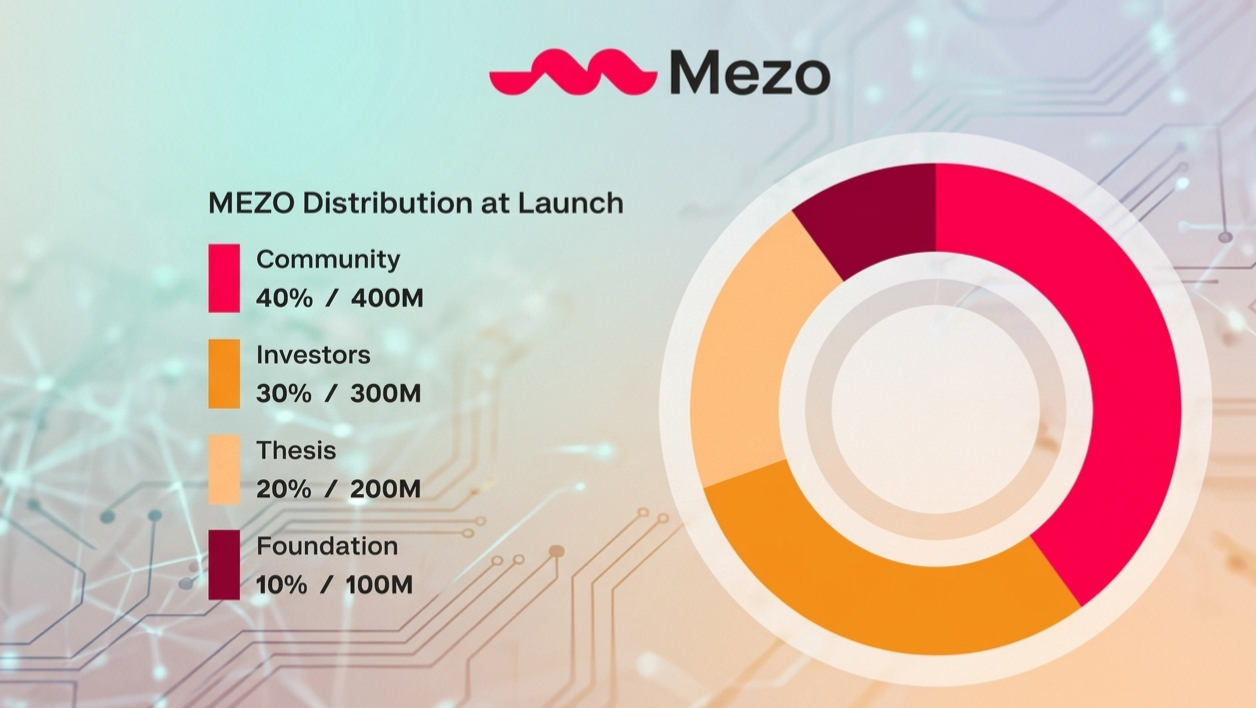
The community allocation is intended for ecosystem participants, airdrops, LP incentives, validators, and grants. The investors and partners bucket is reserved for early backers and strategic participants. The team allocation supports core contributors, while the foundation reserve is meant for long-term protocol sustainability, ecosystem development, and partnerships.
Vesting Structure
Community and foundation allocations unlock immediately. Team and investor allocations have a 12-month cliff followed by 24 months of linear vesting, with full vesting completed within 36 months.
Emission Model
The emissions model follows a Bitcoin-inspired declining schedule, starting with higher emissions in the early years and eventually moving toward a 2% terminal emission rate. Mezo also includes anti-dilution rebases for locked veMEZO holders and a governed splitter system that distributes emissions between validators, staking gauges, and broader ecosystem initiatives.
Future Roadmap and Ecosystem Growth
-
Product Expansion : Mezo’s roadmap includes BTC-backed loans, a BTC-backed stablecoin, and a broader Bitcoin lending ecosystem designed to support a circular Bitcoin economy.
-
Early Ecosystem Development: The project has already introduced pre-deposit vaults and is using early participation incentives to attract users and liquidity into the ecosystem.
-
Growth Potential : Mezo’s future growth will depend on user adoption, ecosystem activity, and how well it can combine Bitcoin utility with sustainable onchain incentives. Its Bitcoin-first approach makes it a project worth watching in the growing Bitcoin DeFi space.
Why Traders and Investors Are Watching MEZO
MEZO is attracting attention because it combines a strong Bitcoin-native DeFi narrative with a token model tied to actual protocol utility. Instead of trying to replace BTC, Mezo positions Bitcoin as the core asset and uses MEZO to coordinate incentives and boost BTC-linked earnings.
A few reasons the market is watching it:
-
Bitcoin-focused utility — Mezo says users can lock BTC to earn BTC-denominated yield from network activity such as bridging fees, swap fees, and MUSD interest.
-
Reward amplification — Locking MEZO can boost veBTC earnings by up to 5x, giving the token a defined role inside the ecosystem.
-
Clear tokenomics — The project outlines a 1 billion MEZO genesis supply, fixed allocation buckets, vesting structure, and a declining emissions model inspired by Bitcoin-style halvings.
-
Broader roadmap — Mezo’s 2026 roadmap includes MUSD expansion, new BTC yield strategies, infrastructure upgrades, and ecosystem growth, which gives traders more reasons to follow the project beyond the token launch itself.
-
Early market visibility — MEZO has appeared in pre-market activity, which often increases attention from traders tracking new launches and potential exchange expansion.
Overall, MEZO is being watched because it is tied to a broader effort to build a more usable Bitcoin financial ecosystem, not just a standalone token story. That combination of utility, narrative, and ecosystem growth is what makes it notable.
MEZO Set to Launch on KuCoin on April 1
Mezo is also gaining wider market attention, with MEZO set to launch on KuCoin on April 1st, marking an important step in the project’s public market debut. A listing on a major exchange can help increase visibility, improve accessibility for new users, and support broader participation in the ecosystem as interest in Bitcoin-native finance continues to grow. For Mezo, this upcoming launch adds momentum to its expansion by potentially bringing more traders, investors, and community members into the project at a time when its tokenomics, utility, and long-term roadmap are drawing increasing attention.
Disclaimer: The information provided on this page may originate from third-party sources and does not necessarily represent the views or opinions of KuCoin. This content is intended solely for general informational purposes and should not be considered as financial, investment, or professional advice. KuCoin does not guarantee the accuracy, completeness, or reliability of the information, and is not responsible for any errors, omissions, or outcomes resulting from its use. Investing in digital assets carries inherent risks. Please carefully evaluate your risk tolerance and financial situation before making any investment decisions. For further details, please consult our Terms of Use and Risk Disclosure