

Tokenized Stock Holders Surge 619% to 3.6 Million as Onchain Equity Race Accelerates
Key Takeaways
-
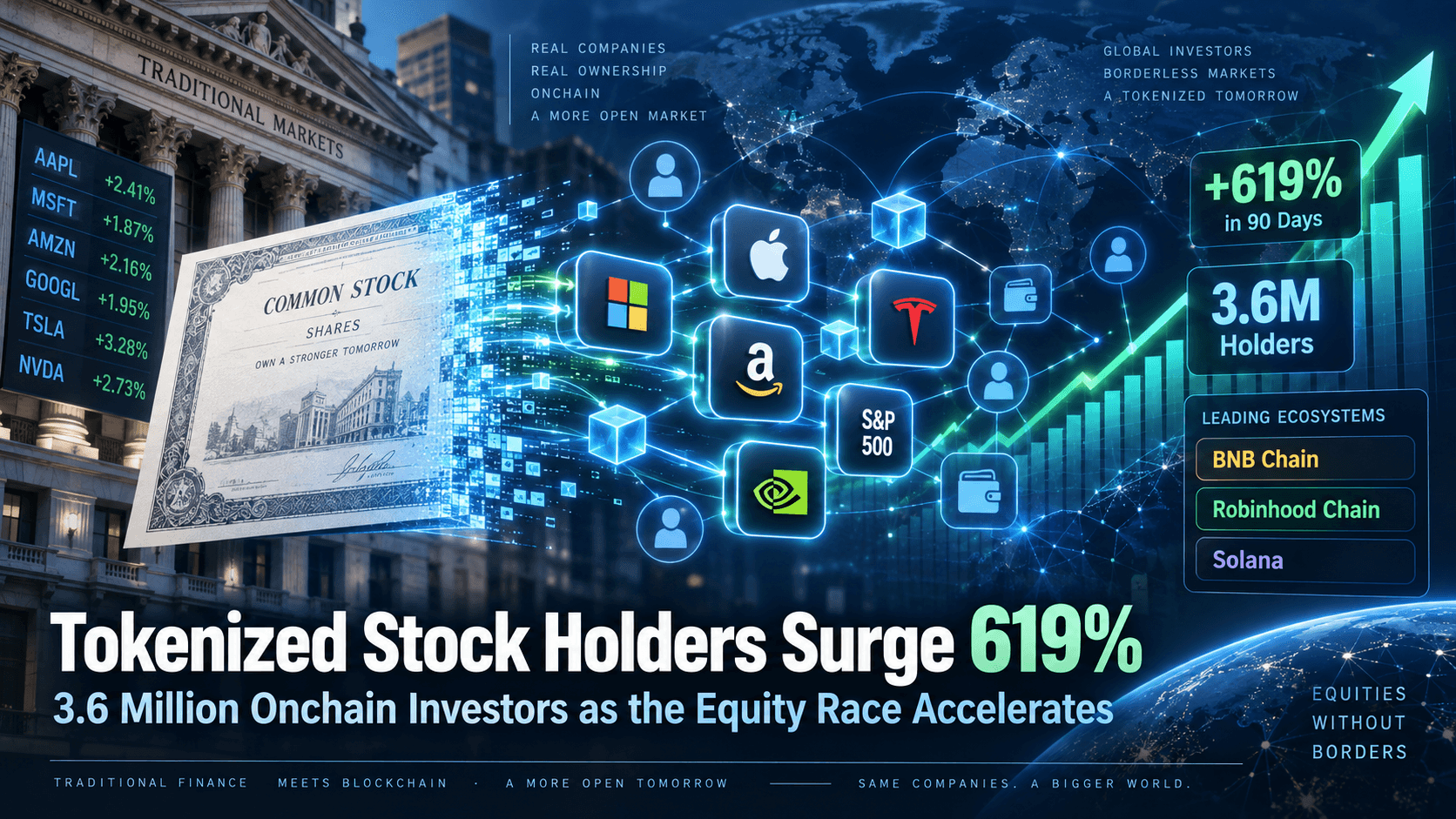
Tokenized stock asset holders have surged 619.1% in just 90 days to roughly 3.6 million, with BNB Chain, Robinhood Chain and Solana emerging as the largest distribution networks.
-
Adoption is moving beyond simple stock-price exposure. Tokenized equities are increasingly being traded on decentralized exchanges, used as collateral and integrated into lending markets, turning stocks into programmable onchain assets.
-
Wall Street is entering the same race. Nasdaq recently agreed to invest $100 million in Kraken parent Payward, highlighting how traditional exchanges are beginning to build regulated infrastructure around tokenized securities.
Tokenized stocks are moving from an experimental corner of crypto into one of the fastest-growing segments of onchain finance. According to Token Terminal data, the number of tokenized stock asset holders jumped 619.1% over the past 90 days to approximately 3.6 million, led by BNB Chain with 1.5 million holders, Robinhood Chain with 1.2 million and Solana with 647,500. Thirty-day decentralized exchange volume for tokenized stocks has also reached about $14.8 billion, up 242.3% from the previous 30-day period.
The timing is significant. Crypto-native networks are racing to distribute hundreds of tokenized equities just as traditional exchanges are embracing blockchain infrastructure themselves. Nasdaq announced a $100 million investment in Kraken parent Payward on September 10, while Robinhood has turned its new blockchain into a major distribution network for tokenized U.S. stocks.
The question is no longer simply whether stocks can move onchain. It is who will control their distribution, liquidity and investor relationships when they do.
Why Are Tokenized Stocks Growing So Fast?
The first driver is access. Traditional stocks still operate through brokerage accounts, geographic eligibility rules, fixed market hours and legacy settlement systems. Tokenization can move equity exposure into the infrastructure crypto users already understand: wallets, stablecoins, decentralized exchanges and blockchain networks. For eligible users, that can mean gaining exposure to U.S. equities through the same wallet used to hold USDC, trade crypto or interact with DeFi. BNB Chain, for example, said in June that more than 709 tokenized stocks and ETFs were available across its ecosystem, with cumulative volume above $5 billion and market capitalization exceeding $1 billion.
The second driver is that the product selection has expanded rapidly. Tokenized equities are no longer limited to a few experimental versions of Apple or Tesla shares. Investors can now find products linked to major technology stocks, broad-market ETFs and other traditional financial assets. Robinhood currently advertises more than 190 Stock Tokens linked to companies and ETFs including Nvidia, Alphabet, Apple and Invesco QQQ. Its products can be held in compatible self-custody wallets and, where supported, used in onchain lending and yield strategies.
Still, a 619% growth rate needs context. Tokenized equities are expanding from a relatively small base, and “3.6 million holders” should not automatically be interpreted as 3.6 million unique individual investors. One person can control multiple blockchain addresses, while different platforms may measure holders differently. The more meaningful signal is that holder growth is being accompanied by rising trading activity. Token Terminal reported that 30-day DEX volume reached $14.8 billion, a 242.3% increase from the preceding period, suggesting that the trend is increasingly about actual market activity rather than simply the creation of more wallets.
BNB Chain, Robinhood and Solana Are Fighting for Distribution
BNB Chain currently has the largest tokenized-stock holder base at roughly 1.5 million, or more than 40% of the total tracked by Token Terminal. Its advantage is largely distribution. BNB Chain already sits inside a large crypto ecosystem built around wallets, stablecoins and decentralized venues such as PancakeSwap. Rather than asking traditional investors to learn an entirely new financial system, it can introduce equity products to users who already trade onchain. The addition of xStocks in April accelerated that strategy, initially bringing more than 50 tokenized U.S. equities and ETFs to BNB Chain, with further expansion planned.
Robinhood is approaching the same market from the opposite direction. Instead of bringing equities to crypto-native users, it is trying to bring brokerage-style investing onchain. Robinhood Chain launched on July 1, and the value of assets tokenized on the network rose from about $11.9 million at launch to $149.4 million by September 4. Tokenized equities represented roughly 77% of that value, or about $115 million. The network now supports more than 190 Stock Tokens, while Token Terminal counts roughly 1.2 million tokenized-stock holders on Robinhood Chain.
Solana ranks third by holder count at approximately 647,500, but wallet numbers alone do not capture its role. Solana has become important for the DeFi composability of tokenized equities. The xStocks market on Kamino, for example, lets investors deposit tokenized products such as SPYx and QQQx as collateral and borrow stablecoins against them. The market reached 92% utilization earlier this year, demonstrating that tokenized equities can support lending and leveraged strategies rather than functioning only as blockchain-based representations of stock prices. In simple terms, BNB Chain is competing through distribution, Robinhood through brokerage integration and Solana through deeper DeFi utility.
Tokenized Stocks Are Becoming Programmable Assets
That shift in utility may ultimately matter more than the number of stocks available onchain. In a traditional brokerage account, an investor generally buys a stock, holds it, sells it or uses a broker's margin system. Tokenization can potentially make equity exposure compatible with a much wider range of financial applications. A token can move between wallets, enter a decentralized exchange, serve as lending collateral or interact with another smart contract without every new use case requiring an entirely separate financial intermediary.
Robinhood is explicitly building around that idea. Its Stock Tokens use the ERC-20 standard, and Robinhood Chain documentation highlights their potential use in trading interfaces, lending markets and structured products. The company also markets eligible Stock Tokens as assets that can be deployed onchain for yield or used as collateral for borrowing. Solana-based xStocks are following a similar path as deeper liquidity allows assets such as tokenized SPY, QQQ, Tesla and Nvidia exposure to move into lending and leveraged strategies.
This is where the tokenization thesis becomes more significant than 24/7 trading alone. If equities, ETFs, stablecoins, Treasuries and eventually other real-world assets can operate within interoperable blockchain markets, investors could move collateral between asset classes with far less friction. Tokenized equities are still only a small part of global capital markets—The Block recently estimated the segment at roughly $2.9 billion, compared with around $15.9 billion for tokenized Treasuries—but equities have also become one of the fastest-growing RWA categories. The long-term opportunity therefore lies not merely in putting a stock ticker onchain, but in making traditional assets usable inside programmable financial markets.
Wall Street Is Building Its Own Onchain Rails
The strongest evidence that tokenization is moving beyond a crypto-native trend comes from traditional market operators themselves. On September 10, Nasdaq announced that Nasdaq Ventures would invest $100 million in Payward, the parent company of Kraken. The two companies plan to deepen their cooperation around infrastructure for tokenized equities, bringing one of America's largest regulated stock exchanges closer to one of the largest crypto trading platforms. The announcement arrived only days before Token Terminal published its 3.6 million-holder figure, making the convergence between crypto distribution and traditional market infrastructure particularly visible.
This is not Nasdaq's first move toward tokenization. The broader U.S. regulatory framework has already begun adapting to securities represented on blockchain networks, while the SEC published detailed guidance in January distinguishing between issuer-sponsored tokenized securities and products created by third parties. Traditional exchanges increasingly appear interested in using blockchain for areas such as ownership records, trading infrastructure, settlement and cross-border distribution while preserving the surveillance, compliance and investor-protection systems associated with regulated securities markets.
That distinction is important. Wall Street is not simply abandoning regulated exchanges and moving everything to permissionless decentralized exchanges. A more realistic scenario is that blockchain rails become integrated into regulated capital markets. Crypto-native networks may lead in 24/7 trading, self-custody and composability, while Nasdaq and other incumbents concentrate on compliant issuance, institutional liquidity and legally recognized ownership. Those models could increasingly overlap rather than one completely replacing the other.
A Tokenized Stock Is Not Always the Same as a Stock
The rapid growth in tokenized equities also makes product structure increasingly important. The SEC emphasized this point in its January 2026 statement on tokenized securities. Some securities can be issued directly onchain by or on behalf of the company itself. Others are created by third parties holding the underlying shares, while still others provide only synthetic exposure to a stock's economic performance. The rights associated with those structures can differ materially.
Robinhood provides a useful example. Its Stock Tokens are tokenized debt securities issued by Robinhood Assets (Jersey) Limited. Robinhood says each token is backed 1:1 by an underlying security held with a custodian, but owning the token does not give investors legal or beneficial ownership of the underlying company shares. The company's SEC filing specifically states that Stock Token investors do not receive legal or beneficial rights against the issuer of the referenced stock. These differences recently became highly visible when AMC CEO Adam Aron criticized the creation of an AMC-linked token without the company's approval, while Robinhood CEO Vlad Tenev argued that third parties can create financial products referencing publicly traded shares.
That debate gets to the heart of the next stage of tokenization. Investors cannot assume that buying something called an “Apple token” or “AMC token” makes them conventional Apple or AMC shareholders. Voting rights, dividends, bankruptcy protections, custody arrangements and legal claims depend on how the product is structured. The most successful platforms may therefore be those that combine onchain convenience with clear legal rights and transparent collateral arrangements—not simply those that issue the largest number of tokens.
Can Tokenized Stocks Really Challenge Traditional Markets?
The 619% increase in holders shows that onchain equities are entering a much faster adoption phase, but the market remains tiny compared with the global public-equity system. Tokenized equities were recently estimated at around $2.8 billion to $2.9 billion in market capitalization, even as their share of the broader tokenized RWA market increased rapidly. By comparison, the companies referenced by these tokens can individually be worth hundreds of billions or even trillions of dollars. Tokenization is therefore growing rapidly without yet representing a meaningful replacement for traditional stock exchanges.
There are also structural problems to solve. Liquidity can fragment when the same company has several tokenized versions across multiple blockchains and issuers. Geographic restrictions remain important: Robinhood's current Stock Tokens, for example, are unavailable to residents of the United States, Canada, the United Kingdom and Switzerland. Around-the-clock trading introduces another question. If a token linked to Nvidia trades throughout a weekend while Nasdaq is closed, the onchain market must still determine a fair reference price before the underlying stock begins trading again. Those gaps could create both new price-discovery mechanisms and new forms of volatility.
For that reason, the most likely near-term outcome is not that blockchain “replaces Wall Street.” Tokenization is emerging as an additional distribution, settlement and collateral layer alongside the existing securities system. The real competition will be over who can combine three things: genuine users, deep liquidity and enforceable investor rights. Holder counts show who currently controls distribution, but those deeper measures will determine which platforms remain relevant as the market matures.
What Comes Next for the Onchain Equity Race?
The next phase will test whether today's explosive holder growth can translate into durable financial activity. BNB Chain needs to prove that its distribution advantage can support sustained liquidity. Robinhood needs to turn its large brokerage ecosystem and rapidly growing blockchain into a long-term market for tokenized securities. Solana has an opportunity to deepen the DeFi use cases that make tokenized stocks more than passive representations of traditional assets. At the same time, Nasdaq and other traditional market operators are developing their own tokenization infrastructure, bringing regulatory credibility and institutional relationships into competition with crypto-native networks.
The evolution can be viewed in three stages. The first question was whether stocks could be tokenized at all. That has effectively been answered. The current question is who controls distribution and liquidity. The longer-term question will be whether tokenized securities become a meaningful layer of mainstream capital-market infrastructure rather than remaining a specialized crypto product.
For investors, that makes the 619% surge important but incomplete. Holder growth shows where users are arriving. Trading volume, liquidity, legal rights and the ability to integrate assets into broader financial markets will show whether they stay.
🔥 Beyond the Headlines: What KuCoin 5.0 Means for You
Market news moves fast — but where you act on it matters just as much. This October, KuCoin launches KuCoin 5.0, transforming KuCoin into a rebuilt platform. Here's what actually changes for you:
-
One account for everything. Older platforms split your money across separate "spot," "margin," and "futures" accounts and expected you to understand why. KuCoin 5.0's unified account removes that entirely — deposit once, and everything is simply there.
-
Stocks, indices, and commodities. KuCoin 5.0 expands beyond crypto into global markets. When crypto chops sideways and equities rally (or the reverse), you rotate in minutes instead of opening a brokerage account and waiting days for fiat rails.
-
Real-world assets (RWA). Tokenized exposure to traditional assets like commodities, right inside your crypto account. One of the fastest-growing segments in global finance is no longer reserved for institutions — you access it from the same balance you trade with.
-
Earn while you learn. Not ready to trade? KCUSD lets your stablecoins earn daily, auto-compounding interest. The lowest-stress way to put your idle deposit to work for 4% yield.
-
An AI assistant in plain language. Ask questions, get market context, understand what you're looking at — built into the platform, no jargon required.
-
An app that doesn't overwhelm. Faster, cleaner, and consistent — intuitive from the first tap, not after a tutorial.
-
Safety you can check, not just trust. A MiCAR-licensed EU entity, Proof of Reserves you can verify yourself, and internationally certified security (SOC 2 Type II, ISO 27001:2022).
Create your account in minutes — and start on the platform built for where crypto is going, not where it's been.
Conclusion
Tokenized stock holders reaching roughly 3.6 million does not mean Wall Street has already migrated to blockchain. It does, however, show that onchain equities are moving beyond the proof-of-concept stage and into a much more competitive distribution phase. BNB Chain, Robinhood Chain and Solana are already pursuing different strategies, while Nasdaq's $100 million investment in Kraken parent Payward shows that traditional market operators increasingly view tokenization as infrastructure worth building rather than a crypto experiment.
The next phase of the market will not be won simply by whichever blockchain lists the most stock tokens. It will depend on which platforms can combine distribution, deep liquidity, useful onchain functionality and credible investor protections. The 619% surge tells us the race has accelerated. It does not yet tell us who will win it.
FAQs
Can tokenized stocks pay dividends?
They can, but the mechanism depends on the product. Some issuers may pass through the economic value of dividends, while others adjust token balances or reference values. Investors should check each product's documentation rather than assume it carries the same dividend rights as directly owned shares.
Can tokenized stocks trade when U.S. markets are closed?
Some can trade outside traditional U.S. exchange hours, including around the clock. However, when the underlying market is closed, price discovery may rely more heavily on available liquidity, reference feeds and trader expectations, potentially increasing deviations from the last traditional-market price.
Can U.S. investors buy every tokenized stock?
No. Eligibility varies significantly by issuer and jurisdiction. Some major tokenized-stock offerings are specifically unavailable to U.S. residents even though they reference U.S.-listed companies.
What happens if a tokenized-stock issuer fails?
The outcome depends on the legal structure, custody arrangement and investor claim on the underlying shares. Third-party tokenization can introduce issuer or bankruptcy risk that would not necessarily exist when an investor directly owns the original stock.
Are tokenized stocks the same as stock CFDs?
Not necessarily. Both can provide economic exposure without direct ownership, but tokenized products can use different collateral structures and may be transferable between blockchain wallets or integrated into DeFi. Their legal and regulatory treatment also varies by jurisdiction and product design.
Disclaimer: This article is for informational purposes only and does not constitute investment advice. Crypto assets can be highly volatile, and market conditions, token liquidity and project developments may change rapidly. Readers should conduct their own research and assess their risk tolerance before making financial decisions.