

Stablecoins, RWAs, and AI Are Becoming the Core Financial Infrastructure
2026/05/22 18:36:02
Thesis
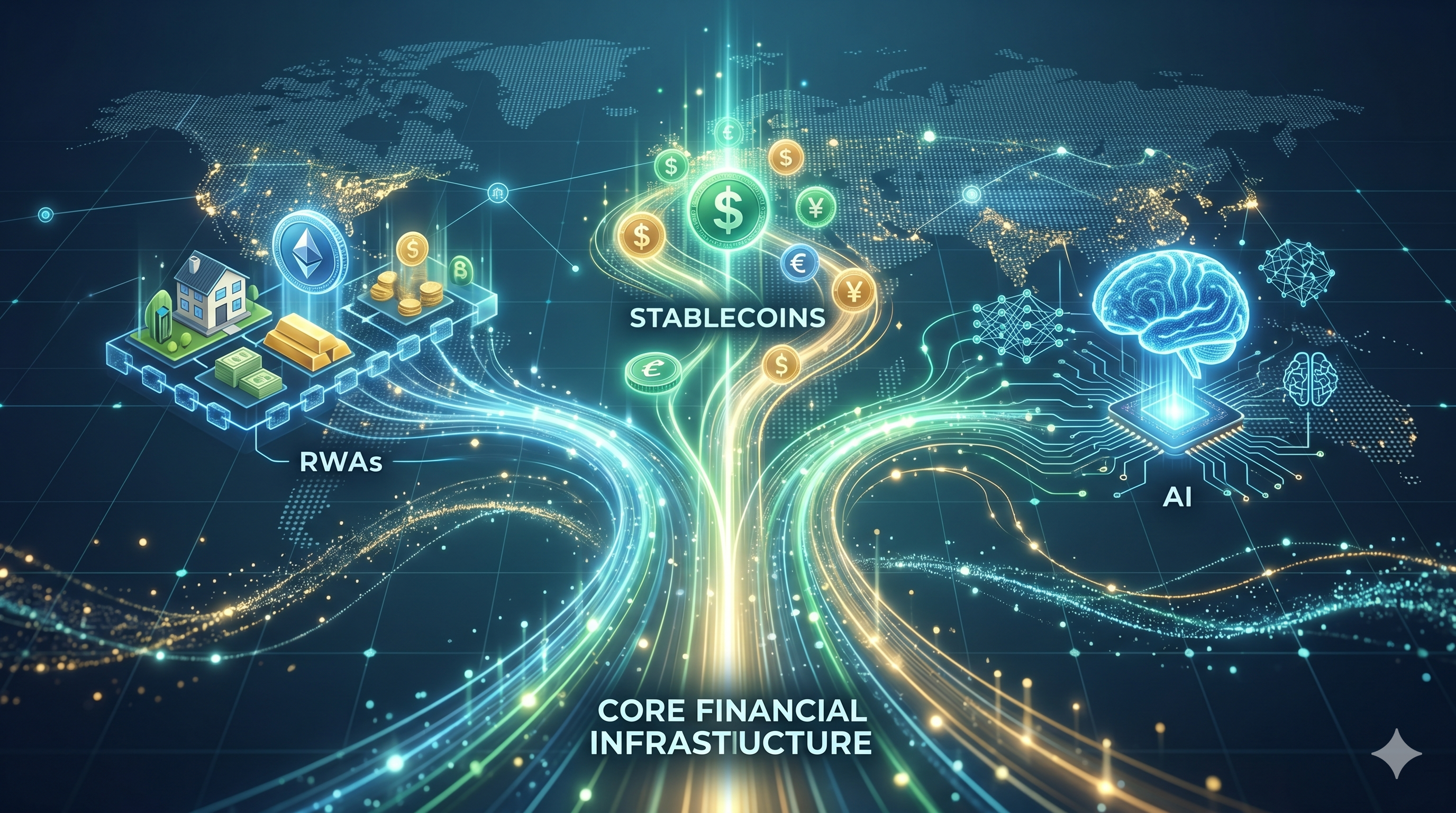
Stablecoins have achieved mainstream scale with a market capitalization exceeding $320 billion as of mid-2026, while tokenized real-world assets (RWAs) have surpassed $33 billion in on-chain value. Artificial intelligence systems, particularly autonomous agents, increasingly rely on these rails, for instance, programmable settlements that traditional systems cannot match in speed or efficiency. Major institutions like BlackRock, with its BUIDL fund, alongside Ondo Finance and Circle, demonstrate how tokenization bridges traditional assets with blockchain transparency and liquidity.
Transaction volumes for stablecoins reached tens of trillions in 2025, outpacing legacy payment networks in key segments, as programmable money enables new economic models. Stablecoins provide the stable settlement layer, RWAs bring trillions in traditional value on-chain, and AI supplies intelligent automation, collectively forming the programmable infrastructure that is redefining global finance through efficiency, accessibility, and real-time execution.
💡 Tips: New to crypto? KuCoin's Knowledge Base has everything you need to get started.
Stablecoin Supply and Volume Metrics Signal Infrastructure Maturity
Stablecoin market capitalization has climbed to approximately $322 billion in 2026, with Tether’s USDT holding around 59% dominance and Circle’s USDC serving as the preferred choice for regulated and institutional flows at over $75 billion. Annual transaction volumes exceeded $33-46 trillion in 2025, depending on methodology, with raw on-chain figures approaching or surpassing combined Visa and Mastercard throughput in certain estimates. Adjusted volumes remain substantial, reflecting genuine utility in payments, treasury management, and DeFi. Growth stems from regulatory clarity, including U.S. legislation in 2025, alongside adoption in emerging markets for remittances and commerce. Projects from a16z and industry reports highlight stablecoins as foundational settlement infrastructure, with daily volumes potentially scaling toward hundreds of billions.
Banks and fintechs integrate these assets for cross-border efficiency, reducing settlement times from days to seconds while lowering costs. Tokenized treasuries and yield-bearing variants further enhance appeal by combining stability with returns. As corporations and payment processors expand pilots, stablecoins transition from crypto-native tools to core components of global financial plumbing, supporting both retail and high-volume enterprise use cases without the volatility of other digital assets. This maturity positions them as reliable rails for the broader tokenization wave and AI-driven automation.
Tokenized RWAs Surpass $33 Billion as Institutions Allocate Capital On-Chain
The tokenized real-world assets market, excluding stablecoins in some counts, reached record levels around $33.8 billion in on-chain value by mid-2026, reflecting roughly 30% growth in Q1 alone and over 200-260% expansion in prior periods. U.S. Treasuries dominate, with products like BlackRock’s BUIDL exceeding $2 billion and Ondo Finance’s offerings like USDY and OUSG contributing significantly to the total. Ethereum leads with the largest share, while Solana and other chains show rapid percentage gains in adoption. Over 796,000 holders engage with these assets, drawn by yields typically in the 4-15% range through DeFi protocols. Tokenization converts illiquid assets, real estate, private credit, commodities, and bonds into divisible, tradable tokens with 24/7 liquidity and transparent ownership records.
Institutional demand drives this, as firms seek better capital efficiency, fractional ownership, and secondary market access. BCG and other forecasts project that the broader tokenized asset market could reach $10-16 trillion by 2030, representing a meaningful portion of global GDP. Real estate and private credit emerge as key growth areas alongside treasuries. Platforms streamline issuance, compliance, and distribution, enabling traditional managers to tap blockchain benefits without abandoning existing frameworks. This shift improves price discovery, reduces intermediaries, and unlocks previously inaccessible investment opportunities for a wider participant base.
BlackRock BUIDL and Ondo Finance Set the Pace for Institutional Tokenization
BlackRock’s BUIDL fund, custodied by BNY Mellon, stands as a flagship example with assets of around $2.5 billion, offering institutional-grade exposure to tokenized U.S. Treasuries with daily yield accrual and multi-chain redemption options into USDC. Ondo Finance complements this through products like USDY, which has accumulated substantial TVL and provides accessible yield-bearing mechanisms integrated deeply with DeFi. These initiatives demonstrate how leading asset managers leverage blockchain for operational efficiency while maintaining regulatory compliance. JPMorgan has filed for additional tokenized funds to support stablecoin reserve requirements, signaling a broader Wall Street commitment.
Partnerships and platforms reduce friction in issuance and trading, allowing assets to move seamlessly between traditional and on-chain environments. Minimum investment thresholds vary, with some products opening to qualified investors and others broadening access. The convergence attracts capital seeking stable yields in a low-interest environment while providing transparency through on-chain records. Secondary markets and collateral use in DeFi further amplify utility. As more issuers enter, competition drives innovation in liquidity provision, redemption processes, and cross-chain interoperability. These leaders establish templates for scaling tokenization across additional asset classes, including equities and structured products, fundamentally altering how value is stored, transferred, and utilized in modern portfolios.
AI Agents Emerge as Major Users of Stablecoin Payment Rails
Autonomous AI agents require instant, programmable, low-cost settlement mechanisms that legacy rails cannot provide at machine scale. Stablecoins, particularly USDC and USDT, serve as the native medium for these transactions, enabling micropayments for data, compute resources, API calls, and services without traditional invoicing or delays. Executives at firms like Bridge and Deus X Capital note that large corporations and AI agents represent the next major growth drivers, with pilots already underway for agent-initiated commerce. Protocols like x402 facilitate reactive, intent-based payments where agents execute autonomously upon conditions being met.
Projections suggest agentic commerce could reach trillions globally by 2030, with stablecoins handling the majority of settlements due to their speed and global reach. Mastercard and others experiment with authenticated agentic transactions, while infrastructure providers build compliance and metering layers suitable for high-frequency activity. AI agents cannot navigate complex KYC or banking interfaces, making blockchain wallets and stablecoins the practical solution. This dynamic accelerates adoption as developers embed payment logic directly into agent behaviors. Early statistics show growing but still nascent volumes relative to total stablecoin activity, indicating significant headroom as agent ecosystems mature. The combination creates economic actors capable of continuous operation across borders and time zones.
Programmable Money Enables AI-Driven Financial Automation
The intersection of stablecoins and AI goes beyond simple payments to full programmability. Smart contracts combined with stablecoin rails allow conditional logic, automated rebalancing, and real-time execution of complex strategies. AI agents can analyze market data, allocate to tokenized RWAs for yield, and redeploy capital instantly based on predefined parameters or learned optimization. Platforms like IXS and Ant Group developments target AI-native investment layers for holding and transacting tokenized assets. This setup reduces human intervention in portfolio management, compliance monitoring, and risk adjustment. In corporate treasury, AI systems optimize cash flows using stablecoins for FX and payments, minimizing idle balances and counterparty risks.
Prediction markets and other applications self-settle in real time as events unfold. Developers ship software with built-in payment rules, audit trails, and limits, eliminating traditional integration overhead. The result is a financial system operating at digital speed with verifiable transparency. Challenges around security, agent authentication, and regulatory alignment persist, but see active development through sandboxes and industry standards. As agent capabilities advance, the volume of AI-intermediated stablecoin transactions is expected to rise substantially, reshaping everything from supply chain finance to personal wealth management.
Yield-Bearing Stablecoins and Tokenized Treasuries Reshape Liquidity Management
Tokenized U.S. Treasuries and related products offer stability plus attractive yields, appealing to both institutions and DeFi users. Funds from BlackRock, Ondo, Franklin Templeton, and others provide exposure with varying accessibility and integration levels. Yields around 3.5-5% in early 2026, depending on the product and prevailing rates, compete with traditional money market options while adding blockchain advantages like instant liquidity and composability. JPMorgan analyses indicate stablecoins retain dominance over tokenized money market funds due to broader utility and network effects, though the latter capture a growing share for yield-focused capital.
Corporations use these instruments for treasury reserves, earning returns on cash that would otherwise sit idle. Redemption mechanisms into native stablecoins enhance flexibility. In DeFi, these assets serve as collateral, enabling leveraged strategies while maintaining links to real-world backing. Growth in this segment supports stablecoin issuers by providing compliant reserve options under evolving regulations. As tokenization scales, expect more structured products that blend yield, stability, and programmability, attracting capital from traditional fixed-income markets seeking efficiency gains. This evolution contributes to deeper on-chain liquidity and more sophisticated risk management tools across the ecosystem.
Cross-Border and Corporate Treasury Applications Drive Real-World Utility
Stablecoins excel in cross-border payments by offering near-instant settlement, lower fees, and 24/7 availability compared to correspondent banking. Commodity traders like Trafigura explore USDT for fuel station payments, while fintechs and banks pilot solutions for remittances and B2B flows. Corporations manage global treasury operations with reduced FX friction and improved visibility. Tokenized RWAs extend these benefits by allowing on-chain representation of invoices, trade finance instruments, or revenue streams. AI agents further optimize these processes by monitoring rates, executing hedges, and reconciling transactions autonomously.
Emerging market adoption remains strong due to currency stability needs and limited traditional infrastructure. Payment processors and banks integrate stablecoin capabilities to retain customers and expand services. The combination of speed, transparency, and programmability addresses long-standing pain points in international finance, potentially capturing significant market share from legacy systems. Real-time data and smart contract automation reduce reconciliation costs and errors. As volumes grow, network effects strengthen, making the rails more attractive for larger participants. This practical utility cements stablecoins and RWAs as essential tools rather than experimental technology.
DeFi Protocols Integrate RWAs for Enhanced Capital Efficiency
DeFi platforms increasingly accept tokenized Treasuries, private credit, and other RWAs as collateral, unlocking borrowing, lending, and yield strategies backed by real assets. This integration bridges on-chain liquidity with off-chain value, allowing users to earn compounded returns while maintaining exposure to traditional instruments. Total DeFi TVL in RWAs has grown alongside the broader market, with protocols offering 4-15% yields on select assets. Composability enables complex strategies, such as using tokenized bonds in perpetuals or options markets. Institutions participate through permissioned pools or direct holdings, gaining efficiency without full decentralization trade-offs.
Hurdles include oracle reliability for valuations and legal enforceability of claims, but progress in standards and wrappers addresses these. The result is more robust on-chain markets with reduced systemic risk through diversified, asset-backed collateral. Retail and professional users benefit from fractional access and global availability. As more traditional assets tokenize, DeFi evolves from speculative venues toward sophisticated financial infrastructure supporting hedging, funding, and investment needs. This maturation attracts larger capital allocations and fosters innovation in product design.
Technological Advancements Support Interoperability and Scalability
Layer-1 and layer-2 networks compete to host tokenized assets, with Ethereum maintaining leadership through security and ecosystem depth while Solana and others gain through speed and cost advantages. Cross-chain bridges, standards for tokenization, and compliance tooling improve interoperability, allowing assets to move fluidly between environments. Privacy-enhancing technologies and zero-knowledge proofs address data sensitivity for institutional users. Oracles feed real-world information reliably into smart contracts for accurate valuations and settlements.
AI contributes by optimizing routing, risk assessment, and even automated compliance checks. Infrastructure providers focus on custody solutions, legal wrappers, and enterprise-grade APIs to lower integration barriers. These developments enable seamless experiences where users or agents interact with hybrid systems without noticing underlying complexity. Ongoing improvements in finality, throughput, and security are critical for handling projected volume growth. Collaboration between old tech stacks and blockchain protocols accelerates progress toward a unified infrastructure layer. The technical foundation now supports meaningful scale, setting the stage for broader mainstream integration.
Market Forecasts Point to Multi-Trillion Scale by 2030
Analysts project stablecoins reaching $1.9-4 trillion by 2030 in various scenarios, driven by payments, crypto adoption, and liquidity substitution. Tokenized assets could hit $10-16 trillion or higher, according to BCG, Standard Chartered, and Mordor Intelligence estimates, with RWAs growing at CAGRs exceeding 40-70% in optimistic models. AI agent-driven activity adds another dimension, potentially multiplying transaction volumes through autonomous commerce. Combined, these elements form an infrastructure capable of supporting a significant share of global financial activity. Growth depends on continued regulatory support, technological reliability, and user adoption.
Institutional inflows, particularly from asset managers and corporates, provide steady momentum. Emerging markets and specific sectors like real estate and commodities offer additional upside. Economic implications include improved capital allocation, reduced friction costs, and new opportunities for yield and inclusion. Risks around concentration, liquidity in stress periods, and integration challenges warrant monitoring. Overall direction suggests these technologies will occupy a central role in future finance, influencing everything from monetary policy transmission to individual wealth building.
Implementation Challenges Require Coordinated Solutions
Scaling these systems involves addressing custody risks, oracle dependencies, regulatory fragmentation across jurisdictions, and operational complexities in bridging traditional and digital worlds. Idle assets and secondary market liquidity remain areas for improvement despite overall growth. Security incidents, though less frequent in mature products, highlight the need for robust auditing and insurance mechanisms. User education and interface simplicity are essential for broader participation beyond crypto natives.
AI-specific concerns around agent authentication, liability, and control add layers that developers and regulators must navigate. Interoperability standards and shared compliance frameworks can reduce duplication and enhance trust. Industry initiatives and public-private collaboration help align incentives and mitigate systemic concerns. Progress in these areas determines the pace of adoption and the ultimate impact on financial inclusion and efficiency. Practical solutions emerge through iterative pilots and data-driven refinements rather than top-down mandates. The ecosystem demonstrates resilience by focusing on measurable utility and risk management as it expands.
Industry-Specific Adoption Examples Illustrate Practical Impact
In commodities, traders explore stablecoins for settlement and RWAs for inventory financing. Real estate platforms tokenize properties for fractional ownership and global investment. Supply chain finance benefits from transparent, programmable invoices and instant payments. Wealth managers incorporate tokenized funds for client portfolios seeking diversification and yield. Payment firms embed stablecoin options for merchants, reducing costs in high-fee corridors. AI developers build agents that autonomously handle subscriptions, resource procurement, and revenue distribution using on-chain rails.
Corporate treasuries in multinational firms pilot 24/7 FX and cash management solutions. These cases show tangible cost savings, speed improvements, and new revenue models. Success hinges on integration with existing workflows and clear legal pathways. As more sectors experiment and share results, best practices spread, accelerating overall maturity. The diversity of applications underscores the versatile nature of this infrastructure across different scales and requirements.
Toward a Unified Programmable Financial Operating System
The convergence of stablecoins for settlement, RWAs for asset representation, and AI for decision-making and execution creates a cohesive layer that operates continuously, transparently, and at a global scale. This system supports both traditional efficiency gains and novel economic activities impossible under prior constraints. Institutions, developers, and users co-create standards and tools that balance innovation with stability. Future developments will likely emphasize usability, resilience, and inclusive access.
The foundational elements are now in place, with momentum building across metrics of capitalization, volume, and participation. Continued focus on practical value and risk mitigation will determine long-term success. This infrastructure promises more responsive, efficient, and accessible finance that aligns better with the speed and connectivity of the digital economy. Stakeholders across sectors stand to benefit from engaging with these developments as they mature.
FAQs
How do stablecoins support AI agent transactions in practice?
AI agents use stablecoin wallets and protocols like x402 to execute micropayments and conditional transfers autonomously for services, data, or compute without human intervention or traditional banking friction, enabling continuous operation at machine speeds.
What makes tokenized Treasuries attractive compared to traditional holdings?
They combine government backing and yields with 24/7 liquidity, DeFi composability, instant settlements, and transparent on-chain records, offering efficiency advantages for treasury management and collateral use.
Which blockchains lead in hosting RWAs currently?
Ethereum holds the largest share due to security and institutional comfort, while Solana and others grow rapidly through lower costs and higher throughput, with interoperability solutions bridging the ecosystem.
How significant is the projected growth for these technologies?
Forecasts indicate stablecoins potentially reaching trillions and tokenized assets scaling to double-digit trillions by 2030, driven by institutional adoption, payments utility, and AI automation across multiple sectors.
What role do traditional institutions play in this evolution?
Firms like BlackRock, JPMorgan, and Ondo issue and manage major tokenized products, providing compliant bridges that bring regulated capital and credibility while leveraging blockchain for operational improvements.
Are there risks associated with relying on these new rails?
Key considerations include smart contract security, regulatory changes, liquidity during stress, concentration in major issuers, and the need for robust oracles and custody solutions, which the industry continues to strengthen through standards and audits.
Disclaimer: This content is for informational purposes only and does not constitute investment advice. Cryptocurrency investments carry risk. Please do your own research (DYOR).