

Ripple Prime Launches 24/7 RWA Perpetual Swaps Across 100+ Markets
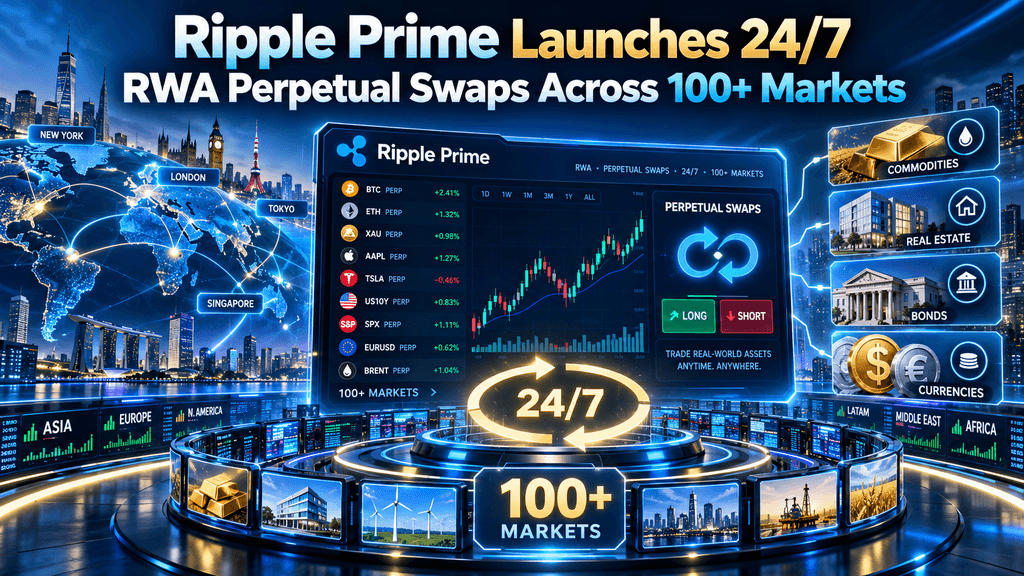
What happens when traditional financial markets meet the 24/7 trading model of crypto derivatives? Ripple is taking another step in that direction. On October 15, 2026, Ripple announced that its institutional prime brokerage platform, Ripple Prime, had launched support for real-world asset (RWA) perpetual swaps covering more than 100 reference markets across equities, equity indices, exchange-traded funds (ETFs), metals, energy, and foreign exchange. The contracts reference perpetual futures listed by Trade.xyz on Hyperliquid, while Ripple Prime acts as the principal counterparty for its clients.
The launch gives eligible institutional customers access to trading and settlement around the clock, including weekends, and allows them to use Ripple USD (RLUSD) as collateral where permitted. Market maker Virtu is among the institutions already trading the products. The announcement highlights a growing connection between crypto-native derivatives infrastructure and traditional financial markets. However, these contracts provide price exposure rather than automatic ownership of underlying assets, and their expansion will depend on liquidity, risk controls, regulation, and actual institutional demand.
Key Takeaways
-
Ripple Prime launched RWA perpetual swaps on October 15, covering more than 100 reference markets.
-
The contracts reference Trade.xyz perpetual futures listed on Hyperliquid, while Ripple Prime acts as the principal counterparty.
-
Eligible clients can trade and settle around the clock, use RLUSD as collateral where available, and cross-margin supported exposures.
-
Virtu is among the institutions already trading the new products.
-
The launch could strengthen institutional access to RWA derivatives, but it does not automatically create demand for XRP or guarantee higher HYPE prices.
What Did Ripple Prime Launch?
Ripple Prime has introduced institutional access to perpetual swaps linked to more than 100 traditional-asset reference markets, extending its multi-asset brokerage offering into a growing segment of crypto-linked derivatives. Announced on October 15, the service covers equities, equity indices, ETFs, metals, energy, and foreign exchange. Ripple says trading and settlement are available 24 hours a day, seven days a week, including weekends. The products are designed for institutional clients seeking to manage traditional and digital asset exposures through a consolidated brokerage relationship.
The launch is significant because it brings traditional-market price exposure into an always-on trading environment. Rather than requiring customers to open separate accounts across multiple venues, Ripple Prime offers a single counterparty relationship and consolidated risk management across supported asset classes. Virtu, a global market-making firm, is among the early participants. Its involvement indicates that the offering has moved beyond an announcement into actual institutional use, although Ripple has not disclosed product-specific trading volumes, open interest, or total client exposure.
Which Markets Are Included?
The more than 100 reference markets span several major asset categories. Equities and equity indices allow clients to take positions linked to individual companies or broader stock-market benchmarks. ETF references extend the range to exchange-traded products, while metals and energy provide exposure to commodity-related price movements. Foreign exchange adds currency-market references to the mix.
The breadth of coverage matters because institutions often manage risk across multiple markets rather than treating each asset independently. A portfolio might combine equity exposure, currency risk, and commodity positions, creating opportunities to manage related exposures within one brokerage framework. However, the announcement does not establish that every listed stock, ETF, metal, or currency is available in every jurisdiction. Clients must check the actual contract list, eligibility requirements, and product terms before assuming access to a specific market.
How Do Ripple Prime's RWA Swaps Work?
The key to understanding the launch is the distinction between the reference market, the pricing infrastructure, and the institution that faces the customer. Ripple Prime's swaps reference perpetual futures listed by Trade.xyz on Hyperliquid, a decentralized derivatives venue. Ripple Prime acts as principal in the client transaction, meaning the institutional customer enters into the swap with Ripple Prime rather than automatically becoming a direct counterparty to Trade.xyz or Hyperliquid. This arrangement combines crypto-native market pricing with an institutional brokerage relationship.
A perpetual swap is a derivative contract without a conventional fixed expiration date. Its value tracks a reference market according to the contract's pricing rules. Traders can gain or lose money as the reference price moves, and leveraged positions may require margin to cover potential losses. Unlike purchasing a stock through a traditional exchange, entering a swap does not, by itself, grant ownership of the underlying company shares or voting rights. The customer's rights and obligations instead depend on the swap agreement, collateral arrangements, and applicable law.
Why Does the Hyperliquid Connection Matter?
Hyperliquid provides the venue where the referenced perpetual futures are listed, while Trade.xyz supplies the relevant contracts. Ripple Prime then offers its institutional customers swaps tied to those markets through its own brokerage infrastructure. The result is a bridge between a crypto-native derivatives venue and institutions that may prefer to manage positions through an established prime-broker relationship.
This structure can reduce the operational burden of interacting with separate trading venues, but it does not eliminate risk. The reference contract's liquidity, pricing quality, and trading conditions can still affect the swap's valuation. Meanwhile, clients remain exposed to the terms and creditworthiness of their direct counterparty, Ripple Prime. The launch should therefore be understood as an institutional access and intermediation development, not proof that all Ripple Prime trades are executed directly on Hyperliquid or settled on-chain.
Why Does 24/7 RWA Trading Matter?
Round-the-clock trading gives institutions a way to adjust certain traditional-asset price exposures outside conventional exchange hours. Stock exchanges generally follow scheduled sessions, and many commodity and currency markets also operate under defined trading calendars. Crypto derivatives venues, by contrast, can continue operating through nights, weekends, and holidays. Ripple Prime's new offering brings that continuous trading model to swaps referencing more than 100 traditional markets, potentially allowing eligible clients to respond more quickly to breaking news and changing risk conditions.
This capability may be particularly relevant when major events occur while traditional markets are closed. Political developments, economic announcements, corporate news, or geopolitical shocks can alter expectations before the underlying exchange reopens. A continuously traded reference contract can provide an additional channel for expressing those expectations and adjusting exposure. Institutions may also use such contracts to hedge other positions, subject to the availability and suitability of the relevant market.
Continuous Trading Does Not Mean Continuous Underlying Markets
The most important limitation is that the underlying stock, ETF, or commodity market does not necessarily remain open simply because its associated perpetual contract can trade. During traditional market closures, prices on the reference venue may reflect expectations, limited liquidity, or differing views about where the underlying asset would trade if its primary market were open. Spreads can widen, and prices may move sharply when trading activity is thin.
These conditions create potential complications for valuation and risk management. If a reference contract moves substantially over a weekend, institutions may need to adjust collateral even though the underlying exchange is closed. When the traditional market reopens, its price may converge with or diverge from the weekend reference price. Continuous access is therefore a useful tool, but it does not guarantee tighter spreads, deeper liquidity, or more accurate prices at every hour.
What Do RLUSD Collateral and Cross-Margining Add?
RLUSD and cross-margining are central to Ripple Prime's institutional proposition because they address how clients fund positions and manage portfolio risk. Ripple says eligible clients can use its US-dollar stablecoin, RLUSD, as collateral for the new swaps, subject to jurisdictional availability. The platform also supports cross-margining across supported asset classes, allowing the risk of multiple positions to be considered together rather than necessarily requiring each position to be funded in isolation.
For an institution trading equities, currencies, commodities, and digital assets, separate collateral pools can tie up substantial capital. Cross-margining may allow eligible offsets between positions to reduce aggregate margin requirements when the portfolio's risk profile supports it. This can improve capital efficiency and simplify oversight. However, the degree of offset depends on the broker's margin model, eligible instruments, concentration limits, and the correlation assumptions used to estimate risk. It should not be interpreted as a promise that clients will always need less collateral.
RLUSD adds a stablecoin-based funding option to this structure. Its use as collateral could make the product more convenient for institutions already operating within Ripple's supported financial infrastructure. Yet collateral eligibility is not universal, and a stablecoin's dollar reference value does not remove all liquidity, issuer, operational, or legal risks. Institutions must understand how collateral is valued, whether haircuts apply, how quickly it can be transferred, and what happens if its market price or redemption access deteriorates.
What Could the Launch Mean for XRP, HYPE, and RWA Markets?
Ripple Prime's expansion could increase attention on institutional RWA derivatives and the infrastructure supporting them, but the effects on individual crypto assets will depend on measurable usage rather than headlines alone. The launch directly confirms a new institutional service, a reference-price relationship with Trade.xyz contracts on Hyperliquid, and the eligibility of RLUSD as collateral in supported jurisdictions. It does not establish a required role for XRP in each transaction or guarantee that the new service will increase demand for HYPE.
| Asset or market | Potential connection | Evidence to monitor |
| XRP | Broader interest in Ripple's institutional business could affect market sentiment | Confirmed XRP usage, transaction demand, and relevant company disclosures |
| RLUSD | Eligible collateral use could expand its institutional utility | Actual collateral balances, usage disclosures, and circulation changes |
| HYPE | More attention to Hyperliquid-based reference markets could influence sentiment | Relevant market activity, fees, open interest, and liquidity |
| RWA derivatives | Institutional brokerage access could broaden participation | Trading volume, market depth, open interest, and new client adoption |
XRP: Business Expansion Is Not the Same as Token Demand
Ripple's institutional business development may strengthen the company's position in financial services, but the new swaps do not automatically require XRP. RLUSD is the specifically identified stablecoin collateral option, while Ripple Prime acts as principal in the swap transactions. Without evidence of direct XRP usage or a change in XRP-related demand, it would be premature to attribute a future price move to this announcement alone.
HYPE and the Broader RWA Derivatives Market
Hyperliquid's connection is more direct at the infrastructure level because Trade.xyz contracts listed on the venue provide the reference pricing for the swaps. The launch could encourage market participants to examine Hyperliquid's traditional-asset derivatives activity and liquidity. However, Ripple has not published its own product-specific volumes or disclosed how much trading activity will translate into activity on the reference venue. Any claim that the announcement will raise HYPE demand should be tested against market data, not assumed from the partnership.
What Risks and Regulatory Limits Should Institutions Consider?
The main risks involve counterparty exposure, liquidity, collateral management, and jurisdictional restrictions. Since Ripple Prime acts as principal, customers need to understand their contractual relationship with Ripple Prime, including margin calls, close-out rights, default procedures, and how disputes are handled. The fact that the reference contracts trade on Hyperliquid does not mean that the client's direct contractual exposure is automatically transferred to that venue.
Liquidity is another concern. Perpetual contracts linked to traditional assets may experience wider spreads or less reliable price discovery during weekends and holidays, particularly when the underlying market is closed. A sharp move in the reference contract could increase margin requirements or force a client to reduce exposure at an unfavorable price. Cross-margining can improve capital efficiency in normal conditions, but correlated losses across multiple asset classes can also place pressure on a portfolio at the same time.
Regulatory access is equally important. Ripple has said the service is currently offered through its CIV BVI license and that it intends to expand into additional regions, without announcing a firm timetable. Availability, eligible customers, and permissible collateral can vary by jurisdiction. Institutions should review the relevant product documentation and legal requirements rather than assume that a service announced globally is available to every customer.
What Should Traders Watch Next?
The next stage of the story will be determined by adoption and measurable market activity. Ripple's announcement establishes that the product is live and that Virtu is among the institutions already using it, but the company has not disclosed product-specific trading volume, open interest, or total collateral deployed. Those figures would help distinguish a promising launch from a service that is gaining sustained institutional traction.
Three indicators deserve particular attention. First, monitor the liquidity and open interest of the relevant Trade.xyz markets on Hyperliquid, while recognizing that venue-wide activity cannot be attributed entirely to Ripple Prime. Second, look for new institutional clients, additional supported markets, and concrete announcements about geographic expansion. Third, track RLUSD's disclosed role as eligible collateral and any evidence of actual usage in the new product. Changes in overall RLUSD supply alone would not prove that this launch caused additional demand.
For crypto-market participants, XRP and HYPE price action should be considered alongside those operational indicators. A token-price move immediately after a headline does not establish a causal relationship. Stronger evidence would include sustained product adoption, rising relevant market activity, and disclosures showing how the service uses the underlying infrastructure. Until that evidence emerges, the launch is best viewed as a meaningful development in institutional access to RWA derivatives rather than a guaranteed catalyst for any specific token.
Conclusion
Ripple Prime's launch of 24/7 RWA perpetual swaps across more than 100 reference markets highlights how crypto-native derivatives infrastructure is increasingly being connected to traditional financial products. By referencing Trade.xyz perpetual futures on Hyperliquid, acting as principal to institutional customers, supporting RLUSD collateral where permitted, and offering cross-margining across supported assets, Ripple is expanding the ways eligible institutions can manage traditional and digital market exposure through one brokerage relationship.
The broader significance lies in access and market structure. Continuous trading can help institutions respond to events outside traditional exchange hours, while consolidated margining may improve capital efficiency. At the same time, these benefits come with important limitations: the contracts do not confer automatic ownership of underlying assets, weekend pricing may be less liquid, and cross-margining cannot eliminate portfolio losses or counterparty risk.
The launch also should not be treated as automatic proof of increased demand for XRP or higher HYPE prices. The next meaningful signals will be actual trading activity, institutional adoption, RLUSD collateral usage, and expansion into additional jurisdictions. Those developments will show whether Ripple Prime's new service becomes a lasting part of the evolving RWA derivatives market.
🔥 Beyond the Headlines: What KuCoin 5.0 Means for You
Market news moves fast — but where you act on it matters just as much. This October, KuCoin launches KuCoin 5.0, transforming KuCoin into a rebuilt platform. Here's what actually changes for you:
-
One account for everything. Older platforms split your money across separate "spot," "margin," and "futures" accounts and expected you to understand why. KuCoin 5.0's unified account removes that entirely — deposit once, and everything is simply there (only available to VIPs for now).
-
Stocks, indices, and commodities. KuCoin 5.0 expands beyond crypto into global markets. When crypto chops sideways and equities rally (or the reverse), you rotate in minutes instead of opening a brokerage account and waiting days for fiat rails.
-
Real-world assets (RWA). Tokenized exposure to traditional assets like commodities, right inside your crypto account. One of the fastest-growing segments in global finance is no longer reserved for institutions — you access it from the same balance you trade with.
-
Earn while you learn. Not ready to trade? KCUSD lets your stablecoins earn daily, auto-compounding interest. The lowest-stress way to put your idle deposit to work for 4% yield.
-
An AI assistant in plain language. Ask questions, get market context, understand what you're looking at — built into the platform, no jargon required.
-
An app that doesn't overwhelm. Faster, cleaner, and consistent — intuitive from the first tap, not after a tutorial.
-
Safety you can check, not just trust. A MiCAR-licensed EU entity, Proof of Reserves you can verify yourself, and internationally certified security (SOC 2 Type II, ISO 27001:2022).
Create your account in minutes — and start on the platform built for where crypto is going, not where it's been.
FAQs
Does trading an RWA perpetual swap give an investor shareholder voting rights?
No. A swap linked to a stock price generally provides contractual price exposure rather than direct ownership of the underlying shares. Voting rights and other shareholder privileges do not automatically come with the derivative position.
Can retail traders access Ripple Prime's new swaps?
The announcement describes the service as an institutional offering. Retail availability should not be assumed; access depends on Ripple Prime's eligibility requirements, contractual terms, and the rules applicable in each jurisdiction.
What happens to a perpetual swap when its underlying stock pays a dividend?
The effect depends on the specific contract's pricing and adjustment methodology. Some equity-linked derivatives incorporate dividend expectations or adjustments into their valuation, but clients should consult the relevant contract terms rather than assume that they receive the dividend directly.
Does 24/7 settlement mean withdrawals are guaranteed at any time?
No. Continuous trading and settlement do not guarantee uninterrupted withdrawals or immediate access to all collateral. Availability can depend on operational systems, risk controls, banking rails, market conditions, and applicable restrictions.
Why might an institution choose a swap instead of buying an ETF directly?
A swap can provide contractual price exposure without requiring the institution to purchase and custody the underlying ETF. It may also fit into a broader hedging or margin framework. The trade-off is that the institution takes on derivative-specific risks, including counterparty exposure, margin requirements, and contract terms.
Disclaimer: This article is for informational purposes only and does not constitute financial or investment advice. Cryptocurrency and derivatives trading carry significant risk, including the potential loss of capital. Always conduct your own research before trading.