

Polymarket Partners with Nasdaq: Trade OpenAI & SpaceX Valuations via Crypto
2026/05/22 16:30:03
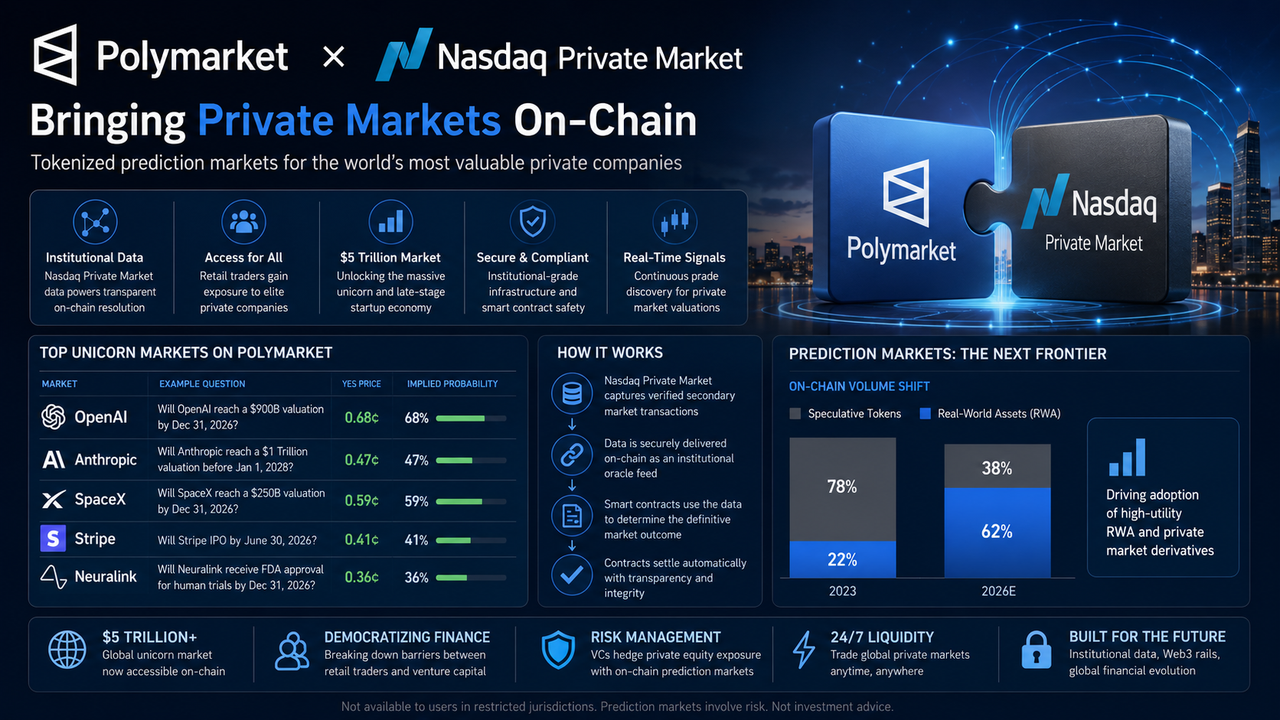
The digital asset ecosystem is witnessing a historic convergence between decentralized finance and traditional capital markets. In a groundbreaking move, Polymarket Partners with Nasdaq Private Market (NPM) to launch tokenized prediction markets centered on the valuations, secondary share prices, and initial public offering (IPO) timelines of elite private tech giants. This monumental collaboration bridges the gap between on-chain liquidity and off-chain corporate equities for the first time.
By utilizing Web3 infrastructure, this integration introduces an unprecedented asset class to global retail traders. In this comprehensive analysis, we will explore how Polymarket Partners with Nasdaq to transform synthetic private equity trading, reshape on-chain derivatives volumes, and unlock a $5 trillion market of late-stage startup data.
Key Takeaways
-
Institutional Oracle Integration: Polymarket Partners with Nasdaq Private Market to utilize institutional-grade secondary trading data for objective, transparent on-chain contract resolution.
-
Democratizing Venture Capital: Retail crypto traders can now gain financial exposure to high-value, pre-IPO tech giants like OpenAI, SpaceX, and Anthropic without needing accredited investor status.
-
Synthetic Capital Access: The partnership targets a massive $5 trillion global "unicorn" market, unlocking real-time price discovery for traditionally opaque private valuations.
-
Shift in On-Chain Volume: Crypto exchanges and prediction platforms are transitioning from speculative memecoins toward high-utility, institutional-backed Real-World Assets (RWA).
-
VC Portfolio Hedging: Venture capital firms and institutional desks can leverage these prediction markets as macro hedging tools to manage downside risks in their private equity portfolios.
-
Regulatory Milestones: The initiative sets a major precedent for compliance, smart contract settlement safety, and multi-jurisdictional financial frameworks in 2026.
Decoding the Alliance: Polymarket Partners with Nasdaq for Institutional Data
The strategic alliance between Polymarket and Nasdaq Private Market represents a foundational shift in how decentralized applications leverage institutional data. For years, the integration of traditional equities into Web3 environments was stifled by the lack of reliable data streams. This partnership directly addresses these historical inefficiencies by merging Nasdaq's robust data infrastructure with Polymarket’s massive decentralized trading volume.
The Resolution Problem: How Nasdaq Private Market Solves Equity Opacity
The primary obstacle preventing the growth of prediction markets for private companies has always been the "resolution problem." Unlike publicly traded stocks, which print verifiable price ticks every second on public exchanges, private company valuations are notoriously opaque. Share prices are locked behind non-disclosure agreements, funding rounds happen infrequently, and secondary market transactions are scattered across disjointed brokerages.
Without an indisputable source of truth, decentralized smart contracts cannot safely resolve. If a prediction market asked whether a company's valuation hit a certain threshold, determining the "Yes" or "No" outcome would often result in disputes, oracle failures, or manipulation. Nasdaq Private Market solves this structural deficit by operating a closed, regulatory-compliant network that facilitates actual secondary trading for private unicorn shares. By piping this transaction ledger directly on-chain, Web3 platforms finally possess the verified, institutional transactional records required to settle high-stakes financial contracts cleanly.
From Politics to Finance: Polymarket’s Evolution into Advanced Derivatives
Polymarket’s meteoric rise established it as the global hub for political forecasting and cultural sentiment wagering. However, relying purely on cyclical events like national elections presents long-term sustainability challenges for on-chain volumes. To cement its position as a pillar of modern decentralized finance, the platform has actively expanded into sophisticated financial derivatives.
This evolution into corporate valuation contracts transforms prediction markets from niche forecasting tools into a legitimate alternative financial layer. Instead of betting solely on binary news events, users can now trade macro tech trends, corporate cash flows, and institutional capital raises. The partnership allows the crypto ecosystem to capture a segment of the traditional options and futures volume, positioning decentralized prediction markets as direct competitors to legacy legacy derivatives desks.
The Oracle Shift: Using NPM Data as the Ultimate Settlement Authority
In decentralized networks, an oracle acts as the bridge translating real-world information into executable smart contract code. When Polymarket Partners with Nasdaq, the nature of this bridge undergoes a major institutional upgrade. Rather than relying on crowd-sourced consensus or multi-signature web-scraping algorithms—which are vulnerable to manipulation—the contract logic relies on NPM's transaction engine.
Every contract tracking a startup’s valuation or secondary share price is bound to NPM’s verified data feeds. When a contract reaches its expiration date, the smart contract queries the NPM oracle to confirm the latest volume-weighted average price (VWAP) or formal valuation milestone. This institutional oracle architecture eliminates counterparty disputes, protects traders from malicious oracle exploits, and creates an ironclad foundation for processing hundreds of millions of dollars in synthetic volume safely.
OpenAI, SpaceX & Anthropic: Tracking the Top Unicorn Prediction Markets
The initial rollout of these institutional prediction markets focuses heavily on the crown jewels of the venture capital world. By launching contracts centered around the most valuable and heavily discussed private tech enterprises, Polymarket has instantly captured the attention of both crypto natives and legacy tech analysts.
OpenAI $900B Valuation: Analyzing Market Sentiment for Late 2026
OpenAI continues to dominate global technology discourse, yet direct retail financial participation in its exponential growth has been structurally impossible. Through this new product suite, traders are aggressively positioning themselves on OpenAI’s corporate trajectory.
Current contract pricing reveals highly optimistic long-term market sentiment. For instance, traders have allocated significant capital toward contracts predicting whether OpenAI’s valuation will cross the $900 billion threshold by December 31, 2026. The real-time pricing of these contracts fluctuates based on enterprise client acquisitions, compute cluster expansions, and regulatory policy shifts, acting as a direct barometer for OpenAI's perceived market dominance.
Anthropic to $1 Trillion? Decoding the Boldest AI Predictions on Polymarket
As the primary rival to OpenAI, Anthropic has drawn billions in capital from tech giants like Amazon and Google. The prediction markets tracking Anthropic’s valuation offer a unique lookup into how the market weighs the artificial intelligence arms race.
One of the most heavily traded long-term contracts centers on whether Anthropic futures will hit a staggering $1.0 trillion valuation milestone before legacy tech incumbents slow down. Because these contracts are priced between 1 and 99 cents based on implied probability, the continuous movement of these shares provides an on-chain visualization of market confidence. It lets the public analyze exactly how unexpected model breakthroughs or core developer migrations impact Anthropic's multi-billion dollar valuation in real time.
Tech IPO Timelines: Betting on Stripe, Databricks, and Kraken Liquidity
Initial Public Offerings represent the ultimate liquidity event for private companies, but their timing is notoriously difficult to pin down due to shifting macroeconomic conditions. Polymarket’s IPO tracking contracts offer traders a way to monetize these highly anticipated liquidity timelines.
| Company | Market Target Event | Implied Market Probability | On-Chain Volume Trends |
| Stripe | Public Market Debut before Q4 2026 | 68% | High Institutional Inflow |
| Databricks | Valuation Crossing $60B Post-IPO | 54% | Moderate Steady Growth |
| Kraken | NYSE/Nasdaq Direct Listing in 2026 | 79% | Aggressive Crypto Native Accumulation |
These contracts resolve to "Yes" only if the formal SEC Form S-1 registration statement becomes effective and shares begin public trading within the designated window. Traders utilize historical macroeconomic indicators, federal interest rate trajectories, and internal corporate insider rumors to trade these contracts mispricings, creating a highly liquid market around corporate exit strategies.
Defense Tech & Brain-Tech: Speculating on Anduril and Neuralink Contracts
Beyond software and AI, the partnership introduces cutting-edge hardware, defense, and biotechnology companies to the decentralized trading arena. Defense-tech powerhouse Anduril and Elon Musk’s neurotechnology startup Neuralink have emerged as massive retail favorites.
Contracts tracking Anduril focus heavily on government defense contract acquisitions and geopolitical procurement cycles. Meanwhile, Neuralink markets revolve around FDA approval milestones, successful human trial expansions, and breakthrough patient recovery metrics. These specialized prediction markets allow subject-matter experts and specialized researchers to monetize their domain knowledge directly on-chain, bypassing the restrictions of traditional retail brokerage accounts.
Market Implications: Why Private Equity Proxy Trading Changes the Game
The systemic implications of this partnership extend far beyond the immediate trading revenue generated by Polymarket and Nasdaq. By fusing decentralized order books with private equity data, this initiative challenges the structural foundation of traditional corporate finance and capital allocation.
Demolishing Barriers: Granting Retail Investors Access to Venture Capital
The traditional venture capital asset class is built upon systemic exclusion. Under current financial frameworks, participating in early or late-stage private funding rounds requires accredited investor status—a designation requiring high net worth or strict income minimums. Consequently, the explosive wealth generated by tech startups during their private growth phases is captured exclusively by elite institutional funds.
When Polymarket Partners with Nasdaq, this exclusionary paradigm is fundamentally broken. Any individual with an internet connection and a web3 wallet can now buy, sell, and trade financial exposure based on the growth of the world's premier tech startups. A user can risk as little as five dollars to back their thesis on SpaceX's aerospace supremacy or OpenAI's revenue growth, completely democratizing access to wealth generation vehicles that were previously gatekept for decades.
Real-Time Price Discovery: Creating Public Signals for Private Entities
Private markets suffer from extreme information lag. A startup's true valuation is typically marked to market only once or twice a year during formal capital raises or structured tender offers. In the interim months, the broader market remains completely blind to how macroeconomic shifts or internal corporate disasters impact the company's baseline value.
The continuous, 24/7 trading of synthetic contracts on Polymarket creates an instantaneous, crowd-sourced price discovery mechanism. If a private unicorn experiences a major security breach or lands a massive enterprise client, the immediate price fluctuations in its corresponding prediction market provide a clear public signal regarding its financial impact. This real-time feedback loop gives employees, founders, and secondary buyers a much clearer understanding of their company’s current market standing than traditional quarterly or annual valuation updates could ever provide.
Hedging Private Equity: How VCs Can Use Polymarket to Risk-Manage Portfolios
While retail traders will utilize these prediction markets primarily for capital appreciation, institutional venture capital firms can deploy them as powerful risk-management tools. VCs frequently find themselves "paper wealthy" but structurally illiquid, holding hundreds of millions of dollars in private startup equity that cannot be sold due to lock-up periods, shareholder agreements, or illiquid secondary markets.
By utilizing Polymarket's synthetic contracts, an institutional fund can hedge its downside risk. For example, if a VC fund holds a massive, illiquid equity position in an AI startup, it can open a large "No" position on that company’s valuation contract on Polymarket. If the startup's valuation declines during the next funding round, the losses sustained in the fund's physical private portfolio are partially offset by the profits generated from the winning on-chain prediction contract. This ability to short or hedge private equity exposure on-chain marks a monumental advancement in institutional portfolio management.
Crypto Exchange Perspective: How This Shifts On-Chain Trading Volume
From the viewpoint of centralized and decentralized crypto exchanges, the news that Polymarket Partners with Nasdaq serves as a vital blueprint for the future of on-chain trading volumes. As global liquidity pools evolve, platforms must adapt to user demands that extend far beyond traditional spot and futures crypto trading.
Beyond Memecoins: The Transition to High-Value Real-World Assets (RWA)
For a significant portion of recent crypto history, speculative retail volume was driven heavily by memecoins and hyper-volatile digital assets. While these assets generate massive short-term trading fees for exchanges, they lack fundamental value drivers, long-term structural utility, and institutional capital interest.
The introduction of Nasdaq-backed prediction markets accelerates the industry’s transition toward institutional Real-World Assets (RWA). Traders are demonstrating an insatiable appetite for on-chain products backed by tangible, real-world economic fundamentals. By offering contracts rooted in the financial health and operational milestones of multi-billion dollar tech corporations, the crypto ecosystem can capture a far more stable, mature, and capitalized user base, paving the way for sustainable platform fee generation.
Synthetic Derivatives: The Future of Cross-Platform Liquidity Pools
The mechanics underlying the Polymarket-Nasdaq partnership point toward a future dominated by advanced cross-platform synthetic derivatives. Instead of simply trading basic token pairs, users want to trade complex economic correlations.
Crypto exchanges can capitalize on this trend by building specialized liquidity pools designed to support synthetic equities trading. By providing deep on-chain liquidity for prediction market shares, platforms can attract professional market makers and algorithmic trading firms. These institutional players require robust, low-latency execution environments to manage their synthetic positions, driving substantial transaction volume and native token utility to the exchanges that build the most efficient infrastructure.
Arbitrage Opportunities: Trading Polymarket Yields Against Secondary Shares
The coexistence of Nasdaq’s physical secondary market and Polymarket’s synthetic prediction market creates a highly lucrative playground for quantitative arbitrageurs. Because the two markets operate on different rails and cater to distinct user bases, structural mispricings are guaranteed to occur.
-
Discount Arbitrage: When a prediction contract undervalues a startup’s true valuation relative to private secondary market trade data, arbitrageurs will aggressively buy up the on-chain shares.
-
Premium Extraction: Conversely, if speculative retail hype drives a Polymarket contract price significantly higher than the actual implied equity values on NPM, funds can short the prediction market while securing cheaper physical equity via private channels.
-
Delta Neutral Yielding: Market participants can construct delta-neutral positions across platforms to extract risk-free yields from market sentiment discrepancies, injecting continuous liquidity into both networks.
Regulatory and Safety Outlook: Trading Private Markets on Polymarket
As decentralized prediction markets scale to handle billions of dollars in enterprise equity exposure, they inevitably attract intense scrutiny from global financial regulators. Navigating this complex regulatory landscape is the single most critical factor determining the long-term viability of this new asset class.
Compliance Hurdles: Navigating SEC and CFTC Scrutiny in 2026
The intersection of crypto derivatives and corporate equity tracking falls directly into a regulatory gray area monitored closely by the Securities and Exchange Commission (SEC) and the Commodity Futures Trading Commission (CFTC). Historically, both regulatory bodies have taken an aggressive enforcement stance against unauthorized synthetic stock offerings and unregistered prediction platforms.
Because Polymarket Partners with Nasdaq, the platform gains a substantial layer of institutional credibility. However, the legal classification of these contracts remains highly complex. Regulators must determine whether a tokenized contract tracking a company's private valuation constitutes a swap, a binary option, or a synthetic security. To maintain operational stability throughout 2026 and beyond, platforms must proactively implement rigorous geo-fencing protocols, advanced identity verification (KYC/AML) procedures, and comprehensive compliance frameworks to align with evolving international securities laws.
Counterparty Risks: Understanding Smart Contract Security and Settlement
From a technical security standpoint, trading advanced corporate derivatives on-chain introduces unique risk vectors that users must understand. Unlike traditional equity brokerages backed by federal clearing houses and insurance programs, decentralized prediction markets rely entirely on the execution of automated smart contracts.
If a smart contract contains a logical vulnerability or a compiler exploit, malicious actors could theoretically drain the liquidity pools supporting these valuation markets. Furthermore, traders face settlement risk if the underlying oracle data feed experiences latency, data corruption, or temporary downtime during a critical contract resolution window. Ensuring rigorous, multi-firm smart contract audits, implementing decentralized insurance backstops, and establishing clear fallback resolution rules are essential requirements for protecting user capital as on-chain open interest reaches new historical highs.
FAQ
Q1: What happens when Polymarket Partners with Nasdaq?
A1: When Polymarket Partners with Nasdaq Private Market, the decentralized prediction platform integrates Nasdaq’s institutional, real-time private equity secondary trading data. This data serves as the official reference source to accurately verify and settle on-chain prediction contracts tracking private company valuations and IPO timelines.
Q2: Can I buy actual shares of OpenAI or SpaceX on Polymarket?
A2: No, you cannot purchase actual equity or physical shares of OpenAI or SpaceX on Polymarket. Instead, you are trading synthetic prediction contracts that track the financial performance, valuation milestones, and liquidity timelines of these companies, using crypto as the underlying collateral.
Q3: How do Polymarket unicorn contracts resolve if private valuations are secret?
A3: The contracts resolve safely because Polymarket Partners with Nasdaq to gain access to exclusive institutional transaction data. Nasdaq Private Market tracks actual private share trades and primary funding rounds, providing an indisputable data feed that automatically triggers contract settlement upon expiration.
Q4: Who can legally participate in these private equity prediction markets?
A4: Participation depends heavily on your local jurisdiction and regional regulations. Due to ongoing compliance frameworks enforced by the CFTC and SEC in 2026, users in restricted regions, including the United States, are structurally geo-fenced from trading these financial contracts directly on Polymarket.
Q5: Why is the Polymarket and Nasdaq alliance important for the crypto industry?
A5: This alliance is monumental because it accelerates the integration of high-value Real-World Assets (RWA) into decentralized finance. It shifts on-chain trading volume away from purely speculative tokens toward sophisticated, data-driven derivatives backed by the institutional credibility of a premier legacy stock exchange.