

Nvidia Just Authorized $150 Billion in Buybacks—Here's What It Means for NVDA Stock
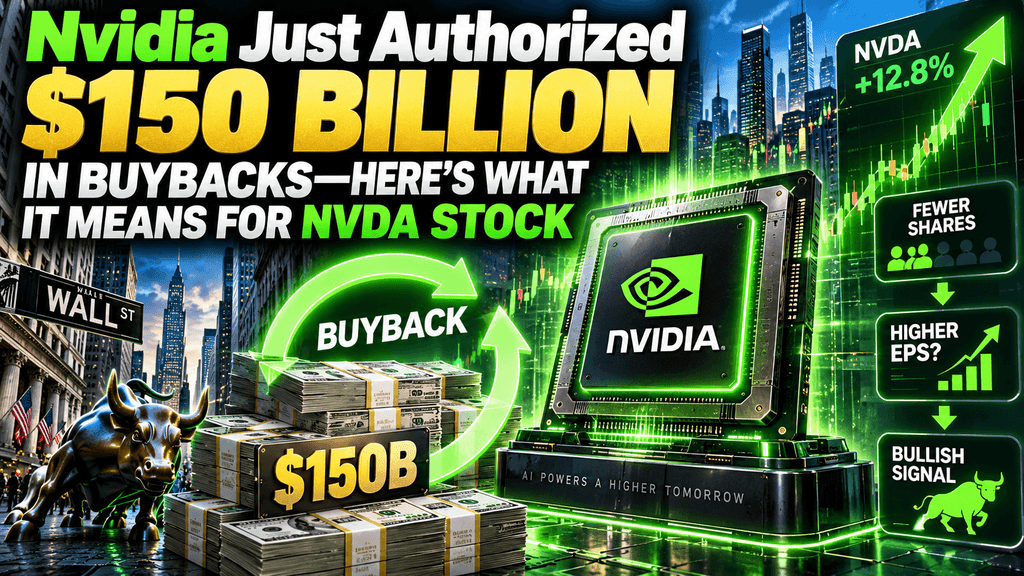
Nvidia’s board of directors authorized an additional $150 billion under its existing share repurchase program on September 28, 2026, raising the remaining total authorization to $235 billion. The company expects to execute the full remaining program through fiscal year 2028. This stands as the largest single increase to a share repurchase authorization in corporate history, surpassing Apple’s prior $110 billion expansion in 2024. Shares of Nvidia (NASDAQ: NVDA) rose approximately 1.7% to 2.8% on the announcement day, closing near $228.86 with a market capitalization around $5.5 trillion. The decision arrives as Nvidia continues to generate substantial cash from demand for its artificial intelligence and accelerated computing platforms.
CEO Jensen Huang tied the move directly to the company’s cash generation capacity, stating that growth stems from a once-in-a-generation platform shift and that the authorization reflects confidence in the long-term opportunity. Investors now assess how this capital return program interacts with ongoing technology investments, earnings growth, and a forward price-to-earnings multiple that has compressed to multi-year lows. The scale of the authorization provides meaningful flexibility for reducing shares outstanding while the business funds expansion in data center and AI infrastructure. This feature examines the authorization’s structure, supporting financial results, valuation context, market reaction, and implications for NVDA holders based on verified recent disclosures and performance data.
Nvidia’s Board of Directors formally authorized the $150 billion increase on September 28, 2026, as detailed in the company’s official newsroom release. The action builds directly on the existing repurchase framework rather than creating an entirely new program. Prior to this expansion, remaining authorization stood near $99 billion following an $80 billion increase approved in May 2026 and subsequent execution. The latest step elevates remaining capacity to $235 billion and sets an explicit expectation of completion by the end of fiscal 2028. Company materials describe the increase as the largest share repurchase authorization expansion on record. Execution remains subject to market conditions, available cash, and other capital needs, consistent with standard repurchase program mechanics.
Nvidia has already demonstrated active use of prior authorizations. In the second quarter of fiscal 2027 alone, the company returned approximately $26 billion to shareholders through a combination of share repurchases and dividends. First-half fiscal 2027 repurchase activity totaled $39.8 billion for 203 million shares. These figures illustrate operational readiness to deploy capital when management deems prices and cash levels appropriate. The September authorization therefore extends a pattern of progressively larger capital-return capacity rather than introducing an abrupt shift in policy.
The $235 billion remaining authorization represents an extraordinary pool of capital relative to most corporate balance sheets and even relative to Nvidia’s own prior programs. At recent share prices near $229, the full authorization could theoretically retire more than one billion shares, though actual share count reduction depends on execution prices, timing, and any offsetting equity issuances for employee programs. Management has indicated an expectation of completing the remaining program by fiscal 2028, providing a multi-year horizon that aligns with forecasted free-cash-flow generation. In the first half of fiscal 2027, operating cash flow reached $74.4 billion, supporting both investment and the $39.8 billion in buybacks already completed.
Cash, cash equivalents, and marketable securities stood at substantial levels at the end of the July 2026 quarter, with cash and cash equivalents alone reported at $22.4 billion alongside larger holdings of marketable debt and equity securities. The authorization does not obligate immediate full deployment; boards retain discretion to adjust pace based on valuation, macroeconomic conditions, and competing uses of capital such as research, manufacturing partnerships, or strategic investments. Nonetheless, the public commitment to a defined timeline elevates the program from pure optionality to a clearer capital-allocation signal. Historical execution shows Nvidia has consistently utilized available authorization, reducing shares outstanding even while issuing shares for compensation.
Founder and CEO Jensen Huang framed the authorization as a direct reflection of confidence in long-term opportunity. In the official statement, Huang noted that NVIDIA’s growth is being driven by a once-in-a-generation platform shift to AI and accelerated computing. He added that cash generation provides capacity both to invest in the technologies advancing that transformation and to return capital to shareholders. The language positions the buyback as complementary to, rather than competitive with, ongoing investment. Huang has previously described the current period as the largest infrastructure build-out in human history, with Nvidia occupying a central role. This perspective underpins the decision to expand repurchase capacity even while the company continues to scale production of advanced GPUs and systems for data-center customers.
The dual-capacity argument rests on the economics of Nvidia’s fabless model: capital intensity remains relatively modest compared with pure-play manufacturers because manufacturing partners handle fabrication. Consequently, a larger fraction of operating cash flow becomes available for returns once research, development, and working-capital needs are met. The September authorization therefore serves as both a capital-return vehicle and a public affirmation of management’s view that AI demand will sustain elevated cash generation through at least fiscal 2028. Investors interpreting the statement must weigh the forward-looking language against the inherent uncertainties of technology cycles and competitive dynamics in the AI hardware market.
Cash-flow strength underpins the feasibility of the expanded program. Operating cash flow for the first half of fiscal 2027 totaled $74.4 billion. In the second quarter specifically, the company returned nearly $26 billion via repurchases and dividends while still recording free cash flow of approximately $21.3 billion after capital expenditures. Gross margins held near 75 percent, supporting conversion of revenue into cash. Data Center revenue, the primary growth engine, reached $89.0 billion in the second quarter, up 117 percent year over year. These results translate into substantial discretionary cash after funding research and development, which rose but remained a manageable percentage of sales. Nvidia has also accessed debt markets, issuing $25 billion of senior notes in June 2026 for general corporate purposes, further expanding liquidity flexibility.
The combination of high-margin revenue growth, modest capital intensity, and access to capital markets creates the capacity to pursue both organic investment and large-scale share repurchases. Management has previously indicated a target of returning roughly half of free cash flow to shareholders through buybacks and dividends. The $235 billion remaining authorization is consistent with that framework if cash generation continues on the trajectory implied by recent results and guidance. Sustained execution will depend on continued customer demand for high-performance computing platforms and the company’s ability to manage supply-chain and inventory dynamics.
Nvidia reported second-quarter fiscal 2027 revenue of $96.2 billion for the period ended July 26, 2026, representing 106 percent growth year over year and 18 percent sequential growth. Data Center revenue accounted for $89.0 billion of the total, up 117 percent from the year-earlier period. GAAP net income reached $59.7 billion, or $2.46 per diluted share. Non-GAAP diluted earnings per share stood at $2.22. Gross margin registered 75.0 percent on both a GAAP and non-GAAP basis. Operating income exceeded $63 billion. These figures illustrate the scale of the AI-driven expansion that funds the repurchase program.
The company guided third-quarter revenue to $108.0 billion, plus or minus 2 percent, excluding any assumed Data Center compute revenue from China. Sequential growth remains robust even as absolute numbers reach levels that few technology companies have previously achieved. Share repurchase activity during the quarter totaled $19.7 billion for 94 million shares, contributing to the broader first-half total of $39.8 billion. Dividend payments added further capital return. The earnings release and accompanying Form 10-Q provide detailed segment and cash-flow data confirming that the business continues to convert high-margin sales into cash available for both reinvestment and shareholder returns. Full details appear in the company’s August 26, 2026, financial results announcement and SEC filings.
At the time of the authorization announcement, Nvidia shares traded at approximately 16.5 times 12-month forward earnings, the lowest multiple since January 2015 and well below the company’s 15-year average near 30 times, according to data cited across multiple financial reports. Some sources placed the fiscal 2028 forward multiple even lower, around 14.5 times. This compression has occurred despite continued strong revenue and earnings growth forecasts, including management’s prior indication of roughly 70 percent revenue growth for fiscal 2028. The lower multiple reflects market debate over the duration of elevated AI infrastructure spending and the potential for increased competition in accelerated computing.
From a capital-allocation perspective, the reduced valuation makes share repurchases more accretive on a per-share basis than would have been the case at higher multiples. Buying shares at a lower earnings multiple increases the earnings yield captured by remaining shareholders. Management’s decision to expand authorization at this valuation level therefore aligns with a rational view that the stock represents an attractive use of excess cash relative to historical norms. Investors monitoring the multiple will watch whether continued execution and the buyback itself help stabilize or expand the valuation over the coming quarters.
Apple’s $110 billion buyback authorization increase in 2024 previously held the record for the largest single expansion of a U.S. company share-repurchase program. Nvidia’s $150 billion increase exceeds that figure by roughly 36 percent. The comparison highlights both the absolute scale of capital generation among the largest technology platforms and the distinct drivers behind each company’s decision. Apple’s program has long been associated with mature cash flows from a broad consumer and services ecosystem. Nvidia’s expansion is explicitly linked to the rapid scaling of AI and accelerated computing demand.
Both companies operate high-margin businesses capable of generating cash far in excess of internal reinvestment needs, yet the underlying growth rates and capital-intensity profiles differ. Nvidia’s fabless structure and current revenue direction produce cash conversion that supports an even larger absolute authorization. The record status of the Nvidia increase also places it in historical context relative to earlier large programs by other megacap firms. Market participants frequently reference these authorizations as signals of management confidence and as mechanisms that can influence earnings-per-share directions over multi-year periods. The Nvidia announcement therefore resets the benchmark for the size of capital-return capacity that leading technology companies are prepared to commit publicly.
Share repurchases reduce the number of shares outstanding, increasing the proportional ownership of remaining shareholders and, all else equal, elevating earnings per share. Nvidia’s recent activity illustrates the effect in practice. In fiscal 2026 the company repurchased 282 million shares for $40.4 billion, yet the net decline in shares outstanding was smaller because of equity issuances for employee compensation. First-half fiscal 2027 repurchase volume of 203 million shares for $39.8 billion continues the pattern. If the full $235 billion remaining authorization is executed at prices near current levels, the potential reduction in share count could reach several percentage points of the approximately 24.15 billion shares outstanding.
Even partial execution can produce measurable EPS accretion when earnings continue to grow. The precise impact depends on the average price paid, the pace of purchases, and the volume of new shares issued under equity plans. Buybacks also provide a flexible alternative to dividends for returning capital, allowing the company to adjust activity according to valuation and cash availability. For long-term holders, the combination of rising absolute earnings and a declining share count can compound per-share value. Tracking the quarterly share-count disclosures in Nvidia’s Form 10-Q filings remains the most direct method for quantifying the cumulative effect of the expanded program.
Nvidia shares advanced roughly 1.7 percent to 2.8 percent on the day of the authorization announcement, with intraday highs near $233. Year-to-date performance through late September 2026 stood near 20 to 24 percent, broadly in line with the Nasdaq-100 yet trailing certain semiconductor peers that posted larger percentage gains from lower bases. The modest positive reaction to the buyback news occurred against a backdrop of broader market softness on the announcement day. Over the preceding twelve months the stock had advanced approximately 24 to 26 percent, lifting market capitalization above $5.4 trillion. The 52-week range spanned roughly $164 to $236.
Trading volume on the announcement day was elevated relative to recent averages. The price response suggests that investors largely anticipated continued capital returns given the company’s cash generation, yet still viewed the record scale as incrementally positive. Subsequent sessions will reveal whether the authorization contributes to sustained support or whether broader questions about AI spending sustainability dominate price action. Historical patterns show that large buyback announcements by high-growth technology companies often produce short-term stability rather than dramatic re-ratings, with longer-term impact depending on actual execution and concurrent earnings delivery.
Demand for Nvidia’s data-center products remains closely linked to capital expenditure by large cloud and AI infrastructure providers. Industry projections cited in contemporaneous reporting indicate combined hyperscaler capital spending could exceed $1.3 trillion by 2027. Nvidia’s second-quarter Data Center revenue of $89 billion, driven by the ramp of Blackwell Ultra systems, reflects the current intensity of that spending. Management has guided sequential revenue growth into the third quarter, consistent with ongoing customer deployments. The durability of this demand underpins the cash-flow assumptions supporting the multi-year buyback timeline.
While spending rates may moderate from peak growth rates, the absolute levels required to support training and inference workloads for large language models and related applications remain substantial. Nvidia’s position as a primary supplier of high-performance GPUs and networking solutions places it at the center of these investments. The buyback authorization implicitly assumes that this demand environment will continue generating sufficient cash through fiscal 2028. Investors evaluating the program must therefore monitor both Nvidia’s quarterly Data Center results and the capital-expenditure guidance of major cloud providers for early signals of any material change in spending journey.
At the end of the second quarter of fiscal 2027, Nvidia held $22.4 billion in cash and cash equivalents, $34.1 billion in marketable debt securities, and $42.8 billion in marketable equity securities. Total assets exceeded $320 billion. The company has demonstrated the ability to fund research and development, working-capital needs, and large shareholder returns while maintaining a strong liquidity position. Capital expenditures remain modest relative to cash generation because of the fabless operating model. The June 2026 issuance of $25 billion in senior notes further diversified funding sources.
This balance-sheet flexibility allows management to pursue the dual objectives of technology advancement and capital return without forcing a binary choice between the two. The $235 billion repurchase authorization therefore sits alongside continued investment in next-generation architectures, software platforms, and ecosystem partnerships. The structure reduces the risk that buybacks would constrain growth initiatives. For shareholders, the combination of a robust balance sheet and a large authorized repurchase capacity provides both downside support through potential share-count reduction and upside participation in continued platform growth.
Market commentary surrounding the authorization has focused on the sustainability of the cash flows that make the program feasible. Some analysts interpret the expanded capacity as a signal that management expects demand for hardware and related services to retain staying power even if the absolute pace of infrastructure build-out moderates. Others note that the lower forward multiple already incorporates a degree of caution about growth duration. Consensus estimates referenced in financial reports project continued substantial free-cash-flow expansion into fiscal 2028. The authorization itself does not guarantee that every dollar will be spent; boards can adjust or pause programs.
Actual deployment rates in coming quarters will provide the most concrete evidence of management’s confidence level. Independent of the buyback, Nvidia’s revenue guidance and segment results remain the primary indicators of business momentum. The record authorization adds a capital-allocation dimension to the existing fundamental debate. Investors synthesizing these views typically examine both the absolute scale of projected cash generation and the competitive landscape in accelerated computing when forming judgments about the program’s long-term impact on shareholder value.
Holders and prospective investors evaluating the authorization should focus on several measurable factors. First, track quarterly updates on shares repurchased, average purchase prices, and remaining authorization in the company’s Form 10-Q filings. Second, monitor the trajectory of free cash flow and the percentage of that flow directed to buybacks versus dividends and other uses. Third, observe changes in the forward earnings multiple and whether the program contributes to multiple expansion or simply stabilizes the share count. Fourth, place the capital-return activity in the context of ongoing revenue growth, gross-margin trends, and Data Center segment performance.
The $235 billion figure is an authorization ceiling rather than a committed expenditure schedule; actual impact will depend on execution. Diversified portfolios already containing significant NVDA exposure may view the program as incremental support for per-share metrics. Concentrated positions require ongoing assessment of both the AI demand environment and competitive developments. Primary source documents, including the September 28, 2026, press release and the second-quarter fiscal 2027 results, remain the most reliable foundation for analysis. No single authorization alters the fundamental risks associated with technology investment, including cyclical demand, competitive pressure, and execution challenges.
Market news moves fast — but where you act on it matters just as much. This October, KuCoin launches KuCoin 5.0, transforming KuCoin into a rebuilt platform. Here's what actually changes for you:
-
One account for everything. Older platforms split your money across separate "spot," "margin," and "futures" accounts and expected you to understand why. KuCoin 5.0's unified account removes that entirely — deposit once, and everything is simply there (only available to VIPs for now).
-
Stocks, indices, and commodities. KuCoin 5.0 expands beyond crypto into global markets. When crypto chops sideways and equities rally (or the reverse), you rotate in minutes instead of opening a brokerage account and waiting days for fiat rails.
-
Real-world assets (RWA). Tokenized exposure to traditional assets like commodities, right inside your crypto account. One of the fastest-growing segments in global finance is no longer reserved for institutions — you access it from the same balance you trade with.
-
Earn while you learn. Not ready to trade? KCUSD lets your stablecoins earn daily, auto-compounding interest. The lowest-stress way to put your idle deposit to work for 4% yield.
-
An AI assistant in plain language. Ask questions, get market context, understand what you're looking at — built into the platform, no jargon required.
-
An app that doesn't overwhelm. Faster, cleaner, and consistent — intuitive from the first tap, not after a tutorial.
-
Safety you can check, not just trust. A MiCAR-licensed EU entity, Proof of Reserves you can verify yourself, and internationally certified security (SOC 2 Type II, ISO 27001:2022).
Create your account in minutes — and start on the platform built for where crypto is going, not where it's been.
How large is Nvidia’s remaining share repurchase authorization after the September 2026 increase?
The board’s $150 billion addition raised the total remaining authorized amount to $235 billion. The company has stated it expects to execute the remaining program through fiscal year 2028. This figure is an upper limit rather than a fixed spending commitment and remains subject to board discretion, market conditions, and other capital needs. Prior to the increase, remaining authorization stood near $99 billion following earlier activity and the May 2026 $80 billion expansion. Actual share retirement will depend on the prices paid and the pace of purchases over the multi-year horizon.
What financial results support Nvidia’s ability to fund such a large buyback program?
Second-quarter fiscal 2027 revenue reached $96.2 billion, up 106 percent year over year, with Data Center revenue of $89.0 billion. GAAP net income was $59.7 billion. First-half operating cash flow totaled $74.4 billion. The company returned approximately $26 billion to shareholders in the second quarter alone through buybacks and dividends. High gross margins near 75 percent and a fabless operating model that keeps capital expenditures relatively modest contribute to strong free-cash-flow conversion.
How does the $150 billion increase compare with previous large buyback authorizations?
The expansion exceeds Apple’s $110 billion authorization increase from 2024, which had been the largest single expansion on record. Nvidia’s figure is approximately 36 percent larger in absolute dollars. The comparison underscores the scale of cash generation among leading technology platforms, though the underlying growth drivers differ. Nvidia links its program explicitly to the AI and accelerated-computing platform shift, while earlier large programs often reflected more mature cash-flow profiles.
What effect can share repurchases have on Nvidia’s earnings per share?
By reducing the number of shares outstanding, buybacks increase the ownership percentage of remaining shareholders and can elevate earnings per share when absolute earnings remain stable or grow. Nvidia has already repurchased hundreds of millions of shares in recent periods. Full or substantial execution of the $235 billion remaining authorization could produce a multi-percentage-point reduction in the share count, amplifying per-share metrics. The precise accretion depends on average purchase prices, timing, and any offsetting share issuances under equity compensation plans.
How did NVDA stock react to the buyback authorization announcement?
Shares rose between roughly 1.7 percent and 2.8 percent on September 28, 2026, with intraday highs near $233. The move occurred against a softer broader market backdrop. Year-to-date performance through late September stood in the low-to-mid 20 percent range. The reaction was positive but measured, consistent with market anticipation of continued capital returns given the company’s cash profile and the already-compressed forward valuation multiple.
Does the authorization require Nvidia to spend the full $235 billion?
No. Share repurchase authorizations establish a maximum capacity that the board may utilize. Management has indicated an expectation of completing the remaining program through fiscal 2028, yet the board retains flexibility to adjust the pace or suspend purchases based on market conditions, investment requirements, and other uses of capital. Historical execution shows consistent utilization of available capacity, but the authorization itself is not a binding spending commitment.
Disclaimer: This content is for informational purposes only and does not constitute investment advice. Investments carry risk. Please do your own research (DYOR).