

NEAR Protocol Price Breaks $3.10: Why AI Agents and Chain Abstraction Are Driving Demand
Introduction
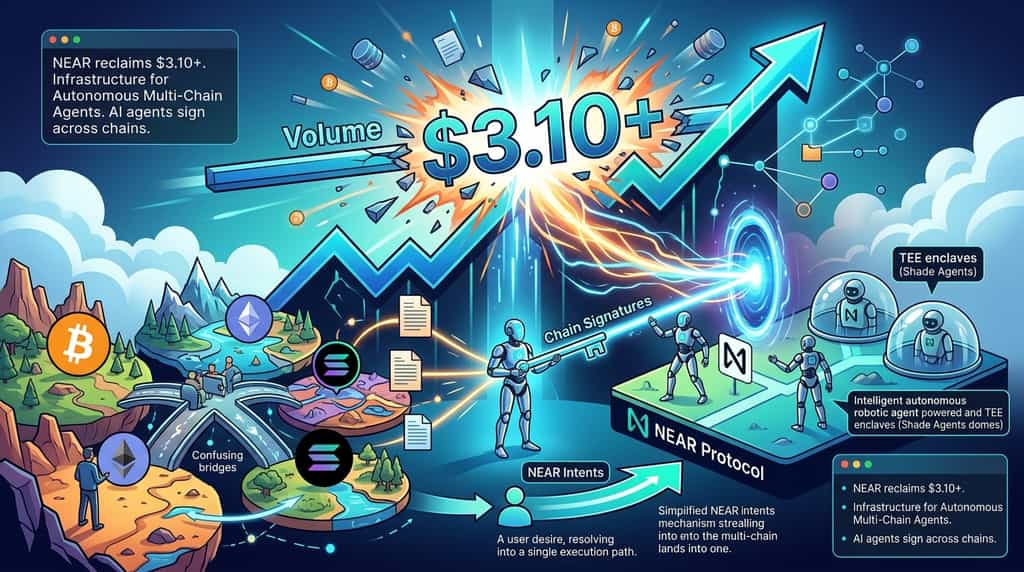
NEAR Protocol reclaimed the $3.10 level in mid-September 2026 after a sharp two-day advance that pushed the token back into the market's spotlight. According to CoinGecko historical data, NEAR closed September 17, 2026 at $3.15 after finishing September 16 at $2.62. CoinMarketCap listed NEAR near $3.23 with a market cap of about $4.21 billion and a 24-hour volume of about $1.57 billion around the same window. The move is not just a technical bounce. Traders are pricing NEAR as infrastructure for autonomous agents that can hold assets, sign across chains, and settle outcomes without users managing wallets, gas tokens, or bridges.
The market is backing a deliberate pivot. NEAR is no longer selling itself only as a fast Layer 1. Official NEAR materials now frame the network as the execution layer for chain abstraction and AI agents — a stack built on Chain Signatures, NEAR Intents, Omnibridge, and Shade Agents.
Why Did NEAR Protocol Break Above $3.10?
NEAR crossed $3.10 because price, volume, and product narrative aligned at the same time. CoinGecko shows market cap rising from about $3.05 billion on September 16, 2026 to about $4.11 billion on September 18, 2026, while 24-hour volume on September 18 printed about $1.28 billion.
The immediate catalyst is positioning around NEAR's agent and abstraction stack. Official NEAR pages state that chain abstraction lets AI interact with assets and applications across multiple chains as if they were one system. That claim matters because most crypto users still fail at the last mile: they can hold a token, but they cannot move authority across Bitcoin, Ethereum, Solana, and other networks without bridges, wrappers, and extra gas tokens.
Volume confirms attention, not just a thin wick. CoinMarketCap reported a 24-hour volume near $1.57 billion against a circulating supply of about 1.31 billion NEAR. A high volume-to-market-cap ratio means the $3.10 break happened with real turnover. CoinLore's September 17, 2026 row also shows a large session, with volume near $1.1 billion and a close at $3.16.
The rebound also sits on a broader 2026 recovery path. CoinLore's yearly table lists 2026 year-to-date performance with a high near $3.19 and a low near $0.86. HTX historical summaries on the same week listed a 30-day gain above 80%. Those figures do not guarantee continuation. They do explain why $3.10 became a psychological magnet: it is the first round-number reclaim after a long grind off the 2026 lows.
Traders should separate the break from the thesis. A $3.10 print can fade if volume collapses. It holds more weight when it arrives with a product story that official documentation can support — agents that sign, intents that settle, and a single account that controls external chains.
What Is NEAR's Chain Abstraction Pivot?
NEAR's chain abstraction pivot is a product bet that users and agents should not have to know which chain they are using. Official NEAR documentation defines the stack as three parts working together: Chain Signatures for control, NEAR Intents for execution, and Omnibridge for asset movement.
Chain Signatures let a NEAR account — including a smart contract — sign transactions on other networks. NEAR's official chain abstraction page says the system uses a multi-party computation network secured by NEAR validators. The point is authority, not just asset wrapping. A user or agent can keep one NEAR identity and still act on Bitcoin, Ethereum, Solana, and other supported chains.
NEAR Intents flip the transaction model. Official docs describe an intent as a desired outcome, such as swapping one asset for another at a constraint the user sets. A solver network competes to fulfill that outcome. Settlement is verified on NEAR. Users do not construct a multi-step bridge path. Agents do not need a custom integration for every destination chain.
Omnibridge handles the asset layer. Official docs describe it as a multi-chain bridge that acts as token factory and custodian through a unified interface. Combined with Chain Signatures, it is designed to cut the classic bridge workflow: lock on chain A, wait, mint on chain B, then find gas.
This is the strategic shift. NEAR still markets high performance — official academy-style summaries still cite fast finality and sharded execution — but growth is now framed around removing chain friction. If agents become the default interface for on-chain activity, the valuable layer is the one that can execute anywhere from one account.
How Do AI Agents Work on NEAR Protocol?
AI agents on NEAR are designed to be economic actors, not chatbots with a wallet plugin. Official Shade Agent documentation describes agents as verifiable, trust-minimized services that can hold assets and sign across chains under on-chain guardrails.
A Shade Agent has two halves. The off-chain agent runs business logic, often inside a Trusted Execution Environment. The on-chain agent contract decides who may act, checks attestations, and grants access to Chain Signatures. That split is the security model. The model can reason off-chain. The contract constrains what the model is allowed to sign.
NEAR Intents give those agents a market interface. Official NEAR blog language describes intents as commitments among users, solvers, and agents. An agent can request a portfolio rebalance, a payment, or a cross-chain transfer by stating the outcome. Solvers compete. The verifier contract settles. The agent does not need to pick a bridge, a DEX route, and a gas token on every destination chain.
Official NEAR materials also point to AITP — the Agent Interaction and Transaction Protocol — as a way for agents to communicate and transact with other agents. The 2025-era ecosystem update on near.org described AITP as infrastructure for agent payments, identification, and multi-agent workflows. That matters because an agent economy is not one bot making one swap. It is agents negotiating with other agents.
Confidential execution is the next layer. The February 25, 2026 PR Newswire release introduced IronClaw as an open-source runtime that deploys agents in encrypted enclaves on NEAR AI Cloud. Co-founder Illia Polosukhin said agents need universal execution, hardware-enforced security, and a settlement layer that can scale. That quote is the product thesis in one sentence: agents cannot run markets if keys leak or if every action is stuck on one chain.
This is why the $3.10 break has a narrative hook. Traders are not only buying "AI" as a label. They are buying a stack that official docs say can let an agent own keys through MPC, express an intent, and settle across chains without a human clicking through five wallets.
Why Is the Market Backing This Strategy?
The market is backing NEAR because the strategy maps onto a bottleneck every multi-chain user already feels. Bridges move assets. They do not move authority. Official NEAR commentary on Chain Signatures makes that distinction explicit: a single NEAR account can control accounts and assets across multiple blockchains.
That distinction is commercially useful. If an agent can sign on 30-plus chains from one identity, developers can ship one product instead of one integration per chain. Official NEAR posts have cited support spanning Bitcoin, Ethereum, Solana, XRP, ZEC, and other networks. The exact roster can change as integrations ship. The design goal does not: one account, many destinations.
Liquidity evidence is still early, but it is no longer only a white paper. CoinMarketCap's September 17, 2026 product notes tied part of the rally to Confidential Intents activity and a TVL print around $70 million. Treat that figure as a usage datapoint, not a valuation model. $70 million is small versus large DeFi venues. It is large enough to show that private, intent-based flow is more than a demo.
The consumer wrapper matters as much as the cryptography. The PR Newswire release said near.com is a super-app powered by NEAR Intents. If users can swap and settle across dozens of chains from one account, NEAR captures the interface even when the underlying asset lives elsewhere. That is a different business than competing only for native NEAR DeFi deposits.
Timing also helps. CoinGecko and CoinMarketCap both show NEAR reclaiming the $3 handle after trading closer to $1.60–$2.00 through much of August 2026. When a project already has a live abstraction stack, a sector-wide AI-agent narrative can reprice the token faster than a project that only has a roadmap.
None of this means the market has "proven" the pivot. It means buyers are paying for optionality: if agents become a real transaction source, the chain that abstracts other chains can take fees, solver flow, and account activity from many ecosystems at once.
How to Buy and Trade NEAR on KuCoin?
You can buy and trade NEAR on KuCoin through a standard spot or derivatives workflow once your account is verified. Create a KuCoin account, complete identity checks required in your region, and enable security controls such as two-factor authentication before you deposit funds.
Fund the account with a supported fiat on-ramp or by transferring crypto from an external wallet. Search for NEAR trading pairs on KuCoin, review the order book, and choose a market order if you want immediate execution or a limit order if you want a set price. Spot pairs suit holders who want direct exposure to NEAR Protocol. Perpetual contracts suit traders who want long or short exposure with leverage — and they also add liquidation risk.
Beyond the Headlines: What KuCoin 5.0 Means for You
Market news moves fast — but where you act on it matters just as much. This October, KuCoin launches KuCoin 5.0, transforming KuCoin into a rebuilt platform. Here's what actually changes for you:
-
One account for everything. Older platforms split your money across separate "spot," "margin," and "futures" accounts and expected you to understand why. KuCoin 5.0's unified account removes that entirely — deposit once, and everything is simply there.
-
Stocks, indices, and commodities. KuCoin 5.0 expands beyond crypto into global markets. When crypto chops sideways and equities rally (or the reverse), you rotate in minutes instead of opening a brokerage account and waiting days for fiat rails.
-
Real-world assets (RWA). Tokenized exposure to traditional assets like commodities, right inside your crypto account. One of the fastest-growing segments in global finance is no longer reserved for institutions — you access it from the same balance you trade with.
-
Earn while you learn. Not ready to trade? KCUSD lets your stablecoins earn daily, auto-compounding interest. The lowest-stress way to put your idle deposit to work for 4% yield.
-
An AI assistant in plain language. Ask questions, get market context, understand what you're looking at — built into the platform, no jargon required.
-
An app that doesn't overwhelm. Faster, cleaner, and consistent — intuitive from the first tap, not after a tutorial.
-
Safety you can check, not just trust. A MiCAR-licensed EU entity, Proof of Reserves you can verify yourself, and internationally certified security (SOC 2 Type II, ISO 27001:2022).
Create your account in minutes — and start on the platform built for where crypto is going, not where it's been.
Conclusion
NEAR's move through $3.10 in September 2026 is a market vote on infrastructure, not only a candle on a chart. CoinGecko, CoinMarketCap, and Coinranking all placed the token above $3 with a multi-billion-dollar market cap and sharply higher volume after September 16–17. That tape arrived as official NEAR materials pushed chain abstraction and autonomous agents as the core product.
The stack is coherent on paper. Chain Signatures give one account authority across chains. Intents let users and agents state outcomes instead of routes. Omnibridge and the near.com interface try to hide the rest. Shade Agents and TEE runtimes try to make those agents verifiable rather than custodial chatbots.
The bull case is simple: if AI agents need to pay, swap, and settle everywhere, the network that abstracts other chains can capture flow that no single L1 can keep inside its own walls. The bear case is equally simple: usage metrics can stay small, complexity can bite, and a high-volume breakout can fade.
Traders should watch three things from official and market-data sources: whether price holds above $3 with durable volume, whether intents and agent products keep publishing usage, and whether NEAR remains easy to trade on liquid venues. The $3.10 level is a headline. The pivot is the thesis.
FAQs
Is NEAR only an AI narrative token now?
No. NEAR remains a sharded Layer 1. The AI-agent and chain-abstraction stack is an additional product layer built on that base.
Does chain abstraction remove all bridge risk?
No. Official docs still include Omnibridge and solver settlement. Abstraction can reduce user-facing steps without deleting all cross-chain risk.
Can a Shade Agent hold assets on other chains?
Yes, according to official Shade Agent and Chain Signatures documentation. The agent contract and MPC signing are what grant that control under guardrails.
Is the $3.10 level a guaranteed support zone?
No. It is a round-number reference from the mid-September 2026 rally. Support only exists if buyers keep defending it with volume.
Where should I verify NEAR market data?
Use specialized market-data sites such as CoinMarketCap and CoinGecko, and use official NEAR documentation for product claims.
Disclaimer: This article is for informational purposes only and does not constitute financial, legal, or investment advice. Always conduct your own research before interacting with digital assets.