

Multiliquid Raises $8 Million as Polychain Backs Tokenized Asset Settlement
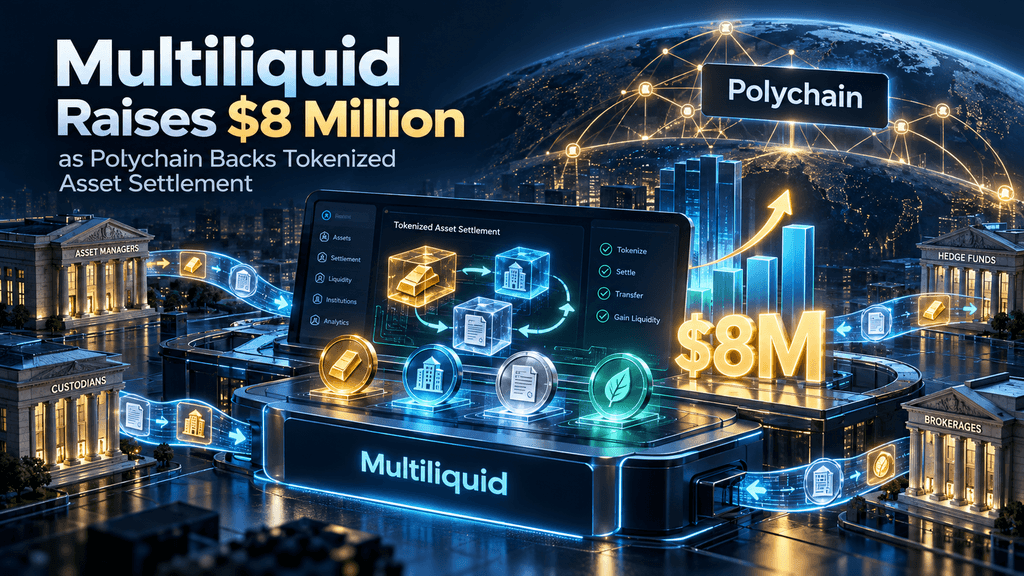
Multiliquid Targets Institutional Liquidity Challenges in Tokenized Real-World Assets
Institutional demand for seamless and efficient movement between yield-bearing tokenized assets and transactional stablecoins has significantly intensified as the on-chain real-world asset market continues to expand and grow. Traditional subscription and redemption cycles, which often stretch across several days, create substantial friction that limits the practical and effective use of tokenized Treasuries, money market funds, and related financial products. Uniform Labs, the innovative developer of the Multiliquid platform, has successfully closed a funding round that brings its total capital raised across both pre-seed and seed rounds to an impressive $8 million, with Polychain Capital leading the latest tranche of the seed funding.
The Multiliquid platform is already operational on both Ethereum and Solana, supporting atomic conversions that are settled against net asset value for a variety of products from well-known managers including Wellington Management, VanEck, Janus Henderson, and Fasanara, alongside major stablecoins such as USDC. This recent funding and ongoing product development position Multiliquidity is a specialized infrastructure that is aimed at providing continuous, compliance-oriented liquidity rather than focusing solely on issuance. This approach addresses a core bottleneck that has historically constrained broader institutional participation in the quickly developing tokenized markets, thereby enhancing the overall efficiency and accessibility of these financial instruments.
Polychain Capital Anchors Multiliquid’s Combined Pre-Seed and Seed Capital Raise
Uniform Labs announced the close of its seed round led by Polychain, with participation from Strobe Ventures, CMT Digital, Metalayer Ventures, Generative Ventures, and Circle Ventures, bringing cumulative funding to $8 million. The pre-seed portion occurred between May and June 2025 via a SAFE structure, while the seed round, completed between April and June 2026, took the form of a priced equity investment. Founder and CEO Will Beeson declined to disclose the split of the total amount or the valuation attached to the seed round. The company has not formed a board, and investors did not receive board, observer, or advisory seats according to the same statements.
Capital will support protocol engineering, expansion of liquidity and trading venue partnerships, and integration of additional tokenized cash and U.S. Treasury products across EVM-compatible networks and Solana. Multiliquid has stated it has no current plans to launch a native token. The investor mix combines crypto-native capital with strategic participation from Circle Ventures, reflecting interest in the intersection of regulated tokenized assets and stablecoin settlement rails. This structure provides runway for a small team that has already launched live routes while prioritizing institutional-grade controls over quick consumer-facing growth.
Atomic T+0 Settlement Enables Single-Transaction Conversion Between Tokenized Funds and Stablecoins
Multiliquid functions as a neutral liquidity aggregation layer rather than a proprietary capital pool. Multiple liquidity providers submit competing quotes for swaps, and the protocol routes transactions to the best available price. Conversions settle atomically in a single blockchain transaction, eliminating the multi-day windows common in traditional primary redemptions. Pricing references the relevant fund’s net asset value, tying the exchange rate to the underlying holdings rather than purely secondary-market dynamics. The platform supports USDC and USDT alongside tokenized products from Wellington Management, VanEck, Janus Henderson, and Fasanara. Live liquidity currently exceeds $20 million.
Operations run on both Ethereum, where the protocol launched on mainnet in December 2025, and Solana, where an instant redemption facility was added in February 2026 in collaboration with Metalayer Ventures. In September 2026, the system expanded routes to include JTRSY and JAAA tokenized funds. Revenue derives from basis-point fees charged on completed conversions. This design prioritizes predictability and compliance features such as whitelist checks, making it suitable for institutional treasury desks that require reliable, same-day movement of capital without balance-sheet drag.
Institutional Investor Participation Underscores Focus on Continuous Settlement Infrastructure
Polychain’s decision to lead the seed round, joined by the listed participants, signals conviction that liquidity and continuous settlement form the next foundational layer for institutional adoption of tokenized assets. Olaf Carlson-Wee, founder of Polychain, noted that tokenized assets have gained traction yet liquidity remains the primary bottleneck, and Multiliquid is constructing the connective layer that allows institutions to move between tokenized funds and stablecoins across issuers and venues. Will Beeson emphasized that traditional capital markets depend on deep repo facilities and overnight lending; on-chain finance requires equivalent institutional plumbing.
The presence of Circle Ventures aligns with the protocol’s heavy reliance on USDC as a settlement asset. Strobe Ventures, CMT Digital, Metalayer Ventures, and Generative Ventures add specialized experience in digital asset infrastructure and market structure. Collectively, the backers provide both capital and network access that can accelerate onboarding of additional liquidity providers and asset issuers during the remainder of 2026. The absence of a native token at this stage keeps the business model oriented toward fee-based infrastructure rather than speculative token economics, consistent with a compliance-first institutional positioning.
Settlement Friction Remains a Binding Constraint in the Expanding Tokenized Treasury Segment
Tokenization has successfully moved ownership records and certain fund units onto public blockchains, yet many products retain traditional subscription and redemption timelines measured in days. Institutions holding yield-bearing tokenized Treasuries or money market funds often cannot convert those holdings into stablecoins for payments, margin, or rebalancing without delay. Multiliquid targets this specific gap by offering 24/7 atomic conversion at NAV. Corporate treasuries can therefore keep operational float or card-settlement reserves in yield-generating tokenized products and redeem into stablecoins only when capital is required.
Capital providers can underwrite secondary redemptions and capture spreads while the underlying continues to earn. Asset issuers gain the ability to offer programmatic secondary exits without constructing custom facilities or trapping balance-sheet capacity. These use cases become more relevant as the broader tokenized real-world asset market has grown into the high tens of billions of dollars in distributed value. Data trackers place on-ledger distributed RWA value (excluding stablecoins) near $38–39 billion in recent readings, with tokenized Treasuries and money market funds forming a substantial share.
Will Beeson’s Career Path Connects Traditional Banking Innovation with Tokenization Infrastructure
Will Beeson founded Multiliquid in 2025 after serving as Chief Product Officer at Standard Chartered’s Libeara platform, where he led development of institutional tokenization infrastructure and contributed to Wellington Management’s tokenized money market fund. Earlier, he co-founded Allica Bank in the United Kingdom, a fully chartered challenger bank focused on SME lending that has scaled significantly. He also co-founded and served as Chief Product Officer of BELLA, a consumer digital bank. His background therefore spans bank formation, product leadership inside a major global bank’s digital asset initiative, and direct experience issuing regulated tokenized products.
Co-founder and COO Angelo D’Alessandro brings nearly three decades in financial services, including founding and scaling UniCredit’s buddybank digital bank. The team’s composition reflects deliberate emphasis on operators who understand both legacy settlement constraints and the technical requirements of on-chain systems. This experience informs Multiliquid’s design choices around neutrality, compliance controls, and NAV-based pricing rather than purely secondary-market mechanisms.
Live Liquidity Above Twenty Million Dollars Supports Instant NAV-Referenced Conversions
The protocol reports more than $20 million in live liquidity available for atomic swaps. This capital is supplied by external providers rather than a single proprietary pool, allowing multiple parties to compete on price for each conversion. Settlement against net asset value reduces the risk of large deviations from the economic value of the underlying fund holdings. Supported assets already include products from several premier asset managers, with recent additions of JTRSY and JAAA routes in September 2026.
The dual-chain deployment on Ethereum and Solana positions the platform where a significant share of both tokenized funds and stablecoin activity already occurs. Institutions monitoring current Ethereum network conditions and related activity can view the dual deployment as pragmatic coverage of the dominant environments for regulated tokenized products. Growth in live liquidity and the number of quoting providers will serve as near-term indicators of whether the model can scale beyond early pilot volumes.
Expanded Coverage of Tokenized Products from Established Asset Managers
Multiliquid’s supported roster includes tokenized funds from Wellington Management, VanEck, Janus Henderson, and Fasanara. These managers bring established institutional distribution and risk frameworks that increase the credibility of the underlying assets available for conversion. The September 2026 addition of liquidity routes for JTRSY and JAAA further broadens the set of products that can be swapped into stablecoins without traditional redemption delays.
Asset issuers benefit from the ability to offer continuous secondary liquidity without building proprietary facilities or reducing assets under management. For holders, the presence of multiple independent liquidity venues, including Multiliquid, improves optionality. The protocol’s neutral stance is intended to encourage additional managers to connect their products, since Multiliquid does not compete as an issuer itself. Continued expansion of the supported asset list remains a stated use of the newly raised capital.
Allocation of Proceeds Prioritizes Engineering, Liquidity Partnerships, and Product Integrations
Proceeds from the $8 million total raise will fund protocol development, recruitment of additional liquidity and trading venue partners, and integration of further tokenized cash and U.S. Treasury products. The company plans to onboard more liquidity providers during the fourth quarter of 2026. Engineering work will focus on refining the aggregation and routing logic, strengthening compliance and whitelist controls, and ensuring reliable performance across Ethereum and Solana.
Partnership expansion aims to deepen the set of quoting counterparties so that larger transaction sizes can be accommodated with minimal slippage relative to NAV. Product integrations target both additional fund issuers and complementary stablecoin or cash-equivalent instruments. These priorities align with the stated goal of building durable institutional plumbing rather than pursuing short-term volume metrics alone.
Neutral Compliance-Oriented Architecture Supports Institutional Risk Frameworks
Multiliquid positions itself as neutral market infrastructure that embeds permissioning, KYC/AML considerations, and whitelist controls at the protocol level. This approach is designed to satisfy institutional requirements that pure open DeFi systems often struggle to meet. By remaining issuer-agnostic and focusing on conversion rather than issuance or proprietary funds, the platform reduces potential conflicts that could deter asset managers from connecting their products.
Atomic settlement removes the multi-day counterparty and operational risk window inherent in traditional redemptions. Institutions evaluating stablecoin market dynamics can view the heavy reliance on established stablecoins as a pragmatic choice that leverages existing institutional comfort and liquidity. The combination of neutrality and compliance features differentiates Multiliquid from both pure DeFi aggregators and captive solutions built by individual asset managers.
Tokenized Real-World Asset Market Context Provides Scale for Specialized Liquidity Layers
Distributed on-chain value of tokenized real-world assets (excluding stablecoins) has reached approximately $38–39 billion, according to recent tracker readings, with some broader measures higher. Tokenized U.S. Treasuries and money market funds constitute a substantial portion of that total. Growth over the past year has been rapid on most measures, yet the infrastructure for continuous secondary liquidity has lagged issuance.
Multiliquid’s focus on the conversion layer rather than primary issuance places it downstream of the initial wave of tokenization activity. As more institutions seek to use tokenized holdings as active treasury or collateral instruments rather than buy-and-hold positions, demand for reliable T+0 rails is expected to rise. The $20 million-plus of live liquidity currently available represents an early base that the new capital is intended to expand.
Practical Applications for Corporate Treasuries and Capital Providers
Corporate treasury teams can deploy idle stablecoin balances or operational float into yield-bearing tokenized products and redeem atomically when payments or margin calls arise. This compresses the traditional trade-off between yield and immediate liquidity. Capital providers can underwrite secondary redemptions, earning spreads while the underlying assets continue to generate returns. Asset issuers gain a distribution and liquidity tool that does not require them to hold large balance-sheet facilities.
Market makers and specialized liquidity desks obtain a structured venue for quoting against NAV. These use cases become more valuable as the absolute size of tokenized holdings grows and as institutions seek to treat on-chain assets as active working capital rather than static investments. The protocol’s dual-chain presence and expanding asset list increase the probability that relevant holdings already sit on supported networks.
Impacts for Stablecoin Usage and Yield-to-Liquidity Rotation
Because every Multiliquid route currently terminates in major stablecoins, the platform’s utility is linked to institutional acceptance of those instruments as settlement cash. The ability to rotate between yield-bearing tokenized funds and stablecoins on a continuous basis supports more efficient capital management in environments where payment stablecoin issuers face constraints on direct yield distribution.
Institutions monitoring Bitcoin and major digital asset price levels alongside broader market conditions can view specialized settlement layers as complementary infrastructure that improves the usability of tokenized holdings without requiring changes to primary issuance processes. Over time, deeper liquidity and additional asset coverage would strengthen the feedback loop between tokenization volume and secondary-market functionality.
Outlook for Multiliquid Within On-Chain Capital Market Infrastructure
The $8 million raise provides Multiliquid with resources to scale engineering capacity, deepen liquidity partnerships, and broaden supported products at a moment when distributed tokenized asset value has already reached tens of billions of dollars. Success will depend on growth in live liquidity, the addition of further institutional-grade fund routes, and consistent performance of the atomic settlement engine under higher volumes.
The absence of a native token and the emphasis on fee-based infrastructure keep incentives aligned with reliable service rather than token price dynamics. Continued participation by established asset managers and liquidity providers will serve as the clearest near-term signals of product-market fit. Multiliquid’s progress illustrates the broader shift from pure issuance of tokenized assets toward the construction of the settlement and liquidity layers required for those assets to function as practical components of institutional portfolios.
🔥 Beyond the Headlines: What KuCoin 5.0 Means for You
Market news moves fast — but where you act on it matters just as much. This October, KuCoin launches KuCoin 5.0, transforming KuCoin into a rebuilt platform. Here's what actually changes for you:
-
One account for everything. Older platforms split your money across separate "spot," "margin," and "futures" accounts and expected you to understand why. KuCoin 5.0's unified account removes that entirely — deposit once, and everything is simply there (only available to VIPs for now).
-
Stocks, indices, and commodities. KuCoin 5.0 expands beyond crypto into global markets. When crypto chops sideways and equities rally (or the reverse), you rotate in minutes instead of opening a brokerage account and waiting days for fiat rails.
-
Real-world assets (RWA). Tokenized exposure to traditional assets like commodities, right inside your crypto account. One of the fastest-growing segments in global finance is no longer reserved for institutions — you access it from the same balance you trade with.
-
Earn while you learn. Not ready to trade? KCUSD lets your stablecoins earn daily, auto-compounding interest. The lowest-stress way to put your idle deposit to work for 4% yield.
-
An AI assistant in plain language. Ask questions, get market context, understand what you're looking at — built into the platform, no jargon required.
-
An app that doesn't overwhelm. Faster, cleaner, and consistent — intuitive from the first tap, not after a tutorial.
-
Safety you can check, not just trust. A MiCAR-licensed EU entity, Proof of Reserves you can verify yourself, and internationally certified security (SOC 2 Type II, ISO 27001:2022).
Create your account in minutes — and start on the platform built for where crypto is going, not where it's been.
FAQs
What is the total amount Multiliquid has raised, and who led the most recent round?
Uniform Labs has raised a combined $8 million across a pre-seed round completed in mid-2025 and a seed round closed in 2026. Polychain Capital led the seed portion, with participation from Strobe Ventures, CMT Digital, Metalayer Ventures, Generative Ventures, and Circle Ventures. Specific allocation between the two rounds and the seed valuation were not disclosed.
How does Multiliquid achieve instant settlement?
The protocol aggregates quotes from multiple external liquidity providers and executes atomic swaps in a single blockchain transaction on either Ethereum or Solana. Pricing is referenced to the relevant fund’s net asset value, and both legs of the trade settle simultaneously or not at all, producing effective T+0 finality rather than multi-day traditional redemption windows.
Which tokenized assets and stablecoins does the platform currently support?
Supported tokenized products include funds from Wellington Management, VanEck, Janus Henderson, and Fasanara, with recent additions of JTRSY and JAAA routes. On the stablecoin side, the system works with USDC and USDT. Live liquidity across these routes exceeds $20 million.
Does Multiliquid plan to issue its own token?
Company statements indicate there are currently no plans to launch a native protocol token. The business model centers on basis-point fees charged on completed conversions.
What will the new capital be used for?
Proceeds are allocated to protocol engineering, expansion of liquidity and trading venue partnerships, hiring, and integration of additional tokenized cash and U.S. Treasury products across supported networks. Additional liquidity providers are expected to be onboarded in the fourth quarter of 2026.
Disclaimer: This content is for informational purposes only and does not constitute investment advice. Cryptocurrency investments carry risk. Please do your own research (DYOR).