

Magnificent Seven Funding Chipmakers With Debt: Is This a Boom or a Black Swan Setup for US Stocks?
2026/06/26 11:23:00
Introduction
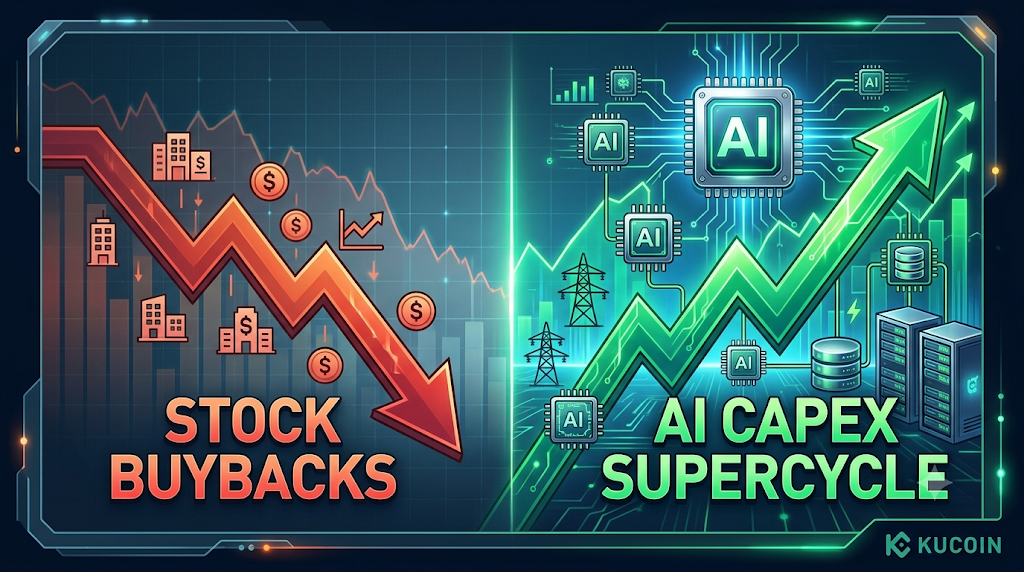
A single statistic captures everything wrong — and everything right — with US equities in 2026: in the first quarter of 2026, the year-over-year growth rate of capital expenditure for S&P 500 constituents reached as high as 38%, while the growth rate of buybacks was just 1%. The Magnificent Seven are no longer the buyers of the US stock market. They are the borrowers. And the cash they raise is flowing into one place — AI chips.
So is this a boom or a black swan in the making? The honest answer is both. The AI capex supercycle is real, but the financing structure underneath it has flipped. The same hyperscalers whose buybacks supported the index for a decade are now issuing equity and debt to feed Nvidia, Micron, Broadcom and a handful of memory and silicon suppliers. The payers are getting sold. The receivers are getting bid. That is not a stable equilibrium — and for crypto traders, it is a signal worth watching closely.
What Does It Mean That the Magnificent Seven Are "Funding" the Chipmakers?
The Magnificent Seven are now net issuers of capital to fund AI infrastructure, reversing a decade in which they were the market's largest net buyers of their own stock. The Magnificent 7, which account for roughly 30% of S&P 500 gross buyback spending, posted 0% year/year buyback growth, and the buybacks are on hold because the money is going into AI. So far this year, the hyperscalers — Amazon, Alphabet, Meta, Microsoft, and Oracle — have deployed $368 billion in capital expenditure, according to Goldman Sachs.
The 2026 numbers are even more extreme. Capital expenditure for the five major tech giants is projected to reach $755 billion in 2026, with capital diffusing from software into the physical economy, including power and industrial sectors. The four biggest hyperscalers — Amazon, Alphabet, Microsoft and Meta — are on pace to combine for roughly $750 billion of AI infrastructure spend this year, an 80%-plus jump versus 2025.
Where is the money going?
Almost all of it ends up with a small group of semiconductor and memory companies. Nvidia, Broadcom, TSMC, SK Hynix, Samsung and Micron sit at the receiving end of the largest infrastructure transfer in modern corporate history. The clearest evidence: when the largest hyperscalers globally — Amazon, Microsoft, Meta, Google — have collectively earmarked over $725 billion in AI data center capex for 2026, the money eventually runs through memory chips.
Why Have Hyperscalers Stopped Buying Back Stock?
Hyperscalers stopped buying back stock because AI capex has consumed the cash flow that used to fund repurchases. According to Goldman Sachs, the trade-off is now mathematical, not strategic.
Surging capex spending related to AI will likely prevent a major increase in the buyback payout ratio. The 2Q earnings season reaffirmed the ongoing corporate focus on AI investment spending, which appears to be crowding out buybacks — S&P 500 companies reported 24% year/year capex growth during the quarter but reported -1% growth in gross buybacks.
The structural shift is even larger than a single quarter suggests. Goldman Sachs has released a report titled "The Post-Modern Cycle: Navigating the Capex Boom," declaring the end of the low-inflation, low-interest-rate "Modern" cycle and the arrival of a high-volatility, high-cost-of-capital "Post-Modern" era. The report's core thesis indicates that markets are shifting from rewarding corporate stock buybacks to rewarding capital expenditure.
Why does this matter for the index?
Buybacks have been the most reliable bid for US equities for over a decade. When that bid disappears and is replaced by new share supply, the supply-demand balance of the entire S&P 500 changes. Less buying, more selling — and a heavier psychological tax on every earnings season where capex guidance ticks higher.
How Big Is Alphabet's $80 Billion Raise — And Why Does It Matter?
Alphabet's June 2026 equity raise is the largest single AI-funding capital raise in market history, and it is the clearest signal yet that hyperscalers can no longer self-fund the buildout. On June 2, 2026, Alphabet announced the pricing of its registered public offerings of Class A Common Stock, Class C Capital Stock and depositary shares representing interests in mandatory convertible preferred stock. The gross proceeds, together with Alphabet's previously announced $40 billion at-the-market offering program, and concurrent $10 billion private placement, represent a total equity raise of $84.75 billion. The equity capital raise was upsized from the previously announced total equity raise of $80 billion.
Google parent Alphabet is raising $80 billion through a package of equity offerings, including an investment deal with Berkshire Hathaway, to help fund AI spending plans. The company will also offer $30 billion in underwritten offerings of shares and mandatory convertible preferred stock, as well as a $10 billion deal with Berkshire.
The capex figure that this raise is meant to fund tells the whole story. Alphabet had already lifted its 2026 capital expenditure guidance by approximately $5 billion, to a range of roughly $180 billion to $190 billion, tied to AI infrastructure and custom silicon. The company is choosing equity over incremental leverage, citing the objective of maintaining a healthy balance sheet while funding the capex program.
What about Oracle?
Oracle has gone even further — borrowing aggressively while issuing equity. Oracle (rated Baa2/BBB) returned in February with US$25 billion of senior unsecured bonds across eight tranches, including a floating-rate note geared to bank portfolios. Management has framed a broader plan to raise roughly US$45–50 billion via debt. Oracle spent $55.7 billion on data centres in FY2026, overshooting its own $50 billion guidance, and the stock fell 7% after hours on capex concerns and plans to raise another $40 billion.
Why Did Micron Stock Surge — and Why Is It a Warning Sign?
Micron's blowout earnings prove the AI demand is real, but they also expose the circular structure of the rally — the companies being sold are paying the company being bought. Micron Technology (MU) reports Q3 2026 earnings on June 24. Analysts forecast $35B revenue (+279%) and EPS of $20.28 (+998%). HBM supply is sold out through 2026.
The stock had already exploded before the print. Micron makes a special memory chip (HBM) that AI computers need, and it is sold out for all of 2026. The stock jumped about 11% on Monday to a record high near US$1,089, up more than 700% in a year, making it roughly a US$1.2 trillion company. Experts strongly disagree: some see it rising to US$1,750, while others see it falling sharply from here.
Where does Micron's revenue actually come from?
Micron's customer base is precisely the group of stocks that has been under selling pressure. Its revenue is not coming from consumer electronics — it is coming from hyperscaler AI capex. Demand for high-bandwidth memory (HBM), the advanced memory used alongside AI accelerators from Nvidia and others, continues to outpace supply. At the same time, prices for both DRAM and NAND memory have climbed as manufacturers prioritize higher-margin AI products and capacity remains constrained. Reuters recently noted Micron's earnings growth is being driven by soaring memory prices and strong HBM demand.
That is the circular loop in one sentence: the payers (Meta, Microsoft, Google, Amazon) are being sold because investors are nervous about their capex, while the receivers (Micron, Nvidia) are being bought because that same capex is filling their order books. If the payers crack, the receivers — being the most cyclical link in the chain — are typically last in, first out.
Is This an AI Bubble or a Capex Supercycle?
It is both — and the distinction matters for risk management, not for the long-term thesis. The capex is producing real revenue and real earnings today. But the financing structure has tipped from cash-funded to debt-funded, which changes the risk profile materially.
After Amazon, Meta and Google-owner Alphabet all unveiled sizable increases in their full-year capex spending plans during earnings season, UBS data indicates that aggregated capex spend among AI hyperscalers could top $770 billion in 2026 — some 23% higher than previously expected. UBS credit strategists said such increases imply a $40 billion to $50 billion ramp-up in borrowing from hyperscalers, pushing public market debt issuance to between $230 to $240 billion this year.
This tilt toward the bond market is dramatically shifting the dynamic between hyperscalers and investors. For years, the AI spend was meant to be funded by generated cash flow — equity risk, speculative, not a credit concern. There now seems to be a change in the unspoken contract that while we would continue to lend to these businesses, really AI capex was still going to be equity or cash funded — by bringing capex spend into the debt markets, you now have the question of credit worthiness.
Where do bond yields fit in?
Bond yields are now a tech-stock indicator again. The 10-year Treasury yield is sitting near 4.45%, and Fed Chair Kevin Warsh signaled the door is still open for a 2026 rate hike. Goldman Sachs says big tech's capital spending as a share of cash flow is at its highest level since the dot-com era. When the largest issuers in the corporate bond market all need to roll new paper at higher yields, equity multiples on those issuers tend to compress.
What Are the Real Black Swan Risks for US Stocks?
The most credible black swan risks are not "AI fails" — they are about financing fragility. Three specific risks deserve attention.
Risk 1: Buyback bid disappears at the index level. With Meta and Alphabet near zero buybacks and Oracle now a net issuer, the index loses its most reliable marginal buyer. Share buybacks get cut. This has already happened. Oracle flipped from share buybacks to a share issuer, which has the opposite effect of share buybacks. In 2025, it issued $2.1 billion in new shares, largely the result of its stock compensation plans. In February, it launched a $20 billion at-the-market share offering.
Risk 2: Credit spreads on hyperscaler debt widen. Oracle's credit default swap spreads widened to above 125 basis points, levels not seen since the 2009 financial crisis. Despite maintaining official ratings of Baa2 (Moody's) & BBB (S&P), Oracle's bonds now trade like junk bonds in the secondary market. If that pricing migrates to other hyperscalers, equity multiples follow.
Risk 3: Capex disappointment hits memory first. Storage is the most cyclical link in the AI chain. If Meta or Microsoft trims a capex outlook, Micron — sitting on a $1.2 trillion valuation built entirely on hyperscaler orders — has the furthest to fall.
| Risk Vector | What Triggers It | Most Exposed Names |
| Buyback collapse | Capex outpaces cash flow | Meta, Alphabet, Oracle |
| Credit spread widening | Bond market repricing | Oracle, Meta |
| Capex guidance cut | Hyperscaler discipline | Micron, Broadcom, Nvidia |
Should You Trade Semiconductor and AI Momentum Themes on KuCoin?
Investors looking to position around technology momentum increasingly monitor both traditional equities and digital asset markets together. Micron’s earnings highlighted how developments in one sector can rapidly influence sentiment across others.
KuCoin provides access to a broad range of not only crypto markets, but also stock markets, including MU stock. Now users can also participate in KuCoin's Campaign of Trading US Stock Perps:
-
After complete simple trading missions, users may unlock 100,000 USDT prize pool rewards in TSLA, AAPL, or GOOGL.
Conclusion
The AI capex supercycle is real, the chip demand is real, and Micron's blowout earnings are real. But the financing model behind the boom has flipped — the Magnificent Seven, once the market's largest buyers of their own stock, are now its largest issuers. Alphabet's $84.75 billion equity raise, Oracle's $25 billion bond deal plus $20 billion ATM program, and the disappearance of buyback support across Meta and Alphabet are not isolated events. They are pieces of the same structural shift Goldman Sachs has labeled the "Post-Modern Cycle."
The risk is not that AI fails. The risk is that the payers crack before the receivers stop receiving, and storage — sitting at the end of the chain — falls first and hardest. For traders, the takeaway is to respect the trend while sizing for tail risk. Crypto markets, with their 24/7 liquidity and independent macro drivers, offer one of the few clean ways to diversify around a US equity market that is increasingly concentrated, increasingly leveraged, and increasingly dependent on a single capex cycle.
FAQs
-
How concentrated is the memory chip market?
Extremely. The memory market is highly concentrated. SK hynix, Samsung, and Micron control roughly 89% of the global DRAM market, according to Counterpoint Research, giving the trio unusual pricing power. That concentration is exactly what hands suppliers pricing power during the AI cycle.
-
Could SpaceX's recent pullback signal something broader?
It may. SpaceX is already lining up at least a $20 billion bond offering after its Nasdaq debut on June 12, Reuters reported. When even the most hyped recent IPOs need to immediately tap debt markets, it reinforces the same theme — AI and infrastructure capex is being increasingly debt-funded rather than cash-funded.
-
Why does Berkshire Hathaway's Alphabet investment matter?
It is a quality endorsement and an anchor for the deal. The deal brings in Warren Buffett's diversified holding company as a major new investor, adding a high-profile endorsement of Alphabet's long-term AI and cloud strategy. It also signals that even value investors now view AI infrastructure as a long-duration asset rather than a speculative bet.