

KOSPI Surges Nearly 5% as Samsung and SK Hynix Rally, Triggering Buy-Side Sidecar
2026/08/17 12:01:00
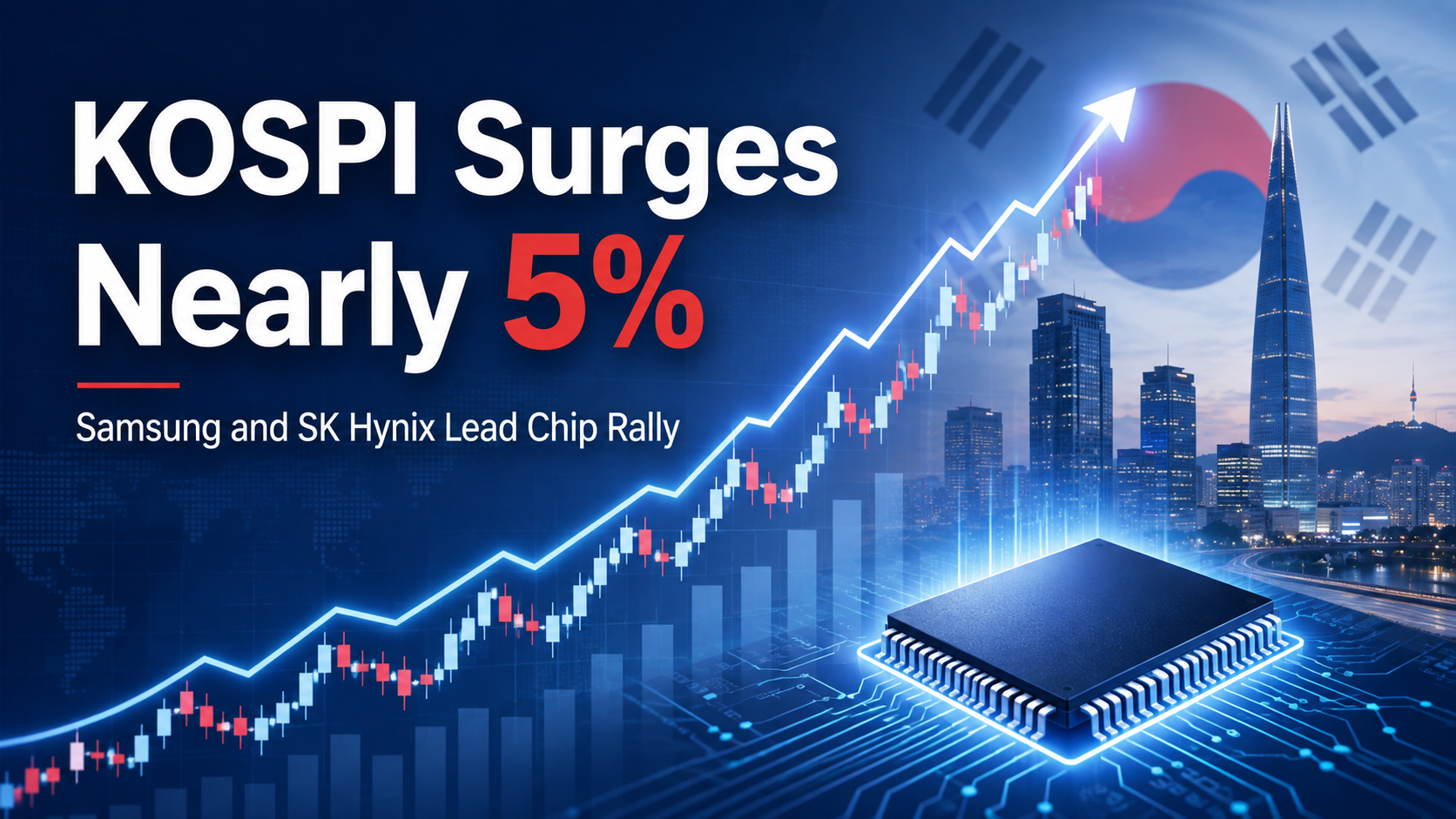
South Korea's stock market staged a powerful rebound as the KOSPI surged nearly 5% intraday, driven by sharp gains in Samsung Electronics and SK hynix, renewed confidence in artificial intelligence infrastructure spending and heavy foreign investor buying. The August 12, 2026 rally pushed KOSPI 200 futures high enough to trigger a rare buy-side sidecar, temporarily restricting program buy orders as market momentum accelerated. With AI memory demand, HBM growth and overseas capital flows supporting Korean semiconductor stocks, investors are now watching whether the KOSPI rally can develop into a more sustained recovery or whether renewed volatility could limit further gains. The move also came as investors continued comparing sentiment across global equities and real-time crypto market data, where changing risk appetite can produce similarly sharp shifts in technology-linked assets.
Why the KOSPI Surged Nearly 5% as Samsung and SK Hynix Stocks Rallied
South Korea’s KOSPI surged as much as 4.97% intraday on August 12, 2026, reaching 6,661.22 as investors returned aggressively to the country’s largest semiconductor stocks. The index later gave back part of those gains but still closed 3.68% higher at 6,579.04, extending its rebound for a third consecutive session. Much of the momentum came from Samsung Electronics and SK hynix, which climbed more than 7% at points during the day before closing up 6.68% and 5.54%, respectively. Because the two chipmakers carry significant weight in the Korean stock market, their sharp gains provided a powerful lift to the broader KOSPI. The move also showed how quickly sentiment can shift in a market where large technology and semiconductor companies account for a major share of index performance.
The rally came after a period of heightened volatility in Korean equities, making the sudden return of buying especially notable. Investors were not only responding to short-term momentum but also reassessing the earnings outlook for major memory-chip producers. Improving expectations around semiconductor profitability, AI-related capital spending and global technology demand helped strengthen confidence in the broader Korean stock market. As Samsung Electronics and SK hynix recovered, the gains spread across other large-cap shares and reinforced the KOSPI’s upward momentum.
AI Memory Demand and Foreign Buying Drove the KOSPI Rally
The semiconductor rebound was supported by renewed confidence in AI infrastructure and memory-chip demand. Investors have been closely watching whether spending on artificial intelligence servers, data centres and advanced computing can continue supporting demand for high-bandwidth memory, or HBM, as well as server DRAM and enterprise storage. Recent earnings from Samsung and SK hynix strengthened that outlook. Samsung reported record quarterly results while highlighting expanding HBM4 sales and strong server-memory demand, while SK hynix said AI infrastructure investment continued to drive demand for HBM and other premium memory products. These trends helped ease concerns that the rapid expansion in AI-related semiconductor spending could lose momentum and encouraged investors to rebuild positions in Korean chip stocks. Stronger expectations for future memory pricing and tighter supply conditions also added to the positive sentiment surrounding the sector. Beyond semiconductors, the convergence of artificial intelligence and digital assets is also increasing attention around AI and blockchain projects across technology-focused markets.
Strong foreign investor buying provided another important source of support. Overseas investors purchased roughly 2.8 trillion won of KOSPI-listed shares during the August 12 session, while institutional investors were also net buyers. Retail investors, by contrast, sold more than 3 trillion won as many traders took profits during the sharp rebound. The combination of foreign capital inflows, improving sentiment toward AI semiconductor demand and strong gains in Samsung Electronics and SK hynix pushed the KOSPI close to a 5% intraday advance. The strength of the buying also suggested that international investors were becoming more confident in South Korea’s semiconductor outlook, helping the market extend its recovery into the following trading session.
What Triggered the KOSPI Buy-Side Sidecar and How the Market Mechanism Works
The sharp August 12 rally became significant enough to activate one of South Korea's key volatility-control mechanisms. Although the KOSPI itself was approaching a 5% intraday gain, the buy-side sidecar was triggered by movement in KOSPI 200 futures rather than by the headline index directly. The mechanism is designed to slow automated trading when futures prices move unusually quickly, giving the cash market time to absorb the sudden shift in momentum without immediately shutting down normal stock trading. The activation also highlighted how closely South Korea's cash and derivatives markets are linked during periods of extreme volatility. For investors, understanding the sidecar mechanism is important because it explains why certain program orders may suddenly pause even while individual stocks continue trading normally.
KOSPI 200 Futures Crossed the 5% Sidecar Trigger
The Korea Exchange activated the buy-side sidecar at 11:57 a.m. KST on August 12, 2026, after KOSPI 200 futures climbed about 5.13% from the previous session's reference price and remained above the required threshold for one minute. Under the KOSPI sidecar rules, a buy-side activation occurs when the relevant futures contract rises at least 5% and sustains that move long enough to satisfy the exchange's trigger condition. The rapid futures advance reflected unusually strong demand for Korean equities during a session in which large-cap technology and semiconductor shares were leading the market sharply higher. Heavy buying in Samsung Electronics, SK hynix and other major KOSPI constituents helped strengthen bullish sentiment across both the cash and futures markets. As futures prices accelerated, automated strategies linked to the KOSPI 200 also became more active, increasing the need for a temporary safeguard.
This distinction matters because a sidecar is sometimes described as if it were triggered simply when the KOSPI rises 5%, which is not technically correct. Futures markets often react faster than the underlying cash index and can amplify short-term trading signals used by institutional and algorithmic strategies. By linking the sidecar to KOSPI 200 futures, the Korea Exchange can temporarily slow program-driven orders when derivatives markets indicate that buying pressure has become unusually intense. The August 12 activation therefore reflected the speed and scale of the futures-market move rather than an automatic response to the KOSPI's 4.97% intraday peak. This distinction is especially relevant for investors tracking fast-moving Korean stock market sessions, because the futures trigger can be reached even when the cash index remains below the same percentage threshold. It also helps explain why sidecars are closely watched by traders as an indicator of unusually strong momentum in the broader market.
What Happens When a Buy-Side Sidecar Is Activated?
Once the trigger was met, the Korea Exchange suspended program buy orders for five minutes. Program trading generally involves automated transactions linked to baskets of stocks, index arbitrage strategies or futures-price relationships, meaning large orders can enter the market almost simultaneously when algorithms detect a pricing opportunity. Temporarily pausing those buy orders gives the market a short period to process the sudden imbalance between buyers and sellers and can reduce the risk that automated strategies accelerate an already rapid price movement. The pause is intended to create a brief cooling-off period rather than reverse the market's direction or prevent investors from participating. It can also give market makers and institutional traders additional time to reassess pricing differences between KOSPI 200 futures and the underlying stocks.
Importantly, the sidecar does not close the KOSPI or stop investors from trading individual stocks. Regular orders can continue while the restriction applies specifically to certain program-trading activity. After the five-minute suspension ends, affected orders can resume under normal exchange conditions. This makes the sidecar a relatively targeted volatility-management tool: rather than freezing the entire market, it briefly interrupts one source of potentially self-reinforcing buying pressure while price discovery continues across listed shares. For retail investors, the distinction is important because shares such as Samsung Electronics and SK hynix may continue moving during the sidecar period even though some automated institutional orders are temporarily restricted. The measure therefore aims to improve market stability without unnecessarily disrupting normal trading activity.
KOSPI Sidecar vs. Circuit Breaker: Why the Difference Matters
A sidecar and a circuit breaker serve different purposes in South Korea's stock market. A sidecar temporarily restricts program trading after a large move in index futures, while a circuit breaker is a broader emergency measure that can halt trading across the market after sufficiently severe movements in the underlying stock index. For investors following the August 12 KOSPI rally, this distinction helps explain why the sidecar activation was a sign of exceptional buying momentum and market volatility, but not evidence that the entire Korean stock market had been suspended. Circuit breakers are generally reserved for more extreme market conditions, whereas sidecars are designed to address rapid futures-driven movements before they potentially spill further into cash equities. Understanding how these two mechanisms differ can help investors interpret market headlines more accurately and assess whether a volatility event represents a temporary trading control or a full market-wide halt.
Can the KOSPI Rally Continue as AI Chip Demand and Foreign Buying Strengthen?
The KOSPI's next move will depend less on short-term momentum and more on whether the forces behind the rebound remain in place. AI-related semiconductor demand, foreign capital flows, memory-chip earnings and global risk sentiment are likely to shape the outlook for South Korean equities. The recent strength in Samsung Electronics and SK hynix has improved confidence in the market, but the speed of the recovery also means investors may become more sensitive to earnings guidance, semiconductor pricing and changes in overseas institutional positioning.
AI Chip Demand Could Keep Samsung and SK Hynix in Focus
Continued investment in AI servers, data centres and advanced computing infrastructure could provide an important foundation for the KOSPI if demand for HBM, server DRAM and other high-performance memory products remains strong. Samsung Electronics and SK hynix are positioned at the centre of this trend, making their earnings outlook and production plans increasingly important for the broader Korean stock market. Further growth in HBM shipments, tighter memory supply and stronger pricing could support semiconductor profitability and help sustain investor interest in Korean technology shares. SK hynix's latest quarterly financial results also highlighted strong AI-related memory demand and continued expansion in high-value HBM and server products. However, any slowdown in global AI capital expenditure, weaker memory pricing or delays in major customer orders could quickly reduce enthusiasm, meaning the durability of the KOSPI rally will depend on whether semiconductor fundamentals continue to justify higher valuations.
Foreign Investor Buying Could Determine the Next Phase of the KOSPI Rally
Foreign investment flows may be just as important as semiconductor demand in determining whether the KOSPI can extend its recovery. International investors have played a major role in the recent rebound, directing substantial capital toward large-cap Korean companies as confidence in the country's semiconductor sector improves. Continued foreign buying could strengthen market liquidity, support heavyweight stocks and help the KOSPI maintain upward momentum, particularly if global investors continue increasing exposure to Asian technology and AI-related companies. At the same time, foreign flows can reverse quickly when global interest rates, currency conditions or risk sentiment change, so sustained gains will likely require a combination of strong corporate earnings, competitive memory-chip demand and continued confidence in South Korea's broader equity market.
Conclusion
The KOSPI's nearly 5% intraday surge reflected a powerful combination of semiconductor strength, improving AI memory expectations and large foreign capital inflows, with Samsung Electronics and SK hynix at the centre of the rebound. The activation of a KOSPI buy-side sidecar showed just how quickly momentum accelerated, while also demonstrating the role South Korea's market safeguards play during unusually volatile sessions. Whether the rally develops into a longer-lasting advance will depend on continued HBM and server-memory demand, semiconductor earnings, foreign investor participation and broader global market conditions. With AI infrastructure spending increasingly influencing South Korea's largest technology companies, Samsung, SK hynix and KOSPI 200 futures are likely to remain important indicators of the Korean stock market outlook. At the same time, developments in real-world asset tokenization show how blockchain infrastructure is increasingly intersecting with traditional financial assets, including equities.
FAQs
What does a buy-side sidecar signal to investors?
A buy-side sidecar signals that futures-driven buying pressure has become unusually strong over a short period. It does not automatically mean the market will keep rising, but it shows that trading momentum has reached a level where the Korea Exchange temporarily limits certain program orders to reduce instability.
Does a KOSPI sidecar affect retail investors?
Retail investors can generally continue buying and selling individual stocks during a sidecar. The restriction mainly targets certain program-trading orders, so normal trading in shares such as Samsung Electronics and SK hynix can continue while the five-minute pause is in effect.
Why are Samsung Electronics and SK hynix so important to the KOSPI?
Samsung Electronics and SK hynix are among South Korea's largest listed companies and carry significant weight in the KOSPI. Large percentage moves in these stocks can therefore have an outsized impact on the overall index, especially when both companies rally at the same time.
What is HBM and why does it matter for Korean chip stocks?
High-bandwidth memory, or HBM, is a type of advanced memory used in AI accelerators, data-centre systems and high-performance computing. Growing demand for generative AI infrastructure has made HBM one of the most important growth areas for memory manufacturers, increasing investor attention on Samsung Electronics and SK hynix.
Can foreign investor buying make the KOSPI more volatile?
Yes. Large foreign inflows can strengthen rallies, particularly in heavyweight stocks, while sudden outflows can increase downward pressure. Because global investors often react quickly to interest rates, currency moves and international risk sentiment, foreign capital flows can significantly influence short-term KOSPI volatility.
How does the Korean won affect the KOSPI?
Currency movements can influence foreign investor returns and the earnings outlook for Korean exporters. A weaker won can support exporters by increasing the local-currency value of overseas revenue, but excessive currency volatility may discourage foreign investors and increase broader market uncertainty.
🔥 KuCoin Offers A More Stable Option in A Volatile Market
If you worry about the frequent ups and downs in the market, and pursue a more stable option to earn money passively, KuCoin is the right place to come:
Simple Earn: Deposit and withdraw tokens anytime, earning stable returns.
Kucoin Earn: Earn stable profits with professional asset management.
Hold to Earn: Earn rewards by holding assets in Funding, Trading, Margin, Futures, Mining, and Unified Accounts.
Staking: Unlock the earning potential of on-chain assets.
Advanced Investments: Advanced Investments offer a variety of structured products to help your money grow in any market.
Shark Fin: Principal Protection and Guaranteed Gains
Dual Investment: Buy low and sell high with transparent return calculations.
Snowball: High yields, with price protection.
Discount Buy: Buy crypto at discount prices.
KCS Loyalty: Level up to enjoy exclusive perks by staking ≥ 1 KCS.
KuCoin Wealth: Discover future value and begin your smart investing journey.
KCS Benefits: Hold and stake KCS to access benefits across the platform.
KCS Staking 2.0: Participate in KCS on-chain governance to earn yield.
Disclaimer: This content is for informational purposes only and does not constitute investment advice. Cryptocurrency investments carry risk. Please do your own research (DYOR).