

How Does Telegram’s No-code AI Bot Builder Differ from Traditional Bot Creation?
Introduction
Did you know that over 950 million people use Telegram every month, yet fewer than 1% of them have ever built a bot?
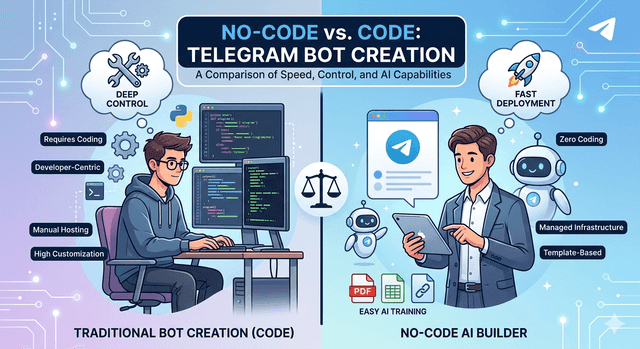
That gap is about to close. In April 2026, Telegram shipped Bot API 9.6 with Managed Bots, a no-code system that lets anyone create and deploy AI-powered bots in seconds without writing a single line of code. But how does this new approach actually compare to the traditional developer-heavy path that has defined Telegram bot creation since 2015? The core difference is speed versus control. Telegram's no-code AI bot builder collapses deployment time from days to seconds, removes the need for programming knowledge, and handles infrastructure automatically, while traditional bot creation offers deeper customization, full API access, and complete control over hosting and data. Both paths lead to functional bots, but they serve fundamentally different users and use cases.
This article breaks down exactly where each approach wins, where it falls short, and which one fits your goals.
What Traditional Bot Creation Looks Like
Traditional Telegram bot creation has been the standard since the platform introduced its Bot API in 2015. It is a developer-centric workflow that requires coding skills, infrastructure management, and ongoing maintenance.
The Developer-First Workflow
Building a bot the traditional way starts with BotFather, Telegram's official bot registration tool. A developer creates a bot through BotFather, receives an API token, and then writes code to handle incoming messages, process commands, and send responses. Popular frameworks include python-telegram-bot for beginners, aiogram for asynchronous scalability, and Telethon for advanced API access. The developer must also choose a hosting solution, whether a $5-15 per month VPS, a serverless function like AWS Lambda, or a free tier on platforms like Railway or Render.
This workflow demands proficiency in at least one programming language, understanding of webhooks versus long polling, and knowledge of how to secure API tokens and manage rate limits. Telegram's Bot API is completely free to use, but the developer bears all infrastructure and maintenance costs. For a bot handling 1,000 messages daily with AI integration, monthly costs typically range from $20 to $450 depending on the AI model used.
Full Control at a Cost
The traditional approach shines when projects demand deep customization. Developers can access all 169 methods in the Bot API 9.6, build complex multi-step workflows, integrate with external databases, and create custom user interfaces through Telegram Mini Apps. They can also implement advanced security measures, optimize performance for high-traffic scenarios, and maintain full ownership of user data by self-hosting everything.
However, this control comes with significant overhead. A custom bot project typically requires 500 to 5,000 EUR in freelance development costs for small business use cases, plus ongoing hosting and maintenance. Updates, bug fixes, and scaling all fall on the developer's shoulders. For a solo trader wanting automated crypto price alerts or a small business operator needing basic customer support, this investment is often prohibitive.
How Telegram's No-Code AI Bot Builder Works
Telegram's no-code AI bot builder, introduced through the Managed Bots feature in Bot API 9.6, fundamentally reimagines who can create bots and how quickly they can deploy them.
Two-Tap Deployment
The mechanics are intentionally simple. A user selects a manager bot, enables management mode, and generates a shareable creation link. Anyone who clicks that link can launch their own customizable AI agent within seconds. There are no configuration screens, no account creation on external platforms, and no tutorials to complete. Pavel Durov, Telegram's founder, framed the feature as a way to democratize access to personal AI helpers, arguing that most people want AI to do things for them rather than spend twenty minutes figuring out how to deploy it.
Each user receives a separate, isolated bot instance rather than sharing a single public chatbot. This architecture is closer to spinning up a personal cloud service on demand, except the user never sees the infrastructure layer. Privacy is baked into the design, and bots can communicate with each other, enabling complex multi-agent workflows without human intervention.
AI-Native from the Ground Up
Unlike traditional bots that rely on rigid command structures and predefined response flows, no-code AI bots leverage large language models to understand context, interpret open-ended questions, and generate human-like responses. Platforms like GPTBots and Telewer, which integrate with Telegram's Managed Bots system, allow users to train bots by uploading PDFs, documents, spreadsheets, and URLs through a visual interface. The AI can then answer questions, qualify leads, process orders, and even perform actions like checking order statuses or scheduling appointments.
The flagship example Durov highlighted is @teleclaw_bot, built on the OpenClaw framework. It demonstrates drafting and sending emails, managing calendar entries, generating business pitches, and fielding routine messages, all without the user writing any code. For crypto communities, which represent one of Telegram's largest user segments, this means automated market alerts, wallet activity notifications, and liquidity event warnings can now be built directly inside Telegram by community members themselves.
Key Differences Between Traditional Bot Creation and Telegram No-code AI Builder
|
Feature
|
Traditional Bot Creation
|
Telegram No-Code AI Builder
|
|
Setup Time
|
Hours to days
|
Seconds to minutes
|
|
Coding Required
|
Yes, proficiency needed
|
No coding at all
|
|
Infrastructure
|
Self-managed hosting
|
Handled by manager bot
|
|
AI Capabilities
|
Manual integration via API
|
Built-in LLM support
|
|
Customization
|
Unlimited via code
|
Template and prompt-based
|
|
Cost Structure
|
Dev + hosting + AI API fees
|
Free to low monthly fees
|
|
Scalability
|
Developer-dependent
|
Platform-managed
|
|
Data Control
|
Full ownership possible
|
Managed by platform
|
The table above captures the structural divide between the two approaches. Traditional creation offers unlimited flexibility at the cost of technical complexity, while the no-code path prioritizes accessibility and speed with some trade-offs in deep customization.
Where No-Code Wins
The no-code AI bot builder excels in scenarios where speed, accessibility, and cost efficiency matter more than granular control.
Instant Deployment for Non-Technical Users
The most obvious advantage is accessibility. Telegram has over one billion users, and Managed Bots makes bot creation available to all of them regardless of technical background. A small business owner who uses Telegram for customer communication can now deploy an AI-powered support agent in the same environment where conversations already happen, without hiring a developer or integrating external chatbot services. The friction that historically kept this capability out of reach for non-technical operators has been removed in a single API update.
Rapid Prototyping and Iteration
No-code builders allow users to go from idea to working bot in under an hour. A community manager can spin up a bot to handle FAQs and welcome new members, test it with real users, and refine responses based on feedback, all in a single afternoon. This iterative cycle would take days or weeks in a traditional development workflow. Platforms like Clepher recommend starting with a single focused outcome, such as qualifying inbound leads or recovering abandoned carts, and expanding from there.
Built-in AI Without Integration Headaches
Traditional bots require manual integration with AI APIs like OpenAI's GPT-5 or Anthropic's Claude 4, which involves managing API keys, handling rate limits, and optimizing token usage. No-code platforms abstract all of this away. Users select an AI model from a dropdown menu, upload training data, and the platform handles the rest. This is particularly valuable for crypto traders and community managers who need intelligent automation but lack the technical expertise to wire together multiple services.
Cost Predictability
While traditional bot costs can spiral based on development time, hosting requirements, and AI API usage, no-code platforms typically offer transparent monthly pricing. A basic no-code AI bot can run on free tiers or low-cost plans starting around $10-30 per month, making it accessible to individual creators and small teams. The total cost of ownership is often 80-90% lower than a custom-built equivalent for standard use cases.
Where Traditional Creation Still Dominates
Despite the no-code revolution, there are clear scenarios where traditional bot development remains the better choice.
Deep Customization and Complex Workflows
When a bot needs to interact with proprietary systems, execute multi-step business logic, or handle edge cases that no-code templates do not cover, coding is unavoidable. A developer can build a bot that queries an internal database, processes payments through a custom gateway, or integrates with enterprise CRM systems in ways that visual builders cannot replicate. The full Bot API 9.6 exposes 169 methods, and only a fraction of these are accessible through no-code interfaces.
High-Volume and Performance-Critical Applications
For bots serving millions of users or handling real-time trading execution, performance optimization is critical. Traditional development allows fine-tuned control over concurrency, caching strategies, and infrastructure scaling. An Erlang-based bot, for example, can leverage the BEAM virtual machine to handle millions of concurrent messages with near-perfect uptime. No-code platforms, while improving, still abstract away the performance layer in ways that can introduce latency or bottlenecks at scale.
Security and Compliance Requirements
Organizations in regulated industries often need complete control over data residency, encryption standards, and audit trails. Self-hosting a traditional bot on a private server ensures that sensitive user data never leaves the organization's infrastructure. No-code platforms, by definition, process data through third-party services, which may not meet strict compliance requirements in sectors like finance or healthcare.
Multi-Agent and Advanced Orchestration
The April 2026 Bot API 9.6 update introduced Bot-to-Bot Communication Mode, allowing bots to interact with each other through mentions and replies. While no-code platforms can create individual bots, building sophisticated multi-agent pipelines, such as a 10-step workflow where each agent handles a specific task and passes output to the next, still requires programmatic coordination. Developers who need this level of orchestration will find traditional coding more suitable.
The Hybrid Future: Best of Both Worlds
The most effective approach for many organizations is not choosing one path but combining both. No-code platforms are ideal for rapid deployment, testing concepts, and handling standard use cases like customer support and lead qualification. Once a bot proves its value and the organization identifies limitations in the no-code environment, a developer can take over, extend functionality through custom code, and optimize for scale.
Telegram's own ecosystem evolution supports this hybrid model. Managed Bots lower the barrier for simple use cases while generating demand awareness for sophisticated implementations. Developers who position themselves as specialists for complex, high-reliability bot infrastructure will find the overall market expanding rather than contracting, because the no-code layer introduces millions of new users to bot automation who may eventually need custom solutions.
Should You Build Your Telegram Bot With No-Code or Code?
The choice depends on your technical resources, timeline, and the complexity of your use case. If you need a bot running today to handle FAQs, send alerts, or qualify leads, Telegram's no-code AI builder is the clear winner. It requires zero coding knowledge, costs little to nothing to start, and deploys in seconds through a shareable link. For solo traders, small business operators, community managers, and creators, this path removes the historical barriers that made bot development inaccessible.
If your project requires custom integrations, handles sensitive data under strict compliance rules, or serves millions of users with sub-second response times, traditional development is still the right choice. The investment in coding expertise and infrastructure pays off in unlimited flexibility, full data control, and performance optimization that no-code platforms cannot yet match.
For most users in 2026, the answer is to start with no-code and escalate to code only when the bot's success demands it. The tools are now good enough that you can validate your idea, serve your first users, and generate revenue before ever hiring a developer. That is the real shift Telegram's Managed Bots have introduced: bot creation is no longer a technical prerequisite but a creative one.
Conclusion
Telegram's no-code AI bot builder, powered by the Managed Bots feature in Bot API 9.6, represents a genuine inflection point for the platform's one billion users. It collapses the time, cost, and expertise required to deploy AI-powered automation from days and thousands of dollars to seconds and zero upfront investment. The trade-off is a ceiling on deep customization and infrastructure control that traditional coding still holds.
For non-technical users, small businesses, and crypto communities already embedded in Telegram's ecosystem, the no-code path is transformative. It enables instant creation of trading alerts, customer support agents, and community moderation tools without external dependencies. For developers and enterprises, the traditional approach retains its value in complex, high-volume, and compliance-sensitive applications where full API access and data sovereignty are non-negotiable.
The smartest strategy is to treat no-code as the starting point and traditional development as the escalation path. Build fast, validate your use case, and invest in custom code only when the bot's growth demands it. Telegram has effectively turned every user into a potential bot creator, and the platforms that thrive in this new environment will be those that know when to trade speed for control, and vice versa.
FAQs
Can I really create a Telegram bot without any coding knowledge?
Yes. Telegram's Managed Bots feature, introduced in Bot API 9.6, allows anyone to create and deploy an AI-powered bot by clicking a shareable link and confirming setup. No programming, hosting configuration, or API management is required.
What is the exact setup time difference between no-code and traditional bot creation?
No-code deployment takes seconds to minutes. Traditional bot creation typically requires hours to days, including coding, testing, hosting setup, and debugging. The no-code path removes infrastructure and development overhead entirely.
Are no-code Telegram bots less powerful than coded ones?
For standard use cases like customer support, lead qualification, and automated alerts, no-code bots deliver equivalent functionality. However, they cannot match coded bots in deep customization, complex multi-step workflows, high-volume performance, or proprietary system integrations.
How much does it cost to run a no-code AI bot versus a traditional one?
No-code AI bots typically start free or cost $10-30 per month on basic plans. Traditional bots require $5-15 per month for hosting plus $10-450 per month for AI API calls, plus upfront development costs of $500-5,000 for custom builds.
Can a no-code bot be migrated to a custom-coded solution later?
Yes. Many organizations start with no-code to validate their concept and then transition to custom development once they identify limitations. The bot's logic, training data, and user base can often be preserved during migration, though the process requires developer involvement to rebuild on the Bot API.