

How Do US Equity Market Retracements and AI Capital Expenditure Divergence Impact the Crypto Market?
Introduction
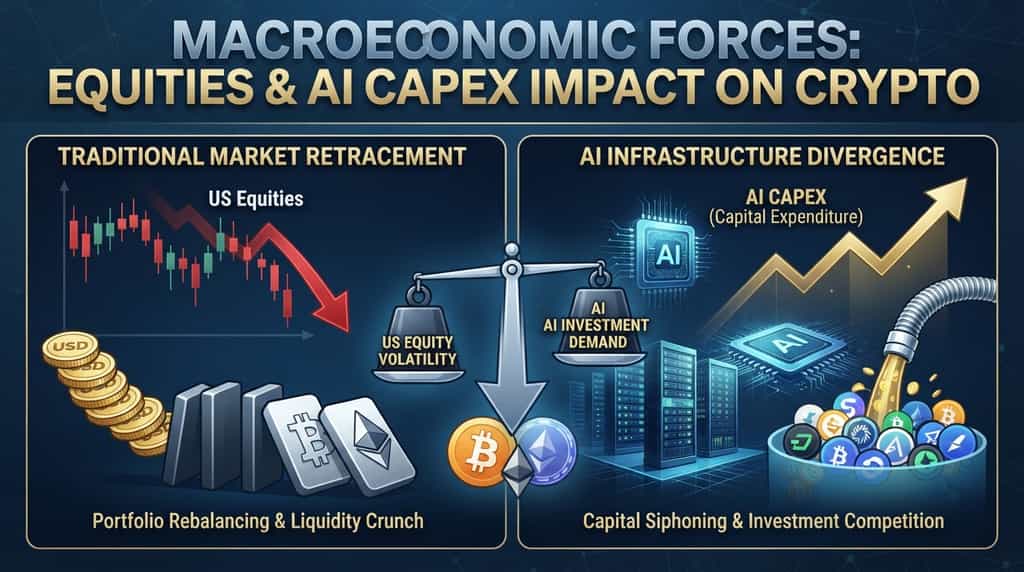
As global financial markets navigate shifting monetary policies and corporate investment cycles, digital assets are increasingly sensitive to broader macroeconomic conditions. The central question facing market participants is: How do US equity market retracements and artificial intelligence capital expenditure divergence impact the trajectory and valuation of the cryptocurrency market?
Understanding this dynamic requires analyzing how cross-asset liquidity flows, institutional portfolio rebalancing, and corporate spending shifts transmit shocks from traditional equities to decentralized assets. As of November 2026, macroeconomic insights from institutional managers highlight that technology sector valuations and monetary policy expectations are key drivers of cross-market correlations. Rather than operating in an isolated speculative bubble, the cryptocurrency market is closely linked to shifts in traditional equity sentiment and enterprise capital allocation.
Key Takeaways
-
Core Conclusion: US equity market retracements and divergences in artificial intelligence capital expenditure directly influence crypto market liquidity, risk appetite, and valuation multiples.
-
Equity Correlation: As institutional adoption grows, digital assets frequently experience synchronized drawdowns during broader US equity market corrections due to cross-asset portfolio rebalancing.
-
Capital Divergence: Intense capital expenditure in artificial intelligence infrastructure draws immense corporate funding, altering overall market liquidity distribution and risk sentiment across alternative asset classes.
-
Liquidity Transmission: Monetary policy adjustments that trigger equity pullbacks also contract the global fiat liquidity pools necessary to sustain high-beta digital asset valuations.
-
Institutional Risk Management: Institutional investors utilize risk models that treat digital assets alongside high-beta equities, leading to automated risk-off liquidations during traditional market volatility.
Why US Equity Retracements Directly Influence Crypto Valuations
The valuation of digital assets is fundamentally tied to the broader risk environment established by major equity exchanges, particularly in the United States. When US equity markets experience significant retracements, the impact cascades rapidly into cryptocurrency valuations through several established transmission channels.
Institutional participation has bridged traditional finance and digital assets. Consequently, when equity portfolios face downward pressure, institutional allocators frequently execute cross-asset risk reduction strategies. This institutional rebalancing often results in automated liquidations across digital asset positions to cover margin calls or maintain mandated portfolio risk limits in traditional equities.
The Mechanism of Cross-Asset Liquidity Transmission
Market corrections in traditional equities alter investor behavior and alter the availability of speculative capital.
-
Portfolio Risk Parity: Institutional risk management frameworks scale down exposure to high-beta assets simultaneously when equity volatility spikes.
-
Margin and Collateral Pressures: Declines in traditional equity portfolios can prompt leveraged traders to liquidate crypto holdings to meet liquidity requirements.
-
Sentiment Spillovers: Macroeconomic pessimism originating in equity earnings reports frequently weighs heavily on risk sentiment across all speculative asset classes.
How Artificial Intelligence Capital Expenditure Divergence Alters Capital Allocation
Corporate spending on artificial intelligence infrastructure has reached historic proportions, drawing massive amounts of venture capital, corporate debt issuance, and institutional equity investment. This intense concentration of capital creates a divergence in how financial resources are distributed across global markets.
While AI infrastructure investments are backed by projected enterprise software revenues and productivity gains, they compete directly for the marginal dollar of institutional risk capital. When capital expenditure in technology sectors accelerates rapidly, it can siphon liquidity away from alternative speculative markets, including digital assets. Conversely, any reassessment of AI return on investment can trigger shifts in capital back toward alternative asset classes.
Economic Implications of Tech Sector Capital Concentration
-
Venture Funding Shifts: Private equity and venture capital allocators frequently reallocate capital toward infrastructure projects, reducing early-stage funding availability for blockchain protocols.
-
Debt Market Competition: Large technology firms issuing corporate debt to fund data centers absorb institutional fixed-income liquidity that might otherwise diversify into alternative instruments.
-
Retail Attention Divergence: Retail investor focus and speculative capital often follow dominant technology trends, impacting trading volumes across digital asset exchanges.
What Macroeconomic Shifts Mean for Crypto Market Volatility
As global financial conditions evolve, macroeconomic indicators such as central bank interest rate decisions, inflation prints, and corporate earnings reports dictate market volatility. According to recent macroeconomic commentary from Rothschild & Co Asset Management covering the global outlook for November 2026, persistent economic adjustments and technology sector investment cycles continue to shape cross-asset correlations.
During periods of macroeconomic tightening or equity market stress, digital assets frequently exhibit compressed correlation structures, moving in tandem with risk-on equities. This structural linkage demonstrates that cryptocurrency valuations cannot decouple entirely from traditional macroeconomic liquidity cycles and institutional risk appetite.
Conclusion
The trajectory of the cryptocurrency market is shaped significantly by external macroeconomic forces, including US equity market retracements and artificial intelligence capital expenditure divergence. Rather than operating in a vacuum, digital assets respond directly to shifts in global liquidity, institutional portfolio rebalancing, and corporate capital allocation trends. Recognizing these interconnected market dynamics is essential for evaluating risk and volatility across the broader financial landscape.
FAQs
Why do cryptocurrency prices often fall when US equity markets retrace?
Cryptocurrency prices often fall during equity retracements because institutional investors manage risk across portfolios simultaneously, liquidating high-beta digital assets to meet margin requirements or reduce overall risk exposure.
How does artificial intelligence capital expenditure affect digital asset liquidity?
Intensive capital expenditure in artificial intelligence draws massive corporate and venture capital funding, which can temporarily reduce the pool of speculative capital available for alternative asset classes like cryptocurrencies.
Are digital assets considered safe havens during equity market downturns?
Current market behavior indicates that digital assets largely function as high-beta risk assets rather than safe havens, meaning they typically experience heightened drawdowns during broad traditional market corrections.
What role do institutional investors play in cross-market correlations?
Institutional investors utilize integrated risk models and automated trading strategies that link digital asset allocations directly to traditional equity volatility and macroeconomic liquidity indicators.
How do macroeconomic data releases influence short-term crypto volatility?
Releases such as US employment reports, inflation data, and central bank interest rate decisions directly impact fiat liquidity expectations, which immediately influence trading activity and valuations across digital asset markets.
Disclaimer
This general market information, possibly from third-party, commercial, or sponsored sources, is provided for reference and educational purposes only and does not constitute financial or investment advice, an offer, solicitation, or guarantee. We disclaim liability for its accuracy, completeness, reliability, and any resulting losses. Investments/trading are risky; past performance doesn’t guarantee future results. Users should research, judge prudently, and take full responsibility. For further details, please consult KuCoin’s Terms of Use and Risk Disclosure.