

Grvt Partners with Ondo Finance to Build $100M USDY Position in Tokenized Treasuries
2026/08/13 18:14:00
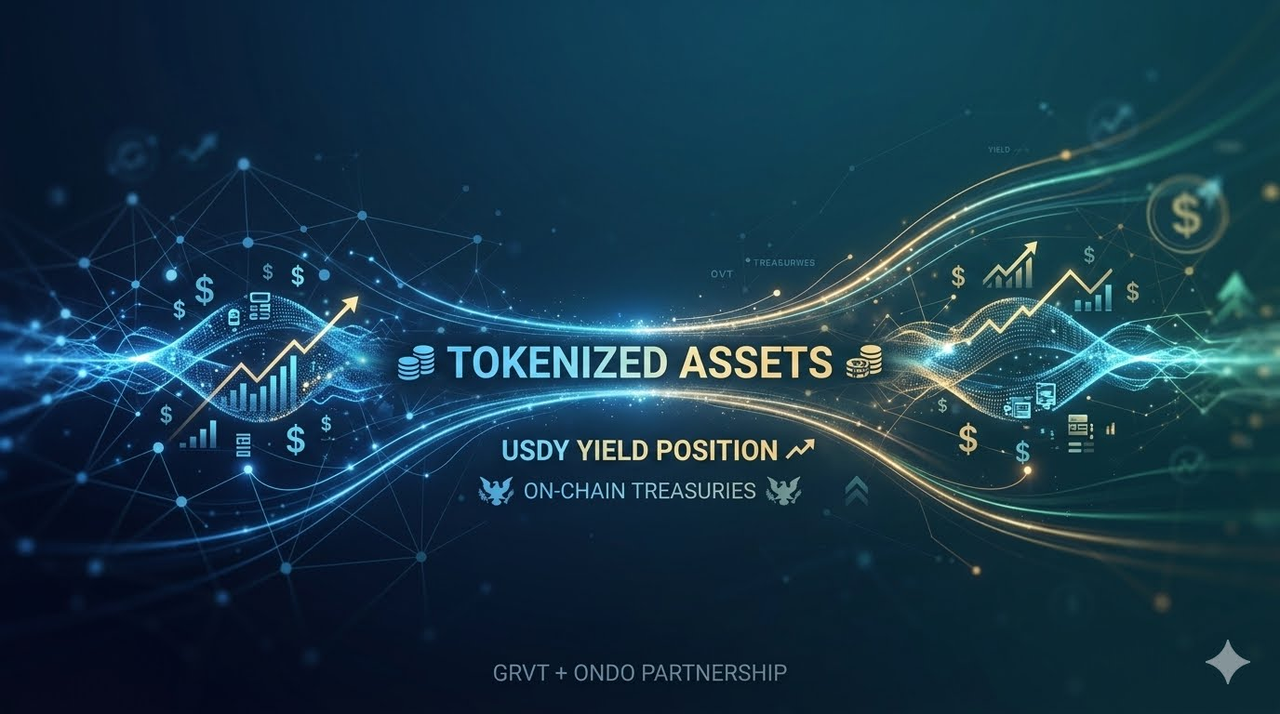
The convergence of traditional finance (TradFin) and decentralized finance (DeFi) continues to evolve. Grvt, a hybrid decentralized exchange (CeDeFi) built on ZKsync's zero-knowledge infrastructure, recently announced a partnership with Ondo Finance, a prominent player in the real-world asset (RWA) tokenization sector.
Under this agreement, Grvt plans to build a $100 million position in Ondo’s US Dollar Yield token (USDY) over the next 12 months. This initiative integrates government bond yields into a retail-focused crypto trading ecosystem, highlighting a growing industry trend of supplementing volatile crypto-native rewards with asset-backed interest rates on-chain.
Key Takeaways
-
Grvt will incrementally build a $100 million position in Ondo Finance’s USDY tokenized treasuries over the next 12 months.
-
By holding USDY on its institutional balance sheet, Grvt eliminates complex KYC and cross-chain onboarding hurdles for everyday retail traders.
-
The integration directs USDY yield into Grvt Earn, offering users an estimated 3.5% APY baseline return anchored to real-world macroeconomic rates.
-
Grvt allows traders' idle derivatives collateral to simultaneously earn interest, eliminating the trade-off between active trading and yield generation.
-
Unlike traditional stablecoins, USDY is a tokenized note strictly backed by short-term US Treasuries, treasury ETFs, and regulated demand deposits.
Decoding the Partnership: How the $100M USDY Allocation Works
The collaboration between Grvt and Ondo Finance addresses several constraints of retail real-world asset adoption by utilizing an institutional balance sheet model. Instead of requiring individual retail traders to complete independent onboarding processes or purchase tokenized products on secondary markets, the integration occurs at the infrastructure layer.
Balance Sheet Integration vs. Retail Purchasing
Grvt will directly purchase and hold up to $100 million worth of USDY on its own official balance sheet. This approach helps abstract the compliance, onboarding, and minimum purchase hurdles often associated with institutional-grade tokenized notes. By handling these operational complexities at the platform level, Grvt allows its user base to access the benefits of the underlying financial instruments implicitly. Traders interact with a unified interface rather than managing multiple wallets, distinct KYC verifications, or cross-chain bridges.
The Mechanics of Grvt Earn Integration
The yield generated by the USDY position will be directed into Grvt Earn, the platform’s native yield-bearing account ecosystem. According to the deployment plan, this capital is expected to provide an additional baseline return of approximately 3.5% Annual Percentage Yield (APY) to users holding eligible deposits. This yield is generated independently of native crypto token emissions, providing a return anchored to macroeconomic interest rates rather than high-risk DeFi lending protocols.
A 12-Month Deployment Timeline
The $100 million position will not be deployed in a single transaction. Grvt will build the position incrementally over a 12-month period to manage liquidity and risk diversification. This staggered accumulation allows Grvt to align its balance sheet growth with user deposit scaling and current market conditions. It provides a steady influx of real-world yield into the ZKsync ecosystem while aiming to minimize slippage and optimize entry points into Ondo's funds.
Deep Dive into the Underlying Assets: What is Ondo USDY?
To accurately assess this integration, it is necessary to examine the asset structure of Ondo’s US Dollar Yield token (USDY). USDY functions as a tokenized bearer note rather than a conventional fiat-pegged stablecoin. It is designed to provide holders with variable yield sourced from low-risk, dollar-denominated financial instruments.
Understanding the Tokenized US Treasury Note
USDY is issued by Ondo USDY LLC, a standalone special purpose vehicle structured to isolate bankruptcy risk from the parent entity. Unlike traditional stablecoins, where issuer profits from treasury reserves are often retained entirely by the parent company, USDY passes the yield generated by its underlying portfolio back to the token holder. This return is reflected through adjustments in the token's redemption value, functioning as an accumulation asset rather than a static medium of exchange.
Asset Backing and Collateral Transparency
The security profile of USDY relies heavily on the quality of its underlying reserves. The instrument is structurally restricted to holding sovereign debts and banking instruments, which are verified by independent third-party audits:
-
Short-Term US Treasuries: Providing baseline security with maturities typically under three months to manage duration risk.
-
US Treasury ETFs: Enhancing immediate liquidity and easing portfolio rebalancing across institutional brokerages.
-
Demand Deposits: Maintained at regulated financial institutions to facilitate immediate cash redemptions.
Market Position: A Growing RWA Asset
Data from real-world asset analytics platform RWA.xyz ranks USDY among the largest tokenized treasury products globally. With a total Asset Under Management (AUM) of approximately $2.14 billion, the product represents a notable share of the on-chain sovereign debt market. Grvt’s planned $100 million allocation will constitute roughly 4.6% of USDY’s current global circulating supply, marking a substantial institutional deployment into the product.
| Feature | Ondo USDY (Tokenized Note) | Traditional Stablecoins (e.g., USDT/USDC) |
| Primary Purpose | Yield Generation + Store of Value | Medium of Exchange + Liquidity |
| Underlying Assets | US Treasuries, Treasury ETFs, Demand Deposits | Cash, Cash Equivalents, Commercial Paper |
| Yield Distribution | Transferred Directly to Token Structure | Retained by the Issuing Entity (Typically 0%) |
| Regulatory Framework | Regulated Institutional Structure | Varying Jurisdictional Compliance |
Addressing Capital Efficiency: The Fusion of Trading and Earning
The structural focus of Grvt’s partnership lies in how it addresses capital inefficiency inside decentralized derivative markets. In standard exchange frameworks, capital deployment is often binary: funds are either risked in active trading margins or locked away in yield-generating smart contracts.
The Pain Point of Traditional Crypto Derivatives
On many decentralized and centralized platforms, collateral posted to back futures, options, or perpetual contracts sits idle in clearing pools. For institutional market makers and retail traders alike, this creates an opportunity cost. Capital dedicated to mitigating liquidation risks cannot simultaneously capture market-rate yields. This dynamic reduces overall portfolio velocity, forcing traders to choose between capital preservation and yield optimization.
Improving CeDeFi Mechanics
Grvt approaches this trade-off through its hybrid CeDeFi architecture. By backing platform clearing pools with yield-bearing instruments like USDY, Grvt enables a capital model designed to maximize deposited assets:
-
Automated Earning: Users receive an estimated 3.5% baseline APY without needing to explicitly buy or stake secondary tokens.
-
Dual-Purpose Capital: Collateral deposits generate yields while actively used in derivatives trading.
-
Institutional-Grade Custody: Funds are backed by audited real-world financial instruments.
This structural alignment allows margin accounts to accumulate interest. Traders can maintain open derivatives positions while their underlying equity earns a yield tied to the federal funds rate, providing additional utility for active traders.
Ecosystem Impact: What This Means for ZKsync and the RWA Sector
The effects of a $100 million capital allocation extend to Layer 2 scaling networks and the broader real-world asset tokenization sector.
Boosting ZKsync’s Institutional Liquidity
As an exchange utilizing ZKsync's zero-knowledge rollup technology, Grvt’s integration introduces substantial liquidity into the network. Real-world assets worth $100 million tied to US dollar value provide a stabilizing element for the Layer 2 ecosystem's Total Value Locked (TVL). This deployment indicates that modern scaling networks possess the capability to handle institutional-sized assets alongside retail trading activity.
The Convergence of TradFin and DeFi
For several years, the adoption of RWA instruments remained siloed within basic tokenization wrappers—users could buy a bond on-chain but had limited utility for it afterward. The Grvt-Ondo partnership represents a practical step in RWA utility integration. As major trading venues begin using tokenized debt as underlying platform collateral, the boundary between chain-native liquidity and traditional financial infrastructure begins to blur. This creates a foundation for future products like RWA-backed options and cross-margining across different asset classes.
Detailed Risk Management and Compliance Framework
While a $100 million deployment brings notable liquidity, managing institutional and technical risk remains essential. Grvt and Ondo Finance have established compliance and technical frameworks to protect user capital throughout this 12-month phase.
Smart Contract Auditing and Circuit Breakers
To mitigate smart contract vulnerabilities, Ondo’s USDY architecture undergoes continuous auditing by blockchain security firms. Additionally, Grvt’s integration layer incorporates automated circuit breakers. In the event of severe chain instability or anomalous price feeds, these circuit breakers can temporarily pause minting and redemption processes, helping preserve the value of the assets held on the balance sheet.
Regulatory Alignment in Multiple Jurisdictions
Ondo Finance operates under specific regulatory frameworks to maintain USDY compliance. USDY is structured as an investment product available to non-US residents under Regulation S of the US Securities Act. By structuring the partnership at the platform level, Grvt aims to ensure that institutional interactions conform to cross-border regulatory standards, maintaining operational compliance amidst a shifting regulatory landscape.
Conclusion
The strategic partnership between Grvt and Ondo Finance reflects the ongoing maturation of the digital asset economy. By committing to a $100 million USDY position, Grvt is supplementing traditional, incentive-driven DeFi yields with economic value derived from established reserve assets.
As this allocation rolls out over the next 12 months, it provides a functional blueprint for how CeDeFi platforms can approach capital efficiency. For the broader industry, it demonstrates how tokenized treasuries are actively being integrated into the functional infrastructure of modern on-chain trading venues.
KuCoin Offers A More Stable Option in A Volatile Market
If you worry about the frequent ups and downs in the market, and pursue a more stable option to earn money passively, KuCoin is the right place to come:
Simple Earn: Deposit and withdraw tokens anytime, earning stable returns.
Kucoin Earn: Earn stable profits with professional asset management.
Hold to Earn: Earn rewards by holding assets in Funding, Trading, Margin, Futures, Mining, and Unified Accounts.
Staking: Unlock the earning potential of on-chain assets.
Advanced Investments: Advanced Investments offer a variety of structured products to help your money grow in any market.
Shark Fin: Principal Protection and Guaranteed Gains
Dual Investment: Buy low and sell high with transparent return calculations.
Snowball: High yields, with price protection.
Discount Buy: Buy crypto at discount prices.
KCS Loyalty: Level up to enjoy exclusive perks by staking ≥ 1 KCS.
KuCoin Wealth: Discover future value and begin your smart investing journey.
KCS Benefits: Hold and stake KCS to access benefits across the platform.
KCS Staking 2.0: Participate in KCS on-chain governance to earn yield.
FAQs
What is the primary goal of the Grvt and Ondo Finance partnership?
Grvt aims to build a $100 million position in Ondo’s USDY over 12 months. This integrates real-world US Treasury yields directly into the platform’s trading and earning ecosystem.
Do Grvt users need to buy USDY tokens directly to earn yields?
No. Grvt holds USDY directly on its institutional balance sheet. Users automatically receive the underlying yields through Grvt Earn without purchasing or managing the tokens themselves.
How much additional yield does this partnership bring to Grvt Earn?
The integration of the tokenized treasury position is expected to inject an additional baseline return of approximately 3.5% Annual Percentage Yield (APY) into eligible user deposits.
Can traders use their deposits as margin while earning interest?
Yes. Grvt’s hybrid CeDeFi architecture allows deposited funds to simultaneously serve as active trading margin for derivatives and continuously generate real-world asset yields without lockups.
What assets back Ondo Finance’s USDY tokenized note?
USDY is fully secured by a low-risk portfolio consisting exclusively of short-term US Treasuries, institutional US Treasury ETFs, and bank demand deposits.
How does this $100M deployment impact the ZKsync ecosystem?
It injects massive, stable, non-crypto-native liquidity into ZKsync. This stabilizes the network's Total Value Locked (TVL) and demonstrates its readiness for large-scale institutional assets.
Disclaimer
The information provided on this page may originate from third-party sources and does not necessarily represent the views or opinions of KuCoin. This content is intended solely for general informational purposes and should not be considered financial, investment, or professional advice. KuCoin does not guarantee the accuracy, completeness, or reliability of the information, and is not responsible for any errors, omissions, or outcomes resulting from its use. Investing in digital assets carries inherent risks. Please carefully evaluate your risk tolerance and financial situation before making any investment decisions. For further details, please consult KuCoin’s Terms of Use and Risk Disclosure.