

Google to Launch Institutional Crypto Custody Platform in 2027: How Its MPC Technology Works
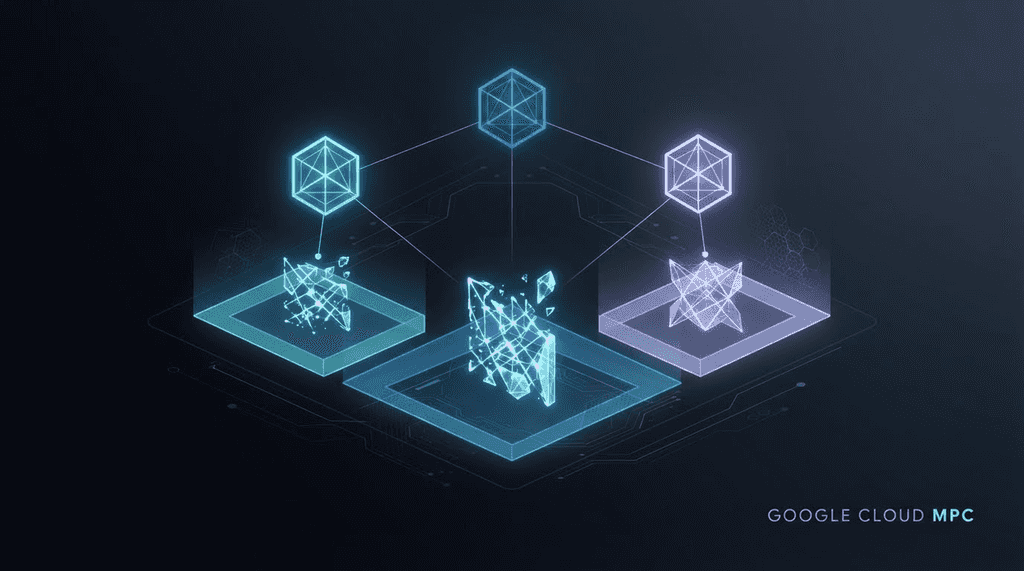
Google Cloud has introduced Google Multi-Party Compute (MPC), a specialized digital asset key-management and custody infrastructure solution engineered for global banks, asset managers, and regulated financial institutions. Currently operating in an invitation-only private preview, the cloud provider is targeting commercial General Availability (GA) in early 2027. Ahead of broad commercial rollout, Google has validated the architecture across internal production environments supporting major blockchain ecosystems, including Ethereum and Solana.
This initiative represents a notable expansion in institutional Web3 cloud infrastructure. For several years, major cloud providers focused their digital asset services primarily on hosting remote procedure call (RPC) nodes, indexing public blockchain datasets in BigQuery, and exploring enterprise settlement networks.
By introducing native MPC infrastructure, Google Cloud is moving deeper into the security stack of institutional digital finance: the distributed generation, policy verification, and threshold signing of cryptographic keys. As regulated financial institutions expand their involvement in tokenized deposits, spot exchange-traded products (ETPs), and real-world asset (RWA) settlement, cloud-integrated MPC offers a modular technical foundation alongside traditional custody providers and legacy hardware vaults.
Key Compromise and Institutional Custody Trade-Offs
The growth of institutional participation in digital assets has underscored the importance of resilient key management systems. Industry security tracking from platforms such as DeFiLlama consistently shows that compromised credentials and private key exploits represent one of the largest vectors of capital loss across the cryptocurrency sector, accounting for billions of dollars in cumulative industry losses over recent market cycles.
Historically, institutional digital asset storage has relied on two primary architectural models, each carrying distinct operational trade-offs for commercial financial institutions.
-
Legacy Hardware Security Modules and Single-Point Risks
Traditional financial key management relies heavily on physical Hardware Security Modules (HSMs) and air-gapped cold-storage environments. While HSMs isolate cryptographic keys inside tamper-resistant hardware, standard single-key configurations can still introduce a structural single point of failure (SPOF).
To authorize a conventional single-signature blockchain transaction, the full private key must exist within a single module's memory boundary during signature generation. If an attacker compromises the host management layer, exploits a firmware vulnerability, or bypasses administrative access controls, the assets controlled by that single key face immediate exposure.
-
On-Chain Multi-Signature Limitations
To avoid single-key dependencies, many Web3 protocols utilize on-chain multi-signature (Multi-Sig) smart contracts, such as Safe. In a standard M of N Multi-Sig structure, multiple independent private keys must submit separate approvals to satisfy a smart contract’s execution rules.
While highly effective for decentralized treasuries, on-chain Multi-Sig presents three practical hurdles for traditional banking workflows:
Cross-Chain Incompatibility: Smart contract Multi-Sig logic is not uniform across heterogeneous Layer-1 blockchains. While widely standardized on Ethereum Virtual Machine (EVM) networks, implementing identical smart contract governance across non-EVM chains (such as Bitcoin or Solana) requires different native scripts and separate operational pipelines.
Higher Network Transaction Costs: Because multiple cryptographic signatures or contract calls are verified directly on-chain, Multi-Sig transactions consume additional block space and gas fees compared to standard single-signature transfers.
Public Visibility of Governance Rules: Because Multi-Sig rules execute via public smart contracts, an institution’s quorum thresholds, signer addresses, and organizational approval patterns are visible on the public ledger.
These constraints have driven institutional demand for off-chain threshold cryptography that unifies security policies across multiple blockchains.
How Google Multi-Party Compute Works
Google Cloud Multi-Party Compute addresses single-point key risks by implementing Threshold Signature Schemes (TSS) built on Multi-Party Computation (MPC). Under this cryptographic model, a complete private key is never assembled on any single device, server memory bus, or data center at any stage of key generation, storage, or transaction signing.
The Hardened DKLs23 Threshold Signature Protocol
According to technical specifications for the platform, Google’s ECDSA signing engine incorporates a hardened implementation of the DKLs23 protocol. Named after cryptographers Döttling, Komargodski, Lai, and Shen, DKLs23 is a modern threshold signature protocol designed to compute elliptic curve signatures securely across distributed parties with minimal communication overhead.
Google’s implementation focuses on three operational priorities:
-
Malicious Adversary Resilience: The protocol is designed to maintain unforgeability even if an attacker compromises a subset of participating nodes below the signing threshold. Built-in consistency checks detect malformed cryptographic shares during the signing ceremony and automatically abort the session before an invalid signature can be produced.
-
Low-Latency Round Optimization: Early MPC implementations often suffered from slow signing times due to multiple rounds of back-and-forth network communication. By utilizing the streamlined round structure of DKLs23, local cryptographic computations complete in milliseconds, enabling sub-second end-to-end signing workflows once institutional policy checks pass.
-
Multi-Curve Blockchain Support: The architecture natively supports the Elliptic Curve Digital Signature Algorithm (ECDSA) over the secp256k1 curve—the standard for Bitcoin, Ethereum, and EVM-compatible Layer-2 networks—alongside staging support for Edwards-curve Digital Signature Algorithm (EdDSA) over Ed25519 to cover high-throughput networks like Solana.
Heterogeneous Key-Splitting: The 2-of-3 Quorum Model
Rather than generating a private key in one place and splitting it afterward, the platform uses Distributed Key Generation (DKG), where independent nodes mathematically compute their respective key shares without any single node ever seeing the full key.
To avoid concentrating risk within a single cloud vendor, institutional deployments typically utilize a heterogeneous 2-of-3 quorum structure:
-
Share 1 (Client-Controlled Environment): Hosted directly within the financial institution’s on-premises data center or dedicated HSM environment.
-
Share 2 (Google Cloud Enclave): Hosted inside Google Cloud’s hardware-isolated Confidential Space environment.
-
Share 3 (Independent Recovery or Third-Party Cloud): Hosted in an external cloud environment (such as AWS or Azure) or held offline by an independent recovery fiduciary.
Under this 2-of-3 threshold structure, any two authorized shares can collaborate off-chain to produce a standard cryptographic signature. To the underlying blockchain, the resulting transaction looks identical to a normal single-key transfer.
If an attacker were to breach a single environment, they would obtain only one isolated key share—which mathematically reveals nothing about the complete private key and cannot authorize transactions on its own. Conversely, if an institution’s local workstation is compromised, the attacker still cannot move funds unilaterally unless Google Cloud’s enclave independently verifies that the transaction complies with preset security policies.
Hardware-Level Isolation: Google Cloud Confidential Space (TEE)
A historical concern with cloud-hosted key management is host-level privilege escalation: if a cloud server’s operating system or hypervisor were compromised, a privileged administrator might attempt to inspect cryptographic material held in system memory (RAM).
Google mitigates this risk by running its MPC signing nodes inside Google Cloud Confidential Space, a Trusted Execution Environment (TEE) backed by confidential computing hardware:
Hardware Memory Encryption: Confidential Space utilizes processor-level memory encryption (such as AMD SEV-SNP), ensuring that key shares and intermediate signing calculations remain encrypted in RAM using hardware keys inaccessible to the host operating system.
Cryptographic Attestation: Before a key share is accessed or a signing round begins, the enclave generates a hardware-rooted attestation token verifying the exact cryptographic hash of the container image and firmware baseline. If the software image has been altered in any way, the attestation check fails and the signing process is blocked.
Restricted Administrative Access: Confidential Space enforces strict workload isolation that removes standard root access or interactive debugging capabilities, preventing even cloud infrastructure administrators from viewing data inside an active enclave.
Protecting key shares from extraction solves only part of the custody challenge. In practice, many institutional security incidents stem from compromised API credentials, phishing attacks, or unauthorized internal approvals that trick valid systems into signing malicious transactions.
Pre-Signing Policy Verification Engines
To guard against unauthorized transfers at the application layer, Google Cloud embeds a deterministic policy verification engine directly inside the Confidential Space enclave. Before Google’s MPC node participates in a threshold signing round, the proposed transaction payload is checked against institutionally defined governance rules—such as whitelisted destination addresses, maximum transaction value limits, velocity caps, time-of-day windows, and multi-approver quorum signatures.
If a compromised endpoint terminal attempts to request a transfer to an unapproved address or above permitted thresholds, the enclave rejects the signing request before any cryptographic share computation takes place.
Proactive Secret Sharing (Key Share Refresh)
To reduce the risk of a sophisticated attacker gradually compromising multiple nodes over a long period, the architecture supports Proactive Secret Sharing (PSS), commonly referred to as key share rotation or refresh.
On a scheduled basis or following personnel changes, the participating nodes run a mathematical refresh protocol:
-
The nodes collaboratively compute a brand-new set of cryptographic shares.
-
The previous key shares are permanently invalidated and overwritten.
-
The underlying master public key and on-chain wallet address remain completely unchanged.
This means that even if an attacker managed to steal a single key share in one month, that fragment becomes useless once the next scheduled share refresh occurs—allowing institutions to rotate their underlying security material regularly without having to move funds to a new blockchain address or pay on-chain gas fees.
Post-Quantum Agility and 2027 Commercial Readiness
As financial institutions evaluate custody infrastructure with multi-year horizons, long-term cryptographic agility, including preparation for quantum computing, has become an important architectural consideration. Standard elliptic curve schemes (secp256k1 and Ed25519) rely on mathematical problems that could eventually be vulnerable to sufficiently powerful, fault-tolerant quantum computers.
While Google Cloud’s initial MPC rollout focuses on solving immediate operational threats, such as credential theft, single points of failure, and insider collusion, the platform is designed with cryptographic modularity in mind. By separating the policy orchestration and API layers from the underlying signing primitives, the architecture is structured to accommodate future post-quantum cryptography (PQC) and quantum-safe transport standards as blockchain networks and international standards bodies (such as NIST) finalize post-quantum signature specifications.
Conclusion
Google Cloud’s rollout of institutional Multi-Party Compute infrastructure highlights the ongoing maturation of enterprise digital asset security. By combining the DKLs23 threshold signature protocol with hardware-attested Confidential Space enclaves and heterogeneous 2-of-3 key distribution, the platform helps financial institutions mitigate single-point key vulnerabilities without sacrificing signing speed or multi-chain flexibility. As the service moves toward commercial availability in 2027, cloud-integrated MPC is poised to play a growing role in how banks and asset managers secure tokenized assets at scale.
FAQs
What is Google Cloud Multi-Party Compute?
Google Cloud Multi-Party Compute (MPC) is an institutional digital asset key-management and signing infrastructure platform currently in private preview ahead of a planned early 2027 commercial launch. It uses threshold cryptography to split private key control across separate environments, eliminating single points of failure during blockchain transaction signing.
Why is Google targeting commercial availability in 2027?
Running an invitation-only private preview in late 2026 allows partner banks and institutional asset managers to conduct security audits, policy integration, and compliance testing. The early 2027 General Availability target aligns with growing institutional adoption under mature regulatory frameworks, such as the EU’s MiCA regime and evolving Basel Committee standards on bank crypto-asset exposures.
How does Google’s MPC differ from on-chain multi-sig?
On-chain multi-sig smart contracts verify multiple separate signatures directly on a blockchain, which increases gas costs, exposes approval structures publicly, and requires chain-specific smart contract support. Google’s MPC conducts the multi-party approval and threshold math off-chain using the hardened DKLs23 protocol, outputting a single standard signature that works across different blockchains with lower fees and private governance rules.
Does MPC technology eliminate all crypto custody risks?
No security architecture can eliminate all risk. While MPC removes the single point of failure associated with storing a complete private key in one location, institutions must still guard against phishing, endpoint compromise, and flawed internal governance. Google’s design helps reduce these operational risks by combining heterogeneously split key shares with hardware-isolated Confidential Space enclaves and pre-signing policy checks.
Disclaimer
This general market information, possibly from third-party, commercial, or sponsored sources, is provided for reference and educational purposes only and does not constitute financial or investment advice, an offer, solicitation, or guarantee. We disclaim liability for its accuracy, completeness, reliability, and any resulting losses. Investments/trading are risky; past performance doesn’t guarantee future results. Users should research, judge prudently, and take full responsibility. For further details, please consult KuCoin’s Terms of Use and Risk Disclosure.