

From Drones to Nuclear Reactors: What Has Paradigm Invested in Beyond Crypto in 2026?
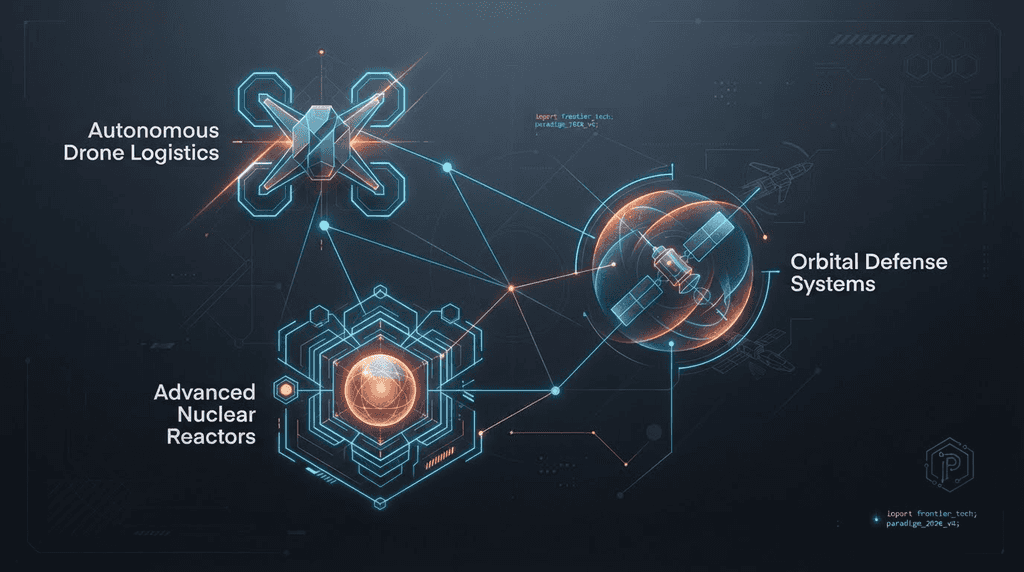
In July 2026, venture capital firm Paradigm closed its fourth flagship fund at $1.2 billion, formally broadening its investment mandate beyond blockchain protocols to encompass what managing partners Matt Huang and Alana Palmedo described as the "technical frontier". Following its co-lead investment in a $1.5 billion financing round for autonomous drone delivery operator Zipline in early November 2026, Paradigm’s non-crypto portfolio now spans factory-built nuclear microreactors, orbital space defense spacecraft, modular semiconductor fabrication equipment, automated metal manufacturing, and embodied robotics models.
This article examines Paradigm's non-crypto investments throughout 2026, evaluating why one of the digital asset industry's most prominent venture firms allocated hundreds of millions of dollars into physical-world industrial technologies and assessing how this dual-track strategy positions the firm across both Web3 and hard-tech markets.
Key Takeaways
-
Paradigm closed its fourth fund at $1.2 billion on July 8, 2026, expanding its early-stage mandate from pure cryptocurrency into artificial intelligence, robotics, and frontier physical hardware.
-
In November 2026, Paradigm co-led a $1.5 billion funding round valuing autonomous drone delivery network Zipline at $21.5 billion, up from $7.6 billion in January.
-
Paradigm led a $470 million Series C for Antares Nuclear in July 2026 after its Mark-0 microreactor achieved criticality at Idaho National Laboratory in June.
-
The firm backed space defense contractor True Anomaly, modular chip-equipment maker Fab2, and automated parts manufacturer SendCutSend.
-
Rather than abandoning crypto, Paradigm operates a dual-track strategy, continuing to back Stripe-partnered payments blockchain Tempo, prediction market Kalshi, Hyperliquid, and Ethereum tooling like Reth and Foundry.
Why Did Paradigm Expand Fund IV to the "Technical Frontier"?
Paradigm expanded its investment thesis because the primary bottlenecks constraining autonomous software, artificial intelligence, and decentralized networks shifted from purely digital code to physical-world limits, specifically electrical power availability, semiconductor manufacturing lead times, and automated physical logistics.
Founded in 2018 by former Sequoia Capital partner Matt Huang and Coinbase co-founder Fred Ehrsam, Paradigm built its reputation as a deeply technical, research-driven investment firm focused on cryptocurrency protocols, mechanism design, and smart contract engineering. The firm launched with a $750 million open-ended vehicle backed by university endowments including Harvard, Yale, and Stanford, followed by a $2.5 billion venture fund at the peak of the crypto market in November 2021 and an $850 million early-stage fund in 2024.
By mid-2026, however, global venture capital dynamics had undergone a structural realignment. During the second quarter of 2026, artificial intelligence and hard-tech startups captured roughly 70% of global venture funding, while traditional cryptocurrency venture activity moderated amid a nearly 30% pullback in Bitcoin prices earlier in the year.
On July 8, 2026, Huang and Palmedo announced the closing of Paradigm’s fourth fund at $1.2 billion, its third closed-end venture fund and fourth vehicle overall. In their statement to founders and limited partners, the partners emphasized that investing at the technical frontier requires throwing out rigid playbooks and recomputing views of reality as technologies converge. Rather than viewing cryptography, artificial intelligence, and physical robotics as isolated silos, Paradigm identified growing overlap across autonomous machine-to-machine payments, programmable financial rails, and the energy and hardware systems required to run autonomous agents in the physical world.
Empirical Fundraising Context
While Paradigm’s $1.2 billion close came in roughly $300 million below early market discussions of a $1.5 billion cap, and below its $2.5 billion 2021 vehicle, it still represented a 41% increase over its $850 million 2024 fund. By widening its aperture to include revenue-generating industrial, energy, and aerospace platforms alongside early-stage crypto protocols, Paradigm positioned its capital base to participate in the largest physical infrastructure buildout in startup history without relying solely on secondary token market cycles.
What Has Paradigm Invested in Beyond Crypto in 2026?
Throughout 2026, Paradigm deployed substantial capital across six non-crypto frontier technology categories: autonomous drone logistics, nuclear microreactors, orbital space defense, modular semiconductor tooling, automated metal fabrication, and embodied robotic intelligence.
Autonomous Aerial Logistics: Zipline International
On November 5–6, 2026, autonomous drone delivery provider Zipline International announced the completion of a $1.5 billion financing round that elevated its post-money valuation to $21.5 billion, nearly tripling from its $7.6 billion valuation in January 2026. Paradigm co-led the financing alongside WCM Investment Management and Layer Global to fund domestic manufacturing expansion, fleet upgrades, and nationwide commercial rollouts.
Originally known for delivering blood plasma, vaccines, and critical medical supplies across Rwanda, Ghana, Kenya, and Côte d'Ivoire, Zipline has scaled rapidly into mainstream U.S. retail, grocery, and restaurant logistics using its quiet, autonomous Platform 2 (P2) aircraft and tethered hovering delivery droids. According to commercial data disclosed alongside the November funding round, Zipline completed more than one million commercial deliveries in the Dallas-Fort Worth metroplex alone during 2026, achieving a median checkout-to-doorstep delivery time of just 19 minutes in October, compared to over 30 minutes for traditional ground couriers.
Among its longest-serving restaurant partners, the share of delivery revenue generated via Zipline climbed from 10.8% in March 2026 to 34.9% in October, driving a 26% increase in overall delivery gross merchandise value (GMV). Backed by a multi-year national expansion with Walmart across 300 additional locations and a partnership with Uber targeting one million daily deliveries by 2029, Zipline exemplifies what Matt Huang described in the announcement as one of the world's largest autonomous robotics companies operating at commercial scale.
Advanced Energy and Fission: Antares Nuclear
In late July 2026, Paradigm led a $470 million Series C financing round for Antares Nuclear, a California- and Idaho-based developer of factory-produced fission microreactors. The financing package comprised $370 million in equity alongside $100 million in debt facilities, with participation from Caffeinated Capital and Point72 Ventures.
Unlike conventional gigawatt-scale nuclear plants that require a decade of custom civil construction, Antares builds compact, transportable microreactors at its 322,000-square-foot "Antares Prime" manufacturing facility. The reactors utilize High-Assay Low-Enriched Uranium (HALEU) TRISO fuel, a graphite-moderated solid core, passive liquid-sodium heat pipes, and a closed-loop nitrogen Brayton power conversion cycle, eliminating the high-pressure water loops and complex mechanical valves of legacy reactors.
Antares hit a series of rapid regulatory and technical milestones throughout 2026. On June 4, 2026, the company achieved zero-power criticality with its Mark-0 demonstration reactor at the Department of Energy’s (DOE) Idaho National Laboratory under the DOE Reactor Pilot Program. Following its $470 million Series C in July, Antares secured an Army Janus microreactor agreement at Fort Bragg in August, won a $161 million Strategic Breakthrough Award to demonstrate a space reactor in September, and in late October 2026 cleared the first DOE authorization gate for Mark-1, its commercial electricity-producing reactor targeted for operation in 2027, while locking in long-term TRISO fuel fabrication with BWXT through the end of the decade. For Paradigm, backing Antares provides direct exposure to off-grid baseload power capable of serving remote military installations, space infrastructure, and energy-constrained data centers.
Orbital Defense and Space Situational Awareness: True Anomaly
In late April 2026, Colorado-based space defense startup True Anomaly closed a $650 million Series D funding round, consisting of $600 million in equity and $50 million in debt from Stifel Bank, at a $2.2 billion valuation, lifting its total capital raised since its 2022 founding past $1 billion. Paradigm participated in the round alongside Eclipse Ventures, Riot Ventures, Accel, and Menlo Ventures.
Founded by former U.S. Air Force officers, True Anomaly is a pure-play space defense contractor building maneuverable spacecraft and autonomous battle-management software. Its core hardware platform, the Jackal Autonomous Orbital Vehicle (AOV), is engineered for rendezvous and proximity operations (RPO), capable of approaching, inspecting, and monitoring uncooperative objects in orbit, paired with its Mosaic command-and-control software. The April 2026 financing came just four days after the U.S. Space Force selected True Anomaly among 12 prime contractors (alongside SpaceX, Anduril, Lockheed Martin, and Northrop Grumman) to compete for up to $3.2 billion in prototype contracts under the "Golden Dome" space-based missile defense initiative, funding the expansion of its manufacturing footprint from 140,000 square feet toward 2 million square feet.
Modular Semiconductor Fabrication: Fab2 (Formerly Atomic Semi)
Paradigm also invested in Fab2, a semiconductor equipment and manufacturing company co-founded by legendary processor architect Jim Keller (known for leading chip architectures at Apple, AMD, Tesla, and Tenstorrent) and Sam Zeloof, who gained prominence as a teenager for fabricating working integrated circuits in his family's garage. Originally founded under the name Atomic Semi before adopting the Fab2 brand in 2026, the company operates facilities across Austin and Lockhart, Texas, as well as San Francisco.
Whereas traditional leading-edge chip foundries cost $15 billion to $20 billion and take years to construct, Fab2 designs its own vacuum chambers, precision positioning equipment, heaters, sensors, and optical tools to build compact, reproducible chip factories. Paired with "Studio", its integrated chip design and process automation software, Fab2 aims to compress custom silicon prototyping cycles from months or years down to days, serving hardware startups, industrial sensor makers, and research labs that cannot afford multi-million-dollar wafer runs at mega-foundries.
Automated Precision Manufacturing: SendCutSend
In the industrial manufacturing sector, Paradigm built a major position in Reno, Nevada-based on-demand custom parts manufacturer SendCutSend. On May 19, 2026, Paradigm helped lead a $110 million financing round alongside Sequoia Capital and Stripe co-founders Patrick and John Collison that valued SendCutSend at $1.01 billion. Just five months later, on October 20, 2026, Paradigm joined SendCutSend’s Series B financing led by Spark Capital (with CRV, MHS, and Sequoia participating), doubling the company’s valuation to $2.1 billion.
SendCutSend operates as an automated digital factory for physical hardware builders. Engineers, robotics startups, and aerospace suppliers upload CAD design files to a web interface, where automated nesting and toolpath software routes jobs directly to laser cutters, CNC routers, waterjets, and press brakes, shipping custom metal and composite parts within days without minimum order quantities.
Embodied AI and Open-Source Research: Andromeda and Nous Research
Rounding out its frontier software-to-hardware bets, Paradigm has invested a cumulative $60 million into Andromeda, an embodied AI and robotics company that closed a funding round in March 2026 at a $1.5 billion valuation. Andromeda develops multimodal foundation models that translate natural-language instructions and visual sensor feeds into real-time motor control for physical robots. Simultaneously, at the intersection of AI and crypto, Paradigm backed decentralized open-source AI collective Nous Research and partnered with OpenAI to release EVMbench, an evaluation suite measuring how effectively AI agents audit and interact with Ethereum Virtual Machine smart contracts.
Why Did a Crypto Venture Leader Expand into Hard Tech?
Understanding why a crypto-native firm like Paradigm chose to back drones, nuclear reactors, and CNC metal factories requires looking at both the maturation of digital asset markets and the physical dependencies of modern computing.
Balancing Token Market Cycles with Real-World Enterprise Cash Flows
During the 2020–2021 cycle, crypto venture capital followed a rapid liquidity playbook: seed a protocol team, structure a governance token, and achieve mark-to-market returns upon exchange listing. By 2026, however, secondary market participants grew increasingly resistant to high-FDV, low-float token launches that lacked sustainable fee revenue, while competing Layer-2 and infrastructure protocols fragmented on-chain liquidity.
By allocating a portion of its capital into hard-tech companies like Zipline, SendCutSend, Antares, and True Anomaly, Paradigm gains exposure to businesses anchored by non-discretionary corporate and sovereign revenue streams—ranging from Walmart and Uber logistics contracts to multi-billion-dollar U.S. Space Force and Department of Defense energy mandates. These real-world cash flows and traditional IPO/M&A exit pathways provide structural portfolio diversification when digital asset token prices experience cyclical drawdowns.
Attacking the Physical Bottlenecks of the AI and Compute Stack
Just as importantly, Paradigm’s hard-tech bets follow a cohesive engineering logic: as software intelligence scales, the binding constraints move into the physical world. Frontier AI data centers and autonomous defense systems are bottlenecked by four-to-seven-year electrical grid queues, multi-year semiconductor fab delays, and slow hardware prototyping cycles. Investing in Antares Nuclear addresses off-grid power generation; Fab2 targets rapid silicon prototyping; SendCutSend accelerates custom metal hardware fabrication; and Andromeda and Zipline deploy autonomous intelligence directly into physical airspace and industrial environments.
Maintaining Core Web3 Commitments: A Dual-Track Strategy
Crucially, Paradigm’s expansion into physical frontier technology does not mean the firm has abandoned cryptocurrency. Unlike generalist firms that completely exited Web3 during market downturns, Paradigm continues to build and invest heavily across high-conviction blockchain infrastructure.
Co-founder Matt Huang personally leads Tempo, an institutional payments blockchain launched in partnership with Stripe (which already hosts over 70% of the initial supply of the OpenUSD consortium stablecoin). Paradigm also remains a major backer of decentralized perpetuals exchange Hyperliquid, federally regulated prediction market Kalshi, decentralized social protocol Farcaster, and foundational open-source Ethereum engineering tools including the Reth execution client and the Foundry development framework. Rather than leaving crypto behind, Paradigm’s $1.2 billion Fund IV reflects a recognition that the next decade of computing will unite programmable on-chain finance with autonomous machines and resilient physical infrastructure.
Conclusion
Rather than confining its $1.2 billion Fund IV to a single asset class, Paradigm is betting that the future of autonomous software depends equally on programmable blockchain rails and resilient physical hardware. For founders and market participants alike, Paradigm’s dual-track portfolio underscores how deeply digital finance, artificial intelligence, and industrial hard tech are converging in late 2026.
FAQs
Did Paradigm stop investing in crypto in 2026?
No. While Paradigm expanded its $1.2 billion fourth fund (announced July 8, 2026) to include AI, robotics, and frontier hardware, the firm continues to actively invest in and incubate cryptocurrency projects—including the Stripe-partnered Tempo payments blockchain, Kalshi, Hyperliquid, and open-source Ethereum tools like Reth and Foundry.
What are Paradigm’s biggest non-crypto investments in 2026?
Paradigm’s major non-crypto investments in 2026 include autonomous drone delivery leader Zipline, nuclear microreactor builder Antares Nuclear, space defense firm True Anomaly, automated parts manufacturer SendCutSend, robotics AI developer Andromeda, and modular chip-equipment maker Fab2.
Why did a crypto VC firm invest in nuclear microreactors and drone delivery?
Paradigm views cryptography, AI, robotics, and energy as converging technologies at the "technical frontier". Backing physical-world leaders like Antares Nuclear and Zipline allows Paradigm to invest in the off-grid electricity and autonomous physical networks needed to power and execute AI workloads, while diversifying its portfolio with companies generating steady commercial and defense revenues.
What is True Anomaly’s role in Paradigm’s portfolio?
True Anomaly bridges national security and autonomous tech. By building the Jackal orbital vehicle and Mosaic software, it secures space-based infrastructure. Paradigm backs it to tap into long-term U.S. Space Force defense mandates while testing automated systems in orbital environments.
Disclaimer
This general market information, possibly from third-party, commercial, or sponsored sources, is provided for reference and educational purposes only and does not constitute financial or investment advice, an offer, solicitation, or guarantee. We disclaim liability for its accuracy, completeness, reliability, and any resulting losses. Investments/trading are risky; past performance doesn’t guarantee future results. Users should research, judge prudently, and take full responsibility. For further details, please consult KuCoin’s Terms of Use and Risk Disclosure.