

Fed September Rate Hike Odds Fall to 30.6% Ahead of FOMC Minutes: Bitcoin and Gold in Focus
2026/08/18 16:01:00
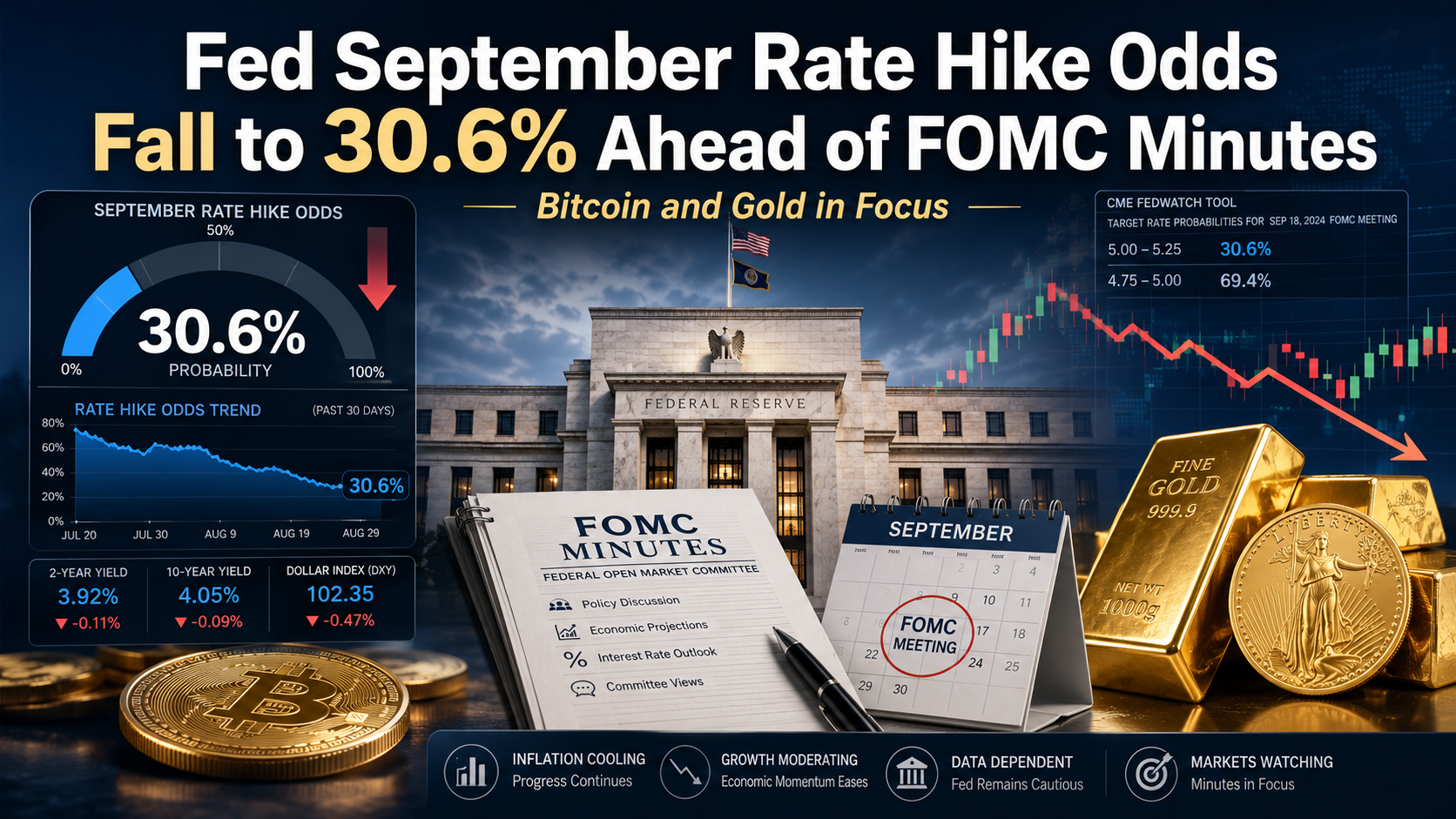
Expectations for another Federal Reserve rate hike have fallen sharply as a run of softer U.S. economic data changes the market's view of September monetary policy. CME FedWatch pricing showed the probability of a 25-basis-point hike falling to 30.6% on August 17, down from 52.2% a week earlier, leaving markets with roughly a 69% probability that the Fed would keep its target range at 3.50%–3.75%. Because futures pricing changes continuously, the implied hike probability had moved back to around 35% by August 18. The broader message, however, remained the same: traders have substantially reduced their conviction that another rate increase is imminent.
That shift matters well beyond the bond market. Bitcoin and gold are both highly sensitive to changes in interest-rate expectations, Treasury yields, the U.S. dollar and global liquidity, although they do not always respond in the same way. With the minutes of the Federal Reserve's July 28–29 meeting due on August 19 at 2:00 p.m. ET, investors are looking for clues about how deeply divided policymakers were over inflation and whether recent economic weakness could reinforce the case for holding rates steady.
Why Did September Rate Hike Odds Fall?
The change in expectations did not come from one economic report. Instead, several important indicators began pointing in a similar direction. July payroll employment changed little at -23,000, while the unemployment rate stood at 4.1%. Consumer inflation slowed slightly, with headline CPI rising 3.4% year over year compared with 3.5% in June, while core CPI eased to 2.5%. Producer prices were unchanged on the month, and retail and food-services sales fell 0.6% from June. Taken together, these figures suggest that demand and hiring are losing momentum even as inflation remains above the Federal Reserve's 2% objective.
| U.S. Indicator | Latest Signal | Implication for the Fed |
| Nonfarm payrolls | -23,000 in July | Suggests weaker hiring momentum |
| Unemployment rate | 4.10% | Labor market remains relatively stable but softer |
| Headline CPI | 3.4% YoY | Inflation eased slightly |
| Core CPI | 2.5% YoY | Underlying inflation continued to cool |
| PPI | 0.0% MoM | Less immediate pipeline inflation pressure |
| Retail sales | -0.6% MoM | Points to weaker consumer demand |
The important point is not that any of these numbers guarantees a Fed pause. Inflation is still above target, and annual energy inflation remains elevated. Rather, the balance of risks is becoming less straightforward. When inflation is high and growth is strong, the case for higher rates is relatively simple. When inflation remains elevated while jobs and consumer demand weaken, another rate increase carries a greater risk of overtightening. That change in the trade-off is what pushed markets away from the earlier assumption that a September hike was likely. A Reuters poll conducted August 12–17 found that an overwhelming majority of economists expected the Fed to leave rates unchanged in September.
What Does the 30.6% FedWatch Probability Really Mean?
The 30.6% figure is easy to misunderstand. It does not mean there is a 30.6% probability that the Federal Reserve will cut rates. At that point in market pricing, it represented the implied probability of a 25-basis-point hike, which would move the target range above the current 3.50%–3.75%. The much larger probability was attached to keeping rates unchanged. In other words, the main September debate is currently hold versus hike, not hike versus cut.
FedWatch probabilities are also not forecasts issued by the Federal Reserve. They are market-implied probabilities derived from federal funds futures and therefore move whenever traders reprice the likely path of policy. Inflation data, employment reports, oil prices, Fed speeches and bond-market moves can all change those probabilities rapidly. The shift from 30.6% on August 17 to roughly 35% on August 18 illustrates why traders should treat the number as a live indicator of expectations rather than a fixed prediction.
Why the FOMC Minutes Matter This Time
The July meeting was unusually important because the Fed's decision was not unanimous. The FOMC voted 9–3 to maintain the federal funds target at 3.50%–3.75%. Beth Hammack, Neel Kashkari and Lorie Logan dissented because they preferred an immediate quarter-point rate increase. The statement also acknowledged that inflation remained above the 2% goal and specifically pointed to supply shocks, including energy, as a source of price pressure.
That creates an important question for the minutes: were those three policymakers isolated, or were other officials who ultimately voted to hold also close to supporting a hike? The answer could matter more than the headline vote itself. A broader group expressing serious concern about persistent inflation would make the July meeting look more hawkish, while extensive discussion of downside risks to growth or the costs of overtightening would support the current market preference for a September pause.
What Traders Will Look For
Investors are likely to focus on how officials described inflation persistence, the labor market, energy prices and the risk of keeping monetary policy restrictive for too long. The most important issue is the Fed's risk hierarchy: whether policymakers regarded renewed inflation as the greater threat, or whether signs of slowing activity were beginning to command more attention. That distinction could shape how markets react even if the minutes contain no explicit guidance about September.
There is also a major timing limitation. The minutes describe discussions held on July 28–29, before the August releases showing a 23,000 decline in payrolls, softer CPI readings, flat producer prices and a 0.6% decline in retail sales. A hawkish document would therefore show how officials viewed the economy before receiving several pieces of weaker data. Markets may react to its language initially, but traders will also ask whether subsequent information has already made some of those concerns less relevant.
Hold, Hike or Cut: What Is the Fed Really Debating?
A rate hike still has a plausible economic case. Inflation has not returned to 2%, and headline CPI remains elevated partly because of energy pressures. If the Fed concludes that high energy costs are feeding into broader prices or inflation expectations, policymakers may decide that keeping rates unchanged is insufficient. The July statement itself emphasized elevated inflation and noted supply-driven price increases in areas including energy.
A hold is currently the more widely expected outcome. Holding rates at 3.50%–3.75% would allow the Fed to maintain restrictive monetary conditions without adding another layer of pressure to an economy showing signs of softer hiring and consumer spending. This option also gives policymakers more time to see whether recent inflation improvement continues or whether higher energy prices cause another acceleration. Reuters' August poll found 94 of 104 economists expected no rate change at the September meeting.
A rate cut, by contrast, is not the dominant September story. Growth concerns have risen, but inflation remains above target. That is why falling hike odds should not automatically be described as a major dovish pivot. A shift from "likely hike" toward "likely hold" is easier for financial conditions than additional tightening would be, but it is fundamentally different from the beginning of an aggressive easing cycle.
The Real Problem for the Fed: Inflation vs Growth
The Fed's difficulty is that the data are no longer delivering a single, clean message. Employment growth has weakened, retail spending fell in July and both headline and core inflation moderated. Yet the price level remains too high for comfort, and energy inflation is still a significant source of uncertainty. This combination raises the risk of an uncomfortable environment in which growth slows without inflation returning quickly to target.
Why Oil Changes the Equation
Oil is particularly important because it can complicate an otherwise straightforward decision to stop tightening. On August 18, Brent crude was trading above $91 a barrel amid renewed Middle East tensions, while long-dated Treasury yields were also rising. Higher energy costs can affect transportation, manufacturing and household expenses, while also influencing inflation expectations.
That creates a policy conflict. Weak employment and consumption data argue for patience, while a renewed energy shock can strengthen the case for keeping monetary policy restrictive. If the Fed worries that oil-driven inflation will spread into other categories, it may be reluctant to signal a fully dovish turn. For markets, that means September policy expectations will not be determined by weak U.S. data alone; the path of energy prices also matters.
Why Falling Hike Odds Matter for Bitcoin
Bitcoin does not have a direct mechanical relationship with the federal funds rate, but it is highly exposed to the financial conditions that monetary policy helps shape. When investors reduce expectations for further rate increases, short-term yields may face less upward pressure, the dollar may weaken and financing conditions can become less restrictive. Those changes can improve demand for assets whose valuations are particularly sensitive to liquidity and risk appetite.
The basic transmission mechanism is:
Lower hike expectations → less pressure on yields → potentially weaker dollar → easier financial conditions → stronger risk appetite → more supportive environment for Bitcoin.
This is why a decline in September hike odds can be interpreted as marginally positive for BTC. Crypto markets operate with substantial speculative positioning and leverage, so the cost and availability of capital can matter significantly. A monetary environment perceived as less restrictive is generally easier for crypto than one in which rates and real yields are moving sharply higher.
However, the reason rate expectations fall matters just as much as the direction of the change. If hike odds decline because inflation is moderating while growth remains healthy, that resembles a soft-landing scenario and can be favorable for Bitcoin. If they fall because employment, consumption and corporate activity are deteriorating rapidly, investors may instead reduce exposure to risky assets. In that case, Bitcoin could fall even as the probability of a Fed hike declines. Lower rates are not automatically bullish when the market is worried about recession.
Why Gold May React Differently
Gold responds to many of the same macro variables as Bitcoin but through a different mechanism. Because bullion pays no interest, falling bond yields generally reduce the opportunity cost of holding it. A weaker dollar can also make gold cheaper for buyers using other currencies. That combination helped spot gold rise on August 17 as the dollar weakened and markets reduced their expectations for Fed tightening.
Yet the following session demonstrated why the relationship is not simple. On August 18, gold slipped as Treasury yields and oil prices rose, even though expectations for an immediate Fed hike remained lower than they had been a week earlier. Higher nominal yields can weigh on a non-yielding asset, while an oil shock creates competing forces: inflation anxiety can support gold's store-of-value appeal, but the possibility of tighter monetary policy can raise its opportunity cost.
For investors comparing gold with Bitcoin, this distinction is important. Gold has a much longer history as a defensive asset and is closely linked to real yields, the dollar and safe-haven demand. Bitcoin is generally more sensitive to liquidity, leverage and broad risk sentiment. They can benefit from the same dovish Fed signal, but they do not necessarily respond with the same timing or magnitude.
Bitcoin vs Gold: Which Benefits More From a Fed Pause?
A Fed pause would remove the immediate pressure of another rate increase, but the relative advantage for Bitcoin or gold would depend on what happens simultaneously to yields, the dollar and risk sentiment.
| Macro Development | Bitcoin | Gold |
| Fed holds rates | Generally supportive | Generally supportive |
| Treasury yields fall | Usually positive for liquidity | Typically positive |
| U.S. dollar weakens | Often supportive | Often supportive |
| Sharp risk-off shock | Can fall with other risk assets | More likely to attract defensive demand |
| Global liquidity improves | Strong potential benefit | Supportive, but usually less liquidity-sensitive |
| Inflation fears rise | Mixed reaction | Can benefit unless yields rise sharply |
The comparison becomes especially interesting when a Fed pause is driven by economic weakness. If the central bank holds rates because inflation is cooling without major damage to growth, both Bitcoin and gold could benefit from easier expected monetary conditions. Bitcoin may outperform if improving liquidity leads investors back into higher-beta assets.
If a pause reflects serious recession concerns, the result could be different. Gold may receive more conventional safe-haven demand while Bitcoin initially trades with equities and other risk assets. The simple question "Is a Fed pause bullish?" is therefore less useful than asking why the Fed is pausing and what the bond market believes that decision means for growth and inflation.
Three FOMC Minutes Scenarios for Bitcoin and Gold
The minutes themselves will not set September policy, but they can change how markets interpret the Fed's reaction function. Three broad outcomes are worth considering.
Scenario 1: Minutes Are More Dovish Than Expected
A dovish reading would emerge if the document shows widespread concern about the risks of overtightening, growing attention to weaker demand or greater confidence that inflation pressures can ease without another hike. Such language could push September hike odds lower again and reduce pressure on the front end of the Treasury curve.
Bitcoin would likely view lower expected policy tightening as supportive, particularly if the dollar and short-term yields decline at the same time. Gold could also benefit through lower opportunity costs and a softer dollar. The strength of the reaction, however, would depend on how much of that outcome markets have already priced in.
Scenario 2: Minutes Show a Divided Fed
A mixed document may prove the most realistic outcome. Some policymakers could remain highly focused on above-target inflation and energy shocks, while others emphasize the risks to employment and growth. That would reinforce the idea that the Fed is genuinely data-dependent rather than committed to either another hike or a rapid shift toward easing.
For Bitcoin and gold, this scenario could generate an initial burst of volatility without creating a durable trend. Markets would probably move quickly back to upcoming inflation and employment releases. The direction of Treasury yields and the dollar after the first reaction would be more informative than the immediate move in BTC or bullion.
Scenario 3: Minutes Are Surprisingly Hawkish
The biggest short-term market shock would come from evidence that support for additional tightening was considerably broader than the three formal dissenters suggested. If several members who voted to hold also believed another rate increase might soon be necessary, markets could restore part of the September hike premium.
That would likely push short-term yields and the dollar higher, creating a more difficult environment for Bitcoin and gold. Yet the reaction could fade because the meeting occurred before several weaker July data releases became available. Traders would have to decide whether they were learning something new about the Fed's policy preferences or merely reading a hawkish assessment of an economic picture that has since changed.
What Crypto Traders Should Watch After the Minutes
The first move in Bitcoin after the minutes may be less important than the market signals surrounding it. Crypto traders should compare the reaction across several indicators rather than treating BTC as a standalone event.
-
September FedWatch odds: A sustained return above 40%–50% would indicate that markets are rebuilding expectations for a hike.
-
2-year Treasury yield: This is particularly sensitive to changes in the expected near-term policy path.
-
10-year Treasury yield: It reflects a broader combination of inflation expectations, growth and term premium.
-
U.S. dollar: A stronger dollar often creates a tougher backdrop for both Bitcoin and gold.
-
Brent crude: Continued gains would reinforce concerns about another inflation shock.
-
Bitcoin dominance: Rising BTC dominance during a broader crypto decline can indicate capital moving away from higher-risk altcoins toward the most liquid crypto asset.
The key is persistence. A five-minute spike in Bitcoin following a single phrase in the minutes matters less than a lasting repricing in Treasury yields, the dollar and September rate expectations. If those macro indicators return to their previous levels quickly, the crypto reaction may also fade. If they establish a new trend, the implications for Bitcoin can extend well beyond the day of the release.
What This Means for Bitcoin and Gold
The fall in September rate-hike odds to 30.6% marked a significant change in market expectations, but it should not be confused with the start of a Fed easing cycle. The dominant shift has been from hike toward hold, driven by softer employment, inflation and consumer-spending data. The July FOMC minutes can clarify how strongly policymakers were still leaning toward additional tightening, but they will describe a meeting held before much of the latest economic weakness was known.
For Bitcoin, the bigger story is the effect of Fed expectations on yields, the dollar, leverage and global liquidity. Gold faces many of the same forces but remains more closely tied to real yields and defensive demand. Neither asset can be reduced to a simple formula in which lower hike odds automatically mean higher prices. The question that matters now is whether the U.S. economy can slow enough to keep the Fed on hold without deteriorating so sharply that investors retreat from risk—and whether renewed energy inflation complicates that balance.
For crypto traders, that macro trade-off may ultimately matter far more than the 30.6% headline itself.
FAQs
How Often Does the Federal Reserve Release FOMC Minutes?
The Federal Reserve generally publishes the minutes of a regularly scheduled FOMC meeting three weeks after the policy decision. They provide substantially more detail than the short policy statement, including discussion of economic conditions, risks and policymakers' views. The minutes of the July 28–29, 2026 meeting are scheduled for release on August 19 at 2:00 p.m. ET.
Why Is the 2-Year Treasury Yield Important for Crypto Investors?
The 2-year Treasury yield is closely linked to expectations for the Federal Reserve's near-term policy path. When traders expect tighter monetary policy for longer, the 2-year yield can rise, increasing the return available from relatively low-risk dollar assets and tightening financial conditions. A sharp move in the 2-year yield after Fed news can therefore help crypto traders judge whether the bond market sees the event as genuinely hawkish or dovish.
Does the Fed Directly Control Bitcoin Prices?
No. The Federal Reserve does not set or target Bitcoin's price. Its policies influence Bitcoin indirectly by affecting interest rates, dollar liquidity, credit conditions, bond yields and investors' willingness to hold risky assets. Crypto-specific developments—including regulation, institutional flows, leverage and network activity—can also dominate Bitcoin's performance even when Fed policy is unchanged.
Why Can Bitcoin Move Before U.S. Stock Markets Open?
Bitcoin trades continuously, 24 hours a day and seven days a week, unlike U.S. stocks and many traditional financial instruments that follow defined exchange hours. This means crypto can react immediately to weekend geopolitical events, overnight central-bank news or developments during Asian and European trading sessions. Its early reaction can reveal changes in global risk sentiment, although it does not reliably predict how stocks will perform when Wall Street opens.
Can Altcoins React More Strongly Than Bitcoin to Fed News?
Yes. Many altcoins have lower liquidity, higher volatility and greater dependence on speculative capital than Bitcoin. When a hawkish Fed surprise pushes yields higher and causes investors to reduce leverage, smaller tokens can experience disproportionately large moves. Conversely, easier financial conditions can produce stronger percentage gains in high-beta altcoins. This is why traders often monitor both total crypto capitalization and Bitcoin dominance when assessing the impact of monetary-policy shocks.
🔥 KuCoin Offers A More Stable Option in A Volatile Market
If you worry about the frequent ups and downs in the market, and pursue a more stable option to earn money passively, KuCoin is the right place to come:

Simple Earn: Deposit and withdraw tokens anytime, earning stable returns.
Kucoin Earn: Earn stable profits with professional asset management.
Hold to Earn: Earn rewards by holding assets in Funding, Trading, Margin, Futures, Mining, and Unified Accounts.
Staking: Unlock the earning potential of on-chain assets.
Advanced Investments: Advanced Investments offer a variety of structured products to help your money grow in any market.
Shark Fin: Principal Protection and Guaranteed Gains
Dual Investment: Buy low and sell high with transparent return calculations.
Snowball: High yields, with price protection.
Discount Buy: Buy crypto at discount prices.
KCS Loyalty: Level up to enjoy exclusive perks by staking ≥ 1 KCS.
KuCoin Wealth: Discover future value and begin your smart investing journey.
KCS Benefits: Hold and stake KCS to access benefits across the platform.
KCS Staking 2.0: Participate in KCS on-chain governance to earn yield.
Disclaimer: This content is for informational purposes only and does not constitute investment advice. Cryptocurrency investments carry risk. Please do your own research (DYOR).