

Hedge Funds Bet on Volatility Dispersion as AI, Oil Shocks, and Rising Yields Split the Stock Market
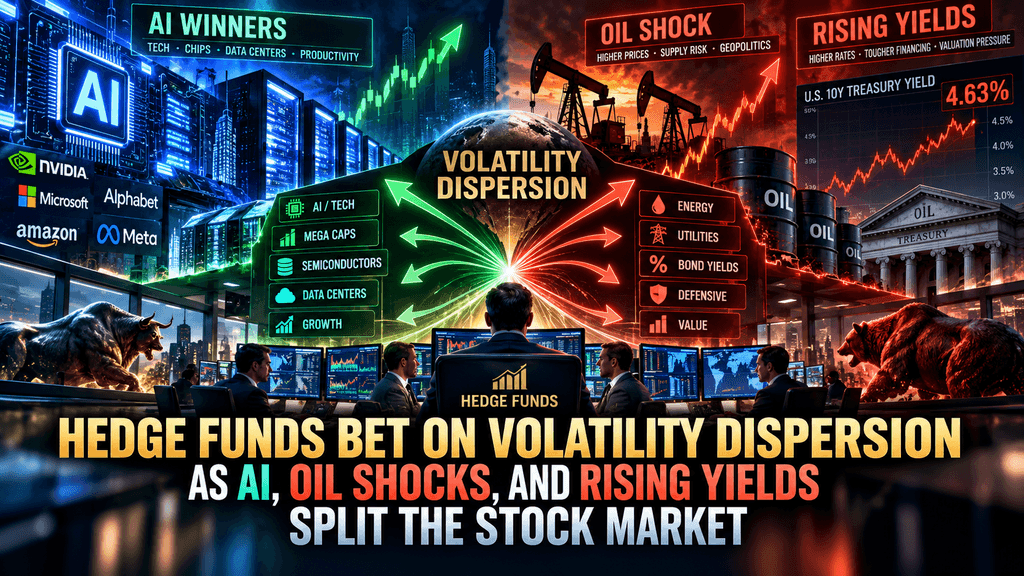
Dispersion Trade Gains Appeal as Stock-Level Divergence Widens
Hedge fund managers have sharpened their focus on a long-standing options strategy that profits when individual stocks move independently of the broader market. Sharp swings driven by competing narratives around artificial intelligence, geopolitical pressure on energy markets, and the highest U.S. Treasury yields in roughly two decades have reduced correlations across S&P 500 constituents. Realized dispersion in one-month absolute returns of index members relative to the benchmark itself has climbed to the 95th percentile of the past three decades, according to Nomura data reported in late September 2026.
Single-stock implied volatility has meanwhile compressed since late July, particularly among leading technology names, lowering the cost of establishing positions that buy options on individual equities while selling options on the S&P 500. This combination of elevated realized differentiation and more attractive entry pricing has revived interest in the classic dispersion trade. The core thesis is that AI-driven winner-and-loser dynamics, divergent impacts of oil price moves on producers versus refiners, and rising borrowing costs are generating the precise market conditions and high single-stock volatility relative to subdued index volatility that historically reward carefully constructed dispersion strategies, even as overall equity indexes remain near record highs.
Agentic AI Narratives Create Sharp Winner-Loser Gaps Across Sectors
Optimism surrounding advances such as Meta Platforms’ Muse AI agent has collided with investor concerns that rapid deployment of agentic systems could disrupt established business models in banking, travel, software, and professional services. Stocks tied to AI infrastructure and model development have experienced large independent swings, while companies perceived as vulnerable to automation have lagged or declined. This intra-sector differentiation has reduced the average correlation among S&P 500 members and lifted measures of realized dispersion to multi-decade extremes. Traders report heightened client interest in identifying beneficiaries of agentic AI growth versus those exposed to margin or revenue pressure. The resulting price action favors strategies that capture idiosyncratic moves rather than directional market bets. Earnings season is expected to amplify these differences as companies report concrete results on AI-related spending, productivity gains, or competitive threats.
Single-stock options markets have already seen renewed buying interest in AI-exposed names over recent weeks, consistent with positioning for continued differentiation. Market participants note that the current environment differs from earlier AI-driven rallies in which a narrow group of large-capitalization names moved in near-unison. Differentiation now extends across the AI value chain and into secondary industries, creating a richer opportunity set for relative-value approaches. The compression in single-stock implied volatility since late July has made the cost of buying protection or directional options on individual names more reasonable relative to the recent past, according to derivatives desks. This pricing backdrop supports the construction of long single-stock volatility versus short index volatility positions that form the backbone of many dispersion books.
Oil Price Volatility Splits Energy Producers from Refiners
Geopolitical developments linked to conflicts involving Iran and Ukraine have produced rapid moves in crude prices and refined-product margins. Upstream oil producers and downstream refiners have responded differently to the same headlines, generating dispersion within the energy sector itself. Brent crude has risen substantially over the third quarter and stands sharply higher on a year-to-date basis, yet the distribution of gains and losses among energy equities has remained uneven. Refining margins and inventory dynamics create company-specific outcomes that are only partially correlated with the broad oil-price path. These idiosyncratic moves contribute to the elevated dispersion statistics observed across the full S&P 500.
Hedge funds active in the space monitor both the direction of crude and the relative performance of producers versus processors when sizing single-stock options exposure. The energy complex therefore offers a second, non-technology source of differentiation that supports the same volatility-dispersion framework. When individual energy names exhibit larger absolute returns than the overall index, the arithmetic of dispersion trading improves. Options market activity reflects this reality through increased interest in single-name energy contracts alongside continued selling of index volatility. The combination of geopolitical catalysts and sector-specific operational differences keeps correlation within energy and between energy and the broader market lower than in more homogeneous regimes.
Treasury Yields at Two-Decade Highs Raise Borrowing Costs Unevenly
U.S. 10-year Treasury yields have climbed above 5 percent, reaching levels last seen near the 2007 financial crisis period. Higher long-term rates increase discount rates applied to future cash flows and raise the cost of capital for companies reliant on debt markets. The impact is uneven across the equity universe. Firms with strong balance sheets, limited near-term refinancing needs, or robust free cash flow generation have shown greater resilience, while more leveraged or growth-oriented companies have experienced greater pressure. This differentiation in rate sensitivity has contributed to the broader decline in stock-to-stock correlations.
Index-level performance has remained relatively stable near record territory even as individual constituents diverge, consistent with the conditions sought by dispersion strategies. The rise in yields has also influenced the pricing of equity options. Single-stock implied volatility, after rising earlier in the summer, has compressed since late July for many high-profile names. The resulting gap between individual-stock and index volatility has begun to widen again, improving the theoretical attractiveness of buying the former and selling the latter. Market commentary from flow desks indicates that clients are actively discussing these relative-value opportunities as yields stabilize at elevated levels.
Nomura Data Places Current Dispersion at 95th Percentile of Three Decades
Cross-asset strategists at Nomura have quantified the current environment by measuring the one-month absolute returns of S&P 500 constituents relative to the index itself. That realized dispersion measure has reached the 95th percentile of its distribution over the past thirty years. Such extreme readings historically coincide with periods in which stock selection and relative-value approaches outperform pure beta exposure. The same research notes that the Cboe one-month correlation index, after recovering from record lows in July, has declined again in recent sessions.
Lower correlation directly supports the profitability of dispersion trades because index volatility is damped by the averaging of uncorrelated moves. These statistical extremes provide a quantitative backdrop for the qualitative narrative of AI, oil and rates. When dispersion sits near the upper end of its long-term range and single-stock implied volatility has simultaneously declined, the entry cost of the classic long-single-stock, short-index options structure becomes more compelling. Flow traders report that this combination has prompted renewed inquiries from hedge fund clients who had previously reduced exposure after earlier periods of high dispersion.
Single-Stock Implied Volatility Compression Improves Entry Pricing
Implied volatility on individual equities, especially within the technology cohort that led earlier advances, has contracted meaningfully since late July. Market participants describe the current pricing as relatively inexpensive compared with levels observed only weeks earlier. The compression reduces the premium paid when purchasing single-stock options, while the still-elevated realized dispersion maintains the potential payoff if individual names continue to move independently. This asymmetry, cheaper entry with still-high realized differentiation, underpins much of the current interest.
Derivatives desks at major banks have highlighted the improved risk-reward profile in client conversations. The same compression has occurred against a backdrop of resilient index performance. World equity benchmarks remain only a few percentage points from all-time highs and have posted double-digit gains year-to-date despite the triple pressure of AI narrative shifts, oil-price swings, and rising yields. The contrast between calm index behavior and turbulent single-stock behavior is the precise environment dispersion strategies are designed to exploit.
Energy and Software Sectors Provide Additional Dispersion Sources Beyond Core Tech
Opportunities are not confined to the largest AI-related names. Within energy, producers and refiners continue to display divergent reactions to crude price and geopolitical news. Software companies face rapidly shifting investor assessments of how agentic AI will affect their competitive positions, producing company-specific volatility. These secondary sources expand the universe of single-stock options that can be paired against short index volatility.
Portfolio construction therefore benefits from a broader set of idiosyncratic risks rather than concentration in a handful of mega-cap technology names. The expansion of dispersion beyond pure technology reduces the risk that a single narrative reversal will simultaneously unwind every long single-stock position. Managers can allocate across sectors that respond to different primary drivers, AI adoption curves, refining margins, or rate sensitivity, while maintaining the overarching short-index-volatility hedge.
Earnings Season Expected to Amplify Idiosyncratic Stock Moves
The approaching corporate reporting period typically increases the importance of company-specific information. Guidance on AI capital expenditure, productivity benefits, energy cost exposure, and refinancing plans will differ markedly across firms. Historical patterns show that earnings seasons coincide with elevated single-stock volatility relative to index volatility. Current positioning already reflects anticipation of this dynamic through increased single-name options volume.
The combination of already high realized dispersion and the forthcoming information flow creates a self-reinforcing environment for strategies that benefit from differentiation. Market participants monitor options volume and open interest in both individual names and the broader index as leading indicators of how aggressively the dispersion trade is being pursued. Sustained demand for single-stock options alongside the supply of index options would further support the relative pricing that makes the strategy attractive.
Crowded Positioning Raises Liquidation Risk Warnings from Practitioners
Despite the favorable statistical backdrop, some experienced managers caution that dispersion has been a popular theme for several years. Concentrated positioning can produce sharp reversals if correlations suddenly rise or if a broad market shock forces simultaneous liquidation of long single-stock volatility positions. Comments from hedge-fund operators highlight the risk of a “washout” after prolonged popularity.
Risk management therefore emphasizes position sizing, liquidity of the underlying options, and ongoing monitoring of implied correlation metrics. The warning does not negate the current opportunity set but underscores the need for disciplined execution. Strategies that can be adjusted quickly through exchange-traded options rather than bespoke over-the-counter structures may offer greater flexibility if market conditions shift abruptly.
Index Resilience Despite Macro Pressures Supports Relative-Value Approaches
Global equity indexes have absorbed the combined effects of oil-price increases exceeding 40 percent in the third quarter, Treasury yields at multi-decade highs, and ongoing geopolitical uncertainty while remaining close to record levels and posting solid year-to-date gains. This resilience at the index level, paired with elevated single-stock differentiation, is the classic setup for dispersion.
Broad beta exposure continues to deliver returns, yet the incremental opportunity increasingly resides in relative performance across constituents. The contrast between index stability and constituent turbulence also influences portfolio construction decisions outside pure hedge-fund strategies. Investors seeking lower correlation exposure or more selective equity risk may find complementary value in approaches that explicitly target dispersion.
Options Market Activity Confirms Renewed Focus on Single-Stock Volatility
Average options volume has remained elevated, with notable increases in activity around AI-related names. Traders have been net buyers of single-stock contracts while continuing to supply volatility on the broader index. This flow pattern is consistent with the mechanical requirements of dispersion trading. The widening gap between single-stock and index implied volatility further validates the relative-value thesis.
Flow desks report that client conversations increasingly center on agentic-AI winner-and-loser identification and energy-sector differentiation. Sustained options activity of this type can itself influence pricing, potentially extending the window of attractive entry if single-stock volatility remains compressed relative to realized moves.
Broader Market Effects for Stock Selection and Portfolio Construction
Elevated dispersion elevates the importance of fundamental stock selection relative to passive index exposure. Company-specific factors, AI adoption trajectories, energy cost structures, and balance-sheet strength under higher rates now drive a larger share of returns. Portfolio managers may respond by increasing active risk budgets or by incorporating explicit dispersion overlays. The same environment supports market-neutral and relative-value hedge-fund strategies that seek to monetize differentiation without taking large directional market bets.
The persistence of these conditions through the remainder of 2026 will depend on the continued evolution of AI narratives, the path of oil prices under geopolitical pressure, and the trajectory of long-term yields. As long as correlations remain subdued and single-stock volatility stays elevated relative to the index, the structural case for dispersion strategies remains intact.
Practical Steps for Implementing Dispersion in Current Conditions
Implementation typically involves purchasing a basket of single-stock options or variance swaps and selling corresponding index options or variance, often with dynamic delta hedging. Liquidity, option skew, and the precise composition of the long single-stock book determine realized profitability. Current pricing, with compressed single-stock implied volatility and high realized dispersion, improves the starting point for such structures. Managers must still account for the potential for rapid correlation spikes during market stress and for the liquidity of the single-name options used.
Continuous monitoring of realized versus implied metrics remains essential. The confluence of AI differentiation, energy-sector splits, and rate-driven divergence has produced a statistically rare window. Whether that window remains open will be tested by forthcoming earnings reports, further geopolitical developments, and the path of Treasury yields. For now, the data and market flows indicate that hedge funds are actively positioning to capture the resulting volatility dispersion.
🔥 Beyond the Headlines: What KuCoin 5.0 Means for You
Market news moves fast — but where you act on it matters just as much. This October, KuCoin launches KuCoin 5.0, transforming KuCoin into a rebuilt platform. Here's what actually changes for you:
-
One account for everything. Older platforms split your money across separate "spot," "margin," and "futures" accounts and expected you to understand why. KuCoin 5.0's unified account removes that entirely — deposit once, and everything is simply there (only available to VIPs for now).
-
Stocks, indices, and commodities. KuCoin 5.0 expands beyond crypto into global markets. When crypto chops sideways and equities rally (or the reverse), you rotate in minutes instead of opening a brokerage account and waiting days for fiat rails.
-
Real-world assets (RWA). Tokenized exposure to traditional assets like commodities, right inside your crypto account. One of the fastest-growing segments in global finance is no longer reserved for institutions — you access it from the same balance you trade with.
-
Earn while you learn. Not ready to trade? KCUSD lets your stablecoins earn daily, auto-compounding interest. The lowest-stress way to put your idle deposit to work for 4% yield.
-
An AI assistant in plain language. Ask questions, get market context, understand what you're looking at — built into the platform, no jargon required.
-
An app that doesn't overwhelm. Faster, cleaner, and consistent — intuitive from the first tap, not after a tutorial.
-
Safety you can check, not just trust. A MiCAR-licensed EU entity, Proof of Reserves you can verify yourself, and internationally certified security (SOC 2 Type II, ISO 27001:2022).
Create your account in minutes — and start on the platform built for where crypto is going, not where it's been.
FAQs
How does a classic equity dispersion trade work in practice?
A typical structure buys options or variance on a diversified basket of individual stocks while simultaneously selling options or variance on a broad index such as the S&P 500. Profit arises when the average volatility of the single names exceeds the volatility of the index, a condition that occurs when constituent returns are less correlated. Dynamic hedging of residual delta exposure is usually required. Current market conditions, high realized single-stock dispersion paired with compressed single-stock implied volatility, improve the entry economics of this framework, according to recent dealer commentary.
Why has single-stock implied volatility declined since late July while realized dispersion remains elevated?
Implied volatility reflects market expectations of future moves and can compress when recent realized swings moderate or when the supply of options increases. Realized dispersion measures actual historical absolute returns relative to the index and can stay high even as implied measures fall. The resulting gap between still-elevated realized differentiation and lower implied levels creates a more favorable starting point for long single-stock volatility positions.
What role do geopolitical oil shocks play in current dispersion opportunities?
Conflicts affecting Iran and Ukraine have driven large moves in crude prices and refining margins. Upstream producers and downstream refiners respond differently to the same price path because of operational and margin differences. These company-specific reactions generate dispersion within the energy sector that is only partially correlated with broader market moves, expanding the set of single-stock options useful for dispersion books.
How significant is the current level of S&P 500 constituent dispersion?
Nomura research places the one-month absolute-return dispersion of S&P 500 members relative to the index at the 95th percentile of observations over the past thirty years. Such extreme readings have historically coincided with periods favoring relative-value and stock-selection strategies over pure index exposure.
Are dispersion strategies currently considered crowded?
Some practitioners note that dispersion has been a popular theme for several years and warn of potential liquidation risk if correlations rise abruptly or if a broad market shock forces simultaneous unwinds. Position sizing, liquidity management, and continuous monitoring of correlation metrics are therefore emphasized even when statistical conditions appear favorable.
How might the upcoming earnings season affect dispersion trading?
Earnings reports typically increase the weight of company-specific information. Guidance on AI spending, energy costs, and refinancing under higher yields is expected to differ widely across firms, potentially sustaining or amplifying single-stock volatility relative to index volatility. Options positioning already reflects anticipation of these idiosyncratic moves.
Disclaimer: This content is for informational purposes only and does not constitute investment advice. Investments carry risk. Please do your own research (DYOR).