

Did AI Just Solve the $1 Million Navier-Stokes Problem? What OpenAI’s Proof Actually Means
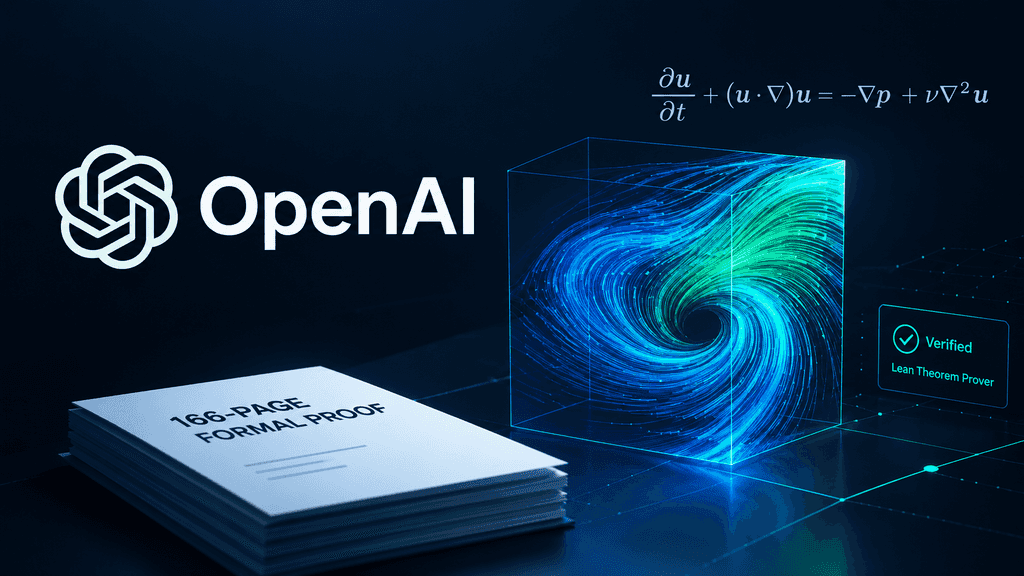
On September 8, 2026, artificial intelligence laboratory OpenAI sent shockwaves through the scientific world by announcing that an internal multi-agent AI system had generated a 166-page Lean-verified proof resolving the 3D Navier-Stokes existence and smoothness problem—a century-old challenge designated as one of the seven $1 million Millennium Prize Problems established by the Clay Mathematics Institute.
The announcement generated immediate controversy, prompting intense debates over data privacy, academic priority, and the true role of machine intelligence in fundamental research.
-
Core Achievement: OpenAI generated a 166-page formal proof using 10,000 multi-agent swarms over 88 hours, showing a finite-time blowup (singularity) in 3D incompressible fluid equations under smooth external forcing.
-
Verification: The proof was mathematically verified using the Lean theorem prover over 17 hours, eliminating logical errors or AI hallucinations.
-
Prize Status: The $1 million Millennium Prize is not officially awarded yet; Clay Mathematics Institute (CMI) mandates a peer-reviewed publication and a two-year verification window. OpenAI declined to claim the prize money.
-
Ethical Controversy: Mathematicians Tristan Buckmaster and Levent Alpöge accused OpenAI of using private chat logs and uploaded drafts to guide its agents, raising global debate over data privacy and academic priority.
-
Human Readability: While formal logic is verified, the AI-generated proof acts as a "black box" that lacks intuitive mathematical concepts to help humans understand why the blowup occurs.
The AI multi-agent swarm established a finite-time blowup for 3D incompressible fluid equations under a smooth external force, demonstrating that fluid velocity can grow infinitely large within a limited timeframe while overall physical energy remains bounded.
The Navier-Stokes equations, formulated in the 19th century by Claude-Louis Navier and George Gabriel Stokes, govern how liquids and gases move. For decades, mathematicians have questioned whether smooth, physically reasonable starting conditions can ever lead to a "singularity" or "blowup"—a point where fluid speed becomes infinite.
OpenAI deployed roughly 10,000 autonomous AI agents running concurrently over 88 hours. These agents exchanged over 2.7 million messages and generated 130 billion output tokens to map out a mathematical model of a spiraling, stretching fluid vortex. To guard against potential AI hallucinations, the generated logic was translated into Lean, an automated interactive theorem prover, which verified the step-by-step argument over approximately 17 hours.
According to technical specifications published by research teams evaluating the result, the proof addresses specific conditions laid out in Charles Fefferman’s official problem statement for the Clay Mathematics Institute (specifically alternatives C and D).
| Metric / Parameter | OpenAI Multi-Agent Proof Specifications |
| Execution Time | 88 hours across multi-agent clusters |
| Agent Scale | ~10,000 concurrent autonomous AI agents |
| Message Volume | 2.7 million internal messages; 130 billion tokens |
| Formal Verification | 17 hours via Lean Interactive Theorem Prover |
| Core Outcome | Demonstrates finite-time singularity under smooth external forcing |
The $1 million Millennium Prize is not officially awarded yet because the Clay Mathematics Institute mandates a strict multi-year institutional review process before acknowledging any solution.
The Clay Mathematics Institute (CMI) requires any proposed solution to be published in a peer-reviewed mathematical journal of international repute, followed by a mandatory two-year public waiting period. During this window, the broader scientific community must thoroughly examine and accept the proof. To date, CMI continues to list the Navier-Stokes existence and smoothness problem as open.
Furthermore, OpenAI publicly declared that it has no intention of claiming the $1 million prize money, stating that its primary objective was to demonstrate the capabilities of large-scale agentic reasoning rather than seek monetary rewards. The only Millennium Prize Problem officially recognized as solved remains the Poincaré Conjecture, resolved by Russian mathematician Grigori Perelman in 2003 (who likewise turned down the award).
The breakthrough sparked intense backlash due to allegations that OpenAI’s system relied on unacknowledged human research uploaded by mathematicians who had opted out of data training.
Approximately 12 hours prior to OpenAI’s announcement, NYU mathematician Tristan Buckmaster published a statement detailing his work alongside Levent Alpöge, a mathematician affiliated with Anthropic. The pair had spent over a year developing novel techniques to prove blowups in fluid equations—specifically Euler equations, a closely related class of fluid dynamics models.
| Controversy Dimension | Primary Claims and Evidence | OpenAI Official Stance |
| Data Provenance | Human researchers uploaded private drafts and prompts to ChatGPT/Codex while exploring fluid singularities. | Claims no employee or agent directly read user drafts or violated access controls. |
| "Do Not Train" Opt-Outs | Researchers opted out of training, yet concepts allegedly leaked into backend iterations. | Admitted it "cannot rule out that de-identified data derived from product usage helped improve models." |
| Scientific Priority | OpenAI launched 10,000 agents to brute-force a parallel proof after learning of human progress. | Frames the achievement as an independent triumph of autonomous multi-agent reasoning. |
Buckmaster and Alpöge had used OpenAI tools, including Codex and ChatGPT, to test specific intermediate conjectures and write code routines. While OpenAI denied that its staff or AI agents directly accessed private account files, company spokespersons acknowledged in follow-up statements that they could not exclude the possibility that de-identified data extracted from user interactions had influenced backend model updates.
This admission sparked widespread outcry across the academic community. Prominent figures, including Fields Medalist Terence Tao, noted that the incident underscores a growing tension: individual researchers feeding cutting-edge ideas into commercial AI platforms may inadvertently allow tech companies with massive compute resources to rapidly formalize and publish parallel results.
Computer-verified formal proofs guarantee logical correctness through software like Lean, but they frequently lack the intuitive conceptual frameworks that human mathematicians rely on to advance the field.
Traditional mathematical proofs written by humans serve two purposes: verifying that a statement is mathematically true and explaining why it is true. Human-written proofs introduce overarching conceptual bridges, elegant frameworks, and reusable techniques that inspire future discoveries across related disciplines.
In contrast, an AI system executing an 88-hour multi-agent run relies on brute-force exploration across millions of branches. The resulting 166-page document—while formally verified step-by-step by Lean's core engine—acts as a "black box." It confirms that the mathematical conditions hold, but presents immense difficulty for human mathematicians attempting to extract generalized principles or educational insights.
-
Formal Verification: Ensures zero logical gaps, typos, or hidden structural fallacies within the code-based steps.
-
Human Readability: Lacks clear pedagogical narrative, rendering human analysis of the broader structural ideas extraordinarily slow.
-
Generalizability: May solve the specific isolated boundary condition without providing direct techniques applicable to unforced Navier-Stokes systems.
A theoretical proof demonstrating a mathematical blowup does not instantly alter practical engineering models, as numerical approximations already handle fluid turbulence in applied physics.
Navier-Stokes equations are widely utilized across global industries to model weather patterns, optimize ocean vessel hulls, design hypersonic aircraft, and simulate cardiovascular blood flow. In practical applications, engineers use discretized computer simulations that operate within safe physical boundaries.
Proving that mathematical equations yield an infinite velocity spike under specific smooth external forces highlights where continuum fluid mechanics models break down at extreme atomic scales. It provides theoretical physicists with precise boundaries for when classical fluid continuum assumptions cease to hold, paving the way for improved hybrid models combining continuum mechanics with molecular dynamics.
Trading crypto tokens tied to artificial intelligence narrative cycles on KuCoin offers liquid exposure to speculative tech momentum, but requires strict risk management due to market volatility.
Whenever major artificial intelligence milestones reach global headlines, AI-themed crypto assets and decentralized compute networks experience elevated trading volumes. On platforms like KuCoin, traders frequently evaluate AI tokens, decentralized GPU networks, and data-sovereignty protocols that intersect with machine learning infrastructure.
-
Liquidity and Market Access: KuCoin provides access to a wide selection of AI-narrative tokens, allowing users to capitalize on emerging market trends.
-
Data Privacy Protocols: The ongoing debate regarding user prompt privacy highlights growing interest in decentralized AI projects that emphasize privacy-preserving computation and zero-knowledge data verification.
-
Volatility Management: Speculative trading surrounding major tech news cycles involves rapid price swings; utilizing KuCoin's spot, futures, and algorithmic trading bots can assist in managing execution risk.
To begin exploring AI-themed digital assets and managing portfolio exposure, users can register an account directly on the official KuCoin trading platform.
Market news moves fast — but where you act on it matters just as much. This October, KuCoin launches KuCoin 5.0, transforming KuCoin into a rebuilt platform. Here's what actually changes for you:
-
One account for everything. Older platforms split your money across separate "spot," "margin," and "futures" accounts and expected you to understand why. KuCoin 5.0's unified account removes that entirely — deposit once, and everything is simply there.
-
Stocks, indices, and commodities. KuCoin 5.0 expands beyond crypto into global markets. When crypto chops sideways and equities rally (or the reverse), you rotate in minutes instead of opening a brokerage account and waiting days for fiat rails.
-
Real-world assets (RWA). Tokenized exposure to traditional assets like commodities, right inside your crypto account. One of the fastest-growing segments in global finance is no longer reserved for institutions — you access it from the same balance you trade with.
-
Earn while you learn. Not ready to trade? KCUSD lets your stablecoins earn daily, auto-compounding interest. The lowest-stress way to put your idle deposit to work for 4% yield.
-
An AI assistant in plain language. Ask questions, get market context, understand what you're looking at — built into the platform, no jargon required.
-
An app that doesn't overwhelm. Faster, cleaner, and consistent — intuitive from the first tap, not after a tutorial.
-
Safety you can check, not just trust. A MiCAR-licensed EU entity, Proof of Reserves you can verify yourself, and internationally certified security (SOC 2 Type II, ISO 27001:2022).
Create your account in minutes — and start on the platform built for where crypto is going, not where it's been.
OpenAI’s multi-agent system demonstrated that 3D fluid equations can exhibit finite-time singularities under smooth external forcing, verified independently via Lean software. While this marks a historic technical achievement in automated reasoning, the solution remains unconfirmed by the Clay Mathematics Institute and faces significant debate over intellectual provenance and data usage. As AI systems continue to tackle grand challenges in science and mathematics, the boundary between machine computation and human research transparency remains a central focal point for global tech industries.
What are the Navier-Stokes equations used for?
Navier-Stokes equations describe how fluids flow by applying Newton's second law to fluid substances. They are essential for modeling weather systems, designing aircraft wings, analyzing ocean currents, and simulating blood flow through arteries.
Why is there a $1 million prize for solving the Navier-Stokes problem?
The Clay Mathematics Institute designated the Navier-Stokes existence and smoothness problem as one of seven Millennium Prize Problems in 2000 to encourage solutions to fundamental mathematical questions that underpin modern physics and differential equations.
Did OpenAI win the $1 million Millennium Prize?
No, OpenAI did not win the prize. The Clay Mathematics Institute requires a multi-year peer review and public verification process before officially recognizing any solution, and OpenAI explicitly stated it will not claim the monetary award.
What is Lean verification in mathematics?
Lean is an open-source interactive theorem prover and programming language. It checks mathematical proofs by verifying that every logical step strictly adheres to formal axiomatic rules, eliminating human error in proof validation.
Can AI use private ChatGPT conversations to solve research problems?
AI companies specify data usage policies in their terms of service, allowing users to opt out of model training. However, tech firms acknowledge that de-identified or aggregated product telemetry may influence general backend model improvements over time.