

Deutsche Bank Research: Tokenization Set to Become Next-Gen Financial Infrastructure
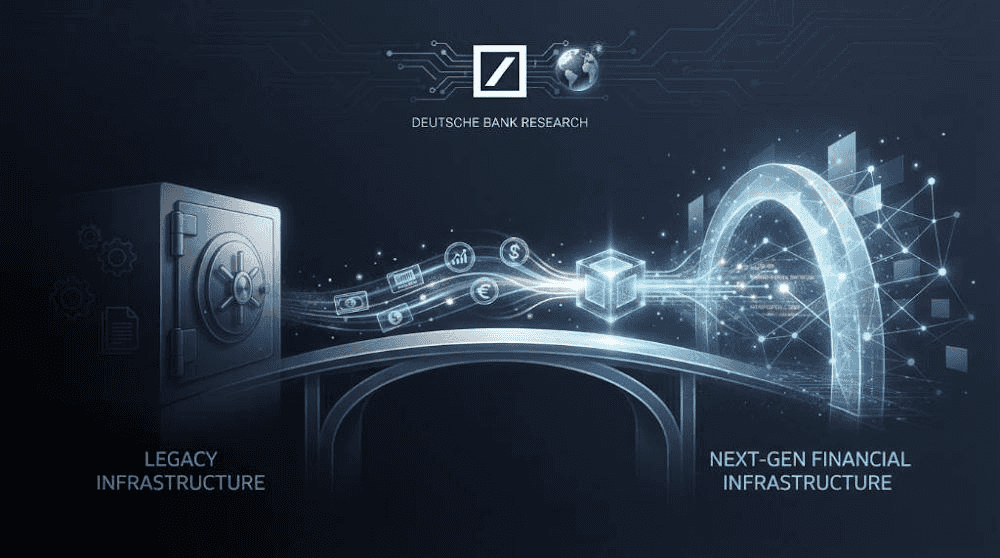
According to research published by the Deutsche Bank Research Institute, headlined by its study Asset Tokenization 101: The Next Phase of Financial Infrastructure alongside companion reports on currency and market structure, distributed ledger technology is transitioning from an exploratory trial phase into the operational architecture of global finance. Deutsche Bank’s analysts conclude that tokenization is positioned to become a core operating layer for capital markets over the coming decade.
Historically, discussions surrounding blockchain adoption in banking were caught between two extremes: skepticism from traditional risk officers on one side, and overly broad predictions of total institutional disintermediation by early crypto proponents on the other. The research framework established by Deutsche Bank reframes this dynamic. By analyzing market data across sovereign debt issuances, foreign exchange trading desks, and money-market instruments, the bank demonstrates that tokenization does not eliminate traditional financial institutions. Instead, it upgrades the settlement ledgers, collateral management systems, and liquidity networks upon which these intermediaries operate.
Analyzing Deutsche Bank’s tokenization research requires examining the empirical metrics behind recent growth, the economic arguments refuting disintermediation, the technical synchronization of cash and collateral ledgers, and the long-term capital projections guiding tier-one financial institutions through 2035.
Market Dynamics: Isolating the $39 Billion Real-World Asset Expansion
Previous market commentaries often aggregated consumer-facing stablecoins like USDT and USDC with institutional real-world assets (RWAs), masking the specific adoption curves of debt and equity instruments.
Deutsche Bank’s research addresses this by isolating the global market for tokenized assets excluding stablecoins. The findings demonstrate measurable expansion across institutional balance sheets:
-
Nearly Fourfold Asset Growth: The global volume of tokenized assets (excluding stablecoins) increased from approximately $10 billion in January 2025 to $39 billion by September 2026.
-
Base-Year Baseline: This growth built upon a consolidated institutional base of $25 billion recorded across core asset classes during 2025.
-
Long-Term Projection Path: Under conservative assumptions, Deutsche Bank Research projects the tokenized asset market (excluding stablecoins) to reach between $1.5 trillion and $2.0 trillion by 2030, with longer-term modeling pointing to a scale of $3.0 trillion to $4.0 trillion by 2035.
The Dominance of Tokenized US Treasuries and Money Market Funds
The primary driver behind the rise to $39 billion in late 2026 is the concentration of capital in tokenized US Treasuries and institutional liquidity wrappers. Rather than placing illiquid physical real estate or complex private equity on public ledgers first, institutional issuers prioritized standardized, yield-bearing cash equivalents.
Offerings such as BlackRock’s USD Institutional Digital Liquidity Fund (BUIDL) and Franklin Templeton’s OnChain U.S. Government Money Fund (BENJI), alongside tokenized structures from platforms like Ondo Finance, demonstrated that high-quality collateral could be represented as digital tokens within existing compliance frameworks. These funds offer qualified institutional investors programmable subscription and redemption capabilities, transparent yield accrual, and the ability to deploy government debt instruments as margin collateral across supported trading venues.
Following short-term sovereign debt, private credit represents the second-fastest-growing segment. Institutional credit origination platforms utilize distributed ledgers to streamline interest distributions, standardize covenant tracking, and fractionalize loan tranches for qualified buyers, helping reduce back-office administrative overhead.
Institutional Disintermediation Debunked: Modernizing Financial Intermediaries
A central conclusion of Deutsche Bank’s research is the rejection of the premise that public blockchains will replace licensed financial intermediaries.
The Regulatory and Legal Reality of Commercial Banking
In the report Asset Tokenization 101, co-authored by Senior Strategist Marion Laboure and Analyst Camilla Siazon, Laboure formulated the baseline institutional principle: "Tokenization will modernize financial infrastructure rather than eliminate intermediaries."
This view is grounded in the statutory and risk-management responsibilities that regulated financial institutions fulfill within modern economic systems, which cannot be replicated solely by autonomous smart contracts:
-
Legal Identity and Anti-Money Laundering Safeguards: Sovereign jurisdictions mandate strict Know-Your-Customer (KYC), Customer Due Diligence (CDD), and Counter-Terrorist Financing (CTF) enforcement. Permissionless, unscreened environments cannot independently satisfy the legal compliance standards required to handle sovereign debt or corporate treasury allocations.
-
Bankruptcy Remoteness and Asset Safeguarding: Tokenized real-world instruments rely on off-chain legal wrappers to ensure that a token represents a valid, enforceable legal claim against an underlying asset. Qualified custodians and trust banks provide the balance-sheet segregation necessary to help protect underlying assets for token holders in the event of an issuer’s insolvency.
-
Credit Intermediation and Liquidity Management: Commercial banking involves active maturity transformation—converting short-term deposits into longer-term commercial credit. Automated market makers (AMMs) do not possess discretionary balance sheets to absorb macroeconomic credit shocks or provide regulated lender-of-last-resort liquidity during systemic market stress.
Institutional Adoption in Major Financial Centers
Mallika Sachdeva, Head of FX Thematics at Deutsche Bank, emphasizes in her companion report (Capitalism and the Dollar) that asset tokenization is actively progressing within primary market centers: "Asset tokenization is not futuristic. It is happening now at the heart of US markets."
Major clearing and custodial institutions, including the Depository Trust & Clearing Corporation (DTCC), alongside banks such as BNY Mellon, State Street, and Citi, are actively developing tokenization infrastructure. Rather than being displaced, these incumbents are utilizing distributed ledger technology to streamline trade confirmation, reduce reconciliation costs, and improve clearing efficiency across fixed-income and repo markets.
The Tri-Pillar Architecture: Tokenized Money, Capital Assets, and Atomic Clearing
To function as comprehensive financial infrastructure, a distributed network requires more than the tokenization of securities. It requires the integration of three distinct operational layers:
Pillar 1: Tokenized Money and FX Clearing
Representing securities on a blockchain provides limited efficiency gains if the cash leg of the transaction remains tied to legacy, batch-processed payment networks operating strictly during standard banking hours.
As outlined by Rohini Grover, Head of FX Quant and Market Structure Research at Deutsche Bank, in Tokenised Money and the Future of FX: "Tokenization has the potential to transform the way financial markets operate, from the movement of money and assets to the management of liquidity and risk."
The liquidity foundation relies on tokenized representations of central bank money and commercial bank liabilities:
-
Wholesale Central Bank Digital Currencies (wCBDC): Direct central bank settlement assets designed for licensed financial institutions to conduct interbank clearing.
-
Tokenized Commercial Bank Deposits: Digital representations of deposit liabilities issued by regulated depository institutions, enabling corporate clients to transfer commercial bank money 24/7 across supported networks.
-
Regulated Fiat-Backed Stablecoins: Fully reserved digital tokens providing cross-border settlement liquidity across digital asset and FX trading desks.
Pillar 2: Tokenized Capital Assets
This pillar encompasses the issuance and lifecycle management of securities as smart-contract-enabled instruments or compliant digital twins. By embedding corporate actions, coupon distributions, and maturity redemption rules into the token's programmatic logic, issuers can substantially reduce the manual reconciliation steps that historically prolonged post-trade settlement cycles.
Pillar 3: Programmable and Atomic Settlement
A major operational milestone highlighted in Deutsche Bank’s research is atomic settlement.
In legacy securities clearance, the delivery of an asset and the transfer of cash often occur across separate ledgers via asynchronous messaging networks. This time lag introduces principal settlement risk (historically known as Herstatt risk in foreign exchange), where one counterparty might deliver an asset while the other defaults prior to payment completion.
Atomic settlement utilizes smart contract logic to coordinate Delivery-versus-Payment (DvP) and Payment-versus-Payment (PvP):
-
The transfer of the tokenized asset and the transfer of tokenized cash are linked conditionally and executed simultaneously within the same transaction block.
-
If either the cash leg or the asset leg lacks valid authorization, sufficient balance, or compliance verification, the entire transaction reverts automatically.
-
Principal settlement risk is substantially mitigated, reducing the need for institutions to lock up excessive defensive capital buffers against settlement delays.
Furthermore, atomic clearing enhances collateral operations through intraday repo markets. Financial institutions frequently manage temporary liquidity needs lasting only a few hours. Under traditional frameworks, executing an overnight repo transaction requires locking capital and paying interest across a full 24-hour cycle.
Through programmable settlement, institutions can pledge tokenized Treasuries to borrow tokenized commercial deposits for specific intraday windows, returning the collateral automatically via smart contract upon maturity. This capability improves balance-sheet capital velocity and assists banks in managing regulatory liquidity metrics.
Market Architecture: Traditional Rails vs. Tokenized Financial Systems
To evaluate how asset tokenization modernizes financial infrastructure, it is useful to contrast traditional post-trade mechanisms against tokenized architectures.
| Operational Vector | Legacy Capital Market Rails | Tokenized Financial Infrastructure |
| Settlement Velocity | T+1 (US Equities/Bonds) to T+2/T+5 (International/Loans) | Near-Instantaneous / Atomic Settlement (T+0) |
| Operating Windows | 8 to 10 hours per day, Monday through Friday | 24 hours a day, 7 days a week, 365 days a year |
| Clearing Architecture | Central clearing counterparties (CCPs), batch netting | Smart contract execution, programmatic atomic clearing |
| Reconciliation Overhead | Separate internal ledgers reconciled via messaging | Shared state across permissioned or interoperable ledgers |
| Asset Divisibility | High minimum denominations ($100k+ institutional lots) | Programmable fractionalization (subject to regulatory rules) |
| Collateral Velocity | Constrained by multi-day transfer cycles and cut-off times | Real-time mobility and programmable intraday repo transfers |
| Settlement Exposure | Asynchronous timing lag (Herstatt / principal risk) | Simultaneous DvP/PvP execution mitigating default windows |
This comparison illustrates why major commercial banks are investing in distributed ledger protocols. Institutional adoption is driven not by ideological decentralization, but by measurable reductions in capital tie-ups, lower balance-sheet holding costs, and streamlined back-office operations.
Structural Headwinds and Systemic Risk Factors
While Deutsche Bank Research projects multi-trillion-dollar growth for tokenized assets over the coming decade, the analysis highlights several structural hurdles that the industry must navigate:
-
Liquidity Fragmentation Across Competing Networks
Currently, financial institutions are deploying private or consortium permissioned networks (such as JPMorgan’s Kinexys, formerly Onyx, or the Canton Network) while asset managers also issue tokens across public blockchains like Ethereum, Avalanche, and Solana. Without standardized cross-chain interoperability protocols, liquidity risks becoming fragmented across isolated silos, limiting market depth for individual issuances.
-
Accelerated Capital Flight and Liquidity Risk
The availability of 24/7 instantaneous settlement introduces new considerations for prudential bank risk management. During periods of market stress, institutional counterparties holding tokenized cash instruments could execute large-scale redemptions or transfers outside standard central bank operating hours. Regulators and risk committees must therefore design programmable velocity limits, liquidity buffers, and circuit breakers to manage potential run dynamics.
-
Cross-Border Legal and Insolvency Frameworks
Regulated securities operate under distinct national legal regimes. When an investor in one jurisdiction purchases a tokenized instrument issued via a special-purpose vehicle in another and settled on a distributed ledger, cross-border conflict-of-law and insolvency priority rules require clear statutory alignment. Harmonizing legal definitions around digital asset custody and finality remains a key priority for global policymakers.
Conclusion
Deutsche Bank’s research indicates that tokenization is steadily upgrading wholesale financial infrastructure rather than replacing established financial institutions. Having grown from approximately $10 billion in early 2025 to $39 billion by September 2026, and projected to reach up to $4 trillion by 2035, real-world asset tokenization offers capital markets programmable atomic settlement, continuous liquidity, and more efficient collateral management. Financial intermediaries that successfully bridge regulatory compliance with interoperable ledger technology will play a central role in shaping the next generation of global capital markets.
FAQs
What is the Deutsche Bank tokenization forecast for 2030 and 2035?
According to the Deutsche Bank Research Institute, the global market for tokenized assets (excluding stablecoins) expanded from roughly $10 billion in January 2025 to $39 billion by September 2026. Under conservative estimates, it is projected to reach between $1.5 trillion and $2.0 trillion by 2030, and between $3.0 trillion and $4.0 trillion by 2035.
Will tokenization eliminate financial intermediaries?
No. Deutsche Bank Senior Strategist Marion Laboure concludes that tokenization will modernize financial infrastructure rather than eliminate intermediaries. Commercial banks, qualified custodians, and licensed broker-dealers remain essential for KYC/AML compliance, credit intermediation, bankruptcy-remote asset safeguarding, and regulatory oversight.
What is the difference between stablecoins and tokenized assets (RWAs)?
Stablecoins function primarily as digital cash equivalents designed for payment settlement and liquidity transfer. Tokenized real-world assets (RWAs) represent on-chain claims on capital-generating or financial instruments, such as US Treasury bills, money-market funds, corporate bonds, and private credit, used by institutions for yield generation and programmable collateral management.
What is the role of tokenized deposits in future banking?
Tokenized deposits convert regulated bank liabilities into 24/7 programmable cash. Unlike stablecoins, they maintain direct access to central bank settlement networks, offering multinational corporations superior regulatory compliance and reduced counterparty risk for cross-border transactions and real-time automated corporate treasury operations.
Disclaimer
The information provided on this page may originate from third-party sources and does not necessarily represent the views or opinions of KuCoin. This content is intended solely for general informational purposes and should not be considered financial, investment, or professional advice. KuCoin does not guarantee the accuracy, completeness, or reliability of the information, and is not responsible for any errors, omissions, or outcomes resulting from its use. Investing in publicly traded stocks and digital assets involves financial risks, including potential loss of capital. Please carefully evaluate your risk tolerance and financial situation before making any investment decisions. For further details, please consult KuCoin's Terms of Use and Risk Disclosure.