

Dell Stock Surges After Earnings Beat as AI Server Demand Hits Record High
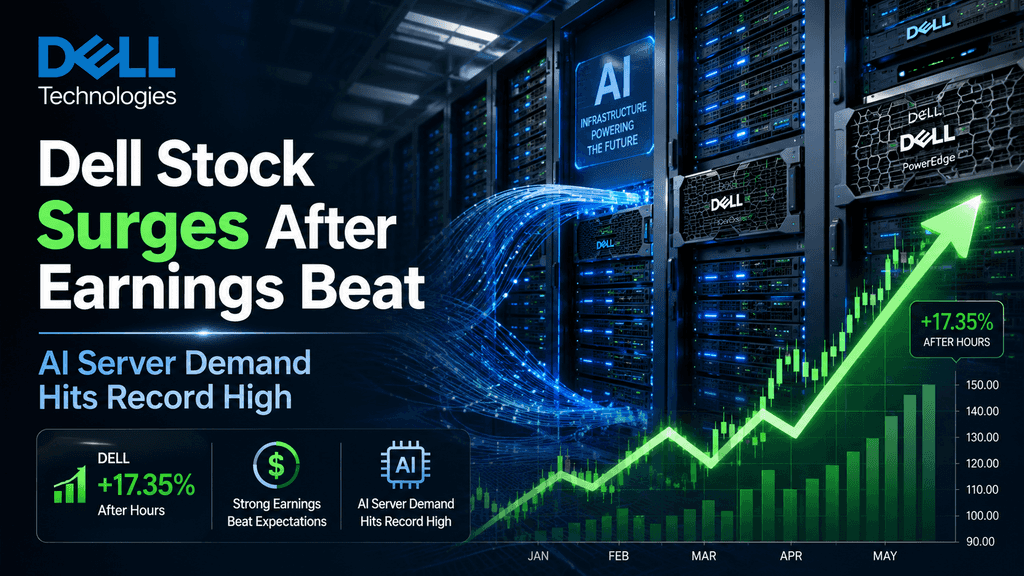
Dell Technologies delivered one of its strongest earnings reports in years as surging artificial intelligence infrastructure demand pushed revenue, profits and AI server orders to record levels. In its fiscal 2027 second quarter, Dell reported $47 billion in revenue, up 58% from a year earlier, while adjusted earnings per share reached $7.04. The bigger surprise, however, came from AI infrastructure: quarterly AI server orders reached a record $60.9 billion, while the company's AI server backlog climbed to approximately $95 billion.
Investors responded quickly. Dell shares jumped after the earnings release as the company also raised its full-year revenue outlook to $192 billion and increased its forecast for fiscal 2027 AI server revenue to $74 billion. The numbers suggest that the market is no longer viewing Dell simply as a PC manufacturer. Increasingly, the company is being valued as a major supplier of the servers, networking, storage and enterprise infrastructure required to support the global AI buildout.
What Did Dell Report?
Dell reported record fiscal second-quarter revenue of $47 billion, representing 58% year-over-year growth. Adjusted earnings per share reached $7.04, while GAAP EPS rose to $6.34. The results were supported by strong demand across the company's infrastructure business, particularly AI-optimized servers.
| Metric | Dell Q2 FY2027 |
| Revenue | $47.0 billion |
| Revenue growth | +58% YoY |
| Adjusted EPS | $7.04 |
| AI server revenue | $16.4 billion |
| AI server orders | $60.9 billion |
| AI server backlog | $95 billion |
| FY2027 revenue outlook | $192 billion |
| FY2027 adjusted EPS outlook | $25.50 |
The combination of record revenue, record earnings and a significant increase in future guidance made this more than a normal earnings beat. Dell showed that demand is not only strong in the current quarter but also extending into future periods through an unusually large order book and backlog.
Why Did Dell Stock Surge After Earnings?
The stock-market reaction reflected three factors occurring at the same time. First, Dell exceeded expectations on both revenue and earnings. Second, AI server orders reached a record level, giving investors evidence that infrastructure demand remains strong. Third, management dramatically raised its full-year guidance, suggesting that the latest quarter was not simply a temporary spike.
The guidance increase may have mattered most. Investors generally value stocks based on expected future earnings rather than past performance alone. When Dell raised its revenue forecast from roughly $167 billion to $192 billion and its adjusted EPS outlook from $17.90 to $25.50, expectations for the company's future earnings power moved sharply higher.
The rally therefore reflected a broader repricing of Dell's growth story. Investors were not simply rewarding the company for a strong quarter; they were reassessing how much Dell could earn if AI infrastructure spending continues at its current pace.
AI Server Orders Hit a Record High
Dell received approximately $60.9 billion of AI server orders during the quarter, the highest level in company history. Over the previous 12 months, total AI server orders exceeded $130 billion. That scale highlights just how rapidly artificial intelligence investment is moving from software development into physical infrastructure.
Orders are especially important because they provide a forward-looking view of customer demand. Revenue represents products that have already been delivered and recognized, while new orders can offer clues about future shipments. Dell's $60.9 billion quarterly figure therefore suggests that customers are continuing to commit capital to AI infrastructure even after several years of aggressive data-center investment.
The customer base is also broadening. AI cloud providers remain major buyers, but enterprises, sovereign AI projects and organizations building private AI infrastructure are increasingly participating in the market. If that trend continues, AI server demand may become less dependent on a relatively small number of hyperscale technology companies.
Why Dell's $95 Billion AI Backlog Matters
Dell ended the quarter with approximately $95 billion in AI server backlog. Backlog generally represents orders that have been booked but have not yet been fully delivered or recognized as revenue. For investors, that creates greater visibility into future demand than quarterly revenue alone.
The figure is significant because it shows that Dell has not yet converted much of its existing AI demand into reported sales. Even after delivering $16.4 billion of AI servers during the quarter, the company still had a massive amount of unfulfilled business waiting to move through its supply chain.
At the same time, backlog is not the same as guaranteed immediate revenue. Dell still needs sufficient GPUs, memory, networking equipment and other components to build and ship the systems. The company's ability to convert the backlog into revenue, operating profit and cash flow will therefore become one of the most important measures of execution over the coming quarters.
Dell Raises Its AI Server Forecast to $74 Billion
Dell had previously expected approximately $60 billion in AI server revenue for fiscal 2027. Following the latest results, management increased that forecast to approximately $74 billion. The $14 billion increase in a single quarter is particularly notable because the revised figure is roughly three times Dell's AI server revenue from the previous fiscal year.
Raising guidance this aggressively signals that management expects AI demand to remain strong beyond the current quarter. A company can sometimes beat estimates because of temporary timing, one unusually large customer or a short-term supply improvement. Raising a full-year forecast requires greater confidence that demand will continue.
That is why the $74 billion target may carry more significance than the quarterly revenue number. It indicates that Dell believes AI infrastructure spending is becoming a sustained business cycle rather than a brief surge in hardware purchases.
Why Nvidia Is Central to Dell's AI Growth
Nvidia is one of the most important suppliers behind Dell's AI server expansion. Modern AI systems require large numbers of accelerators capable of training and running increasingly complex models, and Nvidia remains a dominant supplier of those processors.
Dell packages those chips into complete server systems that also include CPUs, memory, networking components, storage and management software. The relationship can be understood as a chain: AI applications create demand for computing capacity, cloud providers and enterprises purchase GPUs, and Dell integrates those processors into deployable data-center infrastructure.
That means strong Dell AI server orders can also provide an indirect signal about demand across Nvidia's ecosystem. Dell is not competing with Nvidia in the accelerator market. Instead, it is monetizing the broader infrastructure needed to turn high-performance chips into operating AI systems.
The AI Boom Is Spreading Beyond GPUs
The most important long-term implication of Dell's earnings may be that AI spending is becoming broader than semiconductor demand alone. Building an AI data center requires far more than purchasing GPUs. Companies also need networking, storage, power systems, cooling infrastructure, traditional servers and software capable of managing increasingly complex computing environments.
Dell is positioned across several of these categories. Its Infrastructure Solutions Group generated $31.8 billion in quarterly revenue, up 89% from a year earlier. Traditional servers and networking revenue reached approximately $10.5 billion, while storage generated roughly $4.9 billion.
This suggests that AI may be triggering a wider infrastructure-refresh cycle. The first stage of the AI investment boom was largely identified with chip companies. The next stage may increasingly reward businesses that build the networking, storage, power and server systems surrounding those chips.
Dell's Traditional Server Business Is Growing Too
One of the more encouraging parts of Dell's results is that demand is not limited to dedicated AI servers. Traditional servers and networking products also posted strong growth, suggesting that AI adoption is pushing companies to modernize broader parts of their IT infrastructure.
Organizations deploying AI workloads often need to redesign data-center architecture. New GPU clusters can require upgraded networking, additional storage and more traditional servers to support databases, applications and enterprise workloads around the AI environment.
This gives Dell an opportunity to benefit twice from the same investment cycle. It can sell dedicated AI systems while also supplying the traditional infrastructure required to integrate those systems into existing enterprise environments.
Is the PC Business Finally Recovering?
Dell's PC business also showed signs of stronger growth. Sales increased by roughly 20%, one of the fastest growth rates for the segment in several years. That creates a second growth engine alongside data-center infrastructure.
Several factors may be supporting the improvement. Corporate customers continue to replace older devices, while enterprises are also evaluating newer AI-enabled PCs and hardware capable of supporting modern productivity software. A broader commercial refresh cycle can therefore improve demand even if consumer PC growth remains uneven.
This diversification matters because it reduces Dell's dependence on a single investment theme. If AI servers remain strong while PCs recover at the same time, the company's overall earnings structure becomes more resilient than one based exclusively on data-center demand.
Why Dell's $192 Billion Outlook Matters More Than the Beat
Dell's full-year revenue guidance increased from approximately $167 billion to $192 billion, a $25 billion upward revision. Adjusted EPS guidance rose from $17.90 to $25.50. These changes represent a major reset of expectations rather than a small adjustment after a good quarter.
Guidance often matters more to stock prices than reported earnings because financial markets are forward-looking. A strong quarter tells investors what has already happened. Higher guidance changes expectations for future revenue, profits and cash generation.
Dell is effectively telling investors that it expects the current demand environment to continue. If the company reaches its updated targets, fiscal 2027 would represent a dramatic acceleration in scale compared with its historical business profile. That helps explain why investors reacted so strongly to the report.
Can Dell Turn AI Revenue Into Higher Profits?
The next challenge is profitability. AI servers can generate enormous revenue, but they also contain expensive components, particularly high-end GPUs. As a result, rapid AI server sales growth does not automatically produce the same rate of improvement in gross margins.
Dell therefore needs to show that it can monetize the entire infrastructure stack around AI. Storage, networking, services and software can provide additional revenue opportunities beyond the server itself. If customers purchasing GPU systems also buy broader enterprise infrastructure, the economics of AI demand may become more attractive.
There are encouraging signs. Dell's Infrastructure Solutions Group operating income reached approximately $4.8 billion, up sharply from the previous year. If profit growth continues alongside AI revenue growth, investors may become more confident that the current cycle is creating lasting earnings power rather than simply producing high-volume hardware sales.
What Are the Biggest Risks for Dell?
Supply remains one of the clearest risks. AI systems depend on GPUs, high-bandwidth memory, CPUs, networking components and other specialized hardware. Even strong demand cannot become revenue if Dell cannot secure the components needed to complete customer orders. A $95 billion backlog is therefore both a sign of strength and a major execution challenge.
A second risk is the sustainability of AI capital spending. Many of Dell's customers are investing enormous sums in computing infrastructure. If hyperscalers, AI cloud providers or large enterprises eventually reduce capital expenditures, order growth could slow rapidly. The current backlog provides some visibility, but it cannot guarantee that the same pace of new orders will continue indefinitely.
Valuation is another consideration. After the stock's large advance, expectations are significantly higher than they were before the AI server boom. The question is gradually changing from whether Dell can grow to whether it can grow fast enough, profitably enough and for long enough to justify those elevated expectations.
What Dell Earnings Mean for AI Stocks
Dell's results matter beyond Dell itself because they provide another data point on the health of the broader AI infrastructure cycle. Companies supplying GPUs, networking hardware, storage, cooling systems, power equipment and data-center services all depend to varying degrees on continued capital spending.
Strong Dell orders therefore offer a positive read-through for parts of the AI ecosystem. If cloud providers and enterprises continue purchasing large numbers of servers, demand for Nvidia accelerators, networking equipment and data-center capacity can remain elevated as well.
Still, investors should avoid assuming that every AI-related stock benefits equally. Companies have different margins, competitive positions, valuations and customer exposures. Dell's earnings indicate that infrastructure demand is strong; they do not automatically determine whether every company connected to the AI theme is attractively valued.
Is the AI Infrastructure Boom Still Growing?
Dell's latest results provide strong evidence that AI infrastructure spending has not yet entered a clear downturn. Quarterly AI server orders of $60.9 billion, a $95 billion backlog and a $74 billion annual AI server revenue forecast all point toward continued investment.
More importantly, the growth is expanding beyond dedicated GPU systems. Traditional servers, networking, storage and other infrastructure categories are benefiting as organizations redesign their data centers around artificial intelligence. That broadening may make the AI investment cycle more durable than one driven only by semiconductor purchases.
The key question will be whether these trends continue. If new orders remain strong, backlog converts successfully into revenue and margins improve, Dell's results may eventually be viewed as evidence that the AI infrastructure cycle entered another expansion phase. If orders begin slowing sharply or customers reduce capital spending, the current quarter could instead mark a peak. For now, the data remains firmly on the growth side of that debate.
What Should Investors Watch Next?
Dell's stock price will continue attracting attention, but the most useful indicators are deeper inside the business. Investors can track whether orders, backlog, revenue and profits continue moving in the same direction.
| Indicator | What to Watch | Why It Matters |
| AI server orders | New quarterly bookings | Shows whether demand continues accelerating |
| AI backlog | Growth or decline | Indicates future revenue visibility |
| AI server revenue | Progress toward $74B | Tests management's guidance |
| ISG margins | Operating-profit growth | Shows quality of AI revenue |
| GPU availability | Supply from chip partners | Affects delivery capacity |
| PC revenue | Continued recovery | Provides a second growth engine |
| Cash flow | Earnings conversion | Measures financial execution |
| AI CapEx | Spending by cloud and enterprise customers | Signals industry-cycle strength |
The most important chain is straightforward: orders need to become backlog, backlog needs to become revenue, revenue needs to become profit, and profit ultimately needs to translate into cash flow. If that sequence remains healthy, Dell's AI growth story will become much stronger than a single record quarter.
Conclusion: Dell Is Becoming an AI Infrastructure Story
Dell's latest earnings report shows why the company's investment narrative is changing. Record revenue and earnings were impressive, but the more important signals came from $60.9 billion in quarterly AI server orders, a $95 billion backlog, a $74 billion AI server forecast and a dramatic increase in full-year revenue guidance.
Those numbers suggest that the AI infrastructure boom is still creating substantial demand across servers, networking, storage and broader enterprise technology. At the same time, Dell must prove that it can convert record demand into durable margins, cash flow and profitable growth.
Dell was once viewed primarily as a PC company. Its latest results show why investors are increasingly evaluating it as one of the major infrastructure suppliers behind the global AI buildout.
FAQs
What does Dell's fiscal year 2027 mean?
Dell's fiscal year does not exactly match the calendar year. Fiscal 2027 refers to the company's accounting year that extends into calendar 2027, so its second-quarter results were reported during 2026.
What are Dell's main business segments?
Dell primarily reports through the Infrastructure Solutions Group, which includes servers, networking and storage, and the Client Solutions Group, which includes commercial and consumer PCs and related products.
Does Dell manufacture its own AI GPUs?
Dell does not primarily design the high-end GPUs used in its AI servers. It builds complete computing systems using accelerators supplied by chip companies such as Nvidia, together with other server components and infrastructure.
Who competes with Dell in AI servers?
Dell competes with companies including Hewlett Packard Enterprise, Super Micro Computer and other enterprise server and infrastructure providers. Competitive positions can vary depending on customers, system design and data-center requirements.
What is the difference between an AI server and a traditional server?
AI servers typically include high-performance accelerators such as GPUs, larger memory capacity and high-speed networking designed for artificial intelligence workloads. Traditional servers are generally optimized for broader enterprise computing, databases and applications.
Does Dell pay a dividend?
Dell has returned capital to shareholders through dividends and share repurchases. Dividend levels and capital-return policies can change over time, so investors should check the company's latest investor-relations information for current details.
🔥 KuCoin Offers A More Stable Option in A Volatile Market
If you worry about the frequent ups and downs in the market, and pursue a more stable option to earn money passively, KuCoin is the right place to come:

Simple Earn: Deposit and withdraw tokens anytime, earning stable returns.
Kucoin Earn: Earn stable profits with professional asset management.
Hold to Earn: Earn rewards by holding assets in Funding, Trading, Margin, Futures, Mining, and Unified Accounts.
Staking: Unlock the earning potential of on-chain assets.
Advanced Investments: Advanced Investments offer a variety of structured products to help your money grow in any market.
Shark Fin: Principal Protection and Guaranteed Gains
Dual Investment: Buy low and sell high with transparent return calculations.
Snowball: High yields, with price protection.
Discount Buy: Buy crypto at discount prices.
KCS Loyalty: Level up to enjoy exclusive perks by staking ≥ 1 KCS.
KuCoin Wealth: Discover future value and begin your smart investing journey.
KCS Benefits: Hold and stake KCS to access benefits across the platform.
KCS Staking 2.0: Participate in KCS on-chain governance to earn yield.
Disclaimer: This content is for informational purposes only and does not constitute investment advice. Cryptocurrency investments carry risk. Please do your own research (DYOR).