

CoreWeave (CRWV) Stock May Be Undervalued: What Does the November 2026 Sell-Off Reveal About Its Valuation?
Introduction
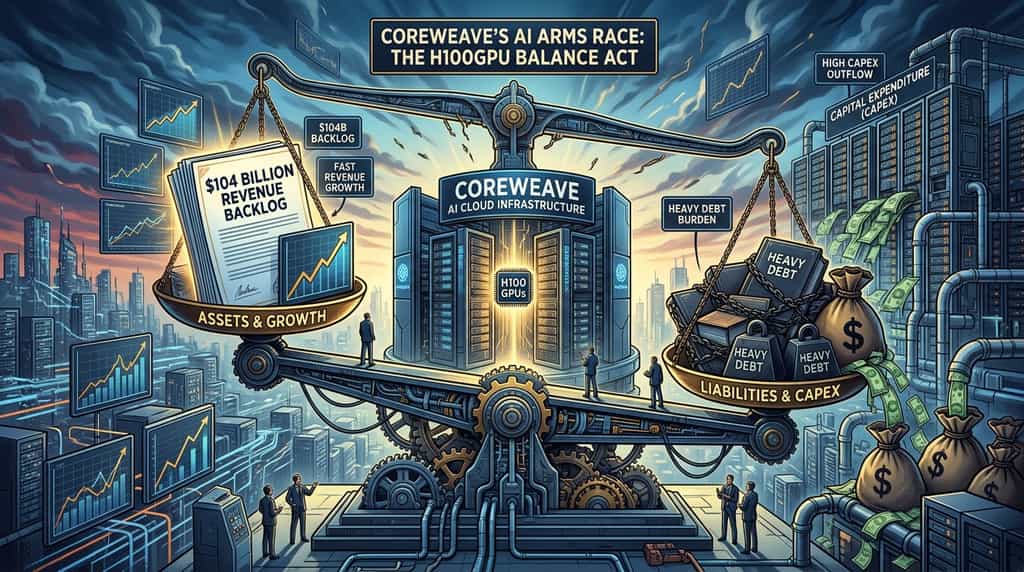
CoreWeave's recent share-price decline has raised a key question for investors: has the market correction made CRWV stock undervalued, or does the lower share price reflect growing concerns about the company's debt, capital expenditure, and long-term profitability? CoreWeave operates in the fast-growing AI cloud infrastructure market, where demand for computing capacity has supported rapid revenue growth and a substantial customer backlog. However, building and operating large-scale data centers requires significant upfront investment, and strong revenue growth does not automatically translate into positive free cash flow.
Assessing CoreWeave's valuation therefore requires looking beyond its recent stock performance and examining its revenue growth, backlog, balance sheet, financing costs, and ability to generate sustainable returns from its expanding infrastructure.
Key Takeways: Is CoreWeave Stock Undervalued in November 2026?
A lower share price alone does not establish that CoreWeave stock is undervalued. The company has demonstrated strong demand for its AI cloud services, but its capital-intensive expansion and financing requirements create substantial risks.
Key points to consider:
-
Revenue growth: CoreWeave reported second-quarter 2026 revenue of $2.575 billion, up 112% year over year.
-
Customer backlog: Its reported revenue backlog was approximately $104 billion as of June 30, 2026, excluding more than $25 billion in net new customer commitments added in early Q3.
-
Profitability: The company recorded a GAAP net loss of $626 million in Q2 2026.
-
Capital expenditure: Capital spending remained substantial as CoreWeave expanded its data center capacity.
-
Valuation question: The central issue is whether future revenue and cash flow can justify the debt and investment required to deliver contracted computing capacity.
Why Has CoreWeave Stock Sold Off in November 2026?
CoreWeave shares experienced a sharp correction in early November. The stock closed at approximately $43.66 on November 5, compared with $60.74 on October 29, representing a decline of roughly 28% over that period. It also recorded two consecutive daily declines of around 10% on November 4 and November 5. These figures illustrate the scale of the recent pullback, but they do not independently explain its causes.
The market's concerns can be grouped into three areas.
First, investors are reassessing the economics of AI infrastructure expansion. Demand for GPUs and cloud computing capacity remains an important growth driver, but data centers require substantial investment in equipment, power, cooling systems, buildings, and network infrastructure. Investors may question how quickly this spending can generate sufficient returns.
Second, CoreWeave relies heavily on external financing to support its expansion. Borrowing costs and debt obligations can become more significant when a company needs to fund infrastructure before all of that capacity begins generating revenue.
Third, the broader AI infrastructure sector faces execution constraints. Data center construction, power availability, equipment delivery, and customer deployment schedules can all affect how quickly announced capacity becomes operational.
These factors do not necessarily indicate that CoreWeave's customer demand has weakened. Rather, they highlight the difference between demand for AI computing and the financial returns a provider can ultimately earn from supplying it.
Does CoreWeave's Revenue Growth Support Its Valuation?
CoreWeave's financial results show that demand for its services has translated into substantial revenue growth. In the second quarter of 2026, the company generated $2.575 billion in revenue, compared with $1.212 billion in the same quarter of 2025. Revenue for the first six months of 2026 reached $4.653 billion, also approximately 112% higher than the corresponding period in 2025.
This growth reflects increased demand from existing and new customers, alongside the expansion of CoreWeave's data center footprint. The company reported that approximately 93% of its revenue increase during the first half of 2026 came from expansion within its existing customer base.
For an AI cloud infrastructure provider, this is an important indicator. Existing customers increasing their use of computing capacity can provide evidence of ongoing demand and potentially support longer-term commercial relationships.
However, revenue growth must be evaluated alongside operating costs and financing expenses. CoreWeave reported a second-quarter operating loss of $49 million and a net loss of $626 million. Net interest expense was $640 million, illustrating the financial burden associated with its capital-intensive business model.
The company also reported adjusted EBITDA of $1.51 billion, with an adjusted EBITDA margin of 59%. This non-GAAP measure offers another perspective on operating performance, but it should not be treated as equivalent to GAAP net income or free cash flow. It excludes certain expenses and does not eliminate the need to fund infrastructure investment and debt obligations.
The distinction is important: CoreWeave is growing rapidly, but investors still need to determine whether that growth can eventually produce durable earnings and cash generation.
For a broader look at the industry conditions supporting this business model, KuCoin Blog's analysis of AI infrastructure demand and supply constraints provides additional context on the physical resources required to expand AI computing capacity.
Can CoreWeave's Debt and Capital Expenditure Become a Valuation Risk?
Debt and capital expenditure are central to the CoreWeave investment case. Its business requires significant upfront investment, while revenue is generated as infrastructure is deployed and services are delivered. This creates a financing challenge: the company may need to secure capital well before all new capacity contributes to revenue.
CoreWeave's second-quarter 2026 Form 10-Q provides several important balance-sheet and cash-flow figures.
| Financial metric | Reported figure | Period |
| Total debt | Approximately $35.6 billion | June 30, 2026 |
| Cash and cash equivalents | Approximately $5.5 billion | June 30, 2026 |
| Total reported liquidity | Approximately $15.6 billion | June 30, 2026 |
| Capital expenditure | Approximately $9.4 billion | Q2 2026 |
| Net cash used in investing activities | Approximately $14.9 billion | First half of 2026 |
| Net cash provided by financing activities | Approximately $14.0 billion | First half of 2026 |
One distinction deserves particular attention: the reported $15.6 billion in total liquidity includes approximately $10 billion of availability under existing credit facilities. It should not be interpreted as cash held in the company's bank accounts. Actual cash and cash equivalents were approximately $5.5 billion.
The company's debt position also makes interest expenses an important valuation consideration. In Q2 2026, net interest expense reached $640 million, exceeding the reported operating loss. If borrowing costs remain high or additional financing is required, interest payments could continue to weigh on earnings.
Capital expenditure creates another challenge. Spending on data centers and computing equipment may support future revenue, but it also increases the amount of capital that must be recovered through operating cash flow. If infrastructure deployment is delayed, utilization is lower than expected, or customer demand changes, the time required to recover those investments could increase.
CoreWeave's expansion is therefore both a growth driver and a source of financial risk. Investors need to assess not only how much infrastructure the company can build, but also how efficiently that infrastructure can generate revenue and cash flow.
The company's Q2 2026 earnings release and Q2 2026 Form 10-Q filing provide the underlying financial disclosures for these figures.
How Should Investors Assess Whether CRWV Is Undervalued?
A meaningful valuation assessment should compare CoreWeave's market value with its growth prospects, capital requirements, and ability to generate cash. Several metrics can help provide a more complete picture.
-
Enterprise Value-to-Revenue
The enterprise value-to-revenue ratio compares a company's enterprise value with its revenue. It can be useful for assessing fast-growing companies that are not yet consistently profitable.
For CoreWeave, investors should compare its valuation with other cloud infrastructure and technology companies while accounting for differences in growth rates, margins, leverage, and business models.
A lower ratio than that of comparable companies does not automatically indicate undervaluation. It may also reflect higher financing risk or lower expected profitability.
-
Revenue Backlog Relative to Enterprise Value
CoreWeave's large backlog provides a measure of future contracted demand. Comparing enterprise value with backlog may help investors understand how much the market is paying relative to disclosed future commitments.
However, this comparison has limitations. Backlog is not the same as recognized revenue, and it does not account for the full cost of delivering services. A backlog-based valuation should therefore be considered alongside expected margins, delivery schedules, and capital requirements.
-
Free Cash Flow and Capital Efficiency
Free cash flow is particularly important for a company that needs substantial infrastructure investment. Investors can monitor whether operating cash flow is growing fast enough to support capital expenditure and reduce dependence on external financing.
A useful question is whether each additional dollar invested in infrastructure produces sufficient incremental revenue and operating cash flow. Improving capital efficiency could strengthen the company's long-term financial position, while persistently high investment requirements could limit the value of its revenue growth.
-
Debt and Interest Coverage
Investors should monitor total debt, interest expense, debt maturities, and the company's ability to meet financing obligations. Revenue growth is less valuable to shareholders if an increasing proportion of operating earnings is absorbed by financing costs.
Because CoreWeave is still reporting GAAP net losses, traditional price-to-earnings analysis is also less informative than it would be for a mature, consistently profitable company.
Conclusion
CoreWeave's November 2026 share-price decline has made its valuation an important subject for investors, but a lower market price does not necessarily mean that the stock is undervalued. The company has demonstrated substantial revenue growth and a large backlog, reflecting demand for specialized AI cloud infrastructure. These are meaningful strengths in a market where computing capacity remains strategically important.
At the same time, CoreWeave's financial profile includes significant debt, high capital expenditure, substantial interest expenses, and continuing GAAP net losses. These factors make cash-flow generation and capital efficiency just as important as revenue growth.
The key valuation question is whether CoreWeave can convert its contracted demand into sustainable operating profits and free cash flow at a level that justifies its infrastructure investment and financing costs. Future quarterly results, backlog conversion, debt management, and capital expenditure trends will provide more useful evidence than the recent share-price decline by itself.
For that reason, the November sell-off should be viewed as a reason to reassess the company's risk-and-growth profile, not as standalone proof that CRWV shares are trading below their intrinsic value.
FAQs
-
What Does CoreWeave Do?
CoreWeave is a cloud infrastructure provider specializing in computing resources for AI workloads. Its services include access to GPU-based computing capacity and supporting infrastructure used for AI model training, inference, and other high-performance computing tasks.
-
Why Has CoreWeave Stock Fallen in November 2026?
The decline has coincided with increased scrutiny of AI infrastructure valuations, capital expenditure, debt, financing costs, and the execution risks associated with expanding data center capacity. These factors may influence investor expectations even when demand for AI computing remains strong.
-
Is CoreWeave Profitable?
CoreWeave reported a GAAP net loss of $626 million in Q2 2026. It also reported adjusted EBITDA of $1.51 billion, but this non-GAAP measure is not equivalent to net income or free cash flow.
-
How Large Is CoreWeave's Revenue Backlog?
CoreWeave reported approximately $104 billion in revenue backlog as of June 30, 2026. The figure excluded more than $25 billion in net new customer commitments added in early Q3. Backlog is subject to contract terms, service delivery, and capacity availability.
-
What Should Investors Watch in CoreWeave's Next Earnings Report?
Investors may focus on revenue growth, backlog conversion, operating margins, capital expenditure, operating cash flow, debt levels, and interest expenses. These indicators can help show whether the company's expanding business is translating into stronger financial performance.
Disclaimer
This general market information, possibly from third-party, commercial, or sponsored sources, is provided for reference and educational purposes only and does not constitute financial or investment advice, an offer, solicitation, or guarantee. We disclaim liability for its accuracy, completeness, reliability, and any resulting losses. Investments/trading are risky; past performance doesn’t guarantee future results. Users should research, judge prudently, and take full responsibility. For further details, please consult KuCoin’s Terms of Use and Risk Disclosure.