

BNY and Ripple Expand Strategic Collaboration for Institutional Digital Asset Custody and Tokenized Trade Finance
Introduction
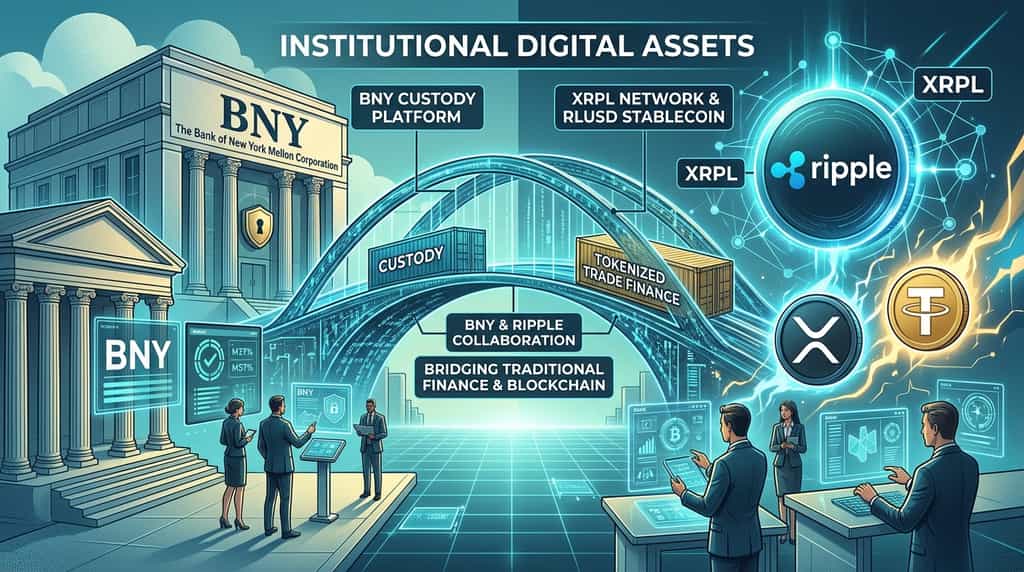
Institutional digital asset adoption reached a monumental milestone as traditional banking giants and public blockchain networks forge deeper integration frameworks. According to official corporate announcements published in October 2026, BNY (The Bank of New York Mellon Corporation) and Ripple expanded their strategic collaboration to broaden institutional digital asset custody capabilities and explore tokenized trade finance on the XRP Ledger. How does this partnership bridge traditional financial infrastructure with blockchain technology, and what does it mean for institutional investors seeking safe, regulated engagement with digital assets?
What Core Digital Asset Capabilities Are Included in the Expanded BNY and Ripple Collaboration?
The expanded collaboration integrates native public blockchain assets into institutional-grade custody by adding support for XRP and Ripple's stablecoin, RLUSD, onto BNY's Digital Asset Custody platform. According to official Bny announcements from October 2026, this infrastructure is designed to provide institutional clients with secure digital asset custody within the governance, controls, and resiliency of BNY's established servicing model, giving eligible institutions a seamless way to safekeep, hold, and transfer digital assets.
Building upon BNY's existing role as primary reserve custodian for RLUSD and its custody relationship with Ripple Prime, the expanded alliance aims to make tokenized assets fully usable for payments and collateral across global financial markets. By connecting traditional banking infrastructure with always-on blockchain technology, institutions can transition from simply holding digital assets to actively deploying them within capital markets workflows. According to corporate statements by Ripple leadership, the focus centers on making onchain assets functional for liquidity management and cross-border settlement.
How Will Tokenized Trade Finance Transform Supply Chain Capital Markets?
Tokenized trade finance uses blockchain technology to digitally represent existing trade finance assets, such as receivables, with the potential to broaden investor access and simplify how those assets are managed and distributed. According to official press releases from October 2026, Ripple and BNY are actively exploring a supply chain finance initiative as a first step toward this ambition, working alongside C2FO, a global platform for working capital.
This initiative aims to explore how a new model for financing approved receivables can broaden institutional access to capital while preserving established business relationships. According to C2FO leadership insights, connecting the financial infrastructure behind working capital marketplaces with public blockchain networks like the XRP Ledger can dramatically enhance efficiency. By leveraging smart contracts and tokenization, market participants can streamline liquidity distribution, reduce friction in document processing, and accelerate settlement times for businesses worldwide.
What Role Do the XRP Ledger and RLUSD Play in Institutional Workflows?
The XRP Ledger (XRPL) and Ripple's U.S. dollar-backed stablecoin, RLUSD, provide the technical foundation required for high-speed, scalable institutional transactions. According to public network metrics from CoinMarketCap and official company data, the XRPL has processed more than 4.6 billion transactions since launch, with transactions consistently settling in approximately three to five seconds. Meanwhile, RLUSD has grown to approximately $2.5 billion in market capitalization, supporting diverse use cases across payments, trading, and tokenized finance.
Institutional deployment requires robust performance, predictable transaction finality, and regulatory alignment. The XRPL's native capabilities for issuing, transferring, and exchanging digital assets make it an ideal ledger for enterprise applications. BNY intends to broaden its support for tokenized assets and investment products issued on the XRPL as institutional use cases develop, working alongside Ripple to enable clients to mint and redeem RLUSD directly through BNY, subject to final regulatory approvals.
How Do Traditional Custody Frameworks Integrate with Public Blockchains?
Integrating public blockchains into traditional custody frameworks requires sophisticated engineering that bridges legacy banking ledgers with decentralized distributed ledgers. According to BNY technological disclosures, future market infrastructure must deliver seamless connectivity across payments, liquidity, collateral, and securities through architected bridges.
Institutional custodians must enforce stringent compliance, cryptographic key management, and multi-signature security protocols without sacrificing the speed of public blockchains. BNY's Digital Asset Custody platform bridges this gap by enveloping digital asset holdings in enterprise-grade operational controls. This ensures that institutional investors adhere to regulatory requirements while benefiting from the transparency and efficiency of tokenized asset ecosystems.
What Are the Implications of Institutional Stablecoin Adoption for Global Markets?
Stablecoins have evolved from crypto-native trading instruments into critical pillars for institutional settlement, cross-border payments, and liquidity optimization. According to industry analyses and corporate financial data, regulated stablecoins like RLUSD bridge fiat currency systems and blockchain rails, eliminating settlement lag and counterparty credit risks.
By enabling direct minting, redemption, and custody through trusted global financial institutions like BNY, market participants gain confidence in stablecoin reserves and operational integrity. This institutionalization of stablecoin infrastructure paves the way for 24/7 capital markets, instantaneous repo transactions, and highly efficient programmatic collateral management.
The convergence of traditional institutional banking and enterprise blockchain solutions signals a mature phase for digital assets. As custodians like BNY expand support for core network assets and tokenized trade finance initiatives take shape with platforms like C2FO, financial markets are moving closer to a continuous, efficient, and resilient global operating model. For institutional investors and financial enterprises, understanding these evolving infrastructure bridges is essential for navigating the next generation of capital markets.
Frequently Asked Questions
What is the primary purpose of the expanded collaboration between BNY and Ripple?
The collaboration expands institutional digital asset custody to include XRP and RLUSD, while exploring new use cases for blockchain technology, including tokenized trade finance and streamlined collateral workflows.
What is RLUSD, and what is its current market scale?
RLUSD is Ripple's purpose-built U.S. dollar-backed stablecoin designed for institutional use. According to official corporate and market data, it has grown to approximately $2.5 billion in market capitalization.
How does tokenized trade finance improve supply chain funding?
Tokenized trade finance digitally represents trade assets like receivables on a blockchain, which broadens investor access, simplifies asset management, and increases liquidity efficiency for working capital platforms like C2FO.
What technical advantages does the XRP Ledger offer to financial institutions?
The XRP Ledger offers high throughput, having processed over 4.6 billion transactions, with fast settlement times averaging three to five seconds and native capabilities for issuing and exchanging digital assets.
Are the planned product features immediately available to all clients?
No. Certain future product plans—such as direct minting and redemption of RLUSD through BNY—remain subject to final corporate and regulatory approvals.
Disclaimer
This general market information, possibly from third-party, commercial, or sponsored sources, is provided for reference and educational purposes only and does not constitute financial or investment advice, an offer, solicitation, or guarantee. We disclaim liability for its accuracy, completeness, reliability, and any resulting losses. Investments/trading are risky; past performance doesn’t guarantee future results. Users should research, judge prudently, and take full responsibility. For further details, please consult KuCoin’s Terms of Use and Risk Disclosure.