

AI Demand Is Still Supply-Constrained: Why the Infrastructure Boom May Outlast the Stock Pullback
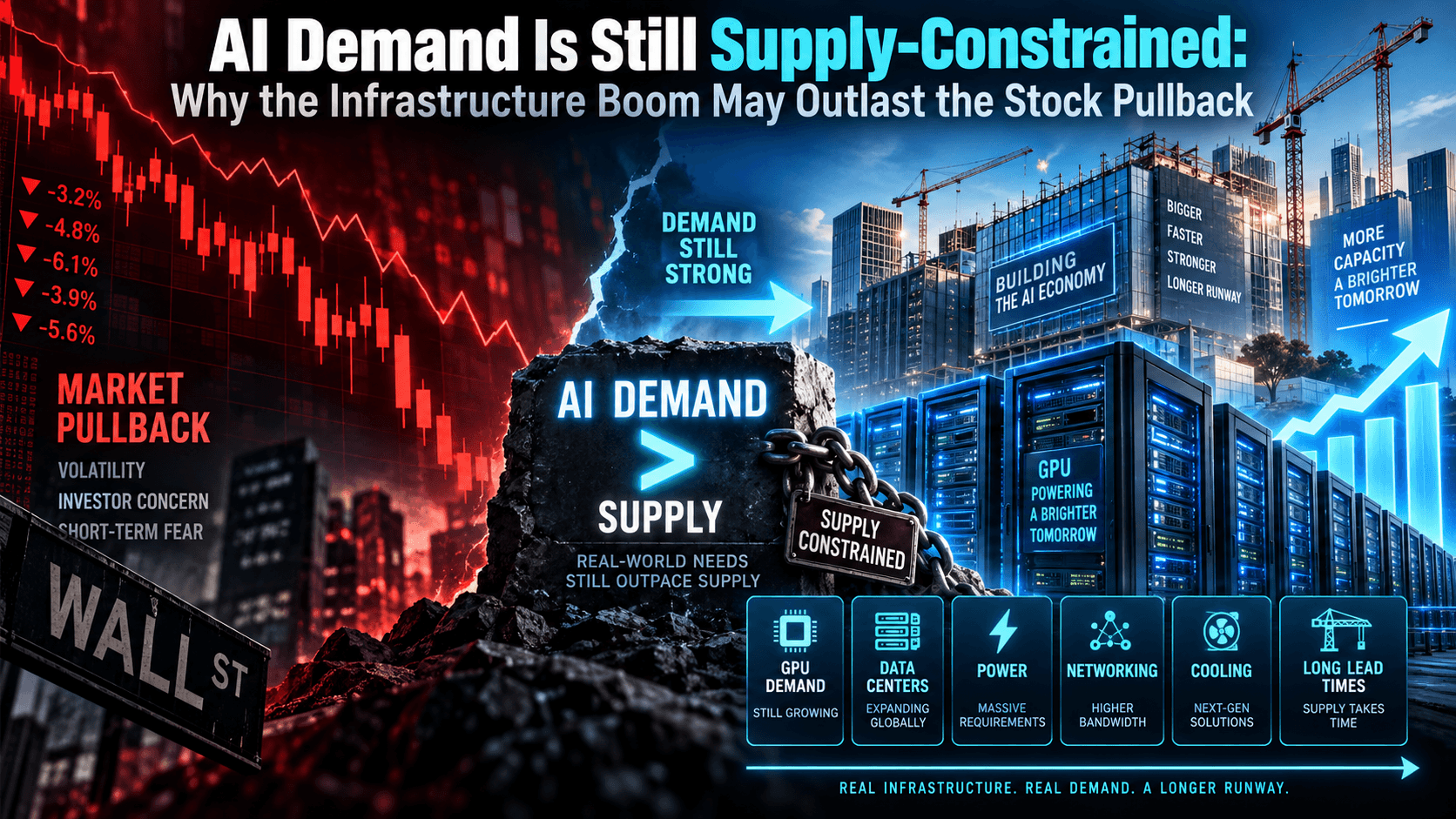
Power, Chips, and Packaging Set the Pace for AI Expansion
The artificial intelligence infrastructure cycle remains defined by persistent mismatches between quickly expanding demand and inelastic physical supply. In 2026, leading technology companies have committed hundreds of billions of dollars to data centers, accelerators, and supporting systems, yet production of advanced semiconductors, high-bandwidth memory, and grid connections continues to lag. Equity markets have experienced intermittent corrections as investors reassess near-term returns and capital intensity. These share-price movements, however, have not altered the underlying imbalance.
Contracted demand already stretches years ahead, while capacity expansions in foundries, memory fabrication, and power infrastructure require multi-year lead times. The result is a structural environment in which physical buildout activity is likely to remain elevated even as sentiment around listed AI-related stocks fluctuates. Because AI demand is still constrained by chip production, high-bandwidth memory availability, advanced packaging throughput, and power-grid interconnection timelines, the multi-year capital expenditure cycle for physical infrastructure is positioned to continue well beyond the equity-market pullbacks observed in 2026.
Hyperscaler Capital Spending Reaches Unprecedented Scale While Compute Delivery Lags
Leading cloud and technology operators have projected combined capital expenditures approaching or exceeding $700 billion for 2026, with the majority directed toward AI-related data centers, accelerators, and networking. Microsoft, Alphabet, Amazon, Meta, and Oracle account for the bulk of this outlay, representing a sharp increase from prior years and reflecting multi-year commitments already signed with chip suppliers and facility developers. These figures appear in recent company disclosures and analyst compilations, including reports noting hyperscaler plans near $700 billion and higher estimates reaching $750–$770 billion when broader AI infrastructure is included. Despite the scale of spending, executives across the sector continue to report that available compute remains insufficient to meet internal roadmaps and customer demand. OpenAI’s leadership has publicly noted that the primary bottleneck has shifted back to chips after earlier power constraints, illustrating the dynamic nature of the shortages. The capital is being deployed into long-lead-time assets whose delivery schedules are gated by wafer starts, memory allocation, and grid interconnection rather than by the availability of funding itself.
This mismatch means that announced spending does not translate into immediate capacity; instead, it builds a pipeline of projects whose completion will stretch across 2026–2028 and beyond. The volume of contracted future revenue reported by suppliers further confirms that demand is booked rather than merely forecasted, locking in the need for continued physical expansion even if equity valuations compress. The scale of these commitments also reshapes supplier behavior and capacity planning. Foundries and memory manufacturers have raised their own capital budgets in response, yet the lead times for new fabrication lines, advanced packaging tools, and power equipment mean that incremental supply arrives gradually.
Analysts tracking the sector note that semiconductor shipment forecasts already imply gigawatts of additional AI power demand that exceed feasible near-term data-center delivery. As a result, the infrastructure boom is characterized less by speculative overbuilding and more by a race to close an existing deficit. Companies that secure early allocation of constrained components gain multi-year advantages, while those relying on spot availability face extended delays. This dynamic supports sustained investment in the physical layer, data centers, substations, cooling systems, and interconnection hardware, regardless of shorter-term fluctuations in public-market pricing of the equities that benefit from the cycle.
High-Bandwidth Memory Shortages Form the Most Acute Near-Term Constraint
High-bandwidth memory has emerged as the binding constraint on AI accelerator shipments in 2026. HBM requires substantially more wafer capacity per gigabyte than standard DRAM, and the three major suppliers have reported that 2026 production is essentially sold out. SK Hynix, Micron, and Samsung have all indicated full allocation, with some executives stating that meaningful relief is unlikely before 2027 or 2028. Contract prices for DRAM have risen sharply; reports document increases of 93–98 percent in the first quarter of 2026 and further gains in the second quarter, while volumes have grown only in the low single digits. This pricing environment has lifted gross margins for memory producers to elevated levels, in one case reaching 85 percent, even as bit growth remains constrained.
Because every high-performance GPU or custom accelerator depends on stacked HBM, shortages at this layer directly limit the number of systems that can be shipped and installed. Lead times for memory allocation now extend well into future quarters, forcing hyperscalers and neocloud operators to plan capacity around confirmed supply rather than desired configurations. The scarcity of HBM also cascades into related markets. Ordinary DRAM is pulled into the same constrained wafer base, tightening supply for non-AI applications and raising costs across the broader electronics sector. Industry observers note that memory now accounts for a significantly larger share of AI system cost than in earlier years, shifting the economics of data center builds.
Companies unable to secure multi-year HBM contracts face higher spot prices or delayed deployments. New fabrication capacity for advanced memory requires years of construction and qualification; announcements of multi-hundred-billion-dollar investment plans by major producers will not yield meaningful additional output until later in the decade. Consequently, the memory bottleneck is expected to persist through at least 2027, supporting elevated pricing power for suppliers and continued urgency among buyers to lock in long-term agreements. This structural tightness reinforces the multi-year character of the infrastructure cycle: capital continues to flow into both memory capacity expansion and the data center facilities that will eventually house the accelerators once memory becomes available.
TSMC Production Limits Continue to Restrict Advanced Logic Output
Taiwan Semiconductor Manufacturing Company remains the primary source of leading-edge logic for AI accelerators, and its capacity continues to fall short of demand. Company leadership has stated publicly that wafer supply will not meet AI-driven requirements for years, even as new capacity comes online. Customers, including NVIDIA, Broadcom, and others, have reported being unable to secure the full volumes requested for 2026 production. Utilization rates on advanced nodes remain near 100 percent, with multi-year bookings already in place. Equipment procurement by TSMC has nearly doubled relative to earlier projections, yet skilled construction labor and tool delivery timelines constrain how quickly additional clean-room capacity can be brought into production.
These limits apply across both process technology and the specialized packaging steps required to integrate logic dies with HBM. The concentration of advanced manufacturing at a single foundry amplifies the constraint. Alternative sources of leading-edge capacity remain limited in both volume and process maturity. As a result, allocation decisions by TSMC effectively determine which AI systems can be produced in any given quarter. Hyperscalers that secured early long-term agreements retain preferential access, while later entrants or smaller operators face longer waits.
Expansion plans in the United States and elsewhere will add capacity over time, but the multi-year construction and yield-ramp cycles mean that near-term relief is modest. The persistence of this bottleneck supports continued capital expenditure on both the foundry side and the downstream data-center infrastructure that depends on finished chips. Even if equity markets reprice growth expectations, the physical shortage of wafers keeps the buildout of supporting facilities on an extended timeline.
Power Interconnection and Transformer Lead Times Extend Facility Timelines
Grid interconnection has become a primary determinant of when new AI data center capacity can be energized. Median times from interconnection request to commercial operation now stretch to approximately five years in major U.S. markets. Utility auctions have cleared at ceiling prices and still fallen short of required megawatts in some regions. Large power transformers face lead times measured in years rather than months, with specialty electrical steel and skilled manufacturing capacity limiting output. These constraints mean that announced data-center projects frequently encounter multi-year delays before power can flow, independent of chip availability. Reports tracking U.S. facilities show substantial announced capacity still awaiting grid connections or transformer delivery, creating a visible gap between planned and operational gigawatts.
The practical effect is that power infrastructure investment must run in parallel with, and often ahead of, semiconductor procurement. Hyperscalers are increasingly pursuing on-site generation, long-term power-purchase agreements, and co-location with existing high-capacity industrial sites to mitigate grid delays. Even these alternatives face their own equipment bottlenecks. The result is a layered set of constraints in which the slowest element, grid interconnection or transformer supply, sets the overall pace of capacity addition. Because these timelines are measured in years, the capital cycle for substations, transmission upgrades, and related equipment is expected to remain active well beyond any near-term correction in AI-related equities. Demand for power infrastructure therefore constitutes an independent and durable component of the broader AI buildout.
Gas Turbine and On-Site Generation Backlogs Reinforce Multi-Year Energy Constraints
Heavy-duty gas turbines have emerged as a critical workaround for grid limitations, yet order books already extend years into the future. One major manufacturer has reported backlog and slot reservations exceeding 100 gigawatts against annual production targets of roughly 20–30 gigawatts in the coming years. Delivery lead times for new turbines now approach three years, and 2030 production slots are largely reserved. Pricing for new equipment has risen accordingly. Data center developers and hyperscalers are locking in these machines to enable on-site generation that can bridge the gap until permanent grid connections are available. The concentration of demand on a limited set of turbine suppliers creates a secondary bottleneck that will take multiple years to resolve through capacity expansion.
This dynamic extends the infrastructure investment cycle into the energy-equipment sector. Manufacturers of turbines, generators, switchgear, and related components are expanding production, but the capital intensity and specialized nature of the equipment mean that supply response is gradual. The same multi-year horizon that characterizes chip and memory capacity also applies to power generation hardware. As long as AI facilities require reliable, high-density power that the existing grid cannot deliver on short notice, capital will continue to flow into these supporting systems. Equity-market fluctuations in semiconductor or pure-play data center stocks do not alter the physical lead times governing turbine delivery and installation.
Advanced Packaging Throughput Limits System Assembly Despite Capacity Growth
Chip-on-wafer-on-substrate and related advanced packaging processes remain capacity-constrained even after significant expansion. TSMC and outsourced assembly providers have increased monthly CoWoS-equivalent output, yet industry estimates still show a shortfall relative to projected demand into 2027. Lead times for packaging services have stretched, and major customers have pre-booked large portions of available capacity. Because packaging is the final step that integrates logic dies with HBM stacks, shortages at this stage directly reduce the number of completed accelerators that can ship. Tooling for advanced packaging is specialized and capital-intensive; adding capacity requires both equipment lead times and process qualification that cannot be compressed arbitrarily.
The packaging constraint interacts with the memory and logic bottlenecks already described. Even when wafers and HBM are allocated, finished modules cannot leave the factory until packaging slots open. This sequential dependency means that improvements in any single layer produce only partial relief until the entire chain advances. Continued investment in packaging capacity is therefore required simply to keep pace with already-contracted demand. The multi-year nature of tool installation and yield ramp-up ensures that packaging infrastructure spending remains part of the broader buildout cycle, independent of shorter-term equity volatility.
Equity Corrections in 2026 Reflect Positioning and Sentiment More Than Supply Fundamentals
AI-related equities experienced notable pullbacks during mid-2026 as investors took profits after strong prior runs, reassessed capital intensity, and reacted to broader macroeconomic signals. Semiconductor and data center names declined in episodes that removed significant market value in short periods. Analyst commentary at the time attributed much of the selling to crowded positioning, forced liquidations, and questions about near-term returns on massive capital outlays rather than to any sudden collapse in underlying demand. Subsequent periods saw partial recoveries as operational results continued to show strong order books and rising backlog. The divergence between share-price volatility and physical supply conditions is instructive: contracted demand and multi-year capacity shortfalls have not disappeared simply because listed valuations compressed.
Market participants continue to debate the ultimate return profile of hyperscaler spending, yet the near-term physical reality remains one of shortage. Suppliers report sold-out memory, constrained foundry allocation, and extended power timelines irrespective of daily equity fluctuations. This separation between financial-market sentiment and industrial fundamentals supports the view that infrastructure investment will persist. Capital already committed under long-term contracts will be spent; additional capacity will be ordered to close existing gaps. Equity corrections may create attractive entry points for longer-horizon investors, but they do not accelerate wafer starts, transformer deliveries, or grid interconnections.
Persistent Gigawatt-Scale Deficits Between Demand and Operational Capacity
Quantitative assessments of data center supply and demand continue to show multi-gigawatt shortfalls. One analysis of 2025 conditions identified only 8.9 GW of operational capacity against 21.1 GW of demand, producing a 12 GW deficit. Forward projections for 2026 indicate AI-related power demand potentially reaching 30 GW globally, with a substantial portion concentrated in North America. Year-on-year capacity additions are rising, yet a meaningful share of announced projects remains in early stages or delayed by power and equipment constraints. Tracking of U.S. AI facilities reveals that a significant fraction of planned capacity is still awaiting construction progress or energization. These gaps are not transient; they reflect the cumulative effect of simultaneous constraints across chips, memory, packaging, labor, and power infrastructure.
The existence of large deficits creates sustained pressure for new builds. Operators that can deliver reliable capacity command pricing power, as evidenced by elevated renewal rates and long-term lease structures. The capital required to close the gap, across land, construction, power, and compute, supports a multi-year investment horizon. Even optimistic assumptions about efficiency gains and utilization improvements leave a substantial physical shortfall that can be addressed only through continued construction and equipment installation. Equity-market reassessments of growth multiples do not eliminate the megawatts of unmet demand already visible in industry data.
Component Pricing Power Migrates Upstream Under Conditions of Scarcity
Scarcity has shifted pricing power toward the most constrained layers of the supply chain. Memory producers have realized substantial price increases and margin expansion while shipping limited incremental volume. Foundry and packaging services command premium allocations. Power equipment suppliers benefit from extended lead times and rising order books. Downstream operators absorb higher input costs or pass them through in the form of elevated cloud and compute pricing. This upstream migration of economic value is a direct consequence of inelastic short-term supply facing elastic and rapidly growing demand. Reports of DRAM contract prices nearly doubling in a single quarter illustrate the magnitude of the shift.
The pricing environment reinforces the durability of the infrastructure cycle. Higher component costs increase the capital intensity of each new data center megawatt, yet the alternative, forgoing capacity, is often more costly for hyperscalers racing to train and serve models. Long-term supply agreements lock in volumes and, in many cases, pricing formulas that protect suppliers. As a result, capital continues to flow into the constrained nodes even when public-market valuations of downstream companies fluctuate. The economic signal is clear: physical scarcity, not financial-market sentiment, is currently setting the terms of trade across the AI infrastructure stack.
Geographic Patterns of Power Availability Influence Facility Siting Decisions
Power availability is increasingly determining where new AI capacity can be located. Regions with existing transmission capacity, favorable interconnection queues, or access to on-site generation options attract a disproportionate share of announced projects. Markets experiencing multi-year grid delays see slower conversion of announcements into operational facilities. Developers are evaluating secondary and tertiary locations, former industrial sites, and areas with stranded generation assets to accelerate timelines. Community opposition and permitting complexity add further geographic filters in some jurisdictions. These constraints are reshaping the map of AI infrastructure away from purely latency- or fiber-driven decisions toward power-centric ones.
The geographic reallocation itself generates additional infrastructure investment. New substations, transmission lines, and generation resources must be built or upgraded in the locations that can absorb load. The capital cycle therefore expands beyond the data-center walls into regional energy systems. Because grid upgrades and generation projects operate on multi-year schedules, the spatial redistribution of AI facilities supports a prolonged period of related construction and equipment spending. Equity corrections in technology stocks do not alter the physical geography of power availability or the timelines required to change it.
Long-Term Contracts Convert Demand Forecasts into Firm Capacity Commitments
A defining feature of the current cycle is the conversion of expected demand into multi-year contractual commitments. Hyperscalers and AI developers have signed large, multi-year compute purchase agreements that lock in both volume and, in many cases, pricing. Suppliers report contracted future revenue measured in the trillions of dollars across the broader ecosystem. These contracts provide the visibility required for foundries, memory makers, and power-equipment producers to invest in capacity. Because the obligations are firm, the capital expenditure plans of both buyers and sellers become correspondingly sticky. Even if near-term model economics or token demand prove softer than expected, the existing contractual base supports continued buildout.
The contractual layer reduces the risk of abrupt cancellation of infrastructure projects. Once land is secured, construction is begun, and equipment is ordered against long-term offtake agreements, the economic incentive is to complete the facilities. This stickiness differentiates the current cycle from purely speculative buildouts of prior technology waves. The multi-year nature of the contracts aligns with the multi-year nature of the physical constraints, creating a self-reinforcing loop of investment that is relatively insulated from short-term equity-market volatility.
Architectural and Efficiency Improvements Provide Incremental but Incomplete Relief
Advances in model efficiency, sparsity techniques, and specialized architectures can reduce the compute required for a given level of capability. Some operators report meaningful gains in tokens per watt or tokens per dollar through software and system-level optimization. These improvements stretch existing silicon and power budgets further than earlier generations of models allowed. However, the absolute growth in demand, driven by larger models, broader deployment, and new use cases, continues to outpace efficiency gains. Industry participants note that even aggressive optimization leaves substantial unmet demand for additional capacity. Efficiency therefore functions as a partial mitigator rather than a substitute for new infrastructure.
The practical implication is that efficiency gains buy time and improve unit economics but do not eliminate the need for continued physical expansion. Capital still flows into new data centers, power systems, and accelerators because the residual demand remains large. Over a multi-year horizon, the combination of efficiency improvements and capacity additions will gradually close today’s deficits; in the interim, both remain necessary. Equity markets may debate the precise contribution of efficiency, yet the physical supply chain continues to operate under conditions of shortage that require ongoing investment.
Supply-Side Response Timelines Indicate Infrastructure Activity Extending Past 2027
Capacity expansions already announced across foundries, memory, packaging, turbines, and transformers will reach meaningful volume only in 2027 and later. New fabrication lines require years of construction, tool installation, and yield ramp. Gas-turbine production rates cannot jump discontinuously. Grid interconnection queues clear only gradually. Even optimistic scenarios leave a multi-year period during which demand growth continues to press against constrained supply. Industry projections consistently show HBM tightness into 2027, advanced packaging shortfalls into the same timeframe, and power constraints of longer duration. These timelines are structural rather than cyclical.
Because the supply response is measured in years, the associated capital expenditure cycle is correspondingly extended. Projects initiated in 2025 and 2026 will still be under construction or in early operation in 2028 and beyond. The infrastructure boom therefore possesses inherent momentum that equity-market pullbacks in 2026 are unlikely to reverse. Physical shortages create the conditions for continued investment; the lead times of the constrained layers determine how long that investment remains necessary. In this environment, the buildout of AI-supporting infrastructure is positioned to outlast the intermittent corrections observed in related equities.
🔥 Beyond the Headlines: What KuCoin 5.0 Means for You
Market news moves fast — but where you act on it matters just as much. This October, KuCoin launches KuCoin 5.0, transforming KuCoin into a rebuilt platform. Here's what actually changes for you:
-
One account for everything. Older platforms split your money across separate "spot," "margin," and "futures" accounts and expected you to understand why. KuCoin 5.0's unified account removes that entirely — deposit once, and everything is simply there.
-
Stocks, indices, and commodities. KuCoin 5.0 expands beyond crypto into global markets. When crypto chops sideways and equities rally (or the reverse), you rotate in minutes instead of opening a brokerage account and waiting days for fiat rails.
-
Real-world assets (RWA). Tokenized exposure to traditional assets like commodities, right inside your crypto account. One of the fastest-growing segments in global finance is no longer reserved for institutions — you access it from the same balance you trade with.
-
Earn while you learn. Not ready to trade? KCUSD lets your stablecoins earn daily, auto-compounding interest. The lowest-stress way to put your idle deposit to work for 4% yield.
-
An AI assistant in plain language. Ask questions, get market context, understand what you're looking at — built into the platform, no jargon required.
-
An app that doesn't overwhelm. Faster, cleaner, and consistent — intuitive from the first tap, not after a tutorial.
-
Safety you can check, not just trust. A MiCAR-licensed EU entity, Proof of Reserves you can verify yourself, and internationally certified security (SOC 2 Type II, ISO 27001:2022).
Create your account in minutes — and start on the platform built for where crypto is going, not where it's been.
FAQs
What evidence shows that AI demand still exceeds available supply in 2026?
Multiple independent sources document sold-out high-bandwidth memory production, near-full utilization of advanced foundry capacity, extended packaging lead times, and multi-gigawatt shortfalls between announced and operational data-center power. Hyperscaler executives continue to state that they could deploy additional compute if supply were available, and contracted future revenue figures far exceed near-term delivery capability.
How long are the current bottlenecks expected to last?
Memory and advanced packaging constraints are widely projected to ease only gradually through 2027. Power interconnection and large-equipment lead times extend further, with some grid-related timelines measured in five or more years. Meaningful new foundry and memory capacity requires multi-year construction cycles, so full balance between supply and demand is not anticipated in the immediate term.
Why have AI-related stocks experienced pullbacks if the infrastructure story remains intact?
Mid-2026 corrections reflected profit-taking after strong prior performance, crowded investor positioning, and questions about the pace of return on capital rather than any sudden disappearance of physical demand. Operational indicators, order books, backlog, and capacity utilization have remained robust even as share prices fluctuated.
Does higher component pricing threaten the overall buildout?
Elevated prices for memory, packaging, and power equipment increase capital intensity, yet the alternative of forgoing capacity is often more costly for companies racing to train and serve models. Long-term contracts lock in volumes, and pricing power has migrated to the constrained layers, supporting continued investment by suppliers.
Are efficiency improvements sufficient to eliminate the need for new infrastructure?
Software and architectural advances improve tokens per watt and stretch existing silicon further, but absolute demand growth from larger models and broader deployment continues to outpace these gains. Efficiency provides partial relief and better unit economics while still leaving substantial unmet capacity needs that require physical expansion.
How does power availability affect the location of new AI facilities?
Regions with faster interconnection queues, existing high-capacity infrastructure, or viable on-site generation options are attracting a larger share of projects. Areas facing multi-year grid delays see slower conversion of announcements into operating capacity, prompting developers to diversify geographically and invest in supporting energy infrastructure.
Disclaimer: This content is for informational purposes only and does not constitute investment advice. Cryptocurrency investments carry risk. Please do your own research (DYOR).