

Explosive Demand for Cold Crypto Wallets in Russia: Why Investors Are Going Offline Before the New Law Takes Effect?
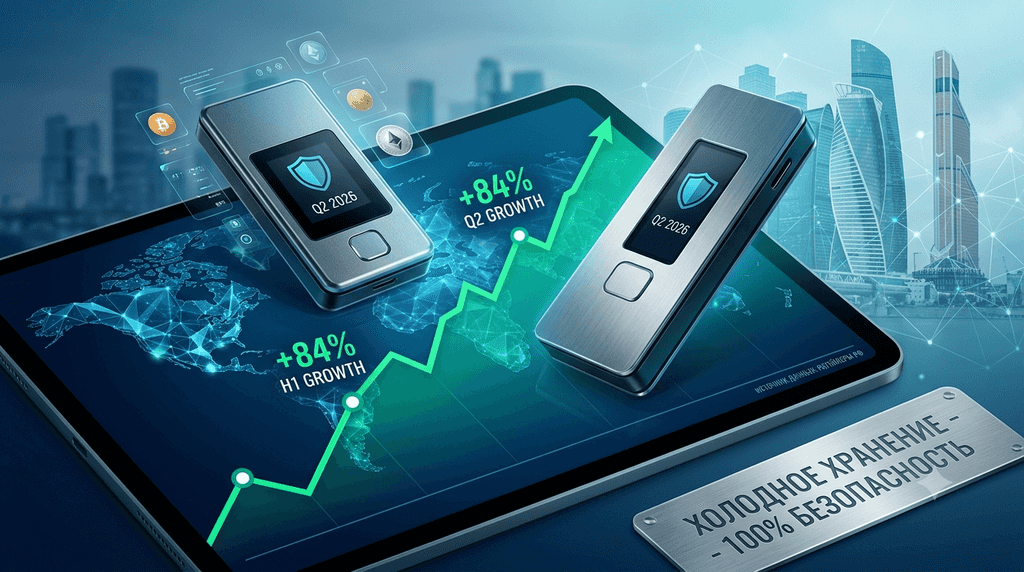
Sales of hardware crypto wallets in Russia in the second quarter of 2026 grew by 107%, signaling a massive drive by investors to ensure maximum security for their assets amidst a fundamental transformation of the regulatory landscape. According to current data from major retailers, Russian users have not only increased their purchase volumes but have also radically shifted their preferences toward high-tech devices supporting NFC, biometric authentication, and autonomous backup methods. This unprecedented trend is driven by a unique combination of factors: from the entry into force of the high-profile law "On Digital Currency" on September 1, 2026, to investors' desire to "average" their positions in Bitcoin and Ethereum amid local market corrections, while ensuring complete independence from centralized intermediaries.
Why are Russians Massively Buying Hardware Wallets in 2026?
The fundamental reason for the explosive interest in hardware solutions is the pursuit of absolute security and legal independence in the context of the formation of a new "legal circuit" for the Russian crypto market. According to official data from the combined company M.Video-Eldorado, at the end of the second quarter of 2026, demand for cold storage devices for digital assets in quantitative terms jumped by 107% compared to the first three months of the year. At the same time, the monetary turnover of the category increased by 92%, indicating the steady formation of a new consumer habit: the crypto wallet has ceased to be an exotic tool for a narrow circle of specialists and has turned into a standard element of personal digital security for the mass user.
Parallel to classic retail, major marketplaces are also demonstrating impressive dynamics. On the Wildberries platform, hardware wallet sales in the first half of 2026 grew by 84% year-on-year, and the total transaction amount increased by 60%. Notably, against the backdrop of growing demand, the average cost of a device decreased by 13%, averaging 7,900 rubles. This price reduction has made cold storage technology accessible to broad segments of the population, including those just beginning their acquaintance with the world of blockchain. Experts note that Russians view the purchase of a wallet as a long-term investment in their own financial sovereignty, especially against the backdrop of news about restrictions on direct withdrawals of funds from regulated platforms.
|
Market Dynamics Indicator
|
Growth (Q2 vs Q1 2026)
|
Growth (H1 2026 vs H1 2025)
|
|
Sales Volume in Units
|
+107%
|
+84%
|
|
Total Monetary Turnover
|
+92%
|
+60%
|
|
Average Purchase Receipt
|
-
|
7,900 RUB (-13% YoY)
|
In addition to legislative pressure, market psychology acted as a powerful driver. During the second quarter of 2026, Bitcoin demonstrated volatility that allowed many investors to make purchases at attractive prices. For long-term storage of such assets ("hodling"), a hardware wallet is an unrivaled solution as it eliminates the risks of exchange bankruptcy, hot wallet hacking, or unreasonable account blocking. In conditions of global economic instability, physical ownership of private keys becomes a way for Russians to create a "digital gold reserve," access to which does not depend on the operation of banking systems or internet providers.
Which Models and Brands Lead the Russian Hardware Solutions Market?
The dominant position in the Russian market continues to be held by global giants Ledger and Trezor, whose combined share accounts for almost 50% of all devices sold. According to M.Video analysts, the French brand Ledger accounts for about 30% of sales in units and about 40% of total turnover, which is explained by the high profitability of their flagship models, such as Ledger Stax and Nano X. Second place is firmly held by the Czech Trezor with a share of 20% in both quantitative and monetary terms. These brands have earned user trust through open-source code (in the case of Trezor) and the use of bank-grade security chips (Secure Element in Ledger).
Nevertheless, 2026 has become a flourishing time for alternative manufacturers offering more flexible usage scenarios. Investors are increasingly paying attention to brands like OneKey, SafePal, and Ellipal, which are actively implementing innovations focused on mobile users. Devices with integrated NFC modules are extremely popular, allowing transactions to be signed with a simple touch of a smartphone, which significantly simplifies work with decentralized applications (dApps) and DeFi protocols. There is also a trend toward using specialized backup cards and metal plates for storing seed phrases, which are replacing unreliable paper carriers.
"We see that hardware crypto wallets are gradually transforming from highly specialized equipment into a full-fledged category of consumer electronics, comparable in importance to smartphones or smartwatches," emphasizes Fedor Pavlenko, head of the computer components category at M.Video.
The modern Russian consumer, when choosing a device, focuses on the following key characteristics:
-
Data Transfer Method: There is a growing demand for "Air-Gapped" wallets (e.g., Ellipal Titan or Keystone) that exchange data exclusively via QR codes, completely excluding physical or wireless connection to the potentially dangerous internet environment.
-
Ecosystem and Network Support: An important factor is native support for a large number of blockchains, including new Layer 2 (L2) networks and popular tokens, allowing the entire portfolio to be managed through a single interface.
-
Autonomy and Convenience: The presence of large touchscreens and high-capacity batteries makes the transaction confirmation process visually clear and secure, minimizing the risk of error when entering an address.
-
Backup Security: Solutions supporting the Shamir Backup standard, allowing a seed phrase to be split into several parts for increased storage fault tolerance, are gaining popularity.
How Will the New Law "On Digital Currency" Change the Game for Cold Wallet Owners?
The law "On Digital Currency and Digital Rights," coming into full force on September 1, 2026, introduces a fundamentally new architecture for market participants' interaction with the state. A key innovation is the legalization of mining and the establishment of clear rules for the circulation of digital currencies; however, for retail investors, these rules carry several significant restrictions. In particular, the institute of "digital depositories" is introduced—licensed organizations that will act as custodians and be responsible for storing clients' private keys. Within this "legal circuit," operations will be transparent to the regulator, but direct withdrawal of assets from such a circuit to personal cold wallets will be strictly regulated.
According to the law's provisions, an ordinary retail investor without qualified status is limited to 300,000 rubles per year for transactions with digital currencies. Moreover, to transfer funds from a Russian digital depository to a personal hardware wallet, the use of a "foreign gateway"—a licensed overseas platform—will be required. This creates additional operational costs and complicates life for those accustomed to instant transactions. However, it is important to understand that the fact of owning a cold wallet and storing previously purchased assets on it is not prohibited and does not require mandatory transfer to the Russian circuit.
Key legal aspects for individuals:
-
Judicial Protection: Recognition of cryptocurrency as property allows owners to protect their rights in court, file lawsuits for theft, or challenge unlawful actions of third parties, even if assets are stored on a cold wallet.
-
Tax Transparency: Despite the absence of an obligation to register the Ledger or Trezor device itself, an investor is obliged to declare income from the sale of cryptocurrency. At the same time, tax (PIT 13% or 15%) is paid only at the moment of converting crypto into fiat or when making an exchange that yields a profit.
-
Constitutional Context: The Constitutional Court of the Russian Federation Ruling No. 2-P of January 2026 pointed out legislative gaps regarding informing about currency ownership for ordinary citizens. Currently, "silent ownership" of a cold wallet is not an offense.
-
Bank Monitoring Risks: The main difficulty lies in the subsequent "cash-out." Banks, guided by Federal Law 115-FZ, can block transfers from crypto exchangers if the investor cannot document the chain of asset ownership starting from the moment of their purchase.
For participants in foreign economic activity (FEA), a special regime is provided. Under sanction pressure, the use of cryptocurrencies and cold wallets for cross-border settlements is recognized as a strategically important direction, giving businesses more freedom in using non-custodial solutions compared to individuals.
Are Cold Wallets 100% Secure? Real Threats and the Coldcard Case
The myth of the absolute invulnerability of cold wallets was seriously corrected by the events of August 2026. At the beginning of the month, a large-scale hack of the infrastructure associated with popular Coldcard wallets became known. Attackers managed to compromise more than 5,000 addresses, and the total losses of users exceeded $115 million. This incident clearly demonstrated that even the most protected device can become a weak link if the attack is directed at the wallet management software or the supply chain.
The critical security factor remains the human factor and the handling of the seed phrase. According to statistics, more than 80% of cases of loss of funds from hardware wallets are associated not with technical hacking of the chip, but with phishing, social engineering, or negligent storage of the backup copy. Many users, striving for convenience, make a fatal mistake—saving a photo of the seed phrase in the cloud or entering it into fake applications imitating official Ledger Live or Trezor Suite services.
|
Threat Category
|
Risk Description
|
Protection Recommendations
|
|
Supply Chain Attacks
|
Installation of malicious software during production or delivery.
|
Buy only from the manufacturer or authorized dealers with verification of seals.
|
|
Phishing and Fake Software
|
Use of fake applications to steal the seed phrase.
|
Download software only from official sites, never enter the phrase on a PC keyboard.
|
|
Physical Access
|
Theft of the device and attempt to guess the PIN code.
|
Use the Passphrase function (25th word), which creates a hidden wallet.
|
|
Firmware Vulnerabilities
|
Bugs in the code allowing keys to be extracted upon physical contact.
|
Regularly update firmware and follow the manufacturer's security bulletins.
|
To ensure the maximum level of protection, experts recommend using the "defense in depth" concept. This includes using multi-sig wallets (e.g., 2-of-3), where signatures from devices of different brands are required to confirm a transaction. Such a scheme completely eliminates the loss of funds in the event of a hack of one specific manufacturer or the compromise of one seed phrase. Additionally, storing the bulk of capital on a "cold" device that never connects to smartphones via Bluetooth remains the gold standard for large investors.
Why is KuCoin the Optimal Choice for Building a Cold Portfolio?
Amidst the fragmentation of the Russian market and the introduction of strict internal restrictions, international platforms like KuCoin are acquiring the status of a key connecting link for conscious investors. KuCoin offers a unique combination of high liquidity, access to a wide range of innovative assets, and, most importantly, transparent mechanisms for withdrawing funds into the non-custodial circuit. Unlike local "digital depositories," KuCoin does not restrict users in their choice of the final address for storage, allowing them to instantly transfer purchased assets to personal hardware wallets like Ledger, Trezor, or SafePal.
For the Russian user seeking to balance purchase convenience and storage reliability, KuCoin provides tools that minimize transaction costs. The exchange supports withdrawing funds via many different networks (e.g., Arbitrum, Optimism, Polygon), allowing assets to be transferred to cold wallets with minimal fees, avoiding the congested Ethereum network. This is especially relevant for investors practicing a dollar-cost averaging (DCA) strategy, where purchases are made in small portions on a regular basis.
Key advantages of KuCoin for hardware wallet owners:
-
Global Liquidity: The ability to purchase assets at the best world prices without the "sanction" markup often found in local exchangers.
-
Transaction Security: The presence of advanced features such as anti-phishing codes, withdrawal passwords, and dynamic two-factor authentication ensures asset protection at the most critical stage—at the moment of purchase and preparation for withdrawal.
-
Support for New Tokens: KuCoin is often the first to add promising projects, allowing investors to fill their cold wallets with assets having high growth potential even before their mass recognition.
-
Absence of Forced Custodiality: The platform respects the user's right to independent storage, providing all necessary tools for fast and safe migration of assets to offline.
Using KuCoin in conjunction with a reliable hardware wallet allows the Russian investor to create a sustainable financial system that is protected from both market manipulations and unpredictable changes in local legislation. This is the path to true digital freedom, where the exchange acts as an efficient trading terminal and the cold wallet as an impregnable personal fortress.
Join KuCoin 9th Anniversary Trading Campaign
KuCoin is celebrating its 9th anniversary with a special platform campaign filled with exclusive rewards, trading activities, and limited-time offers. Don’t miss the chance to participate and enjoy the benefits as the exchange marks nine years of growth and innovation. Visit the official campaign page now:
Conclusion
The boom in demand for cold crypto wallets in Russia in 2026 is not just a temporary spike in interest, but a fundamental shift in the paradigm of digital asset ownership. The 107% growth in sales per quarter clearly demonstrates that Russian investors are choosing the path of conscious and responsible storage, preferring physical control over private keys to any promises of centralized platforms. The entry into force of the new law on September 1 only accelerates this process, forcing users to build their strategies for interacting with the crypto market in advance.
However, owning a hardware wallet is not only a privilege but also a great responsibility. Incidents like the Coldcard hack remind us of the importance of constant learning and compliance with digital hygiene rules. By combining the powerful trading capabilities of global platforms like KuCoin with the reliability of "cold" storage, investors get a tool in their hands capable of providing financial stability in the most turbulent era. The future belongs to those who control their keys and know how to competently use the opportunities of the global digital economy.
Frequently Asked Questions (FAQs)
1. Do I need to report the purchase of a Ledger or Trezor crypto wallet to the tax authorities?
No, the purchase of the device itself is a standard consumer electronics transaction. You have no obligation to notify the tax inspectorate or other government bodies of the fact of owning a hardware wallet. Obligations arise only when performing operations with cryptocurrency that lead to a profit, which must be declared as part of the PIT.
2. Will I be able to transfer cryptocurrency from KuCoin to my cold wallet after September 1, 2026?
Yes, the restrictions of the new Russian law primarily concern "digital depositories" operating in Russian jurisdiction. International platforms like KuCoin continue to work via standard blockchain protocols, allowing users to freely withdraw their assets to any personal addresses, including hardware wallets.
3. Which wallet should I choose if I plan to store many different tokens?
For multi-currency portfolios, the best choices are Ledger Nano X or SafePal S1. These devices support a vast number of blockchains and tokens. If you focus on the Bitcoin ecosystem, it's worth considering specialized solutions from Trezor or Blockstream Jade, which are famous for their security in this segment.
4. What happens if the wallet manufacturer goes bankrupt or stops support?
Your funds will not be lost. Hardware wallets use the generally accepted BIP39 standard for seed phrase generation. This means you will be able to restore access to your assets using your 12 or 24-word phrase in any other wallet (both hardware and software) that supports this standard. Your independence from the manufacturer is one of the main advantages of "cold" storage.
5. Is it safe to buy a used cold wallet on Avito or second-hand?
Categorically no. This is one of the highest risks in the crypto sphere. A used device may be modified by an attacker at the hardware level or have a pre-installed seed phrase, the keys to which the scammer already has. Buy hardware wallets only in sealed form from official manufacturers or in large trusted retail chains like M.Video.
Disclaimer : This material is provided for informational purposes only and does not constitute financial, investment, legal, or tax advice. Transactions involving cryptocurrencies and tokenized assets carry substantial risks — including price volatility, limited liquidity, counterparty exposure, and the potential for total loss of invested capital. Readers should conduct their own research and, where appropriate, consult a qualified professional before making any financial decisions.