

Development and Representative Projects of the Cross-Chain Bridge Track
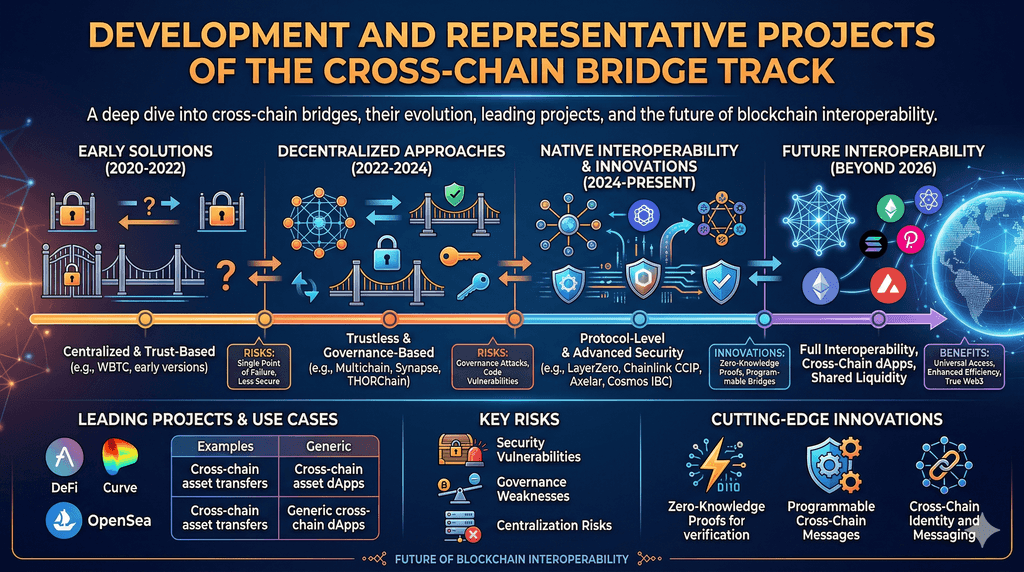
Cross-chain bridges have become foundational infrastructure in the multi-chain era, enabling seamless movement of assets and data across fragmented blockchain ecosystems. As networks like Ethereum, Solana, and BNB Chain continue to grow independently, the need for secure, efficient interoperability solutions has intensified. The development of cross-chain bridge technologies, alongside leading protocols such as LayerZero and Axelar, signals a transition toward a fully connected Web3 ecosystem where liquidity, data, and applications can move freely across chains.
The Fragmentation Problem: Why Cross-Chain Bridges Became Essential
The expansion of blockchain networks has created a paradox. Innovation has flourished, yet liquidity and users have become fragmented across isolated ecosystems. Each blockchain operates with its own consensus mechanism, token standards, and infrastructure, making direct communication nearly impossible. This fragmentation limits capital efficiency, as assets locked in one network cannot easily be deployed in another without complex processes.
For example, users holding assets on Ethereum may want to access lower fees on Solana or participate in decentralized finance opportunities on BNB Chain. Without cross-chain bridges, this would require centralized exchanges, introducing counterparty risk and delays. Bridges emerged to solve this exact problem by enabling direct transfers between chains.
The importance of this infrastructure has grown alongside the rise of DeFi and multi-chain strategies. Liquidity is no longer concentrated in a single ecosystem; it flows dynamically across networks. Cross-chain bridges serve as the highways that connect these ecosystems, allowing capital to move where it is most efficiently utilized. Recent industry reports highlight that billions of dollars in value regularly move through bridging protocols, reflecting their central role in Web3. As the number of blockchains continues to increase, interoperability is no longer optional, it is essential for the next phase of blockchain adoption.
Early Bridge Architectures and the Rise of Wrapped Assets
The first generation of cross-chain bridges relied heavily on a mechanism known as “lock-and-mint.” In this model, a user’s assets are locked on the source chain, while an equivalent “wrapped” version is minted on the destination chain. One of the earliest and most widely recognized examples is Wrapped Bitcoin (WBTC), which allowed Bitcoin to be used within Ethereum’s DeFi ecosystem.
This approach unlocked new possibilities, enabling liquidity from one chain to be utilized in another. However, it also introduced new risks. The custody of locked assets often depended on centralized or semi-centralized entities, creating potential points of failure. If the custodian was compromised, the entire system could collapse.
Despite these risks, wrapped assets played a crucial role in the early growth of DeFi. They demonstrated that cross-chain functionality was not only possible but highly valuable. Over time, more sophisticated bridging solutions emerged, aiming to reduce reliance on centralized custodians and improve security. The limitations of early architectures became increasingly apparent as the scale of bridging activity grew. High-profile incidents exposed vulnerabilities, prompting the industry to rethink its approach. This evolution marked the transition from simple asset wrapping to more advanced interoperability frameworks.
Inside the Mechanics: How Cross-Chain Bridges Actually Move Value
Cross-chain bridges operate through a combination of smart contracts, validators, and messaging systems that coordinate asset transfers between blockchains. At a high level, the process begins when a user initiates a transaction on the source chain. The bridge protocol then verifies this transaction and triggers a corresponding action on the destination chain.
In many systems, validators or relayers play a critical role. These entities monitor transactions and confirm that assets have been locked or burned on the source chain before minting or releasing assets on the destination chain. The security of the bridge depends heavily on the reliability and decentralization of these validators. Modern bridges are increasingly incorporating advanced cryptographic techniques, such as zero-knowledge proofs and light clients, to enhance security and reduce trust assumptions. These innovations allow one blockchain to verify the state of another without relying on intermediaries.
Messaging layers are also becoming more important. Instead of simply transferring tokens, newer protocols enable the transfer of arbitrary data, opening the door to more complex cross-chain applications. This shift reflects a broader trend toward interoperability that goes beyond asset movement. Understanding these mechanics is essential for evaluating the strengths and weaknesses of different bridge designs. Each approach involves trade-offs between speed, cost, security, and decentralization.
The Security Crisis That Shaped the Bridge Narrative
Security incidents have played a defining role in the evolution of cross-chain bridges. Several high-profile hacks exposed vulnerabilities in early designs, leading to billions of dollars in losses and shaking confidence in the sector. Among the most notable cases was the Wormhole exploit in 2022, where attackers exploited a verification flaw to mint unauthorized tokens.
Similarly, the Ronin Network hack highlighted the risks associated with validator centralization. In that case, attackers gained control of a majority of validator nodes, allowing them to approve fraudulent transactions. These incidents underscored the importance of decentralization and robust security mechanisms.
The impact of these events extended beyond financial losses. They forced developers and researchers to re-evaluate existing models and prioritize security in future designs. As a result, newer protocols are placing greater emphasis on minimizing trust assumptions and improving verification processes. Despite these challenges, the industry has shown resilience. Many affected projects recovered and implemented stronger safeguards. The lessons learned from these incidents continue to shape the development of next-generation bridging solutions.
The Shift Toward Trust-Minimized and Native Interoperability Models
In response to security concerns, the industry is moving toward trust-minimized bridging solutions that reduce reliance on centralized components. These models aim to achieve interoperability through cryptographic verification rather than human or institutional trust.
Light client-based bridges represent one such approach. They allow one blockchain to directly verify the state of another by running a simplified version of its consensus mechanism. This significantly reduces the attack surface compared to traditional validator-based systems. Zero-knowledge proofs are also gaining traction. These cryptographic techniques enable one party to prove the validity of a statement without revealing underlying data. In the context of cross-chain bridges, this allows secure verification of transactions across chains.
The concept of native interoperability is becoming increasingly prominent. Instead of treating bridging as an external add-on, newer blockchain designs integrate cross-chain functionality at the protocol level. This approach has the potential to eliminate many of the inefficiencies associated with traditional bridges. These developments signal a shift toward a more secure and scalable interoperability framework, paving the way for a fully interconnected blockchain ecosystem.
Wormhole: From Exploit to Ecosystem Backbone
Wormhole has undergone a remarkable transformation, evolving from a high-profile exploit to one of the most widely used cross-chain messaging protocols. Following the 2022 incident, the project implemented significant security upgrades and expanded its ecosystem.
Today, Wormhole supports multiple blockchains and facilitates both asset transfers and data messaging. Its Guardian network, composed of independent validators, plays a key role in verifying cross-chain transactions. This design balances decentralization with operational efficiency. The protocol has also established partnerships with major projects across the Web3 space, enabling seamless integration of cross-chain functionality.
Its adoption in sectors such as NFTs and gaming highlights its versatility. Wormhole’s recovery demonstrates the resilience of the crypto industry and the importance of continuous improvement. By addressing its vulnerabilities and expanding its capabilities, the protocol has regained trust and solidified its position as a key player in the interoperability ecosystem.
LayerZero and the Rise of Omnichain Applications
LayerZero introduces a novel approach to interoperability by focusing on messaging rather than traditional bridging. Its architecture enables direct communication between smart contracts on different blockchains, allowing developers to build “omnichain” applications.
This concept represents a shift from isolated ecosystems to interconnected networks where applications can operate seamlessly across chains. For example, a decentralized application could manage assets and execute logic on multiple blockchains without requiring users to manually bridge tokens.
LayerZero achieves this through a combination of oracles and relayers that verify transactions. This modular design allows developers to customize security parameters based on their specific needs. The protocol has gained significant traction, with numerous projects integrating its technology. Its emphasis on flexibility and scalability makes it a strong contender in the race to define the future of interoperability.
Cross-Chain Bridges Powering DeFi Composability and Yield Strategies
Cross-chain bridges have become the backbone of DeFi composability, enabling capital and liquidity to flow seamlessly across multiple blockchain networks. Traders and liquidity providers are no longer confined to the ecosystem where their assets were originally deployed. Instead, they can leverage bridges to access higher yields, participate in multi-chain farming strategies, or arbitrage opportunities across chains. For example, an Ethereum-based liquidity provider can use a bridge to move funds to Solana or Avalanche, capturing attractive yield opportunities that would otherwise remain inaccessible.
This interoperability has made it possible to optimize capital efficiency, reducing idle funds and increasing total value locked (TVL) across ecosystems. The rise of omni-chain liquidity strategies has also fostered the creation of integrated DeFi protocols that can track, manage, and deploy liquidity automatically across multiple chains. Protocols like Synapse have capitalized on this trend by combining AMM-based bridging with fast settlement mechanisms, creating a frictionless user experience that aligns with the needs of professional traders and retail participants alike.
By facilitating seamless interaction between chains, bridges are enabling a new level of composability that strengthens DeFi as an interconnected, global financial system. This development emphasizes the central role of interoperability not just as a technical achievement, but as a strategic driver for the future growth of decentralized finance.
The Role of Cross-Chain Bridges in NFTs, Gaming, and Web3 Identity
Cross-chain bridges are not limited to fungible tokens; they are increasingly shaping the NFT, gaming, and Web3 identity landscape. NFTs minted on one chain can now move seamlessly to another, allowing gamers and collectors to interact with ecosystems that offer lower fees, better scalability, or unique marketplaces. For instance, a Solana NFT could be transferred to Ethereum to access a specialized auction platform, or a gaming asset could move across chains to participate in multi-chain game worlds. Bridges also play a crucial role in Web3 identity, enabling decentralized profiles, reputations, and credentials to follow users across multiple chains.
This capability fosters interoperability between social platforms, gaming networks, and DeFi protocols, creating an ecosystem where identity and ownership are portable. Projects like Wormhole have extended their infrastructure to support NFTs and gaming assets, while LayerZero enables developers to build omnichain applications that integrate user identities across ecosystems.
The convergence of cross-chain bridges with NFTs, gaming, and identity solutions represents a transformative stage in blockchain adoption, where interoperability extends beyond money to information, ownership, and digital experiences. This expansion significantly enhances the utility and appeal of Web3 applications, driving broader adoption and richer user engagement.
Conclusion
Cross-chain bridges have evolved from simple asset transfer tools into complex interoperability frameworks that underpin the multi-chain ecosystem. Their development reflects the broader maturation of blockchain technology and the growing demand for seamless connectivity.
As innovation continues, the focus is shifting toward security, scalability, and usability. Projects that successfully address these challenges will play a central role in shaping the future of Web3. The vision of a fully interconnected blockchain ecosystem is becoming increasingly attainable, driven by the fast advancement of cross-chain technologies.
FAQs
-
What is a cross-chain bridge in simple terms?
A cross-chain bridge allows users to transfer assets or data between different blockchains.
-
Are cross-chain bridges safe today?
Security has improved, but risks still exist. Newer models focus on reducing vulnerabilities.
-
What caused major bridge hacks?
Weak validation systems, centralization, and smart contract bugs were common causes.
-
Which projects are leading in 2026?
Wormhole, LayerZero, and Axelar are among the leading protocols.
-
What is cross-chain messaging?
It allows blockchains to exchange data, not just tokens.
-
What is the future of cross-chain technology?
It is moving toward seamless interoperability with stronger security and better user experience.
Disclaimer
This content is for informational purposes only and does not constitute investment advice. Cryptocurrency investments carry risk. Please do your own research (DYOR).