

Ethereum Validator Exit Queue Jumps 392%: Will 850K ETH Trigger a Sell-Off?

Ethereum’s validator exit queue surged to roughly 850,000 ETH in early October 2026, driven largely by precautionary MetaMask Staking exits after a September 30 security incident. The jump raised concerns about potential ETH sell pressure, but a validator exit does not automatically mean the underlying ETH will be sold. The real market impact depends on how much withdrawn ETH eventually reaches exchanges, how much is restaked, and whether new staking demand remains strong.
Why Did Ethereum’s Validator Exit Queue Surge to 850K ETH?
Ethereum’s validator exit queue expanded rapidly between the end of September and the first days of October 2026, climbing from roughly 166,000 ETH on September 29 to around 850,000 ETH by October 2. That increase pushed the backlog to its highest level of the year and drew attention because it represented a sudden concentration of validators seeking to leave active staking. The increase was not the result of a gradual, network-wide decline in validator confidence. Instead, a large group of exit requests arrived over a short period after MetaMask Staking began precautionarily exiting affected validators. Because Ethereum limits how quickly validators can leave the active set, the requests accumulated faster than the network could process them, causing the visible exit queue to rise sharply. This combination of unusually concentrated exit requests and Ethereum’s built-in processing limits explains why the queue changed so dramatically within only a few days.
Ethereum’s Exit Queue Expanded Rapidly Over Just a Few Days
CoinDesk reported that roughly 166,000 ETH was waiting to exit on September 29, while the queue had moved above 770,000 ETH by October 1 before reaching roughly 850,736 ETH on October 2. Several reports described the increase as 392%, although the percentage changes depending on the baseline. Using the September 29 figure produces an increase of slightly more than 400%, so the 392% figure is better treated as one calculation rather than an official Ethereum network statistic. What matters more is the pace of the move: hundreds of thousands of ETH entered the backlog within only a few days, making the event one of the largest short-term shifts in Ethereum staking flows during 2026. The rapid increase also explains why the validator exit queue attracted attention beyond staking participants, since a larger withdrawal backlog can influence expectations about future ETH liquidity.
The queue also began declining after reaching its peak, falling to roughly 786,000 ETH by October 5. That change is important because it shows that the 850K figure represented a short-term high rather than an endlessly rising trend. Live validator data can move quickly as exits are processed, so the headline number should be viewed as part of a changing staking flow rather than a fixed level of permanent ETH supply waiting to leave the network. A falling queue after a sharp spike can also indicate that the initial concentration of exit requests is gradually being absorbed by the protocol rather than being continually replaced by an equally large volume of new exits.
Ethereum’s Validator Exit Limits Turned the Requests Into a Backlog
Ethereum deliberately limits how quickly stake can enter or leave its active validator set. Following the Pectra/Electra changes, validator churn is governed largely by the amount of ETH that can enter or exit during each epoch, which prevents sudden changes in validator participation from happening all at once. When exit requests arrive faster than the protocol can process them, they are added to the queue and must wait. This rate-limited structure explains why a concentrated wave of validator exits could push the backlog toward 850K ETH even though the requests themselves were submitted over a much shorter period. The mechanism is designed to protect network stability by preventing a large portion of active stake from disappearing immediately, which also means that unusually large exit events remain visible in queue data for longer than the original burst of requests.
MetaMask’s Security Incident Drove Most of the Ethereum Validator Exits
The biggest identifiable catalyst behind the surge was a security incident affecting part of MetaMask Staking’s infrastructure on September 30, 2026. In its official MetaMask security update, the company said it was proactively exiting affected validators while investigating the issue and coordinating with external partners and security advisers. MetaMask said it had found no immediate threat to MetaMask wallets and emphasized that its staking operation is non-custodial, meaning it does not manage clients’ withdrawal keys. The exits were therefore a precautionary operational response rather than evidence that users’ staked ETH had been stolen or that MetaMask was liquidating customer positions. That context is important because the motivation behind a validator exit can materially change how the market should interpret a sudden increase in the Ethereum unstaking queue.
What Happened During the MetaMask Staking Security Incident?
On-chain research from Bitquery found that an unauthorized party redirected validator block tips for several hours on September 30. The investigation traced 18 affected blocks and about 0.36 ETH in diverted rewards, with no validator slashing identified. The direct financial loss was small compared with the total value staked, but the incident raised a more serious operational concern around validator signing infrastructure. If signing keys or the systems controlling them may have been compromised, exiting validators can reduce the risk of further penalties or misuse. Lido later confirmed that MetaMask Staking was carrying out precautionary out-of-order exits for validators it operated within the Lido protocol. The decision therefore appears to have been focused on containing infrastructure risk before it could create a larger problem for the affected validators.
MetaMask’s response helps explain why the Ethereum validator exit queue moved so sharply even though the observed loss from diverted rewards was limited. The incident created a need to remove a large validator set from active operation in a short period, and that volume of requests collided with Ethereum’s restricted exit capacity. Lido also said no action was required from stETH holders, reinforcing that the issue centered on validator operations rather than user custody. This makes the October queue surge different from a scenario in which thousands of unrelated validators independently decide to unstake because of falling confidence, weaker rewards, or expectations of a major ETH price decline.
How Much ETH Was Connected to MetaMask’s Validator Exits?
MetaMask has not publicly confirmed one final figure for the total amount involved, so the available numbers should be treated as estimates. Bitquery identified 16,965 MetaMask-operated validators holding about 565,056 ETH that had either exited or entered the exit process, while other reporting placed the affected amount closer to 523,000 ETH. Both estimates point to MetaMask-linked validators accounting for a large share of the roughly 850K ETH peak, making the security response the clearest identifiable driver of the surge. The remaining exits should not automatically be attributed to MetaMask because other validators may have been leaving staking for unrelated reasons. Separating those two groups matters for market analysis because a security-driven migration has different implications from a broad decision by Ethereum stakers to reduce their exposure.
850K ETH in the Exit Queue Does Not Mean 850K ETH Will Be Sold
The size of Ethereum’s validator exit queue may look bearish, but an exit request is not a market sell order. Validators first have to leave active staking, become withdrawable, and complete the official Ethereum withdrawal process before their ETH becomes transferable on the execution layer. Even after that happens, the owner can choose to restake the ETH, hold it in self-custody, move it into DeFi protocols, transfer it between wallets, or send it to an exchange. That makes the exit queue a measure of potential future liquidity rather than confirmed selling pressure. The distinction matters because market headlines can make a large exit backlog sound like immediate supply when the actual price impact depends on what happens after withdrawal. Investors therefore need to distinguish between ETH becoming available for transfer and ETH actually being offered for sale on the market.
Validator Exit and ETH Selling Are Separate Events
A validator exit only means that ETH is leaving active validator duties. It does not tell the market what the holder intends to do next. Blockchain data can show when a validator requests an exit and when the balance becomes withdrawable, but it cannot determine whether those coins will be sold. A withdrawn balance that returns to staking or moves into self-custody has a very different market effect from one deposited on a centralized exchange. For that reason, exchange inflows and post-withdrawal wallet movements are more useful indicators of potential sell pressure than the size of the validator exit queue by itself. Analysts would need to see a meaningful share of newly withdrawn ETH moving toward liquid trading venues before drawing a stronger connection between validator exits and actual spot-market supply.
Withdrawal Timing Spreads Potential ETH Supply Over Time
Ethereum’s exit process also prevents a large amount of stake from becoming liquid at once. During the October 2026 surge, estimated validator exit waits were around two weeks, with further time potentially required before balances were fully withdrawn. Even if some holders eventually decide to sell, the supply would therefore reach the market gradually rather than appearing as one immediate block of 850K ETH. This matters for price impact because a steady flow of withdrawals can be absorbed differently from a sudden wave of exchange deposits. Market depth, spot demand, institutional flows, and the broader crypto environment during the withdrawal period would all influence whether newly liquid ETH creates noticeable downward pressure.
Some Withdrawn ETH May Return to Staking
Lido’s validator disclosure said the ETH linked to affected MetaMask-operated validators was expected to return gradually to the protocol after the exit, withdrawal, and re-entry process. Lido estimated that the full cycle could take up to roughly 45 days because validators must complete the exit and withdrawal stages before entering the activation queue again. If that process occurs as expected, part of the headline exit queue would represent temporary validator migration rather than capital permanently leaving Ethereum staking. This is another reason the 850K ETH figure should not be treated as direct sell-side supply, particularly when such a large portion of the queue appears linked to one operational event.
Exchange Inflows Would Be a Stronger Sell-Pressure Signal
The clearest bearish signal would come from recently withdrawn validator balances moving in size to centralized exchanges and being followed by stronger spot-market selling. If ETH instead returns to staking, remains in self-custody, or moves into DeFi, the market impact would be very different. For investors tracking Ethereum price movements, where exited coins go after they become liquid is more important than assuming the full validator queue will be sold. Other useful signals include changes in spot trading volume, large-holder transfers, exchange balances, and whether the exit queue continues falling after the MetaMask-related validators have been processed.
Ethereum Exit Queue vs Entry Queue: What the Latest Staking Data Shows
The exit queue remains elevated, but the broader staking picture looks more balanced when entry demand is included. As of October 6, 2026, roughly 1.44 million ETH was waiting to enter staking, compared with about 767,000 ETH waiting to exit. That leaves the entry queue around 670,000 ETH larger, with almost 1.9 ETH waiting to enter for every 1 ETH waiting to leave. This does not guarantee a positive ETH price outlook, but it shows that strong staking demand remains present even while Ethereum processes its largest exit backlog of the year. Looking at both queues is especially important because the exit number alone can create the impression that capital is moving only out of Ethereum staking when a substantial new stake is simultaneously waiting for activation.
Ethereum Entry Demand Still Exceeds the Exit Backlog
Ethereum’s entry queue remains significantly larger than its exit queue, with about 1.44 million ETH waiting to enter staking compared with roughly 767,000 ETH waiting to leave. The gap of nearly 670,000 ETH shows that validator demand is still active even while Ethereum processes an unusually large exit backlog. Because both sides are constrained by protocol-level churn limits, queue sizes can remain elevated for days or weeks, making the balance between entries and exits more informative than looking at withdrawals alone. If the entry queue stays larger as MetaMask-related exits are processed, it would suggest that new staking demand continues to absorb a meaningful share of the ETH leaving active validator duties.
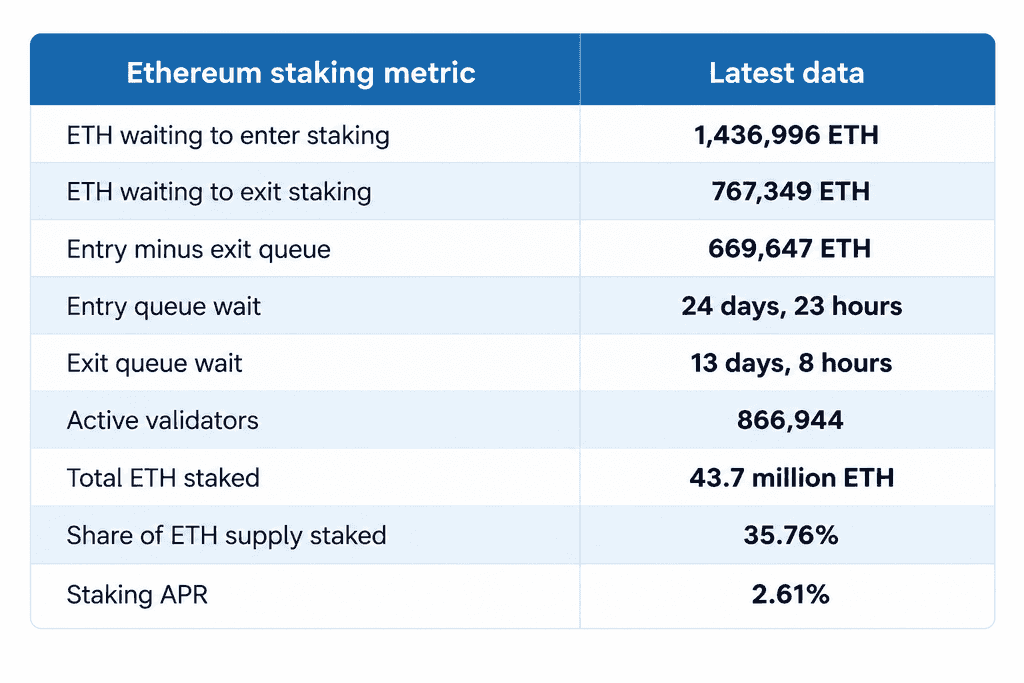
The table shows that Ethereum is seeing strong activity on both sides of staking, not only withdrawals. The larger entry queue and more than 43 million ETH already staked provide useful context for the 850K ETH exit headline, while the longer entry wait also points to continued demand for validator activation.
Staking Demand Has Cooled From September, but Remains Large
The larger entry queue does not mean staking demand is accelerating. CoinDesk reported that roughly 2 million ETH had been waiting to enter staking in early September, compared with around 1.44 million ETH by October 6. That decline shows that new staking demand has cooled from its September high, but the backlog remains large enough to exceed the amount currently waiting to exit. This creates a more balanced interpretation of Ethereum’s staking flows: demand has weakened, but it has not disappeared. The direction of the entry queue over the next several weeks will help show whether the decline is simply normalization from an unusually large September backlog or the beginning of a more sustained slowdown in new validator demand.
More Than 43 Million ETH Remains Staked on Ethereum
Around 43.7 million ETH, or roughly 35.76% of the tracked ETH supply, remains staked across approximately 866,944 active validators. Against that base, the current exit queue represents less than 2% of total staked ETH. That does not make the withdrawal backlog irrelevant, but it puts the headline figure into context. The more important trend over the coming weeks will be whether the exit queue keeps declining while the entry backlog remains substantial, or whether exits begin rising again alongside weaker staking demand. A persistent rise in exits combined with falling entries would carry a different signal from the current situation, where the entry side of the validator system remains considerably larger.
🔥 Beyond the Headlines: What KuCoin 5.0 Means for You
Market news moves fast — but where you act on it matters just as much. This October, KuCoin launches KuCoin 5.0, transforming KuCoin into a rebuilt platform. Here's what actually changes for you:
-
One account for everything. Older platforms split your money across separate "spot," "margin," and "futures" accounts and expected you to understand why. KuCoin 5.0's unified account removes that entirely — deposit once, and everything is simply there (only available to VIPs for now).
-
Stocks, indices, and commodities. KuCoin 5.0 expands beyond crypto into global markets. When crypto chops sideways and equities rally (or the reverse), you rotate in minutes instead of opening a brokerage account and waiting days for fiat rails.
-
Real-world assets (RWA). Tokenized exposure to traditional assets like commodities, right inside your crypto account. One of the fastest-growing segments in global finance is no longer reserved for institutions — you access it from the same balance you trade with.
-
Earn while you learn. Not ready to trade? KCUSD lets your stablecoins earn daily, auto-compounding interest. The lowest-stress way to put your idle deposit to work for 4% yield.
-
An AI assistant in plain language. Ask questions, get market context, understand what you're looking at — built into the platform, no jargon required.
-
An app that doesn't overwhelm. Faster, cleaner, and consistent — intuitive from the first tap, not after a tutorial.
-
Safety you can check, not just trust. A MiCAR-licensed EU entity, Proof of Reserves you can verify yourself, and internationally certified security (SOC 2 Type II, ISO 27001:2022).
Create your account in minutes — and start on the platform built for where crypto is going, not where it's been.
Conclusion
Ethereum’s validator exit queue reaching roughly 850K ETH raised concerns about a possible sell-off, but the data does not show that the full amount will reach the market. Much of the surge was linked to MetaMask’s precautionary validator exits, while Ethereum’s exit limits caused requests to build into a backlog. At the same time, about 1.44 million ETH is still waiting to enter staking, showing that demand remains significant. The key signal now is where withdrawn ETH moves next: exchange deposits could increase sell-pressure concerns, while restaking or self-custody would point to a more temporary validator reshuffle.
FAQs
What is an Ethereum validator exit queue?
The Ethereum validator exit queue is the list of validators waiting to stop active staking. Ethereum limits how quickly stake can leave, so when exit requests rise faster than the protocol can process them, the backlog grows. A larger queue therefore increases waiting times but does not automatically show that validators intend to sell their ETH once withdrawals are completed.
Can an Ethereum validator cancel an exit?
Once a voluntary validator exit is accepted by the network, it generally cannot be reversed. The ETH must complete the exit and withdrawal process before it can later be restaked through another validator setup. This makes voluntary exits different from simply moving liquid ETH between wallets.
Does a large validator exit queue weaken Ethereum?
Not necessarily. A temporary increase in exits does not automatically reduce network security in a meaningful way, particularly when a large amount of ETH remains actively staked. A prolonged decline in total staked ETH combined with weak new validator demand would be a more important signal than a short-term queue spike caused by a concentrated operational event.
What happens to staking rewards after a validator exits?
A validator stops earning normal staking rewards after leaving active duties. Its balance then proceeds through the withdrawal process before becoming transferable. If the withdrawn ETH is later restaked through a new validator or staking provider, rewards can begin again once the new stake completes activation.
Can validator exits increase ETH price volatility?
Yes, mainly through market sentiment and expectations about future liquidity. The actual price impact depends on whether withdrawn ETH reaches exchanges and is sold, as well as broader spot demand, derivatives positioning, institutional flows, and overall crypto market conditions. A large exit queue alone cannot determine the direction of ETH price.
What is the difference between an exit queue and a withdrawal?
The exit queue covers validators waiting to leave active staking, while withdrawal happens later when a validator’s balance becomes eligible to move to its designated withdrawal address. These are separate steps in Ethereum’s staking process, which is why an exit request should not be treated as an immediate release of liquid ETH.
Disclaimer: This article is for informational purposes only and does not constitute investment advice. Crypto assets can be highly volatile, and market conditions, token liquidity and project developments may change rapidly. Readers should conduct their own research and assess their risk tolerance before making financial decisions.