

Ethereum Glamsterdam Upgrade Set for October 27 Hoodi Testnet Activation
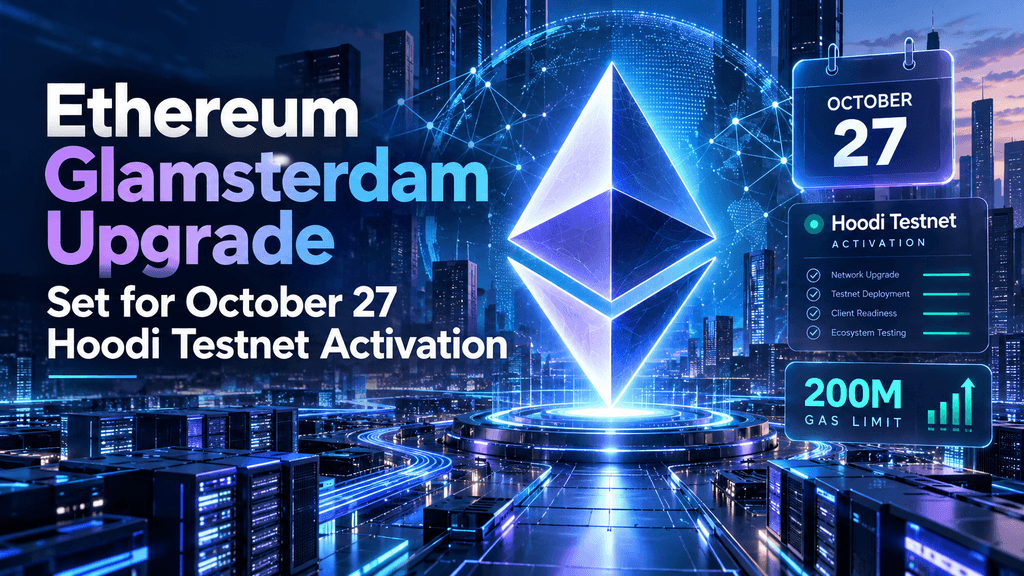
Ethereum's Glamsterdam upgrade is scheduled to activate on the Hoodi testnet on October 27, 2026, in China Standard Time, marking another step in Ethereum's Layer 1 scaling roadmap. The Ethereum Foundation confirmed that activation will occur on October 26 at 17:42:48 UTC, alongside a planned increase in Hoodi's gas limit to 200 million. Following its October 6 deployment on Sepolia, Glamsterdam introduced changes to block construction, transaction validation, and gas accounting through several Ethereum Improvement Proposals (EIPs). These improvements could support greater network capacity and more efficient processing, although the mainnet launch date and potential impact on ETH prices remain uncertain.
Ethereum Glamsterdam Hoodi Testnet Activation Date and 200M Gas Limit
Hoodi provides the next public testing environment for Ethereum's proposed protocol changes following their deployment on Sepolia. The upgrade will allow developers and node operators to evaluate whether the updated infrastructure can handle larger execution workloads while maintaining reliable network operation. This stage is particularly important because Glamsterdam introduces changes affecting both Ethereum's execution and consensus layers, requiring coordinated software updates across participating clients. Testing on a separate network also allows developers to identify implementation problems before introducing changes to Ethereum's production environment.
Ethereum Glamsterdam Activation on the Hoodi Testnet
The Ethereum Foundation scheduled Glamsterdam to activate on October 26, 2026, at 17:42:48 UTC, corresponding to October 27 at 1:42:48 a.m. China Standard Time. The upgrade will occur at epoch 132,352 and slot 4,235,264, following the successful Sepolia activation on October 6. The official Hoodi deployment schedule was announced on October 16, giving participating infrastructure providers time to prepare compatible software. The staged rollout allows developers to identify potential implementation issues before the protocol changes are introduced to Ethereum mainnet. Hoodi's activation will also provide additional evidence about how different Ethereum client implementations handle the updated network rules.
Hoodi node operators must update both execution-layer and consensus-layer clients before activation, while validators must ensure their beacon-node and validator-client software supports the new protocol rules. These updates allow participating nodes to recognize the upgraded network and maintain consensus after the transition. Operators using incompatible software risk losing synchronization with Hoodi. However, the activation concerns the testnet only, so ordinary ETH holders and Ethereum mainnet users are not required to update their wallets or transfer their assets. The Ethereum Foundation's published client-release information provides operators with a reference for selecting compatible software versions.
Hoodi's 200 Million Gas Limit and Network Capacity
Hoodi is scheduled to adopt a 200 million gas limit at the Glamsterdam activation epoch, matching the target introduced on Sepolia. Gas measures the computational resources required for Ethereum transactions and smart contract operations, while a block's gas limit determines how much gas-consuming activity it can accommodate. Compared with a 60 million gas reference, the new target is approximately 3.33 times higher, representing a 233.3% increase in nominal gas capacity. This comparison describes the change in the gas-limit target rather than a measured increase in transaction throughput. Actual processing capacity depends on transaction complexity, execution efficiency, and the resources available to participating nodes.
The adjustment follows EIP-8261, which introduces an optional epoch-based gas-limit schedule for consensus clients. Instead of establishing a fixed protocol maximum, the mechanism provides recommended defaults that validators can use when selecting their preferred gas limits. Ethereum's existing block gas-limit adjustment rules remain in effect, meaning actual limits can change progressively rather than reaching the target instantly. Hoodi testing will help developers assess whether higher capacity can be supported without creating excessive processing delays, infrastructure demands, or network instability. These observations will inform future scaling decisions but do not establish the gas limit that Ethereum mainnet will ultimately adopt.
Key Ethereum Glamsterdam Upgrade Features: EIP-7732, EIP-7928, and Gas Repricing
Glamsterdam introduces substantial changes to Ethereum's underlying architecture, particularly the way blocks are produced, transaction data is processed, and blockchain state is managed. Its central technical components include EIP-7732, which changes proposer-builder coordination, EIP-7928, which introduces structured access information for block validation, and EIP-8037 and EIP-8038, which revise gas costs for state-related operations. Together, these proposals aim to improve execution efficiency while keeping Ethereum's increasing computational and storage requirements manageable. Each proposal addresses a different technical limitation, allowing the upgrade to support higher execution capacity through changes to both processing methods and resource accounting.
How EIP-7732 and EIP-7928 Improve Ethereum Block Processing
EIP-7732 introduces enshrined proposer-builder separation (ePBS), incorporating important parts of Ethereum's block-building process directly into its consensus protocol. Under this mechanism, validators proposing blocks can select commitments from specialized builders, who subsequently provide the corresponding execution payloads. The proposal separates consensus validation from execution validation, giving network participants additional time to process transaction data. It also introduces a payload timeliness committee that evaluates whether builders reveal their promised payloads and make the required data available within the expected period. By bringing builder commitments and payment coordination into the protocol, EIP-7732 aims to reduce reliance on external coordination infrastructure and improve block production efficiency.
EIP-7928 complements these changes through block-level access lists (BALs), which record the accounts and storage locations accessed during block execution alongside their resulting state changes. This structured information allows Ethereum clients to prepare database reads more efficiently and perform certain transaction-validation and state-root calculation tasks in parallel. Without advanced knowledge of transaction dependencies, execution clients generally need to discover storage requirements while processing transactions, limiting opportunities for concurrent operations. Block-level access lists could reduce these bottlenecks, although the resulting performance improvements will depend on client implementations, transaction dependencies, and the additional data required to maintain the lists.
How EIP-8037 and EIP-8038 Change Ethereum Gas Pricing
Glamsterdam also introduces gas repricing through EIP-8037 and EIP-8038 to better align transaction costs with the resources consumed by Ethereum's growing blockchain state. EIP-8037 increases and separately measures the costs of creating new accounts, storage entries, and deployed contract code, while EIP-8038 revises the costs of accessing existing state. These adjustments are intended to make state growth more sustainable as Ethereum increases its execution capacity. In an August 24, 2026 assessment, the Ethereum Foundation reported that historical transaction testing identified a relatively small number of smart contracts that could experience compatibility problems under the revised pricing rules. Contracts relying on fixed gas allowances, hardcoded execution limits, or assumptions about remaining gas may require adjustments, although most tested contracts were unaffected. Many identified issues can be addressed by increasing transaction gas limits, while others may require changes to application code or gas-estimation tools. Developers can use testnet deployments to evaluate these changes before they become part of Ethereum's production network.
How the Glamsterdam Upgrade Could Improve Ethereum Scalability and Gas Fees
Ethereum's long-term scalability depends on its ability to process growing transaction demand without making block verification impractical for network participants. Glamsterdam addresses this challenge through improvements to execution efficiency, state management, and the broader block-processing architecture. These developments could support more activity from decentralized finance (DeFi) protocols, blockchain applications, and other services operating on Ethereum. However, their eventual effects on transaction speeds and costs will depend on real-world network conditions and the performance of the upgraded infrastructure. Improvements must also remain compatible with Ethereum's decentralized validation model, where independent operators verify network activity.
Ethereum Transaction Throughput and Execution Capacity
Glamsterdam could improve Ethereum transaction throughput by reducing processing bottlenecks and allowing clients to handle more computational work within practical validation time limits. More efficient access to blockchain state and improved execution scheduling may help nodes process complex workloads without proportionally increasing validation delays. This could support greater on-chain activity, particularly from applications that interact with multiple smart contracts or storage locations. However, transaction throughput cannot be determined from the block gas limit alone because simple ETH transfers and complex DeFi transactions require different amounts of computational work. Sustained improvements will need to be demonstrated through observed network performance rather than theoretical capacity estimates. Testing should also assess how increased workloads affect node resource consumption and the time required to validate and finalize blocks.
Potential Changes to Ethereum Gas Fees
Glamsterdam could help moderate Ethereum gas fees if greater execution capacity reduces competition for available block space. Ethereum's EIP-1559 fee mechanism adjusts the base fee according to gas usage relative to the network's target, meaning transaction costs remain sensitive to demand. Higher effective capacity may ease fee pressure during periods of relatively stable activity, but congestion can still increase costs when transaction demand rises. Furthermore, the revised pricing of resource-intensive state operations means certain smart contract transactions could become more expensive even if overall network capacity improves. The upgrade therefore does not guarantee lower fees for every transaction, and testnet measurements cannot establish future mainnet transaction costs. The eventual impact will vary depending on the type of transaction, network utilization, and the gas consumed by individual operations.
Glamsterdam's Relationship to Ethereum Layer 2 Scaling
Ethereum Layer 2 networks, including rollups, could benefit indirectly from improvements in mainnet execution efficiency and infrastructure reliability. These networks process transactions separately before submitting settlement information, proofs, or transaction data to Ethereum, making the performance of the underlying blockchain relevant to their operations. However, Layer 2 transaction fees also depend on data availability costs, particularly blob fees, as well as the execution expenses of individual networks. Glamsterdam's execution-layer improvements should therefore not be interpreted as a direct reduction in rollup fees. Any broader cost benefits will depend on how Layer 2 networks interact with Ethereum and whether the upgrade delivers sustained efficiency improvements under production conditions. Rollups using different transaction-processing and data-publication methods may experience different benefits even when they settle on the same underlying network.
Ethereum Glamsterdam Mainnet Launch Timeline and Potential ETH Price Impact
Ethereum's Glamsterdam upgrade could influence expectations for the network's long-term development, but its eventual mainnet deployment and potential effect on ETH prices remain uncertain. The Ethereum Foundation has not confirmed a final activation date, although core developers have discussed possible dates in December 2026. For investors and infrastructure providers, the next developments to watch include successful testing, agreement on a deployment schedule, and evidence that the proposed changes can operate reliably across Ethereum's broader ecosystem. Progress toward mainnet deployment will depend on technical readiness rather than the completion of a single testnet activation.
Ethereum Glamsterdam Mainnet Launch Date and Deployment Schedule
As of October 21, 2026, Ethereum's Glamsterdam mainnet activation date remains unconfirmed. During the October 15 All Core Developers Consensus (ACDC #189) discussion, Ethereum Foundation DevOps representative Barnabas Busa proposed December 1 and December 8, 2026, as possible activation dates, conditional on a successful Hoodi deployment. A representative from Lido expressed a preference for December 8 to provide additional time for testing with block builders. Neither proposal has received final approval, while Ethereum's published roadmap continues to identify the fourth quarter of 2026 as the expected deployment window. These discussions provide insight into the developers' planning process but should not be interpreted as a confirmed launch announcement.
Before finalizing the schedule, Ethereum developers must evaluate testnet stability, coordinate compatible client releases, and address any significant implementation issues. Important considerations include whether participating clients maintain consensus, blocks continue finalizing reliably, and the updated builder infrastructure performs as intended. Additional software adjustments or unexpected testing results could influence the proposed timeline. Once developers agree on a mainnet activation date, the Ethereum Foundation is expected to publish a separate announcement containing the finalized deployment parameters and software guidance for network operators. This announcement would provide the official reference for validators, infrastructure providers, and application developers preparing for the mainnet transition.
Potential Impact of the Glamsterdam Upgrade on Ethereum (ETH) Price
The Glamsterdam upgrade could influence ETH market sentiment by strengthening expectations for Ethereum's long-term scalability and adoption. Investors may interpret a successful deployment as a positive development for the network's ability to support decentralized applications, institutional blockchain infrastructure, and growing on-chain activity. However, technical improvements do not automatically translate into greater demand for ETH or immediate price appreciation. Any lasting market benefit would depend partly on whether the upgrade encourages sustained network usage, attracts additional developers, and supports economic activity across Ethereum-based applications. Changes in activity and transaction demand would provide more meaningful evidence of adoption than the upgrade announcement alone.
Market expectations may also change as Ethereum approaches its eventual mainnet activation. A confirmed deployment schedule, successful testing, and evidence of developer readiness could affect investor confidence, while technical difficulties or unexpected delays may increase uncertainty. Broader cryptocurrency trends, Bitcoin price movements, institutional investment flows, and macroeconomic liquidity conditions will remain important influences on Ethereum's market performance. Investors monitoring the ETH market price should distinguish between short-term trading reactions and the longer-term effects of network development. Since the Hoodi activation schedule has already been publicly announced, its timing alone cannot establish a direct cause of subsequent ETH price movements. Any assessment of the upgrade's market impact should consider price changes alongside trading activity and broader cryptocurrency market conditions.
Conclusion
Ethereum's Glamsterdam upgrade is scheduled to activate on the Hoodi testnet on October 26, 2026, at 17:42:48 UTC, corresponding to October 27 in China Standard Time. The deployment will test significant protocol changes intended to improve Ethereum's execution efficiency, block validation, and resource management. While the planned 200 million gas limit provides greater capacity for testing, the eventual effects on transaction throughput, gas fees, and mainnet performance remain uncertain. The next important milestone will be evaluating Hoodi's stability and determining whether Ethereum's client implementations are ready for broader deployment. Until core developers finalize the mainnet schedule, proposed December dates and potential ETH market reactions should be treated as expectations rather than confirmed outcomes.
🔥 Beyond the Headlines: What KuCoin 5.0 Means for You
Market news moves fast — but where you act on it matters just as much. This October, KuCoin launches KuCoin 5.0, transforming KuCoin into a rebuilt platform. Here's what actually changes for you:
-
One account for everything. Older platforms split your money across separate "spot," "margin," and "futures" accounts and expected you to understand why. KuCoin 5.0's unified account removes that entirely — deposit once, and everything is simply there (only available to VIPs for now).
-
Stocks, indices, and commodities. KuCoin 5.0 expands beyond crypto into global markets. When crypto chops sideways and equities rally (or the reverse), you rotate in minutes instead of opening a brokerage account and waiting days for fiat rails.
-
Real-world assets (RWA). Tokenized exposure to traditional assets like commodities, right inside your crypto account. One of the fastest-growing segments in global finance is no longer reserved for institutions — you access it from the same balance you trade with.
-
Earn while you learn. Not ready to trade? KCUSD lets your stablecoins earn daily, auto-compounding interest. The lowest-stress way to put your idle deposit to work for 4% yield.
-
An AI assistant in plain language. Ask questions, get market context, understand what you're looking at — built into the platform, no jargon required.
-
An app that doesn't overwhelm. Faster, cleaner, and consistent — intuitive from the first tap, not after a tutorial.
-
Safety you can check, not just trust. A MiCAR-licensed EU entity, Proof of Reserves you can verify yourself, and internationally certified security (SOC 2 Type II, ISO 27001:2022).
Create your account in minutes — and start on the platform built for where crypto is going, not where it's been.
FAQs
Do ETH holders need to move their funds or update their wallets for Glamsterdam?
No. Ordinary ETH holders do not need to transfer funds, exchange tokens, or connect their wallets to participate in the Hoodi testnet upgrade. Users should be cautious of messages claiming that ETH must be migrated or that wallet recovery phrases are required before activation. The testing process primarily concerns developers, validators, and infrastructure operators running compatible software.
Is Hoodi testnet ETH the same as real Ethereum (ETH)?
No. Hoodi testnet ETH is used to test blockchain transactions, applications, and network infrastructure without using real mainnet assets. Testnet tokens are generally distributed through faucets and do not represent the same assets as ETH traded on cryptocurrency exchanges. They are intended for testing purposes and should not be treated as ordinary cryptocurrency holdings with the same market value as mainnet ETH.
How does EIP-7708 improve Ethereum transaction tracking?
EIP-7708 introduces standardized event logs for qualifying ETH transfers, including transfers initiated through smart contracts. This could make it easier for blockchain explorers, wallets, and accounting tools to identify ETH movements without relying entirely on transaction traces. The proposal improves transaction observability rather than changing ETH ownership or supply. More consistent transfer records could also simplify the development of applications that monitor on-chain ETH activity.
Will Glamsterdam allow developers to deploy larger Ethereum smart contracts?
Yes, once the relevant proposal is activated on a network. EIP-7954 increases the maximum deployed contract code size from 24 KiB to 64 KiB and the initialization code limit from 48 KiB to 128 KiB. This would give developers greater flexibility when deploying complex applications, although larger contracts still consume gas and remain subject to execution constraints. The expanded limits may reduce the need to split some applications across multiple contracts solely because of existing code-size restrictions.
How will EIP-7778 change Ethereum gas refunds?
EIP-7778 changes how gas refunds are counted toward a block's gas limit. Eligible transactions can still receive refunds for certain operations, such as clearing storage, but those refunds will no longer reduce the computational gas counted against the block limit. This makes block gas accounting more representative of the work performed. The adjustment is intended to prevent refunded gas from allowing a block to contain substantially more computational work than its stated gas limit suggests.
What is the purpose of EIP-7997 in the Glamsterdam upgrade?
EIP-7997 formalizes the availability of a standard CREATE2 factory on EVM-compatible blockchains that adopt the specification. The mechanism allows developers to deploy contracts at predictable addresses across participating networks when using consistent deployment parameters. It could simplify multichain applications, smart contract wallets, and cross-network integrations. However, consistent deployment behavior depends on individual networks implementing the standard rather than merely supporting the Ethereum Virtual Machine.
Disclaimer: This article is for informational purposes only and does not constitute investment advice. Financial markets involve risks, and past performance does not guarantee future results.