

xStocks Crosses $1 Billion in On-Chain Assets: What the Milestone Means for Tokenized Stocks
Introduction
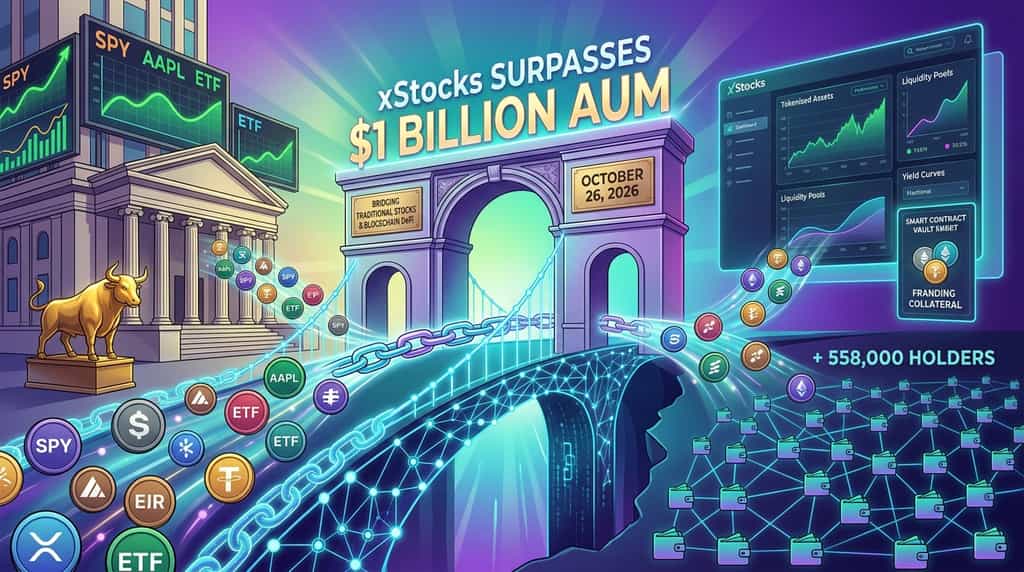
Tokenized equities are bringing traditional stock-market exposure onto public blockchains, and xStocks has reached a notable milestone. As of October 26, 2026, the official xStocks DeFi dashboard reported approximately $1.014 billion in assets under management (AUM), putting the platform above the $1 billion threshold. The figure reflects assets represented by the platform's tokenized products; it should not be confused with the total market capitalization of every tokenized stock across all issuers.
xStocks provides blockchain-based representations of publicly traded equities and exchange-traded funds (ETFs), allowing eligible users to hold and transfer tokens that track the economic value of underlying assets. Its growth highlights increasing interest in connecting traditional financial markets with on-chain trading and decentralized finance (DeFi).
However, the milestone alone does not establish the long-term success of tokenized equities. Investors and market observers should examine what backs the tokens, how pricing and redemption work, what rights holders receive, and how liquidity and regulatory requirements affect access.
What Does the $1 Billion xStocks Milestone Mean?
The $1 billion milestone indicates that xStocks has accumulated substantial value across its tokenized products, but AUM is not the same as trading volume, market capitalization, or net capital inflows. According to the official xStocks DeFi dashboard, the platform's reported AUM stood at approximately $1.014 billion on October 26, 2026. The same dashboard reported more than 558,000 holders, indicating that the ecosystem extends beyond a small group of large participants.
These figures provide a snapshot of the platform's scale, not a complete measure of investor demand. AUM can change as the underlying stock prices move, token supply changes, or users mint and redeem tokens. Holder counts also require careful interpretation because one person may control multiple wallets, and a wallet address does not necessarily represent a unique investor.
The distinction between AUM and market capitalization is especially important in tokenized markets. Market capitalization generally measures a token's circulating supply multiplied by its market price. AUM is a broader measure of the value of assets managed or represented by a platform, depending on the provider's methodology. The two measures may be related, but they are not interchangeable.
For xStocks, the milestone is best understood as evidence of the scale of its tokenized-equity ecosystem. To assess whether that scale is sustainable, observers should also examine secondary-market liquidity, trading activity, redemption mechanisms, the quality of asset backing, and the distribution of holdings across individual products.
What Are xStocks and How Do Tokenized Stocks Work?
xStocks are blockchain tokens designed to provide economic exposure to specific publicly traded stocks and ETFs. According to the official xStocks documentation, each token is backed on a 1:1 basis by the corresponding underlying equity or ETF held in custody. The tokens can then be transferred on supported blockchains and used in compatible applications, subject to each product's terms.
The model connects traditional securities infrastructure with blockchain-based ownership records. In a conventional stock investment, a brokerage and the relevant securities infrastructure maintain records of the investor's position. With tokenized equities, the token records an on-chain position that represents the economic value of an underlying asset. The issuer's custody and legal arrangements remain essential because the blockchain token itself does not replace the underlying security.
xStocks documentation describes two main layers. The primary layer covers issuance and redemption, where eligible participants can obtain or return tokens under the issuer's procedures. The secondary layer includes trading and transfers between wallets or through supported platforms. Secondary-market prices may vary according to supply and demand, liquidity, and trading conditions, even when the token is designed to track an underlying stock.
Tokenization can make financial exposure more programmable. A compatible token may be transferable between supported wallets, integrated into smart contracts, or used in eligible DeFi applications. Yet the exact capabilities depend on the token, blockchain, platform, and legal terms. A token that represents the economic value of a stock should not automatically be treated as identical to holding the stock directly through a brokerage.
Why Is xStocks' Growth Relevant to the Tokenized Stock Market?
xStocks' growth matters because it illustrates how tokenized equities are developing beyond isolated products into a broader market infrastructure. The model combines exposure to familiar public-market assets with blockchain settlement, wallet transfers, and potential DeFi integrations. That combination may appeal to users who already operate on-chain and want access to asset types traditionally held through securities accounts.
Network-level data also provides context for the broader trend. In its September 2026 ecosystem roundup, Solana reported that tokenized stocks on its network had surpassed one million cumulative holder wallets during September. The same report said xStocks trading volume on Raydium exceeded $1.8 billion, while total tokenized equities on Solana reached approximately $4.4 billion that month.
These metrics measure different things. Cumulative holder wallets count addresses rather than verified individuals, trading volume measures transaction activity rather than the value of outstanding tokens, and total tokenized-equity value on a network can include products from multiple issuers. They should not be added together or interpreted as interchangeable evidence of capital inflows.
Even with those limitations, the figures indicate that tokenized equities are gaining a more visible place in blockchain markets. They also show why issuer-specific AUM should be evaluated alongside wider market activity. A growing ecosystem can support more trading venues, wallet integrations, and financial applications, but the durability of that growth depends on user demand, liquidity, asset backing, and the reliability of the underlying infrastructure.
What Benefits Can Tokenized Stocks Offer?
Tokenized stocks can offer more flexible transfers, fractional exposure, and integration with blockchain applications, but their advantages depend on product design and user eligibility. They do not automatically provide every right or protection associated with directly holding a traditional security.
On-chain transferability is one of the main differences. Tokenized assets can move between compatible wallets and applications without relying on the same transfer process used for conventional brokerage holdings. Settlement can be fast when the blockchain and relevant applications are operating normally, although issuance and redemption through the underlying provider may follow separate business-hour procedures.
Fractional exposure can also make it possible to hold smaller amounts of economic exposure to a stock than would be practical through a whole-share purchase. The minimum trade size, supported assets, fees, and available trading pairs depend on the platform. Fractional tokenization does not remove the market risk of the underlying company or ETF.
Programmability is another potential benefit. Compatible tokenized equities can be integrated into smart contracts, lending markets, or other DeFi applications. The Solana ecosystem roundup for September 2026 described xStocks being used as collateral in selected DeFi strategies and reported that Kamino held approximately $20.7 million in xStocks collateral as of September 13. Such integrations may create additional ways to use tokenized assets, but they also introduce smart-contract, liquidation, and protocol risks.
Finally, blockchain records can improve the visibility of token transfers and balances on public networks. That transparency does not mean every aspect of the asset's legal ownership, custody, or redemption can be verified from the token contract alone. Users still need to understand the issuer's documentation and the arrangements supporting each product.
What Risks Should Users Consider Before Using xStocks?
The main risks include market volatility, differences between token prices and underlying share prices, liquidity constraints, smart-contract vulnerabilities, custody exposure, and uncertainty around legal rights. Tokenization changes how an asset is represented and transferred; it does not eliminate the risks of the asset itself.
Market and pricing risk: The value of a tokenized stock is linked to the underlying equity, but secondary-market prices are also affected by available liquidity and supply and demand. During periods of low liquidity or when traditional markets are closed, a token may trade at a premium or discount to the reference price. The ability to trade a token around the clock does not mean the underlying stock market is open at all times.
Smart-contract and blockchain risk: Tokenized assets rely on blockchain infrastructure, token contracts, wallets, and sometimes additional DeFi protocols. Software vulnerabilities, network congestion, transaction errors, or exploits affecting integrated applications can result in losses or delays. Using a self-custodial wallet also means users must protect their private keys and verify transaction details carefully.
Custody and issuer risk: The backing structure matters because the underlying securities are held through custody arrangements rather than inside the token itself. Users should examine who issues the token, where the underlying asset is held, how reserves are documented, and what legal processes apply if the issuer or a service provider experiences financial distress.
Access and regulatory risk: Tokenized securities operate within a changing legal and regulatory environment. Product availability and eligibility vary by jurisdiction and platform. Users should rely on current official terms and confirm that they are eligible to access a particular product. The existence of an on-chain token does not establish that it is suitable or available to every person.
Conclusion
xStocks' reported AUM of approximately $1.014 billion on October 26, 2026, marks a notable milestone for tokenized equities. The figure highlights the scale of an ecosystem that connects traditional stock-market exposure with blockchain-based transfers and potential DeFi applications. Broader market activity, including the growth in tokenized-equity trading on Solana, provides additional context for the sector's development.
However, AUM is only one measure of progress. Holder counts, trading volume, liquidity, asset backing, redemption arrangements, and legal rights each reveal a different part of the market. Tokenized stocks can offer fractional exposure, flexible transfers, and programmable functionality, but they do not necessarily confer the same rights as direct share ownership. They also introduce smart-contract, custody, pricing, and regulatory risks.
The long-term development of tokenized equities will depend on whether issuers can maintain reliable asset backing, provide workable redemption processes, and support sustainable liquidity across platforms. For users researching xStocks, the most useful approach is to verify current figures against official documentation and assess each product on its own terms. The $1 billion milestone signals scale, but continued adoption and sound infrastructure will be more important measures of lasting progress.
FAQs
1. Has xStocks reached $1 billion in assets?
Yes. The official xStocks DeFi dashboard reported approximately $1.014 billion in AUM on October 26, 2026. This figure represents the dashboard's reported assets under management, not the entire tokenized-stock market.
2. Are xStocks the same as owning traditional shares?
No. xStocks are designed to provide economic exposure to underlying equities and ETFs, but they generally do not confer shareholder voting rights. The specific legal rights and mechanisms depend on the product documentation.
3. Can xStocks be traded 24/7?
Supported xStocks can trade on certain secondary markets around the clock. However, issuance and redemption through the provider may follow different operating hours, and prices can diverge from the underlying stock's reference price when traditional markets are closed.
4. How are dividends handled by xStocks?
According to the official xStocks documentation, dividends are reflected through a rebasing mechanism that reinvests them into additional units of the same asset, net of applicable taxes. The exact treatment should be checked in the documentation for the specific token.
6. Can tokenized stocks be used in DeFi applications?
Some tokenized stocks can be used in supported DeFi applications, including selected lending markets and collateral strategies. Availability depends on the token and protocol, and additional risks may include smart-contract vulnerabilities, liquidity problems, and collateral liquidation.
Disclaimer
This general market information, possibly from third-party, commercial, or sponsored sources, is provided for reference and educational purposes only and does not constitute financial or investment advice, an offer, solicitation, or guarantee. We disclaim liability for its accuracy, completeness, reliability, and any resulting losses. Investments/trading are risky; past performance doesn’t guarantee future results. Users should research, judge prudently, and take full responsibility. For further details, please consult KuCoin’s Terms of Use and Risk Disclosure.