

XRP Price Surges 44% in a Week: What’s Driving the Rally and Why Is It Pulling Back?
2026/08/27 16:07:00
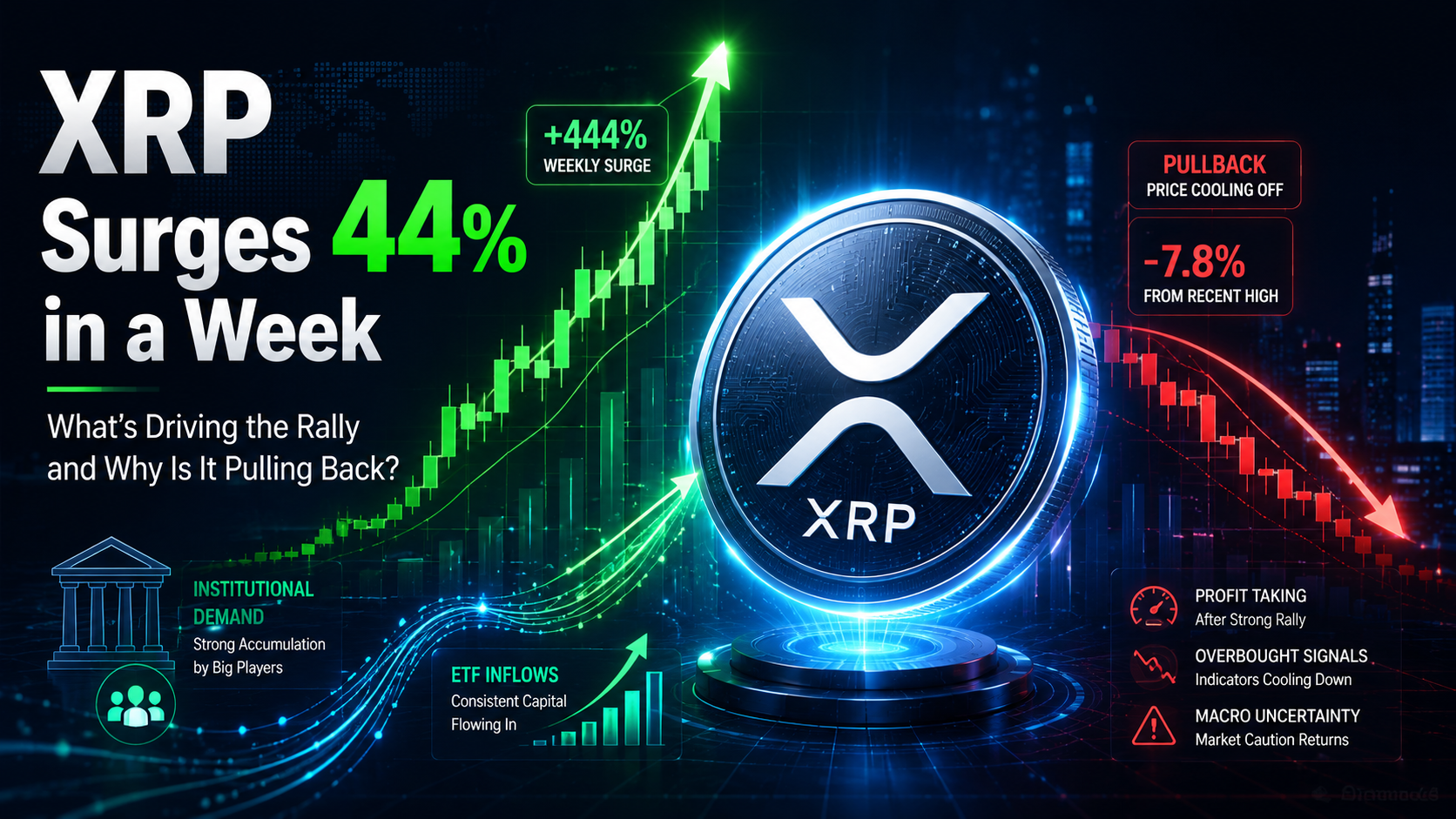
XRP has returned to the center of the crypto market after one of its strongest rallies in months. During the seven-day period measured around August 26, the XRP price gained roughly 44%, climbing from around the $1 area and briefly approaching $1.70. The move significantly outpaced Bitcoin and several other major cryptocurrencies, drawing fresh attention to XRP ETFs, activity on the XRP Ledger, institutional adoption and a rapidly expanding derivatives market.
The rally, however, has already started to cool. XRP fell back toward $1.40 by August 27, while its rolling seven-day gain narrowed as the measurement window shifted. The pullback raises an important question: if ETF inflows and several XRP-related catalysts remain constructive, why is the price falling? The answer lies in the difference between the forces that started the rally and the speculative leverage that later amplified it.
XRP Surged 44% in a Week—What Happened?
XRP entered the second half of August under considerable pressure, trading close to the psychologically important $1 level. Momentum changed quickly after a broader crypto recovery began around August 19. XRP moved through $1.20 and $1.40 before reaching roughly $1.70 on August 22. At the August 26 snapshot, its seven-day gain was close to 44%, making XRP one of the strongest-performing large-cap cryptocurrencies during that window.
The rally was not driven by one isolated announcement. A rebound in global risk appetite gave the crypto market its initial push, while XRP-specific developments—including ETF inflows, new institutional initiatives involving Ripple and the XRP Ledger, sharply higher network activity and aggressive derivatives trading—helped XRP outperform the wider market. Once the token approached $1.70, however, profit-taking and increasingly crowded leveraged positions began to change the short-term balance between buyers and sellers.
| Market Development | Potential Impact on XRP |
| Broader crypto market rebound | Improved risk appetite across digital assets |
| Continued XRP ETF inflows | Added institutional demand |
| Rising XRPL activity | Strengthened the network adoption narrative |
| Growing futures activity | Accelerated momentum but increased leverage risk |
| XRP approached $1.70 | Triggered resistance and profit-taking |
Why Is XRP Price Going Up?
The simplest explanation for XRP’s rally is that several bullish forces arrived at roughly the same time. The initial move was part of a wider recovery across crypto assets after stress in the U.S. bond market eased temporarily. Bitcoin moved from below $68,000 toward $80,000, creating a more favorable environment for larger altcoins. XRP then benefited from its own catalysts, allowing it to outperform the broader market rather than simply following Bitcoin higher.
Institutional demand through spot XRP ETFs added another layer of support, while Ripple-related developments strengthened expectations that the XRP Ledger could capture more activity in stablecoins, lending and tokenized finance. Meanwhile, sharply rising network participation attracted traders looking for momentum. As prices climbed, futures traders increasingly joined the move with leverage. The result was a feedback loop in which improving fundamentals, stronger sentiment and speculative positioning reinforced one another—at least until the market became crowded.
A Broader Crypto Rally Gave XRP the First Push
One of the most important catalysts did not come from Ripple at all. In August, the U.S. Treasury increased the size of its long-duration bond buyback operations as policymakers attempted to improve liquidity following a sharp rise in Treasury yields. Reuters reported that the Treasury doubled long-end buybacks to at least $4 billion per operation. The move temporarily eased pressure in bond markets and was followed by gains across stocks and cryptocurrencies.
This should not be confused with quantitative easing. The Treasury was not printing money to buy XRP or directing investors to buy XRP from exchanges, nor was the Federal Reserve launching a new asset-purchase program. The more relevant transmission mechanism was sentiment: better bond-market liquidity and lower pressure on long-term yields supported investor appetite for riskier assets. Bitcoin reacted first, and capital subsequently spread into Ethereum and major altcoins. That broader recovery explains why the crypto market was rising, but XRP-specific factors are needed to explain why XRP rose much faster.
XRP ETF Inflows Are Strengthening Institutional Demand
Spot XRP ETFs have become an increasingly important part of the token’s market structure. U.S. products recorded approximately $23.87 million of net inflows on August 25, extending their positive streak to nine consecutive trading sessions and bringing cumulative net inflows to roughly $1.6 billion. The consistency of those flows became especially notable because institutional demand continued even as XRP began retreating from its recent high.
ETF inflows matter because they create an additional channel through which traditional investors can obtain XRP exposure without necessarily opening an account at a crypto exchange or managing tokens directly. As assets enter spot-backed funds, the products need exposure to the underlying cryptocurrency, adding another source of market demand. This does not mean every dollar flowing into an ETF produces an immediate dollar-for-dollar increase in XRP’s price, but sustained inflows can alter the supply-demand balance over longer periods.
The recent pullback therefore illustrates an important distinction. Positive ETF flows do not guarantee that XRP will rise every day. Short-term prices are simultaneously influenced by existing holders selling, market makers hedging exposure, Bitcoin volatility, futures liquidations and traders taking profits. ETF inflows can remain constructive while a heavily leveraged spot and derivatives market goes through a short-term correction.
Ripple and XRPL Growth Added Another Catalyst
Ripple also contributed to the bullish narrative by backing a new institutional credit initiative involving Clearpool and Cicada Partners. The proposed fund is designed to provide working-capital loans denominated in the RLUSD stablecoin to fintech and payments companies through infrastructure built around the XRP Ledger. Ripple is participating as a limited partner, while Cicada will handle borrower selection and credit risk and Clearpool will build the lending infrastructure.
The distinction between RLUSD and XRP is important. The proposed loans would be issued and repaid in RLUSD; institutions are not simply borrowing XRP. XRP would continue to serve functions such as transaction fees and required account balances on the ledger. In addition, the product is not yet fully live on the XRPL main network because it depends on proposed lending and vault functionality, including XLS-66 and XLS-65, that has been moving through the network’s amendment process. The development is therefore more meaningful as evidence of growing institutional interest in XRPL infrastructure than as a source of immediate direct XRP buying.
XRP Ledger Activity Is Exploding
The price rally has also coincided with a substantial increase in activity on the XRP Ledger. Data cited from Santiment showed active addresses rising from about 47,180 on August 10 to approximately 356,070 by August 24—an increase of more than 650%. Such a rapid change indicates that substantially more addresses were interacting with the network during the rally.
That does not automatically mean hundreds of thousands of new long-term investors entered XRP. Active addresses can rise because of trading, transfers between wallets, application activity, speculative positioning or existing users becoming more active. The metric is therefore best interpreted as evidence of increased network participation and attention rather than a direct price forecast. Still, the combination of rising prices, ETF inflows and stronger on-chain activity helped reinforce the perception that XRP’s recovery was supported by more than price speculation alone.
Futures Traders Turned the Rally Into a Leveraged Trade
The character of the rally began to change as XRP moved higher. According to CryptoQuant data cited by CoinDesk, XRP’s estimated leverage ratio on Binance rose to around 0.21, its highest level since January. The ratio compares derivatives open interest with the amount of XRP held on the exchange; a higher reading generally indicates that traders are using more leveraged exposure relative to available exchange reserves.
Futures trading also became much larger than spot activity. XRP futures generated approximately $6.4 billion in 24-hour volume, compared with roughly $1.2 billion in spot volume, while futures open interest stood near $3.45 billion. Positioning was also increasingly one-sided. On Binance, roughly two accounts were long for every one account short, while the ratio among top traders was closer to three-to-one.
This matters because leverage works in both directions. When prices are rising, leveraged traders can increase buying pressure and make an already strong rally accelerate. But if prices reverse, positions that no longer have sufficient collateral can be forcibly closed. Long liquidations then create additional selling pressure, potentially turning a normal correction into a faster decline. The same derivatives activity that helped magnify XRP’s upside therefore became one of the main risks to the rally.
Why Is XRP Price Pulling Back?
The first reason for XRP’s pullback is straightforward: the token rose extremely quickly. A gain of around 44% in one week creates strong incentives for traders who bought earlier to lock in profits. This selling became more important as XRP approached the $1.69–$1.70 area, where the first major rally encountered resistance. Once the market failed to establish a sustained breakout above that zone, momentum traders had fewer reasons to keep chasing the price.
The second factor is leverage. XRP fell nearly 5% to around $1.44 on August 26 as derivatives positioning remained heavily tilted toward longs. With billions of dollars in open futures positions and leverage at a multi-month high, even a relatively modest decline can force overextended traders to close positions. That process can produce a self-reinforcing sequence: price falls, leveraged longs are liquidated, forced selling pushes prices lower, and additional positions come under pressure.
Broader market conditions also matter. XRP may have its own catalysts, but it remains a high-volatility crypto asset whose short-term direction is closely connected to Bitcoin and overall risk sentiment. As of August 27, XRP was trading around $1.40, down roughly 2.9% over 24 hours. Its rolling seven-day gain had narrowed to around 28.2%, even though the earlier August 26 snapshot showed the widely reported 44% weekly advance. That difference reflects both the pullback and the changing seven-day measurement window.
Is This a Healthy Pullback or the Start of a Deeper Drop?
A pullback after such a fast rally does not automatically invalidate the bullish factors behind the move. A healthier scenario would involve leverage declining while ETF demand and spot buying remain relatively stable. Open interest could gradually fall as speculative traders exit, allowing XRP to consolidate without a major collapse in underlying demand. In that environment, lower leverage would actually leave the market in a more sustainable position if buyers eventually return.
A more bearish scenario would look different. Persistent ETF outflows, weakening spot demand, a major Bitcoin decline and continued long liquidations would suggest that the correction is spreading beyond speculative futures positioning. The difference between the two scenarios is therefore not simply whether XRP has a red trading day, but whether the market is removing excessive leverage while underlying demand survives.
| Signal | Healthier Pullback | Higher-Risk Correction |
| XRP ETF flows | Remain positive | Turn persistently negative |
| Open interest | Declines gradually | Drops sharply with price |
| Leverage | Cools toward normal levels | Remains high during weakness |
| Spot demand | Holds relatively firm | Selling pressure accelerates |
| Bitcoin | Stable or consolidating | Enters a broader sell-off |
What Price Levels Matter for XRP Now?
The clearest upside reference is the recent $1.69–$1.70 high. XRP’s failure to remain above that area suggests sellers were willing to take profits as the rally approached $1.70. A future sustained break above the region would indicate that buyers had absorbed at least some of the supply that stopped the first advance. Until then, $1.70 is better viewed as an important market reference than as a guaranteed next target.
Closer to the current market, the $1.40 region has become another area to watch as XRP attempts to stabilize after the pullback. If the token weakens further, traders are likely to examine previous breakout zones for evidence of renewed spot demand. These levels should not be treated as automatic reversal points. A support zone becomes meaningful only if buyers actually appear and market structure—including volume, open interest and liquidation activity—starts to confirm stabilization.
What Could Drive XRP’s Next Major Move?
ETF flows are likely to remain one of the clearest indicators of institutional demand. If XRP funds continue receiving capital while the token consolidates, that would suggest professional and traditional-market demand has not disappeared simply because momentum traders are reducing exposure. Sustained ETF outflows, by contrast, would remove one of the strongest structural arguments supporting the recent rally.
The broader crypto market will be equally important. The initial XRP rally emerged during a Bitcoin-led recovery after the Treasury’s bond-market intervention. If Bitcoin remains resilient and financial conditions continue to support risk assets, the environment may remain favorable for large altcoins. A renewed rise in long-term yields, tighter liquidity or a broader Bitcoin correction could instead make it difficult for XRP to sustain an independent rally regardless of XRP-specific news.
Finally, traders should watch the relationship between price and leverage. One potentially constructive setup would be XRP stabilizing while futures open interest and the estimated leverage ratio decline. That would suggest speculative excess is being removed without destroying spot demand. At the same time, progress in RLUSD adoption, institutional lending, tokenization and other XRPL applications could shape the longer-term narrative. Regulatory developments in the United States will remain relevant as well, although the Ripple-SEC appeals should not be treated as a new 2026 catalyst: the SEC and Ripple dismissed their respective appeals in August 2025, leaving the district court’s final judgment in effect.
Is the XRP Rally Sustainable?
There are legitimate reasons why the latest XRP rally attracted more attention than a purely speculative price spike. Spot XRP ETFs have continued attracting capital, activity on the XRP Ledger has increased sharply, and Ripple is pushing deeper into stablecoin and institutional-finance infrastructure. Combined with a stronger broader crypto market, those developments provide a more substantial backdrop than price momentum alone.
The risk is that price appreciation moved faster than those longer-term developments. A 44% weekly surge attracted a large amount of leveraged futures exposure, leaving XRP vulnerable to liquidations when momentum reversed. The sustainability of the move may therefore depend less on whether XRP immediately returns to $1.70 and more on whether institutional and spot demand remain intact while speculative leverage cools.
Conclusion
XRP’s latest rally was the result of several forces working together. A broader risk-asset recovery created the initial conditions, while continued XRP ETF inflows, rising XRP Ledger activity and new institutional initiatives involving Ripple strengthened the token’s individual narrative. Once XRP began accelerating, futures traders added leverage and pushed momentum even further.
That leverage is now one of the main reasons the market is pulling back. Profit-taking near $1.70 and crowded long positioning have increased the risk of liquidations, even while some of the longer-term catalysts remain constructive. The next stage of the XRP market will therefore depend on more than price alone. ETF flows, spot demand, derivatives leverage, Bitcoin’s direction and actual adoption of XRPL infrastructure will offer a clearer indication of whether the recent rally is consolidating or losing momentum.
FAQs
Is XRP still below its all-time high?
Yes. Despite the sharp August rally, XRP remains well below the record levels reached during previous market cycles. This is useful context because a large weekly percentage gain does not necessarily mean an asset is close to a historical high; the starting price and previous drawdown also matter.
Does Ripple own XRP?
Ripple holds XRP and uses the XRP Ledger in parts of its business, but XRP is not equity in Ripple. Buying XRP does not give a holder ownership rights, voting rights or a claim on Ripple’s corporate profits in the way that owning shares in a company might.
Can investors buy XRP through an ETF instead of a crypto exchange?
Spot XRP ETFs provide a way to obtain price exposure through traditional brokerage infrastructure without directly managing a crypto wallet. Direct XRP ownership and ETF exposure are not identical, however. Direct holders control tokens that can be transferred or used on compatible blockchain services, while ETF investors own shares in a financial product.
Does RLUSD use XRP?
RLUSD and XRP are different assets. RLUSD is Ripple’s dollar-pegged stablecoin, while XRP is the native asset of the XRP Ledger. Activity involving RLUSD on XRPL can create network usage, but growth in RLUSD circulation should not be interpreted as an equivalent amount of direct XRP buying.
What is the difference between XRP and the XRP Ledger?
XRP is the native digital asset, while the XRP Ledger, or XRPL, is the underlying blockchain network. XRP can be used for transaction fees and other network functions, while XRPL supports transfers and applications involving multiple types of assets.
Is XRP considered a security in the United States?
The legal picture is more nuanced than a simple yes-or-no label. In the Ripple litigation, different types of XRP transactions received different legal treatment, and the SEC and Ripple ultimately dismissed their appeals in August 2025. The final district court judgment, including the civil penalty and injunction involving Ripple, remained in effect. Regulatory treatment can also depend on how an asset is offered or sold, so the case should not be summarized as declaring that every XRP transaction has the same legal status.
What is XRP mainly used for?
XRP is the native asset of the XRP Ledger and can be used to pay transaction fees, maintain required account balances and facilitate value transfers across the network. Its market price, however, is also influenced by trading demand, institutional products, investor expectations and wider crypto-market conditions, meaning token utility is only one part of its valuation.
🔥 KuCoin Offers A More Stable Option in A Volatile Market
If you worry about the frequent ups and downs in the market, and pursue a more stable option to earn money passively, KuCoin is the right place to come:
Simple Earn: Deposit and withdraw tokens anytime, earning stable returns.
Kucoin Earn: Earn stable profits with professional asset management.
Hold to Earn: Earn rewards by holding assets in Funding, Trading, Margin, Futures, Mining, and Unified Accounts.
Staking: Unlock the earning potential of on-chain assets.
Advanced Investments: Advanced Investments offer a variety of structured products to help your money grow in any market.
Shark Fin: Principal Protection and Guaranteed Gains
Dual Investment: Buy low and sell high with transparent return calculations.
Snowball: High yields, with price protection.
Discount Buy: Buy crypto at discount prices.
KCS Loyalty: Level up to enjoy exclusive perks by staking ≥ 1 KCS.
KuCoin Wealth: Discover future value and begin your smart investing journey.
KCS Benefits: Hold and stake KCS to access benefits across the platform.
KCS Staking 2.0: Participate in KCS on-chain governance to earn yield.
Disclaimer: This content is for informational purposes only and does not constitute investment advice. Cryptocurrency investments carry risk. Please do your own research (DYOR).