

Why Is Gold Falling Despite U.S. Fiscal Risks? Fed vs. Treasury Policy Clash Explained
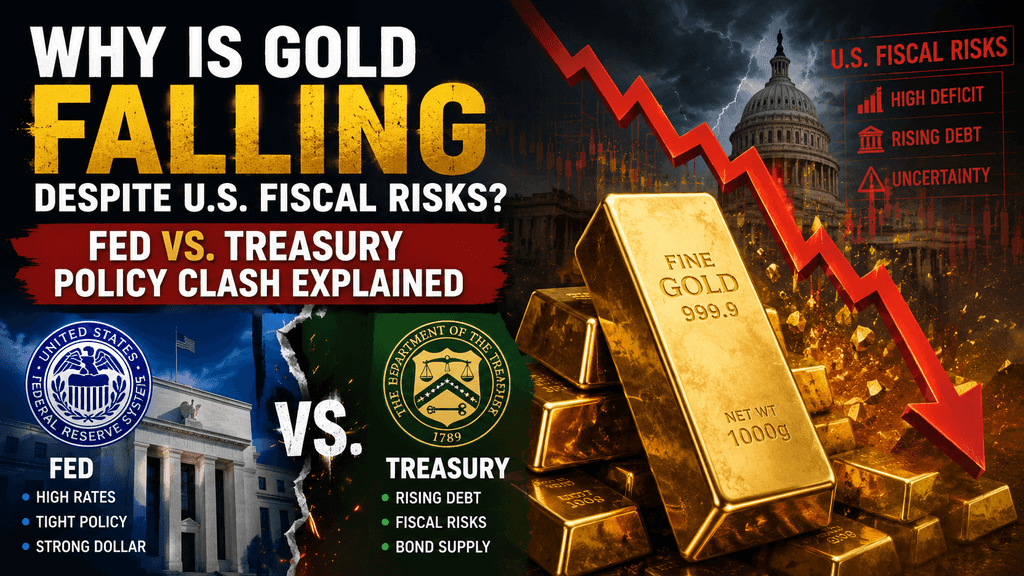
Gold has suddenly lost momentum after one of its strongest rallies of the year, creating an unusual puzzle for investors. U.S. fiscal deficits remain large, federal debt continues to climb, long-term Treasury yields have become increasingly difficult to contain, and geopolitical risks are still elevated. These conditions would normally strengthen demand for gold as a store of value. Yet the gold price has moved sharply lower.
The explanation lies in a growing tug-of-war between fiscal concerns and monetary policy. On one side, the U.S. Treasury is expanding long-term bond buybacks in an effort to support liquidity in the Treasury market. On the other, Federal Reserve Chair Kevin Warsh has made clear that inflation remains too high and that monetary policy may need to stay restrictive. That has pushed rate-hike expectations higher, increased bond yields and raised the opportunity cost of holding gold.
Understanding why gold is falling therefore requires looking beyond fiscal risk alone. The more important question is which force is dominating markets right now: concerns about U.S. debt and currency debasement, or the Fed's determination to control inflation.
Why Is Gold Falling Right Now?
Gold entered the final days of August after a powerful rally, helped in part by falling long-term yields and renewed concerns about U.S. government borrowing. But the trend reversed sharply following Warsh's August 28 speech at the Jackson Hole Economic Policy Symposium. Spot gold fell more than 3% that day as traders increased expectations that the Federal Reserve could raise interest rates again. By September 1, spot gold was trading near $4,437 per ounce, well below its recent three-month high. Markets were assigning roughly a two-thirds probability to a September Fed rate increase.
The selloff does not mean investors suddenly stopped worrying about U.S. debt. Instead, the immediate driver of the gold price has shifted toward monetary policy. Warsh emphasized that the Fed's 2% inflation objective remains firm and that current inflation is still running well above that level. He noted that 12-month PCE inflation stood at 3.7%, while the six-month annualized change was 4.1%, and said recent improvement had not been sufficient to demonstrate that underlying inflation was returning to target quickly enough.
That distinction is crucial. Fiscal deterioration can provide long-term support for gold, but markets do not price long-term narratives in isolation. When investors suddenly expect higher interest rates, rising real yields and a stronger dollar can overwhelm the fiscal argument in the short run. The current gold correction is therefore less a rejection of the fiscal-risk thesis than a repricing of how restrictive the Fed may become.
The Fed Is Putting Pressure on Gold
Gold does not generate interest, which makes interest rates one of the most important variables for its valuation. When cash and government bonds offer higher returns, investors face a greater opportunity cost for holding a non-yielding asset. This relationship becomes particularly important when real yields—the return on bonds after accounting for inflation expectations—rise. Higher real yields allow investors to earn a positive inflation-adjusted return without taking the price risk associated with gold.
The dollar creates a second channel. A more hawkish Federal Reserve can push U.S. yields higher and increase demand for dollar-denominated assets. Because international gold is generally priced in U.S. dollars, a stronger dollar makes the metal more expensive for buyers using other currencies. That combination of higher yields and a stronger dollar helped accelerate the late-August selloff. Reuters reported that expectations for a September rate hike jumped significantly following Warsh's Jackson Hole comments, while the dollar strengthened and gold suffered its largest daily decline in weeks.
This explains how gold can remain attractive as a long-term hedge while falling in the short term. The question is not simply whether inflation or fiscal risks exist. It is whether investors currently receive a sufficiently attractive real return from competing assets. If the Fed keeps policy restrictive and real yields stay elevated, gold may struggle even while concerns about government debt continue to build.
Why U.S. Fiscal Risks Still Matter for Gold
The fiscal backdrop has not improved. The Congressional Budget Office projects a U.S. federal deficit of approximately $1.9 trillion in fiscal 2026, equal to 5.8% of GDP. By 2036, the annual deficit is projected to reach roughly $3.1 trillion, with rising net interest costs responsible for much of the increase. Debt held by the public is projected to rise from around 101% of GDP in 2026 to 120% by 2036, exceeding the previous post-World War II record.
That matters for gold because heavily indebted governments become increasingly sensitive to high borrowing costs. More debt means more Treasury issuance, while higher yields increase the amount the government must spend servicing existing and newly issued debt. CBO estimates that federal net interest outlays will exceed $1 trillion in 2026 alone. Over time, investors may begin to question how long a government can comfortably combine large deficits, rising debt and persistently high real interest rates.
This is where the so-called debasement trade becomes relevant. If investors believe fiscal pressures will eventually encourage lower real rates, greater liquidity creation or a weaker currency, scarce assets such as gold can become more attractive. Fiscal risk does not guarantee that gold will rise every day, but it strengthens the longer-term case for holding assets that do not depend directly on the creditworthiness or monetary policy of a single government.
Why Is the Treasury Buying Back Long-Term Bonds?
The U.S. Treasury added another dimension to the debate on August 19 when it announced a significant expansion of its liquidity-support buyback program for longer-dated government bonds. Beginning September 9, the maximum size of individual buyback operations in the 10-to-20-year and 20-to-30-year sectors will increase from $2 billion to at least $4 billion. The larger operations are scheduled to remain in place through the current refunding quarter ending November 4. Treasury said the change was designed to provide greater liquidity support in longer-dated securities.
The announcement came as long-term Treasury yields had been under significant pressure. The 30-year yield recently reached around 5.33%, its highest level since 2007, as investors demanded greater compensation for duration risk amid heavy government borrowing and persistent inflation concerns. Rising long-term rates do more than increase the government's interest bill: they can raise mortgage costs, tighten corporate financing conditions and reduce the present value investors place on equities and other long-duration assets.
However, Treasury buybacks should not be confused with quantitative easing. QE is a Federal Reserve monetary-policy operation involving central-bank purchases of securities and an expansion of the Fed's balance sheet. Treasury buybacks are debt-management operations intended primarily to improve market functioning and liquidity. The World Gold Council has also stressed that the current program is not formal yield curve control, even though the debate over whether policymakers may eventually consider more aggressive action to restrain long-term yields has intensified.
Fed vs. Treasury: Where Is the Policy Clash?
The phrase “Fed vs. Treasury policy clash” does not mean the two institutions have formally entered a public dispute. The more accurate interpretation is that their immediate policy priorities are pulling financial conditions in different directions. The Treasury is increasingly concerned with liquidity and stress in the long end of the government bond market, while the Federal Reserve remains focused on bringing inflation back toward its 2% target.
The contrast can be summarized simply:
| Policy Force | Main Concern | Market Direction | Potential Gold Effect |
| Federal Reserve | Persistent inflation | Higher policy rates and real yields | Short-term bearish |
| U.S. Treasury | Long-term bond liquidity and borrowing stress | Support for long-duration Treasuries | Potentially bullish |
| U.S. fiscal outlook | Rising deficits and debt | Debasement and sustainability concerns | Longer-term bullish |
Warsh's own policy framework makes this tension particularly important. At Jackson Hole, he described short-term interest rates as the Fed's predominant monetary-policy tool and argued that unconventional policies should generally be reserved for genuine crises. He also said current financial conditions were difficult to characterize as broadly restrictive and emphasized that inflation remained above target. That suggests the Fed is not currently prepared to suppress long-term yields simply because government financing has become more expensive.
Gold sits directly between these forces. A Treasury policy perceived as reducing long-term borrowing stress can lower yields and revive debasement concerns, both potentially supportive for bullion. A hawkish Fed, however, can push real yields in the opposite direction. For now, monetary tightening expectations have gained the upper hand.
Why Fiscal Risk Is Not Enough to Keep Gold Rising
One of the biggest mistakes in analyzing gold is assuming that a single macroeconomic variable determines its price. U.S. fiscal risk matters, but gold also responds to real interest rates, the dollar, inflation expectations, central-bank demand, ETF flows, geopolitical uncertainty and broader investor positioning. Several of these forces can move in opposite directions at the same time.
Consider the current environment. The U.S. fiscal outlook is deteriorating, which is potentially positive for gold over longer horizons. At the same time, persistent inflation has increased the probability of additional Fed tightening. That pushes bond yields higher and raises the relative attractiveness of cash and fixed-income assets. As a result, gold can fall even while the underlying fiscal conditions that supported its earlier rally remain unchanged.
This also helps explain why the late-August decline should be viewed in context. Gold still gained approximately 9.7% during August despite falling sharply at the end of the month, making it one of the metal's strongest monthly performances of the year. The recent decline therefore looks more like a meaningful correction following a strong fiscal-risk-driven rally than evidence that the broader demand for gold has disappeared.
Why Geopolitical Risk Is Not Lifting Gold
Geopolitical instability normally creates a straightforward bullish narrative for gold. Investors seek assets perceived as stores of value during wars, financial crises and periods of political uncertainty. Yet the latest escalation in Middle East tensions illustrates how geopolitical risk can also produce a less intuitive outcome.
Renewed U.S.-Iran tensions have pushed Brent crude above $90 per barrel and increased concerns about disruption to energy flows through the Strait of Hormuz. Higher oil prices can feed directly into transportation, manufacturing and consumer prices, making the inflation outlook more difficult for central banks. On September 1, the U.S. 10-year Treasury yield moved toward 4.8% as rising oil prices and geopolitical uncertainty intensified inflation concerns.
The transmission mechanism can therefore become: geopolitical conflict → higher oil prices → higher inflation expectations → more hawkish Fed expectations → higher yields → pressure on gold. Safe-haven buying is still present, but it is competing with a stronger interest-rate effect. This explains why geopolitical tensions do not automatically produce higher gold prices, particularly when the conflict itself threatens to keep inflation above the Fed's target.
Is This a Gold Correction or a Bigger Reversal?
There is not yet enough evidence to conclude that gold has entered a sustained bearish trend. The metal had risen rapidly before the recent selloff, and August still produced a gain of nearly 10%. Sharp corrections are not unusual after large moves, especially when traders rapidly reposition around a major central-bank event.
A bullish scenario would require some combination of softer inflation, weaker labor-market data, falling Fed rate-hike expectations, lower real yields and renewed dollar weakness. Under those conditions, the market could turn its attention back toward fiscal deficits, Treasury-market stress and concerns about the long-term purchasing power of the dollar. Continued central-bank demand or escalating geopolitical risks could reinforce that trend.
The bearish scenario is almost the mirror image. If inflation remains sticky, employment remains resilient and the Fed concludes that further tightening is necessary, real yields could stay elevated or rise further. A stronger dollar would add another headwind. Gold would then have to compete against increasingly attractive yields on government debt, potentially producing a deeper correction even if the longer-term fiscal story remains unresolved.
Could Fiscal Dominance Become the Bigger Gold Story?
The deeper issue behind the Fed-Treasury tension is the possibility of fiscal dominance. In simple terms, fiscal dominance can emerge when government debt and debt-servicing costs become so large that monetary policy faces growing pressure to accommodate fiscal needs. Instead of setting interest rates purely according to inflation and employment conditions, a central bank may eventually face pressure to consider whether high rates are creating unsustainable financing costs for the government.
The United States is not necessarily operating under a full fiscal-dominance regime today. The Fed still controls monetary policy independently, and Warsh has explicitly emphasized price stability and conventional interest-rate policy. But the underlying numbers explain why investors are discussing the issue. Public debt is projected to keep rising, deficits remain unusually large outside a recession, and net interest costs are already above $1 trillion annually. Meanwhile, the Treasury is expanding measures intended to improve conditions in the long end of the bond market.
For gold investors, the important question is what happens if those trends continue. If the market eventually believes that the Fed cannot maintain high real rates indefinitely because fiscal financing costs have become too burdensome, expectations for future monetary accommodation could strengthen the debasement trade again. Gold's long-term attraction would then come not simply from inflation, but from doubts about whether monetary and fiscal authorities can simultaneously maintain price stability, low borrowing costs and rapidly growing government debt.
What Could Move Gold Next?
The next move in gold will probably depend less on headlines about the current price and more on incoming U.S. economic data. Labor-market reports are particularly important because the Fed currently sees employment conditions as relatively stable. Warsh said at Jackson Hole that unemployment remained around 4.1% and that the labor market was broadly consistent with full employment, allowing policymakers to place greater emphasis on inflation.
That means upcoming job-openings data, private employment figures and nonfarm payrolls could quickly change rate expectations. Weak labor data could reduce the probability of additional Fed tightening, pull yields lower and provide relief for gold. Strong employment data, by contrast, would give policymakers more room to raise rates if inflation stays elevated. Inflation reports themselves remain equally important, especially PCE data because that is the Fed's preferred inflation gauge.
Investors should also watch real yields, the U.S. dollar and what happens when the Treasury's expanded long-term buybacks begin on September 9. If the operations meaningfully reduce long-end market stress without reigniting inflation concerns, gold could benefit. But if oil prices and inflation keep climbing while the Fed maintains a hawkish stance, the monetary-policy headwind could remain dominant. The central question is no longer whether U.S. fiscal risks exist; it is whether those risks become powerful enough to outweigh restrictive monetary policy.
Conclusion
Gold is falling because the market is currently giving greater weight to the Federal Reserve than to the long-term U.S. fiscal story. Warsh's hawkish Jackson Hole message pushed investors toward expectations of higher rates, stronger real yields and a greater opportunity cost for holding a non-yielding asset. That has temporarily outweighed concerns about large federal deficits, growing debt and stress in the long-term Treasury market.
Yet those fiscal risks have not disappeared. The Treasury is preparing to double the size of selected long-term bond buybacks, public debt is projected to continue rising relative to GDP, and interest expenses are becoming an increasingly important part of the federal budget. These trends continue to support the longer-term debate over currency debasement and fiscal dominance.
Gold is therefore caught between two different time horizons. In the short term, Fed policy and real yields may determine direction. Over the longer term, debt sustainability and confidence in fiscal and monetary policy could become increasingly important. The next major gold move may depend on which of those narratives takes control first.
FAQs
Does the U.S. Treasury directly control interest rates?
No. The Federal Reserve directly sets its target range for short-term interest rates, while Treasury yields across the market are determined through trading and investor demand. However, Treasury decisions about how much debt to issue, which maturities to sell and whether to conduct buybacks can affect the supply, liquidity and risk premium of government bonds. As a result, the Treasury can influence market conditions without directly setting bond yields.
Are Treasury buybacks financed by printing new money?
Treasury buybacks should not automatically be interpreted as money printing. They are debt-management transactions in which the Treasury repurchases outstanding securities while managing its broader financing needs through cash balances and new issuance. This differs fundamentally from Federal Reserve quantitative easing, where the central bank creates reserve balances to purchase securities and expands its own balance sheet.
Can gold rise while the U.S. dollar is also rising?
Yes. Although gold and the dollar often move inversely, the relationship is not absolute. During severe financial or geopolitical stress, global investors may demand both dollar liquidity and gold as safe-haven assets. Strong central-bank gold purchases, physical demand or concerns about financial-system stability can also allow gold to rise even when the dollar remains firm.
Why do central banks hold gold when it pays no interest?
Central banks do not evaluate gold solely on yield. Gold is a highly liquid reserve asset with no direct corporate or sovereign counterparty risk, and it can help diversify reserves away from individual currencies and government bonds. Its role becomes particularly valuable when central banks want protection against geopolitical fragmentation, currency volatility or extreme financial-system risks.
What is the difference between gold as an inflation hedge and a crisis hedge?
The two ideas overlap but are not identical. Gold as an inflation hedge is based on preserving purchasing power over longer periods when currency values decline. Gold as a crisis hedge is based on demand for an asset outside conventional credit relationships during geopolitical, banking or sovereign-debt stress. In the short term, gold does not always rise with inflation because aggressive central-bank tightening in response to inflation can raise real yields and temporarily push gold prices lower.
🔥 KuCoin Offers A More Stable Option in A Volatile Market
If you worry about the frequent ups and downs in the market, and pursue a more stable option to earn money passively, KuCoin is the right place to come:

Simple Earn: Deposit and withdraw tokens anytime, earning stable returns.
Kucoin Earn: Earn stable profits with professional asset management.
Hold to Earn: Earn rewards by holding assets in Funding, Trading, Margin, Futures, Mining, and Unified Accounts.
Staking: Unlock the earning potential of on-chain assets.
Advanced Investments: Advanced Investments offer a variety of structured products to help your money grow in any market.
Shark Fin: Principal Protection and Guaranteed Gains
Dual Investment: Buy low and sell high with transparent return calculations.
Snowball: High yields, with price protection.
Discount Buy: Buy crypto at discount prices.
KCS Loyalty: Level up to enjoy exclusive perks by staking ≥ 1 KCS.
KuCoin Wealth: Discover future value and begin your smart investing journey.
KCS Benefits: Hold and stake KCS to access benefits across the platform.
KCS Staking 2.0: Participate in KCS on-chain governance to earn yield.
Disclaimer: This content is for informational purposes only and does not constitute investment advice. Cryptocurrency investments carry risk. Please do your own research (DYOR).