

What Does the Binance Hack Mean for Institutional Crypto Custody?
Introduction
Recent security incidents involving major centralized cryptocurrency trading venues have reignited structural debates across the digital asset industry. Following security breaches and subsequent operational adjustments at prominent centralized platforms, institutional market participants are re-evaluating where and how they store digital assets. Industry executives and market analysts suggest that these developments may accelerate a broader migration toward independent, institutional-grade custody solutions. Understanding this shift requires examining how institutional risk management models operate, the distinctions between exchange-held funds and qualified custodians, and the long-term implications for digital asset market infrastructure.
Key Takeaways
Recent security breaches among centralized crypto exchanges are accelerating institutional demand for independent, third-party custody solutions.
-
Decentralization of Risk: Institutional investors are increasingly separating trading execution from asset storage to mitigate single-point-of-failure vulnerabilities.
-
Regulatory Pressures: Fiduciary standards and institutional compliance mandates require verified segregation of client funds from corporate balance sheets.
-
Technical Safeguards: Third-party custodians typically employ multi-party computation (MPC) and hardware security modules (HSMs) designed specifically to withstand sophisticated cyberattacks.
-
Operational Trade-Offs: While independent custody enhances security and compliance alignment, it can introduce friction in trading execution latency and capital efficiency.
How Are Security Breaches Driving Institutional Custody Shifts?
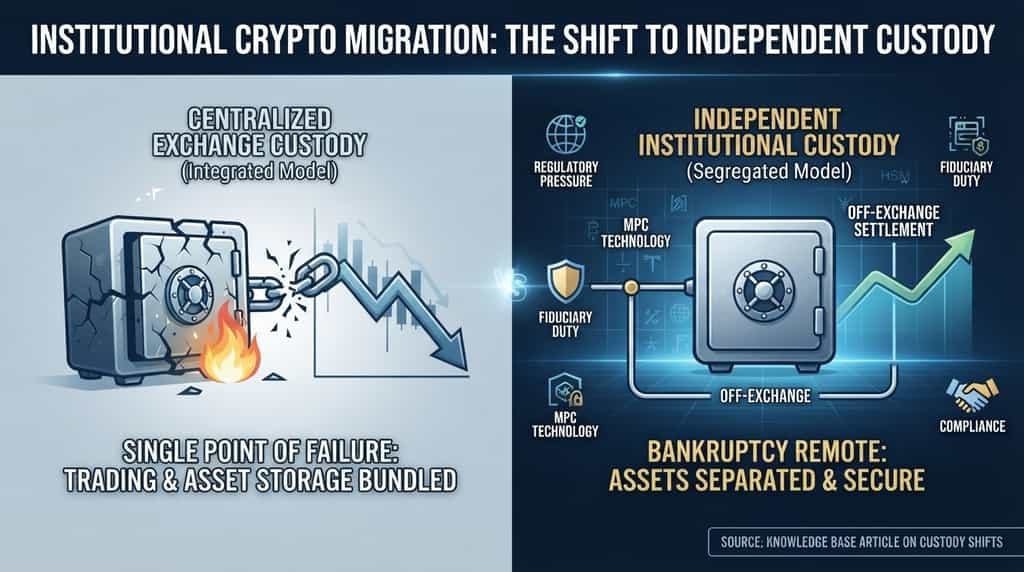
When high-profile security incidents occur within the digital asset ecosystem, institutional risk committees immediately review their counterparty exposure. Centralized trading venues historically bundled liquidity, execution, and custody into a single operational umbrella. While this integrated model offers operational efficiency and rapid trade settlement, it creates a concentration risk where a security breach can compromise client assets alongside exchange operations.
According to market commentary from institutional digital asset prime brokerages like FalconX, security events often serve as catalysts for structural risk mitigation. Institutional participants—such as hedge funds, asset managers, and corporate treasuries—operate under strict fiduciary mandates. When systemic vulnerabilities are exposed, these entities face pressure from risk officers and limited partners to move assets away from exchange-hosted wallets and into dedicated, bankruptcy-remote custody arrangements. This separation ensures that even if an execution venue experiences operational disruption, underlying client assets remain protected behind specialized institutional security frameworks.
What Is the Difference Between Exchange Custody and Independent Custody?
The fundamental architectural difference between holding assets on an exchange and utilizing an independent custodian lies in the segregation of duties and legal ownership structures.
| Feature / Criteria | Centralized Exchange Custody | Independent Institutional Custody |
| Asset Segregation | Often pooled in omnibus wallets; commingled with operational capital in some jurisdictions. | Strictly segregated; client assets held in bankruptcy-remote legal structures. |
| Key Management | Managed primarily by internal exchange security teams using hot/cold storage mixes. | Decentralized using Multi-Party Computation (MPC) or Hardware Security Modules (HSMs) managed by specialized trustees. |
| Primary Focus | High-frequency liquidity, derivatives trading, and rapid order execution. | Secure, long-term asset preservation, compliance reporting, and auditability. |
| Counterparty Risk | Exposed to exchange insolvency, operational failure, or regulatory intervention. | Mitigated by regulated trustee status and bankruptcy remoteness from trading venues. |
Independent custodians operate under strict regulatory supervision, often functioning as qualified custodians with fiduciary duties to protect client principal. This legal separation prevents customer funds from being utilized as corporate liquidity or being caught up in restructuring proceedings during an exchange insolvency event.
Why Do Institutional Fiduciaries Require Segregated Storage?
Institutional fiduciaries, including pension funds, endowments, and registered investment advisers (RIAs), are legally bound to prioritize the safety and prudent management of client capital. Regulatory frameworks across major global jurisdictions mandate that financial intermediaries maintain clear boundaries between firm capital and customer assets.
In traditional finance, broker-dealers are legally required to segregate customer securities from firm assets, typically utilizing independent depositories like The Depository Trust & Clearing Corporation (DTCC). The cryptocurrency market has historically lagged behind this structural separation, with many early participants relying on exchange-held accounts. However, as institutional capital enters the asset class, market participants demand the same structural protections found in traditional equity and fixed-income markets. Independent digital asset custodians fulfill this requirement by providing cryptographic proof of reserves, institutional-grade insurance policies, and independent audit trails that satisfy institutional compliance officers.
How Does Multi-Party Computation (MPC) Enhance Digital Asset Security?
At the core of modern institutional custody is advanced cryptographic architecture, most notably Multi-Party Computation (MPC). Unlike traditional single-signature or multi-signature wallets where private keys are held in a single location or distributed among a small group, MPC splits a private key into multiple cryptographic fragments.
-
Distributed Key Generation: Private key shards are generated independently and stored across geographically separated secure hardware nodes.
-
Collaborative Signing: Transactions are signed collaboratively without the complete private key ever being reconstructed in a single memory space.
-
Elimination of Single Points of Failure: Even if a malicious actor compromises one node or server, they cannot access or transfer the underlying digital assets without controlling the requisite threshold of independent shards.
What Are the Operational Challenges of Externalizing Custody?
While independent custody enhances security and regulatory compliance, it introduces specific operational trade-offs that institutional investors must navigate.
Execution Latency and Capital Efficiency
When assets are stored with an independent custodian rather than directly on an active trading venue, moving capital to seize market opportunities can introduce latency. Institutional market makers and high-frequency trading funds rely on instantaneous access to liquidity. To solve this challenge, prime brokerage models have emerged, offering off-exchange settlement networks and credit-based trading lines that allow institutions to trade on exchanges while their underlying assets remain secured with a third-party custodian.
Integration Complexity
Connecting institutional order management systems (OMS) and execution management systems (EMS) to independent custody APIs requires robust technical infrastructure. Compliance checks, multi-tiered internal approval workflows, and latency optimization add complexity to institutional deployment compared to standard retail exchange onboarding.
Conclusion
Security breaches at centralized trading platforms frequently act as inflection points for market structure evolution. As institutional participation in digital assets matures, the traditional model of integrated exchange custody is facing increased scrutiny. The growing preference for independent, institutional-grade custodians reflects a broader industry transition toward traditional financial risk management standards, where asset safekeeping and trade execution are strictly separated. While externalizing custody introduces operational complexities regarding latency and capital efficiency, the adoption of advanced cryptographic solutions such as Multi-Party Computation helps bridge the gap between security and liquidity. Ultimately, this structural evolution strengthens the overall resilience of the digital asset ecosystem, paving the way for wider institutional integration.
FAQs
What is an institutional crypto custodian?
An institutional crypto custodian is a specialized, regulated financial entity that securely stores private keys and digital assets on behalf of institutional investors, utilizing advanced security infrastructure and bankruptcy-remote legal frameworks.
Why do security breaches at exchanges affect custody practices?
Security breaches highlight the vulnerabilities of integrated models where trading liquidity and asset storage are combined, prompting institutional investors to separate execution venues from asset storage to mitigate single-point-of-failure risks.
What is Multi-Party Computation (MPC) in crypto custody?
MPC is a cryptographic security technology that splits a private key into multiple distinct shards distributed across independent servers, allowing transactions to be signed securely without ever reconstructing the full key in a single location.
Does independent custody slow down crypto trading?
Moving assets to an external custodian can introduce settlement and transfer latency, but modern institutional prime brokerages use off-exchange settlement networks and credit lines to allow rapid trading while assets remain securely in custody.
Are institutional custodians regulated?
Yes, institutional digital asset custodians typically operate under strict regulatory oversight, often holding qualified custodian status and complying with regulatory standards regarding capital reserves, auditing, and fiduciary responsibilities.
Disclaimer
This general market information, possibly from third-party, commercial, or sponsored sources, is provided for reference and educational purposes only and does not constitute financial or investment advice, an offer, solicitation, or guarantee. We disclaim liability for its accuracy, completeness, reliability, and any resulting losses. Investments/trading are risky; past performance doesn’t guarantee future results. Users should research, judge prudently, and take full responsibility. For further details, please consult KuCoin’s Terms of Use and Risk Disclosure.